Tom Ginsburg, the Leo Spitz Distinguished Service Professor of International Law at the University of Chicago, will present the 2024 William Weber Lecture in Government and Society on Tuesday, October 15.
Ginsburg also serves as the faculty director at the Forum on Free Inquiry and Expression, and the Malyi Center for the Study of Institutional and Legal Integrity. His lecture at 4:30 p.m. in the Olmsted Room will address “Surviving the Crises of Constitutional Democracy in the United States: Lessons from Abroad.”
The discussion, which is open to the public, will focus on the idea that many Americans feel that democracy in the United States is in grave danger with polarization high and institutional trust in decline. The U.S. is not alone in this regard as other constitutional democracies around the world are suffering from similar crises. Ginsburg will address the sources of institutional decay and how they might be reversed. The lecture also will approach what resources we as Americans might grasp in attempting democratic renewal.
The William Weber Lecture in Government and Society was founded by Bill Weber, a 1939 graduate of Kalamazoo College. In addition to this lectureship, Weber founded the William Weber Chair in Political Science at K. Previous speakers in this series have included civil rights activist DeRay Mckesson, Chief U.S. District Judge Gerald Rosen, political commentator Van Jones and author Tamara Draut.
Michel Romero ’25 completed a summer Community Building Internship with Farmworker Legal Services that prepared her for life after K in several ways.
Romero ’25 has sought ways to engage with the farmworker community throughout her time at K and hopes to become an immigration attorney.
For Romero, the K experience has included a double major in political science and international area studies, internships with an immigration law firm and Farmworker Legal Services, a Senior Integrated Project examining COVID-19’s effect on the immigration system, civic engagement with local tutoring programs and the Kalamazoo County ID program, and study abroad in Oaxaca, Mexico.
A summer Community Building Internship (CBI) led to a job, LSAT support and career path clarity for Michel Romero ’25, a double major in political science and international area studies.
“Everyone catches wind in the office that you’re studying for the LSAT, you’re on the path to be an attorney, and they throw stuff at you, like, ‘You need experience in this and this and this,’” Romero said. “What prepared me the most for life after K was talking with the attorneys about their law school journey, how they studied for the LSAT, how the LSAT was for them, and the process of law school.”
Those personal experiences provided invaluable information and support for Romero as a first-generation college student.
“I have no one to guide me, so I’m leading on my own, which is scary,” Romero said. “Knowing someone who can talk you through it and basically hold your hand, so you have that extra confidence, that’s indescribable. The fact that I was able to gain that made it so concrete that I can go to law school. They made it, and they’re saying I can, too.”
The internship with FLS included assisting attorneys with legal cases and performing outreach. Romero traveled all over Michigan, visiting registered housing for farm workers and educating the workers on their rights, including topics such as housing conditions, minimum wage, how to leave a contract early, taxes and more. Many migrant workers may not realize they have legal rights regardless of their immigration status, and FLS both educates them and helps them connect with free legal services when needed.
The best part of the CBI, for Romero, was the moments when it became clear that there was sufficient evidence to have confidence in winning a case for a client who wanted to pursue legal action.
“That is such a beautiful moment for me, seeing a client reclaim their individuality, their rights, and regain a sense of respect for themselves,” Romero said. “Sometimes members of the migrant worker community are so defeated, think they have no rights, and they’re scared to do anything because they need to work and send money back to their families.”
A challenge was leaving the emotional burden of the work at work instead of carrying it home.
“When you see something in person like terrible housing conditions, that will stick with you,” Romero said. “I would come home late, drained and devastated with what I saw. But we can’t stop doing the work we do, because there is no one else to do this work.”
While the cases at FLS are confidential, so Romero wasn’t able to share details with friends or family, she found a strong support network in the staff at FLS. In addition, staff and other students at the CCE helped Romero stay motivated with their support and regular reflection dinners for all the CBI students.
“The reflection dinners did provide encouragement to keep going,” Romero said. “I liked seeing what my peers were doing and hearing about their experiences. I went through so much as a child of immigrants. A lot of the students work with children, and hearing about their experiences reminded me that I’m doing this work so other kids don’t have to go through what I went through.”
Romero’s internship with Farmworker Legal Services included assisting attorneys with legal cases and performing outreach.
A summer internship with Farmworker Legal Services helped Romero prepare for the LSAT and led to a part-time job with the organization.
Romero went into the CBI unsure whether she wanted to pursue nonprofit work or private law practice. She learned a lot about nonprofits—and along the way, decided that path is not for her.
“Although I think it’s beautiful, it’s amazing, I don’t think it’s a job for me,” Romero said. “It’s going to be difficult to step away from that type of work, because it’s like a calling sometimes, and it’s so fulfilling at the end of the day. It’s been a tough road sitting with that and navigating that, because although I would love to continue my work there, it’s not what I want to do. I’m planning to work in a private law firm so I can focus on the cases.”
The CBI had been on Romero’s radar since her first year at K, when her advisor Richard Sylvester, assistant director of experiential opportunities at the Center for Career and Professional Development, suggested FLS would be a good fit with Romero’s background and plans. She grew up in agriculture, with parents who were migrant farm workers, and came to K already determined to become an attorney. Although she was initially unsure she could afford to spend a summer interning in Kalamazoo, Romero sought out similar experiences.
Her sophomore year, Romero enrolled in a Spanish course that involved working with FLS to help Spanish-speaking farm workers fill out a form to apply for a COVID-19 relief payment.
Around the same time, Romero connected with Angela Bortel ’97 through her sophomore seminar in international area studies. The seminar focused on immigration, and Professor of Political Science Amy Elman brought Bortel into the classroom via Zoom to talk about her work as an immigration attorney in Minneapolis.
Romero applied for and was offered a summer internship at The Bortel Firm and stayed with the Bortel family while she worked there.
“It was a very immersive experience,” Romero said. “She said, ‘I’m going to give you the tools, and you’re going to learn so much on your own.’ She really threw me in, and then every week, we would meet and discuss things. She was honest about what it would be like to be an immigration attorney, and I got so much hands-on experience.
“It was really fulfilling work for me. I was shying away from being an immigration attorney, because it felt cliché; both of my parents are immigrants. But I fell into this, and I was like, ‘OK, I kind of love this work. I kind of love working with these clients.’ Since I grew up in a farm worker environment, I see each client as part of my community, and I feel like I’m talking to a brother, a sister, or an aunt, an uncle, and I’m trying to provide support that otherwise they wouldn’t have access to.”
Romero’s Senior Integrated Project (SIP) involves research into COVID-19’s effects on an already deeply flawed immigration system.
Romero has been involved with the CCE since her first year at K, when her first-year mentor was the Civic Engagement Scholar (CES) for the tutoring program at local bilingual elementary school El Sol. She encouraged Romero to tutor at El Sol, then to work as the CES for the program her sophomore year. After spending her junior year studying abroad in Oaxaca, Mexico, Romero is the CES for the Kalamazoo County ID program her senior year.
“Throughout my time at K, the CCE has been my home away from home,” Romero said. “They push me to do better and have encouraged me to keep pushing for my goals in a way that I have never encountered, especially in education. They have reminded me countless times that there are good people out in the world and that I have peers that are as passionate as I am. They also make me feel like I belong on campus, that there is a space for me in higher education.
“My time at K has been filled with amazing staff that have supported me in everything and have pushed me to believe in myself. I don’t think I have ever believed in myself as much as I have at K.”
Kalamazoo College will soon be reaching out to thousands of alumni about their career preparation at K and their subsequent career pathways.
The College has partnered with Lightcast, a global leader in labor market data, to conduct the National Alumni Career Mobility Survey (NACM), which will be open from October 15 through December 15, 2024. Alumni will receive an email with a personalized invitation and link to participate. While the sender will say Kalamazoo College, the sender address will say kalamazoo@qumailserver.com. Don’t worry, it’s not spam—it’s safe to open and respond!
“We know our graduates go on to be successful in a variety of industries, and many credit K for helping them get their start,” said Valerie Miller, director of the CCPD. “We want to capture that bigger picture with quantitative data and find out what we are doing well and what we can do better to advance future K students’ career-readiness.”
The survey, which will take around 10 minutes to complete, is completely confidential. Data is shared with the College in aggregate and will be benchmarked with data from graduating peers across the nation.
Retirees may notice that the tool asks questions about a graduate’s “current” job. Would-be participants may reflect on their most salient or recent career experiences as they answer these questions.
“This survey is a really important tool to help us understand the career pathways of our alumni and improve how K prepares our students for future success,” said Alumni Engagement Director Suzanne Lepley. “These insights will also help us demonstrate the impact of a K education to prospective students and their families.
“Alumni sometimes ask about ways to give back to the College that can have an impact but don’t require a huge time commitment or a monetary contribution. Sharing your insights through the NACM survey is a great way to support current and future students, and it only takes a few minutes.”
Alumni who did not receive an email can also access the survey through this survey link through December 15.
About Lightcast
Lightcast provides trusted global labor market data, analytics, and expert guidance that empowers communities, corporations, and learning providers to make informed decisions and navigate the increasingly complex world of work. With a database of more than one billion job postings and career profiles, our team provides best-in-class customer service with robust data, clear analysis, and expert guidance on skills, jobs and opportunities.
Headquartered in Boston, Massachusetts, and Moscow, Idaho, Lightcast is active in more than 30 countries and has offices in the United Kingdom, Italy, New Zealand, and India. The company is backed by global private equity leader KKR. For more, visit www.lightcast.io.
The International Neural Network Society (INNS) is honoring Kalamazoo College Luce Professor of Complex Systems Studies Péter Érdi with a promotion to its College of Fellows, providing him with the highest grade of membership in the organization and recognition of his exceptional achievements in the field of neural networks.
Artificial neural networks are a set of algorithms, inspired by functions found in the human brain, that recognize patterns. Such systems learn to perform tasks by considering examples through processes such as image recognition. The networks might learn about those images to identify similar images, then label them and organize them. The INNS gathers global experts interested in neural networks as they seek to develop new and more effective forms of machine intelligence. Fellows of the society are elected by the INNS Board of Governors.
The International Neural Network Society is honoring Luce Professor of Complex Systems Studies Péter Érdi by naming him to its College of Fellows.
“I have received the two most significant recognitions of my life this year, and they come from two separate communities,” Érdi said. “The Interdisciplinary Fund for Complex Systems Studies was established by my former students, and I have been voted to be a Fellow by my peers from the neural network community. I am not sure I deserved it since the majority of the fellows are the giant pioneers of the field. I mention just three names: Shun-ichi Amari, Stephen Grossberg and the late Teuvo Kohonen.”
Kalamazoo College is pleased to welcome the following faculty members to campus this fall:
Visiting Assistant Professor of Chemistry Kelsey Aldrich
Aldrich arrives at K from Duquesne University, where she earned a Ph.D. and served as a graduate teaching assistant in biochemistry. Her educational background also includes a Bachelor of Science in chemistry with American Chemical Society (ACS) certification from Grove City College, where she was an undergraduate teaching assistant in organic, analytical and general chemistry.
Aldrich will teach a Shared Passages Seminar course this fall titled Cultured: The History and Science of Fermented Foods. In winter spring terms, she will teach classes in general chemistry and biochemistry. Her professional affiliations include membership in the ACS and the American Society for Biochemistry and Molecular Biology (ASBMB).
Visiting Assistant Professor of Chemistry Kelsey Aldrich
Visiting Assistant Professor of English Erika Carbonara
Carbonara recently earned her Ph.D. in English from Wayne State University. She additionally holds a master’s degree from Oakland University and a bachelor’s degree with university honors from Wayne State.
She specializes in early modern literature with an emphasis on gender, sexuality, and kink studies. In her previous teaching positions, she has taught a wide range of courses from introductory composition to literature classes focused on Renaissance literature, children’s literature, and women’s literature. This term she will lead a course on social justice from a literary perspective with a focus on issues, events, movements and historical moments while emphasizing areas of power difference such as race and ethnicity, disabilities, class, gender and sexuality.
Visiting Assistant Professor of English Erika Carbonara
Visiting Assistant Professor of Mathematics Rachel Chaiser
Chaiser’s educational background includes a master’s degree and a Ph.D. in mathematics from the University of Colorado Boulder, and a bachelor’s degree with honors in mathematics from the University of Puget Sound.
In Boulder, she served as a part-time graduate instructor in linear algebra for non-math majors and calculus courses, a graduate teaching assistant in precalculus and an advanced undergraduate research mentor. At K this fall, she will teach calculus with lessons in algebra, precalculus and analytic geometry.
Visiting Assistant Professor of Mathematics Rachel Chaiser
Visiting Assistant Professor of Psychology Sharon Colvin
Colvin has teaching experience with the University of Pittsburgh School of Education as an instructor, leading students with research methods and applied research; and the University of Maryland First-Year Innovation and Research Experience (FIRE) as an assistant clinical professor. Before getting her PhD., she was a youth services librarian for 10 years. At K, Colvin will teach educational psychology in fall, which applies the principles of psychology to the practice of teaching.
Colvin holds a Ph.D. in learning sciences and policy from the University of Pittsburgh School of Education, Health and Human Development; a master’s degree in library science from the Simmons University Graduate School of Library and Information Science; a master’s degree in mind, brain and education from the Harvard University Graduate School of Education; and a bachelor’s degree in psychology from Wellesley College.
Visiting Assistant Professor of Psychology Sharon Colvin
Visiting Assistant Professor of Chemistry Caitlin Coplan
Coplan arrives at K from Northwestern University, where they recently earned a Ph.D. in physical chemistry. They also hold a bachelor’s degree with honors in physical and educational chemistry from the University of Utah.
Coplan has prior professional and teaching experience as an instructor as a part of the Arch program for incoming first-year students, and a teaching assistant for general chemistry and nanomaterials courses at Northwestern. They have also served as an interim undergraduate chemistry advisor, College of Science student ambassador, and teaching assistant in general chemistry at the University of Utah. At K, they will teach analytical chemistry this fall.
Visiting Assistant Professor of Chemistry Caitlin Coplan
Visiting Assistant Professor of Biology Mahar Fatima
For the past seven years, Fatima has served the University of Michigan, first as a postdoctoral researcher and then as a research laboratory specialist. Her research interests include studies of the sensory neural circuits under physiological or pathological conditions, the molecular mechanisms required to interpret sensory information, and how relations between neural and non-neuronal systems contribute to chronic pain, chronic itch, and pulmonary disorders. This fall, Fatima will teach neurobiology at K, addressing the structure and function of the nervous system with topics including the cell biology of neurons, electrophysiology, sensory and motor systems, brain development, and nervous system dysfunction.
Fatima earned a Ph.D. from the National Brain Research Centre in India along with master’s and bachelor’s degrees in biochemistry and life sciences respectively from the University of Allahabad.
Visiting Assistant Professor of Biology Mahar Fatima
Visiting Assistant Professor of Religion Shelby King
King holds a master’s degree and Ph.D. in religious studies from the University of California, Santa Barbara (UCSB) along with a bachelor’s degree in psychology from Texas State University, San Marcos.
Her teaching areas include the history of religion in America, religion and popular culture, religion and American politics, theories and methods in religion, and theories of genders and sexualities. Her professional memberships include the American Academy of Religion, and the UCSB Center for Cold War Studies and International History.
Visiting Assistant Professor of Religion Shelby King
Visiting Assistant Professor of Mathematics Cemile Kurkoglu
Kurkoglu comes to K from Denison University, where she had been a visiting assistant professor, teaching undergraduate mathematics and statistics courses since 2021.
Kurkoglu holds a Ph.D. in mathematics from Indiana University Bloomington, where she served as an associate instructor for algebra, calculus and finite mathematics courses and she assisted for graduate mathematics courses. She also has a master’s degree from Bilkent University and a bachelor’s degree from Hacettepe University. Her graduate-level coursework included abstract and commutative algebra, number and representation theory, and ordinary and partial differential equations, real and complex analysis, and topology.
Visiting Assistant Professor of Mathematics Cemile Kurkoglu
Visiting Assistant Professor of History Josh Morris
Morris is arriving at K from Wayne State University, where he has been a visiting assistant professor at Grand Valley State University since 2021. Elsewhere, he has served St. Clair County Community College, the University of Toledo and Wayne State University as an adjunct faculty member; a graduate teaching assistant at Wayne State and Cal State University Pomona; and a lecturer for the Los Angeles Workers’ Center and the University of California, Irvine.
Morris holds a Ph.D. from Wayne State, a master’s degree from CSU Pomona, and a bachelor’s degree from the University of California, Santa Barbara, all in history. His professional memberships include the American Historical Association, the Organization of American Historians, the Historical Materialism Society for Critical Research in Marxism, the Labor and Working-Class Historical Association and the Historians of American Communism.
Visiting Assistant Professor of History Joshua Morris
Assistant Professor of Anthropology and Sociology Koffi Nomedji
Nomedji holds a Ph.D. in cultural anthropology from Duke University, a master’s degree in economics from Oklahoma State University, and bachelor’s degrees in sociology and economics from the University of Lomé, Togo, West Africa. At Duke, Nomedji taught courses in introductory cultural anthropology, the digital revolution, the anthropology of money, and development and Africa.
Assistant Professor of Anthropology and Sociology Koffi Nomedji
Visiting Assistant Professor of Computer Science Nick Polanco
While recently earning a Ph.D. in computer science at Michigan State University, Polanco conducted research in automotive cybersecurity specific to autonomous vehicles. He also was a teaching assistant in artificial intelligence, computer organization and architecture, software engineering, computer systems, discrete structures, mobile applications and development, and database systems.
At K, Polanco will teach courses in introductory computing and programming basics for JavaScript and web development this fall.
Visiting Assistant Professor of Computer Science Nick Polanco
Director of African Studies and Assistant Professor of Anthropology Dominique Somda
Somda has arrived at K from the Institute for Humanities in Africa (HUMA) at the University of Cape Town, South Africa, where she was a research fellow. She also has past appointments as traveling faculty with the International Honors Program (IHP) at study abroad and world learning sites in the U.S., Spain, Jordan, India, Nepal, Senegal, South Africa, Brazil, Argentina and Chile; as a visiting assistant professor in the Department of Anthropology at Reed College and the Department of Anthropology and Center for Africana Studies at the University of Pennsylvania; as a visiting scholar in anthropology at the London School of Economics; as a postdoctoral fellow at the Université Paris Nanterre in France; and as a teaching and research fellow at the University of Paris Nanterre.
Somda has a Ph.D. and two master’s degrees in ethnology and comparative sociology from the University of Paris Nanterre, and a master’s and bachelor’s in philosophy from the University Clermont Auvergne.
Somda will lead a course this fall at K titled On Being Human in Africa. The course will examine the experiences of Africans through racialized and gendered existences, their affective relations, their ways of relating to and caring for each other and the land; and explore what it means to think and write about Africa with representations and discourses including fiction, academic writing and social media.
Director of African Studies and Assistant Professor of Anthropology Dominique Somda
Assistant Professor of Biology Clara Stuligross
Stuligross was a postdoctoral scholar at the University of California, Riverside prior to K. She holds Ph.D. in ecology from the University of California, Davis, and a bachelor’s degree in environmental studies from Earlham College.
Stuligross studies the impacts of environmental stressors on native bee ecology and recently received a federal grant to study the effects of climate change on bees. She also has professional experience as a museum educator at the Carnegie Museum of Natural History in Pittsburgh, where she taught science outreach programs and developed hands-on climate change education lessons. At K this fall, she will teach Biology Explorations.
Assistant Professor of Biology Clara Stuligross
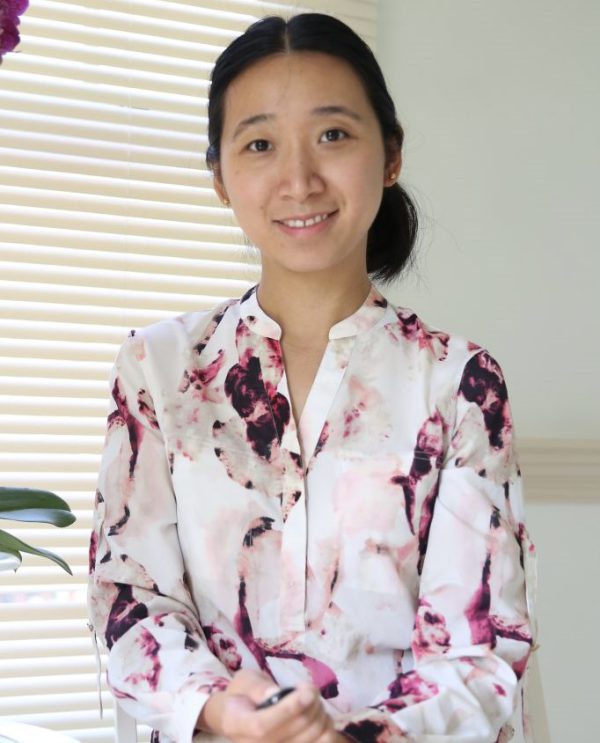
Visiting Instructor of Chinese Ruyuan Yang
Yang has a master’s degree in teaching Chinese to non-native speakers from the Beijing Language and Culture University, and a bachelor’s degree in teaching Chinese as a second language from Yunnan Normal University in Kunming, China.
Yang previously has taught college-level courses in beginning, intermediate and advanced Chinese at K; basic and intermediate Chinese, and Chinese dance and culture at Western Michigan University; and integrated Chinese and Chinese listening and speaking courses at Beijing Language and Culture University. Yang’s courses this fall include beginning and intermediate Chinese.
At the College’s annual Community Breakfast on October 1, Kalamazoo College President Jorge G. Gonzalez highlighted the dynamic relationship between the College and the city of Kalamazoo, focusing on the contributions of K students and the shared successes fostered through local partnerships. The event brought together leaders from nearly 40 organizations, including state and local officials, business professionals and nonprofits, all committed to strengthening these vital community connections.
Gonzalez recapped some of the College’s 2024 achievements and emphasized that Kalamazoo College continues to attract outstanding students from across the United States and around the globe, as well as from the local area.
This fall, the College welcomed 314 first-year students and 24 transfer students from 16 states and 10 countries. Diverse in academic interests and passions, he noted that 31 percent of the first-year class is comprised of domestic students of color, 30 percent are Pell Grant eligible, and 25 percent are first generation college students. Among the College’s 1,335 total students, K counts 90 Kalamazoo Promise Scholars and 28 Heyl scholars; last June the College graduated its largest Promise cohort since joining the list of participating Michigan higher education institutions.
Gonzalez highlighted the many ways that K students become an integral part of the Kalamazoo community, working in local businesses, volunteering in schools and participating in community projects. He cited Professor Amy MacMillan’s Principles of Marketing class, which is working this fall with Greenleaf Hospitality Group to build student awareness and interest in their businesses as a potential employer after graduation. He also cited the nonprofit organization Building Blocks of Kalamazoo, which promotes vibrant neighborhoods through resident-led group projects. Originally founded by Professor Emeritus Kim Cummings, Building Blocks is now led by Kalamazoo College alumna Katie McPherson ’08, who as executive director, continues to foster this partnership through summer internships, volunteer opportunities and collaborations with faculty.
Another highlight of K students’ civic engagement is its partnerships with the City of Kalamazoo. City Planner Christina Anderson ’98 is leading the strategic planning process for Imagine Kalamazoo 2035, kicking off with a community read of the book Happy City: Transforming Our Lives Through Urban Design, an activity supported by the City’s outreach and engagement intern, K senior Emerson Wesselhoff.
“The relationships formed through these community projects are transformational,” Gonzalez said, “not only for our students, but for the entire community.”
He also noted that K is proud to stand alongside Western Michigan University and Kalamazoo Valley Community College “as part of Kalamazoo’s vision to be an education city.”
After Gonzalez’s remarks, senior Alex Nam, a double major in international studies and German, spoke about his experiences at K. The flexible curriculum allowed Nam to explore across disciplines, from political science to fundamentals of acting. During study abroad in Germany, he taught English at a local business school through an internship. His involvement in the Mary Jane Underwood Stryker Center for Civic Engagement and the Center for International Programs led him to tutor students at Kalamazoo Central High School through the Refugee Outreach Collective. He also taught German lessons at Woodward elementary school with the German department and most recently, he interned at Read and Write Kalamazoo. He told the audience that while he was born in Louisiana, and has lived in Los Angeles, Houston, and Connecticut, after four years at K, he now considers Kalamazoo his home.
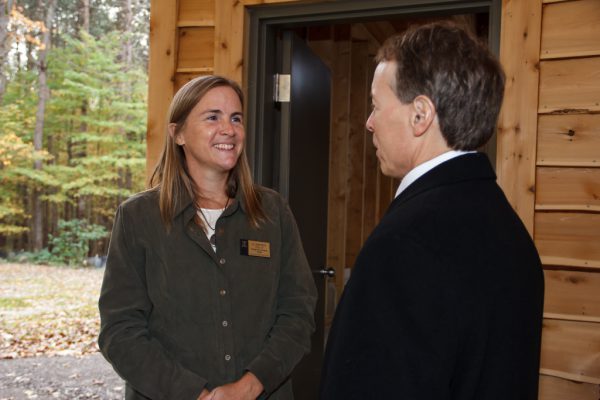
Kalamazoo College President Jorge G. Gonzalez speaks at the Community Breakfast. on Tuesday, October 1.
Alex Nam ’25 spoke at the Community Breakfast on Tuesday, October 1, about his experiences within K’s flexible curriculum.
Of his experiences at K, he said, “I saw first-hand how important it was for higher-ed institutions to be closely connected to the communities that sustain them. From tutoring refugee students, to gaining substantial behind-the-scenes pedagogical experience at a non-profit, the robustness of my teaching resume is a testament to the access that K College ensures for its students and the weight placed upon community engagement and civic help…Although four years at K College may fly by —and as a senior I can testify to this—my teaching experiences have made me feel more connected to this community—my community—than I have anywhere else in my life.”
Kalamazoo College today awarded one faculty member and one staff member with two of the highest awards the College bestows on its employees.
Professor of Theatre Arts Lanny Potts was named the recipient of the 2024–25 Lucasse Fellowship for Excellence in Scholarship, honoring his contributions in creative work, research and publication. Kelly Killen Ross, office coordinator for Campus Safety and Religious and Spiritual Life, was granted the W. Haydn Ambrose Prize, recognizing her outstanding service to the College community.
Potts is a professional designer and consultant. His work includes international lighting and production design; national tour designs for opera and dance; regional designs for opera, modern dance, ballet, drama and corporate events; concert work for Willow Creek International and the Indigo Girls; work in architectural lighting and consulting; TV studio production design and consulting; and consultant planning for performance venues and events including the 1996 Olympics.
In addition to such work, Potts has sustained a 25-year teaching career within higher education while also providing guest masterclass design instruction at various venues, and providing professional presentations on lighting design, design communication, and leadership and creativity within the arts at professional conferences and workshops. He has presented portfolio examples of his work at regional conferences, worked at the John F. Kennedy Center for the Performing Arts, and has received numerous professional awards including a Michigan Governor’s Commendation and Atlanta Critic’s Choice awards for his design work, which included the Atlanta premier of A Few Good Men.
In recent years, Potts has earned five Wilde Awards—distributed through EncoreMichigan.com—for his lighting-design work in Farmers Alley Theatre productions such as Bright Star, Bridges of Madison County and The Light in the Piazza; and a National Lighting Design Award from the John F. Kennedy Center for the Festival Playhouse of Kalamazoo College production of Fun Home. He’s also served K as an associate provost of academic affairs..
A ceremony to confer the Lucasse Fellowship traditionally occurs in the spring term, where the honored faculty member speaks regarding their work.
Killen Ross received five nominations for the Ambrose Prize, with nominators saying she’s humble, kind and always putting others first. They credited her for organizing chili lunches for struggling first-year students, breakfast for custodians during the pandemic, and transportation to the train station or airport for those in need.
The Ambrose Prize is named after W. Haydn Ambrose, who served K for more than 20 years in a variety of roles, including assistant to the president for church relations, dean of admission and financial aid, and vice president for development. Ambrose was known for being thoughtful in the projects he addressed and treating people with respect.
In addition to a financial award, Killen Ross has earned a crystal award to commemorate the achievement and an invitation to sit on the Prize’s selection committee for two years.
Congratulations to the honorees.
Kalamazoo College President Jorge G. Gonzalez congratulates Theatre of Arts Professor Lanny Potts on earning the 2024–25 Lucasse Fellowship.
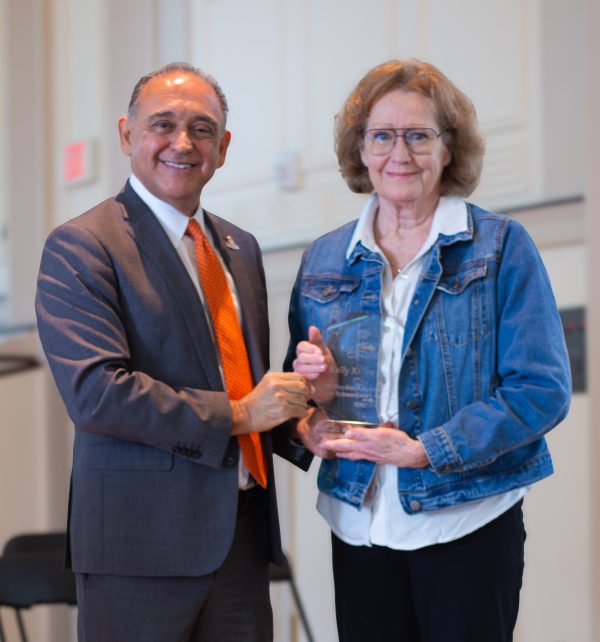
Kelly Killen Ross receives the Ambrose Prize from President Gonzalez.
Kalamazoo College has appointed six faculty members as endowed chairs, recognizing their achievements as professors. Endowed chairs are positions funded through the annual earnings from an endowed gift or gifts to the College. The honor reflects the value donors attribute to the excellent teaching and mentorship that occurs at K and how much donors want to see that excellence continue.
The honorees are:
Espelencia Baptiste, the Arcus Center for Social Justice Leadership Senior Faculty Chair
Anne Marie Butler, the Arcus Center for Social Justice Leadership Junior Faculty Chair
E. Binney Girdler, the Dow Distinguished Professor in Natural Sciences
Sohini Pillai, the Marlene Crandell Francis Endowed Chair in the Humanities
Dwight Williams, the Kurt D. Kaufman Endowed Chair
Daniela Arias-Rotondo, the Roger F. and Harriet G. Varney Endowed Chair in Natural Science
Espelencia Baptiste, Anthropology-Sociology
Baptiste is currently on sabbatical in Benin where she is working on a book project focused on different ways Africans and Haitians claim each other across time and space. Her research focus centers on the relationship between Africa and its diasporas. She has been active and engaged within the College since her arrival; most recently, she received the College’s Outstanding Advisor Award in 2023 and served as Posse mentor from 2019-2022.
Her courses include Lest We Forget: Memory and Identity in the African Diaspora, You Are What You Eat: Food and Identity In a Global Perspective, Communities and Schools, and Missionaries to Pilgrims: Diasporic Returns to Africa. Within her teaching, she is invested in challenging students to imagine the production of power, particularly as it relates to belonging, as a continuous phenomenon.
Baptiste has a bachelor’s degree from Colgate University, and a master’s degree and Ph.D. from Johns Hopkins University.
Espelencia Baptiste, the Arcus Center for Social Justice Leadership senior chair, received the College’s Outstanding Advisor Award in 2023 as presented by President Jorge G. Gonzalez
Anne Marie Butler, Art and Art History; Women, Gender and Sexuality (WGS)
Butler has a joint appointment in Art History and Women, Gender, and Sexuality. Her research focuses on contemporary Tunisian art within frameworks of global contemporary art, contemporary global surrealism studies, Southwest Asia North Africa studies, gender and sexuality studies, and queer theory. At K, she teaches at the intersection of visual culture and gender studies, instructing courses such as Art, Power and Society; Queer Aesthetics; Performance Art; and core WGS classes, and this is her fourth season as volunteer assistant coach for the swimming and diving team at K.
Butler is co-editor for the volume Queer Contemporary Art of Southwest Asia and North Africa, which will be available in October (Intellect Press). She has been published in ASAP/Journal, Journal of Middle East Women’s Studies, Liminalities: A Journal of Performance Studies, and The London Review of Education. She is also an editor for the volume Surrealism and Ecology, expected in 2026.
Butler has a bachelor’s degree from Scripps College, a master’s degree from New York University and a Ph.D. from the State University of New York at Buffalo.
Anne Marie Butler is the the Arcus Center for Social Justice Leadership junior chair.
E. Binney Girdler, Biology
Girdler is the director of K’s environmental studies program and a biology department faculty member. She focuses on plant ecology and conservation biology with her research involving studies of the structure and dynamics of terrestrial plant communities.
Girdler previously had an endowed chair as the Roger F. and Harriet G. Varney Endowed Chair in Natural Science. She develops relationships with area natural-resource agencies and non-profit conservation groups to match her expertise with their research needs and the access needs of students. In 2022, she and K Associate Professor of Biology Santiago Salinas contributed to a global research project that proves humans are affecting evolution through urbanization and climate change. The study served as a cover story for the journal Science.
Girdler commonly teaches courses titled Environmental Science, Ecology and Conservation, and Population and Community Ecology along with an environmental studies senior seminar. She earned a bachelor’s degree from the University of Virginia, a master’s degree from Yale University and a Ph.D. from Princeton University.
Dow Distinguished Professor in Natural Sciences E. Binney Girdler at Batts Pavilion.
Sohini Pillai, Religion
Pillai is the director of film and media studies at K and a faculty member in the religion department. She is a comparatist of South Asian religious literature, and her area of specialization is the Mahabharata and Ramayana epic traditions.
Pillai is the author of Krishna’s Mahabharatas: Devotional Retellings of an Epic Narrative (Oxford University Press, 2024), a comprehensive study of premodern retellings of the Mahabharata epic in regional South Asian languages. She is also the co-editor of Many Mahabharatas (State University of New York Press, 2021) with Nell Shapiro Hawley and the co-author of Women in Hindu Traditions (New York University Press, under contract) with Emilia Bachrach and Jennifer Ortegren. Her courses have included Religion in South Asia; Hindu Traditions; Islam in South Asia; Dance, Drama, and Devotion in South Asia; Religion, Bollywood, and Beyond; Jedi, Sith, and Mandalorians: Religion and Star Wars; and Princesses, Demonesses, and Warriors: The Women of the South Asian Epics.
Pillai has a Ph.D. from the University of California, Berkeley; a master’s degree from Columbia University; and a bachelor’s degree from Wellesley College.
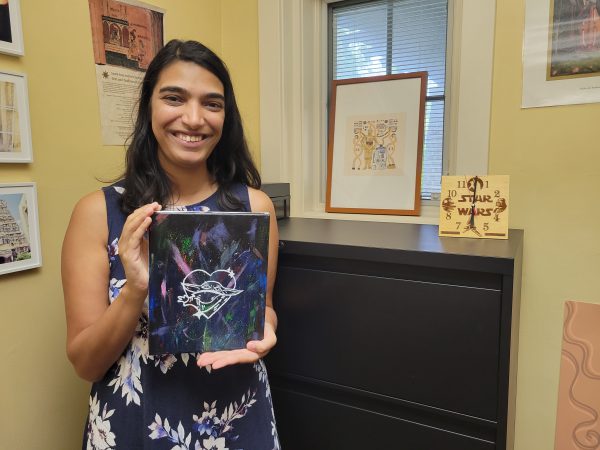
Marlene Crandell Francis Endowed Chair in the Humanities Sohini Pillai displays some of her personal Star Wars memorabilia including a painting of Grogu gifted to her by a student.
Dwight Williams, Chemistry and Biochemistry
Williams previously was an endowed chair at K, having served as the Roger F. and Harriet G. Varney Assistant Professor of Chemistry from 2018–2020. He teaches courses including Organic Chemistry I and II, Advanced Organic Chemistry and Introductory Chemistry. His research interests include synthetic organic chemistry, medicinal chemistry and pharmacology.
Williams spent a year as a lecturer at Longwood University before becoming an assistant professor at Lynchburg College. At Lynchburg, he found a passion for the synthesis and structural characterization of natural products as potential neuroprotectants.
Williams learned more about those subjects after accepting a National Institutes of Health postdoctoral research fellowship at the Virginia Commonwealth University Medical College of Virginia Department of Pharmacology and Toxicology. During that fellowship, he worked in medicinal chemistry and pharmacology, where his work was published in six peer-reviewed journals.
Kurt D. Kaufman Endowed Chair Dwight Williams holding a molecular model in his office.
Daniela Arias-Rotondo, Chemistry and Biochemistry
Arias-Rotondo earned a grant valued at $250,000 last year from the National Science Foundation through its Early-Career Academic Pathways in the Mathematical and Physical Sciences (LEAPS-MPS). The LEAPS-MPS grant emphasizes helping pre-tenure faculty at institutions that do not traditionally receive significant amounts of NSF-MPS funding, including predominantly undergraduate institutions, as well as achieving excellence through diversity. She uses the funding primarily to pay her student researchers, typically eight to 10 per term, and bring more research experiences into the classroom.
This year, Arias-Rotondo earned an American Chemical Society (ACS) Petroleum Research Fund grant, which will provide $50,000 to her work while backing her lab’s upcoming research regarding petroleum byproducts. Her lab traditionally develops molecules that absorb energy from light while transforming that energy into electricity. The grant will allow her and her students to take molecules they have designed to act as catalysts and unlock chemical transformations through a process called photoredox catalysis. In this case, those transformations involve petroleum byproducts and how they might be used.
Arias-Rotondo teaches Introductory Chemistry, Inorganic Chemistry, and Molecular Structure and Reactivity, and commonly takes students to ACS conferences. She holds a bachelor’s degree from the Universidad de Buenos Aires in Argentina and a Ph.D. from Michigan State University.
Daniela Arias-Rotondo has been named the Roger F. and Harriet G. Varney Endowed Chair in Natural Science.
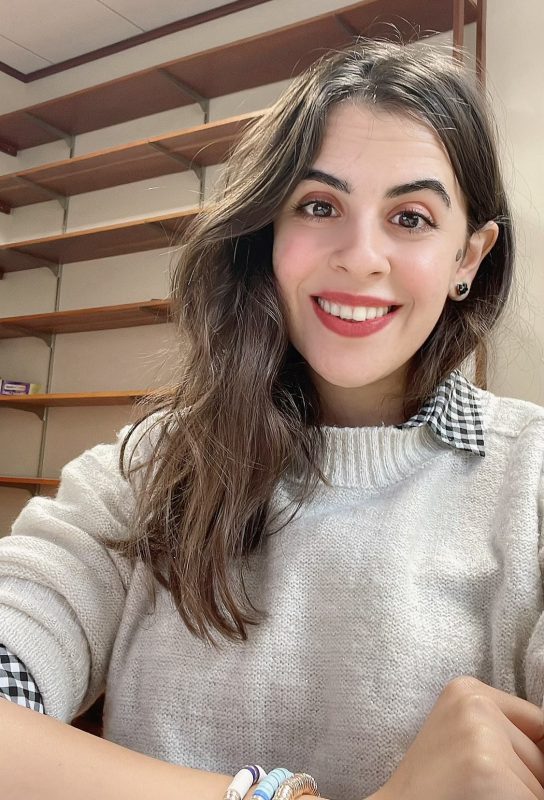
Emerson Wesselhoff ’25 is working in an internship with the city of Kalamazoo, where she is leading the city’s first ImagineKalamazoo Reads effort through the book “Happy City: Transforming Our Lives Through Urban Design” by journalist Charles Montgomery about urban design and happiness.
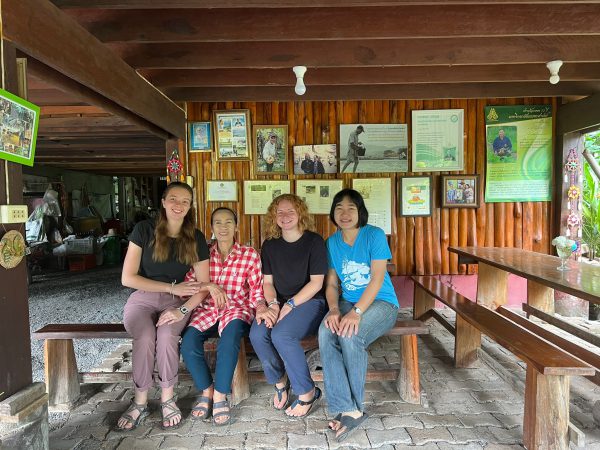
Wesselhoff (left) sits with one of her host families and a fellow student in the Maetha agricultural co-op village. The younger Thai woman is Pi Pui, the expert seed saver for the village. The older Thai woman is her mom, Mae Sawn.
Wesselhoff works with elementary school students during her internship in Thailand with Kiaow Suay Hom, which translates to Green, Beautiful and Fragrant in English.
A study-abroad experience, a passion for sustainability and a love for her city have helped a Kalamazoo College Heyl scholar leave her mark on Imagine Kalamazoo 2035, the city’s newly launched master plan.
Emerson Wesselhoff ’25 is an outreach and engagement intern working with City Planner Christina Anderson ’98. She was among the officials at an open house September 19 when the city shared some of its successes from the previous master plan and discussed with residents what they can expect over the next year with the new plan.
Now, as a part of Imagine Kalamazoo 2035, Wesselhoff will lead the city’s first Imagine Kalamazoo Reads effort, a community read along and discussion with clubs, community groups and residents. Together, they will have meaningful conversations about Happy City: Transforming Our Lives Through Urban Design, a book by award-winning journalist Charles Montgomery beginning Monday, September 30. The book combines urban design and an emerging science of happiness that will help participants analyze some of the world’s most dynamic cities, while brainstorming what residents want in Kalamazoo.
“I first read the book at K through a class I took sophomore year,” Wesselhoff said, speaking of a seminar led by Anderson, City of Kalamazoo Chief Operating Officer Laura Lam ’99 and then-Mary Jane Underwood Stryker Center for Civic Engagement Director Alison Geist. “We want Individual citizens, book clubs, organizations, boards, shops and institutions to read it, and every month we will host a community-led discussion of the book. I’ve put together a big toolkit that provides summaries, links to the author’s TED talk, and discussion questions to guide thoughts and processes. We want to get people thinking about how the city makes us happy and what happiness means in our lives.”
Wesselhoff’s opportunity is a relatable follow-up to a reading-focused experience she led when she studied abroad in Thailand last year. She concluded her time overseas with a six-week climate engagement internship through a non-government organization called Kiaow Suay Hom, which translates to Green, Beautiful and Fragrant in English. There, she studied the benefits of green spaces in fighting pollution and particulate matter (PM 2.5) as smoke and smog cause health risks such as heart attacks, cancer and respiratory issues in Thailand. The organization had created a children’s book about PM 2.5 that was central to the outreach Wessselhoff performed as part of her internship.
How to Participate in the Read Along
Let Wesselhoff know if you or a group will join the read along and whether you would like resources by emailing her at wesselhoffe@kalamazoocity.org.
Happy City is available at a discount at Bookbug and This is a Bookstore (3019 Oakland Drive), in person and online. Use the discount code KALAMAZOO if you buy the book online. You may also read an online version of the book or get it from the Kalamazoo Public Library as an eBook or audio book via Hoopla.
Public read along discussions start Monday, September 30, with a gathering at Bookbug and This is a Bookstore. A second discussion will take place Wednesday, October 23, at Jerico, 1501 Fulford St. Free reservations are available online for the September 30 event and the October 23 event.
A Happy City toolkit is available online to guide independent reads and discussions.
Share your read along results by completing a brief online form, sending an email to hello@kalamazoocity.org with your responses typed, or attaching a scan of any written notes to an email. Return a paper copy by mail or in person to Community Planning and Economic Development, 245 N. Rose St. in Kalamazoo, during business hours.
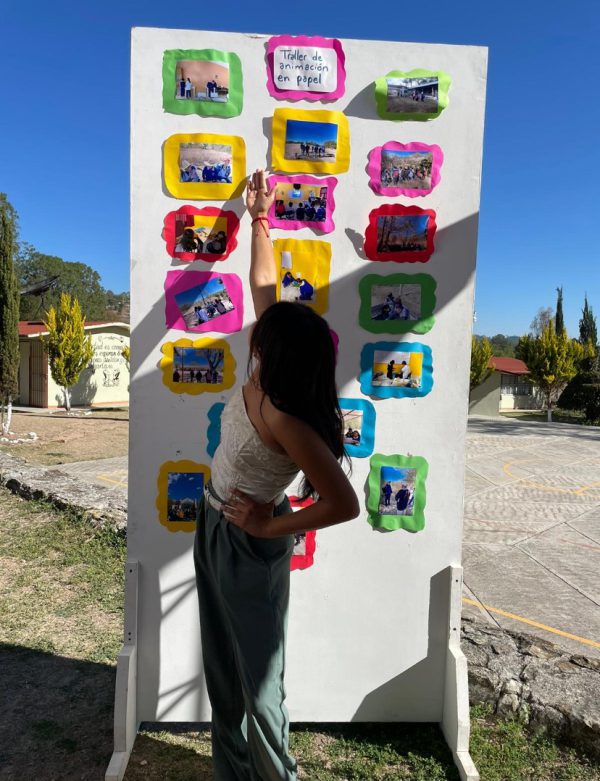
During her internship in Thailand, Wesselhoff volunteered at a local farm with her fellow NGO interns to help the farmers prepare for a big harvesting event.
Wesselhoff told elementary school students about what they can be do with green space and pollution-filtering plants to fight health risks that are common in Thailand.
At the end of her Thailand internship, Wesselhoff presented information on her work to Chiang Mai’s Breath Council, a larger council of NGOs dedicated to helping fight PM 2.5 pollution.
“Having more green space, carbon-sequestering and pollution-filtering plants is a great way to combat PM 2.5,” Wesselhoff said. “Creating those green spaces starts with awareness and I learned the importance of youth education. A huge component of my internship was going around to local elementary schools in In the Mae Hia subdistrict of Chiang Mai, Thailand, and showing how sustainability connects to local culture, children’s lives, and how to keep them and their friends and family safe. I learned how to engage with kids and break down a heavily scientific and scary topic, while connecting it to their culture and their lives at home. It made them feel empowered to make choices that are healthier for their community.”
She hopes Happy City read along conversations will have similar success and spark some ideas regarding potential local sustainability efforts.
“I’m trying to help bring awareness to how the city impacts our sense of happiness and our sense of self in where we live,” she said. “That’s a big piece of environmental engagement work—knowing where you live, knowing its shortcomings, and advocating for the things that make it great, and sustainability planning is a huge part of that. I look at my study abroad experience, which was so centered on putting my assumptions on the back burner and learning from local people through their lived experiences. I’m trying to bring that same practice back here. I think we often turn to academics, politicians or big systems to figure out how to make progress. What I learned from local communities in Thailand is to focus instead on making space for our relationship to land, first and foremost. Community awareness and respect will follow close behind.”
Wesselhoff was abroad for a total of six months, spending her time first with the International Sustainable Development Studies Institute—a hands-on, fieldwork learning center based in Chiang Mai, Thailand, focused on sustainability.
With ISDSI, Wesselhoff and 13 other students from around the world, including two other K students, took one monthlong class at a time with courses including culture, ecology and community; sustainable food systems; political ecology and ocean ecology. The first week of each class consisted of lectures before the students stayed three weeks with host families, mostly in indigenous communities, and performed field or volunteer work in the community.
In the sustainable food systems course, Wesselhoff and her peers spent two weeks living in an organic co-op village called Maetha, staying with a seed saver and learning about organic agriculture. The third week she lived on an organic coffee farm called Nine One Coffee near a jungle and learned about the organic bean-to-cup process.
With the forestry course, Wesselhoff traveled to Mae Hong Son, the northernmost province in Thailand, near the Myanmar border, and backpacked between six villages, starting at low elevation and proceeding higher with each stop. Along the way, she lived with six indigenous host families who graciously taught the students about livelihoods and land rights in their highland communities.
During the ocean ecology course, Wesselhoff and her group went south to learn about mudflats and mangroves while living on a coastal farm, before spending about a week and a half in the Adang archipelago near the Malaysian border to kayak through more trading routes and learn about coral reef ecosystems. When the classes ended, students from other colleges returned home and the K students began working internships. Wesselhoff’s experience now feeds her desire to improve life in Kalamazoo.
Wesselhoff greeted a baby elephant during an excursion with the International Sustainable Development Studies Institute.
Wesselhoff participated in a field expedition to Wiang Khum Kam, an ancient archeological site south of Chiang Mai.
At home, the Loy Norrix High School graduate is a biology major with a concentration in environmental studies and minors in English and anthropology-sociology. She also serves K as a Climate Action Plan Committee student representative and intern, advocating for the College’s efforts in being carbon neutral by 2050. The committee maintains the College’s Climate Action Plan in association with the President’s Climate Leadership Commitment, which K joined in 2010, while establishing goals, monitoring progress, conducting annual reporting and providing guidance on projects and initiatives to support the plan. Plus, Wesselhoff writes blog post updates addressing news on climate efforts at K, and all her work excites her to extend her work into the city.
“The more time I spend in Kalamazoo, the more I realize just how much people care about this place,” Wesselhoff said. “I think I’m lucky because I’m not just here as a four-year college student. I have roots here and that gives me a distinct advantage. I’m in a college environment most of the time with the connections I build in the K community, but I also work with folks in the city, getting to talk to stakeholders and community members, going to places like the farmers market or events downtown like Art Hop and Lunchtime Live. Even if people have a complaint to voice, it’s because they care about where they live. The city of Kalamazoo is headed in a unique direction, with bountiful opportunities to make the city a more connected, livable, and sustainable place. I feel very fortunate to be here in a time of my life where I can learn all about those things.”
For the second year in a row, Kalamazoo College has been selected as a Hidden Gem by College Raptor, a planning platform that helps students and families find college matches driven by algorithms to find their best-fit schools at the best price.
This selection—which places K among the top 15 institutions in the Great Lakes Region of Michigan, Wisconsin, Ohio, Illinois and Indiana—recognizes the College as one of the best in the country based on a combination of factors including retention rates, graduation rates, student-to-faculty ratio, endowment per student, selectivity and other key metrics as reported through the National Center for Education Statistics.
“For students seeking the enriching experience of a smaller college with exceptional programs, institutions like K emerge as prime options, and we are honored to spotlight them with the recognition they genuinely deserve,” College Raptor co-founder and CEO William Staib said.
College Raptor also ranks K 11th in the country among 25 Hidden Gems for Division III athletics. To qualify for either list, an institution must receive fewer than 5,000 applications per year, have fewer than 7,000 undergraduate students, offer at least five unique majors and have an acceptance rate of at least 10%.
College Raptor’s full methodology is outlined on its website.
College Raptor places Kalamazoo College among the top 15 institutions overall in the Great Lakes Region of Michigan, Wisconsin, Ohio, Illinois and Indiana, and rates K 11th nationally for opportunities in Division III athletics.