What’s for Lunch? 25 Years of Inspired Science in Schools

Sisters in Science experiment
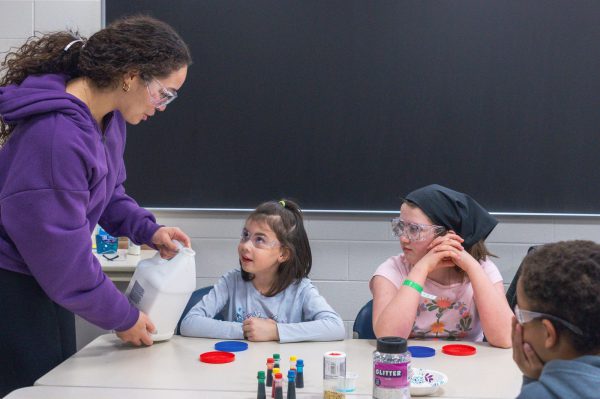
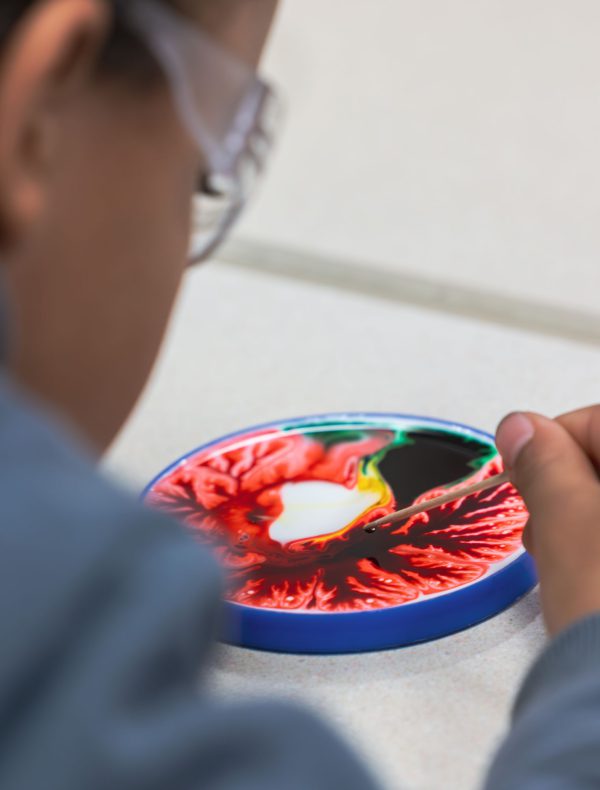
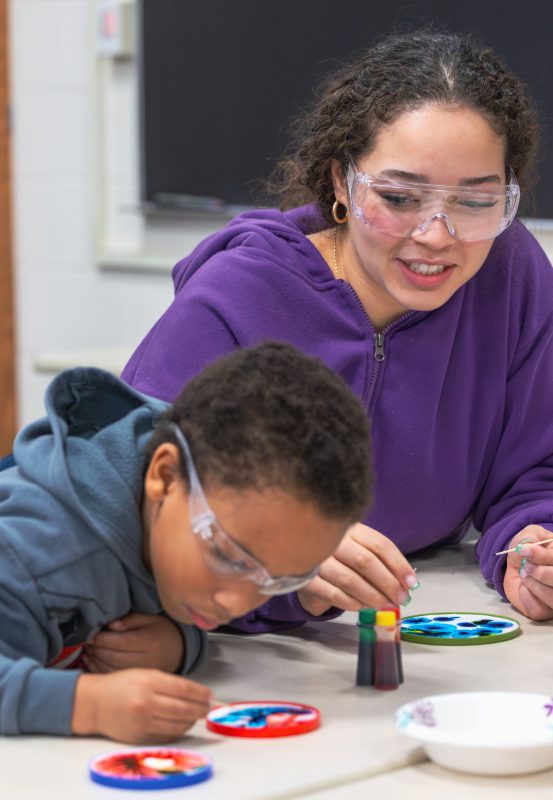
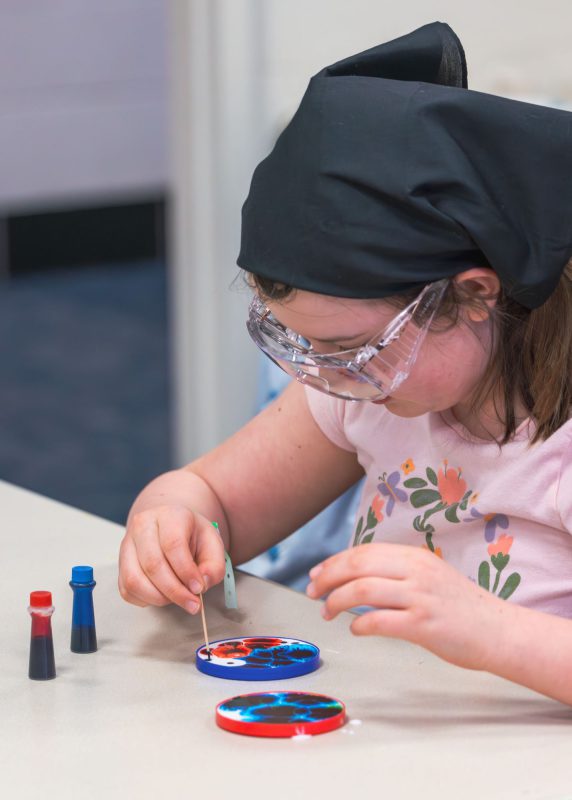
Pauline Hawkes ’26 leads Luella Tresca, Lu Moon and Adwin Williams in a science experiment.
Sisters in Science experiment

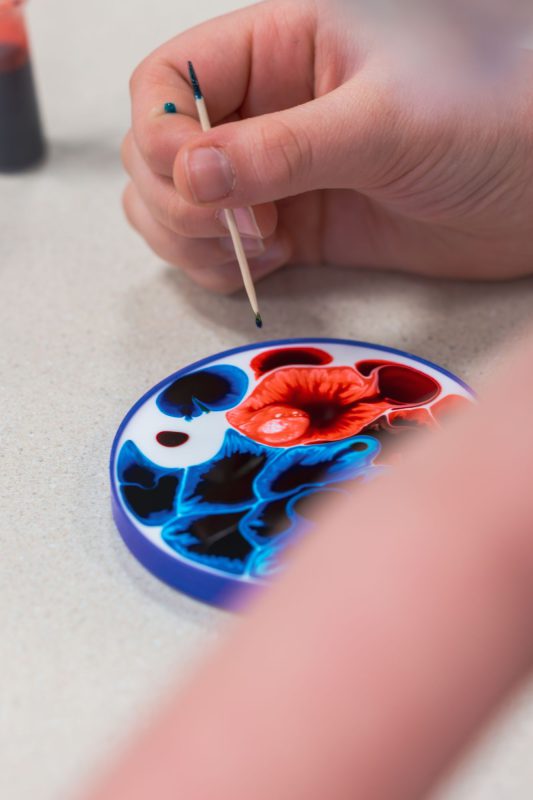
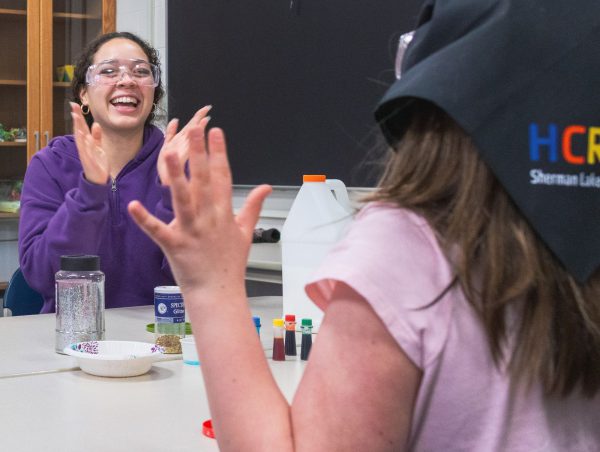
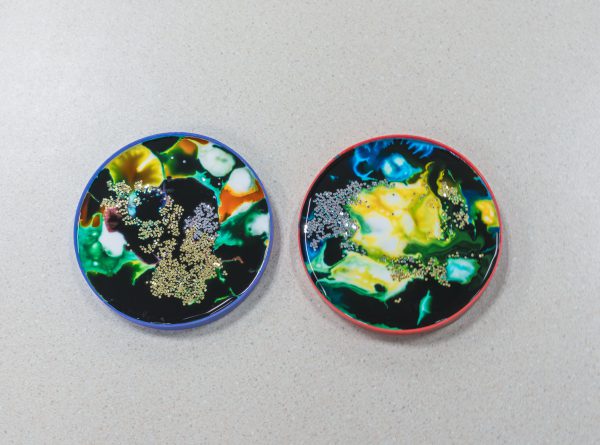
One recent afternoon at Northglade Montessori Magnet School in Kalamazoo, fourth and fifth graders gathered around a table for a simple science experiment involving water, soap and glitter. 

“Think about what happens when germs spread,” a college student presenting the experiment told them. 

Moments later, a finger dipped into the mixture, and the glitter scattered across the surface of the water. The room filled with laughter, surprise and a few delighted yells of “Whoa!” 

For the kids, it looked like magic. For the mentors leading the activity, it was something more powerful. It was a chance to spark curiosity about science through a lesson that showed just how quickly illnesses can jump from one person to another. 

The demonstration was one small moment in a program that has quietly shaped young learners in Kalamazoo for a quarter century. Sisters in Science—a student organization at Kalamazoo College—is celebrating its 25th anniversary of presenting hands-on STEM experiences to local kids. The group partners with Communities In Schools of Kalamazoo to visit youths at Northglade and Woodward Elementary, where K students run experiments and serve as mentors for children discovering science in new ways. 

A Founding Conversation 

Sisters in Science owes its existence to a chance conversation on a school sidewalk. Regina Stevens-Truss, the Dorothy H. Heyl Professor of Chemistry at K and the program’s faculty advisor since its founding, arrived at Northglade in 2001 to pick up her children. A sixth-grade teacher pulled her aside with a question that would stay with her. 

The teacher had noticed that her female sixth-grade students consistently outperformed the boys in math and science. But when she saw those same students again in ninth grade, something had changed. The girls who once loved science no longer seemed interested. She wanted to know why. 

Stevens-Truss couldn’t stop thinking about that conversation. Research backed what the teacher had observed: girls often lose interest in science and math during the transition from elementary school to junior high, as social pressures begin to reframe those subjects as less compatible with femininity. She brought the idea of a mentorship program to the chemistry department’s office coordinator, who suggested the name Sisters in Science, and then to Leslie Tung, who was serving as interim provost at the time. Tung pointed out that every department in the science division had at least one female faculty member, and he encouraged Stevens-Truss to build a program in which K students would mentor girls at Northglade. 

Sisters in Science launched as a one-on-one mentoring program, pairing individual K students with sixth-grade girls at the school in a big sister, little sister model. The pairs would meet weekly to talk about science, math and what it meant to be a young woman with those interests. As demand grew and the sixth grade was moved to the middle school, the model shifted from individual pairings to group sessions at Northglade, and now also at Woodward Elementary School. While the program originally focused on encouraging girls to pursue science, feedback from students led Northglade organizers to expand participation so boys could join as well. The college mentors remain the “sisters” leading the activities, but the sessions now welcome all students. The change reflects the program’s broader mission, which is to make science accessible to everyone. 

From Lunch Tables to Laboratories 

The program is simple but effective. Students bring their lunches into a classroom, where the college volunteers introduce a short experiment. Before long, the room becomes a laboratory filled with egg drops, slime, miniature rockets and glitter experiments. 

“They eat their lunch, and then they pretty much jump right into it,” said Emma Braford, a site coordinator at Northglade for Communities In Schools of Kalamazoo. “They’re always very hands-on. It’s all very fun and interactive things that get the kids really engaged with science and loving science in a way that’s not just textbooks.” 

The program typically serves about 30 elementary students across the partner schools, with three to five K students guiding activities each visit. Over the course of the school year, the mentors work with the same groups of children, building relationships along the way. That mentorship, Braford said, can be just as important as the science lessons themselves. 

“I think it’s cool for them to have that older peer mentor relationship,” she said. “The college students intentionally get to know four or five of the students really well over that time.” 

Opening Doors to Science 

Sisters in Science is led this year by Pauline Hawkes ’26 and Madison Vrba ’26. 

For Vrba, a biochemistry major, the organization represents a natural blend of two passions, science and mentorship. Before joining Sisters in Science, she worked as a pitching instructor for young softball players and discovered how empowering it could be for young girls to realize what they could do. 

“When girls feel confident exploring science and asking questions, it not only benefits them individually but also strengthens the entire scientific community,” Vrba said. 

Historically, STEM fields have been male dominated, she noted, which can make it harder for girls to picture themselves in those careers. Programs like Sisters in Science help change that narrative by introducing science early and making it approachable. 

Success, Vrba said, often comes in small moments. 

“If even one student walks away feeling more confident about science or more interested in learning how things work, I consider that a success,” she said. 

Inspired to Give Back 

For Hawkes, a biology major who hopes to pursue a career in physical therapy, the motivation to mentor younger students is personal. 

Growing up, she watched her mother navigate a series of back injuries and surgeries, which sparked her interest in the human body and how it works. She also had an influential role model close to home in her older sister, Isabelle Hawkes ’24, who was also involved in Sisters in Science. 

“I’ve always looked up to her,” Hawkes said. “She was able to answer questions and help me understand things when I was struggling. I want to be that resource for other people and open doors they might not know existed.” 

Each week during the academic term, Hawkes and other leaders visit partner schools for two days between classes. The goal isn’t simply to perform experiments, she said. “We’re just learning together,” Hawkes said. “It’s a safe, comfortable space where they’re not afraid to ask questions or try different things.” 

Learning Science Through Discovery 

But the lessons go beyond the experiments. Sometimes, students are surprised simply to learn that the College mentors are studying science themselves. 

“I’ve heard some of them say things like, ‘We didn’t know you could study this in college,’” Braford said. “It gives them a broader perspective of different career options that exist.” 

“It’s important for everyone to see what’s possible,” Hawkes said. “This is where you’re developing your interests.” 

That openness, along with the enthusiasm of both the college mentors and elementary students, helps explain the program’s longevity. 

One alumna whose connection to Sisters in Science continues to resonate is Caitlyn VanGelderen ’12. She was deeply devoted to the program during her time at K. Caitlyn loved combining her passion for chemistry with her commitment to mentoring younger students, and she found joy in helping elementary girls discover their own interest in science. Since her passing in 2020, her parents have honored that passion by making annual donations to support Sisters in Science in her memory, ensuring the work that meant so much to her continues to inspire new young scientists. 

“I think people want to be part of it,” Hawkes said. “There’s always going to be interest in teaching kids about science and letting them do experiments they might not otherwise have the opportunity to try.” 

A Spark for the Future 

As Sisters in Science marks its 25th anniversary, the leaders hope to celebrate the milestone with commemorative T-shirts for participants and increased visibility for the program. But the true impact is less tangible. It’s the moment when a student’s eyes widen during an experiment, the moment when a child asks a question no one expected, or the moment when a young student realizes science might be something they love. 

“Science can sometimes feel intimidating,” Vrba said. “But programs like this show students that it can also be creative, fun and something they’re a part of.” 

Stevens-Truss sees the secret to its longevity in the relationships it builds across multiple constituencies at once: the K students who join as first-year students and grow into leaders, the elementary students who see themselves reflected in the mentors above them, and the community partners who have been with the program since the beginning. 

Stevens-Truss said she does little to keep the program running year to year. Each spring, the current leaders identify their successors. Each fall, she reaches out to those students, and they take it from there. The group maintains its own website and keeps its supplies—reagents and materials for experiments—in a cabinet in the science building. 

“There’s never been a year since we started Sisters in Science that the program has not run,” she said. “I don’t hound them; they come to me.” 

And if the excitement in those classrooms is any indication, the next 25 years of Sisters in Science might inspire just as many future scientists as the first. 

Sisters in Science experiment
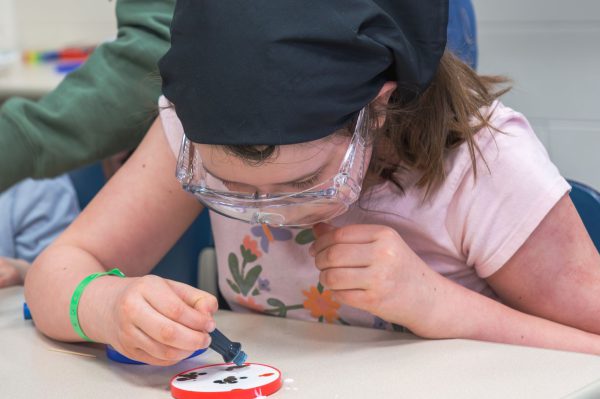
College student and child performing experiment
Sisters in Science experiment
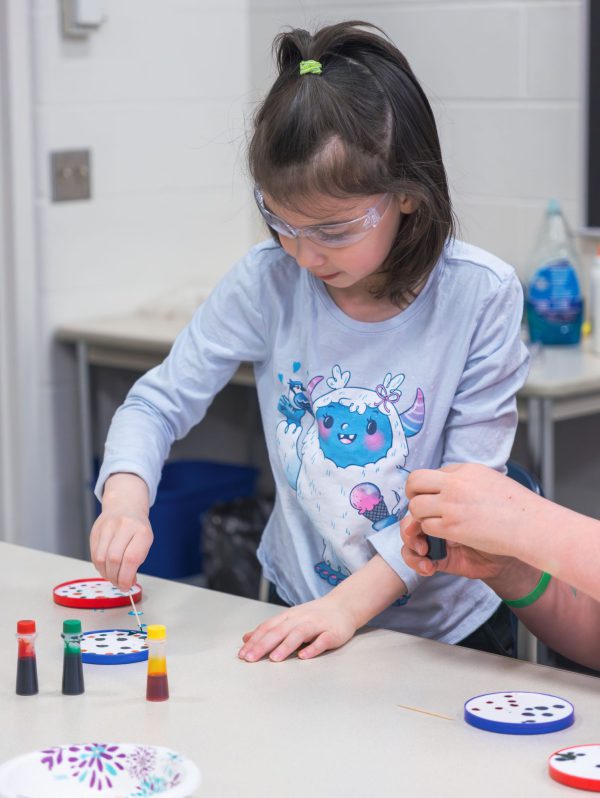
Kids performing experiments

College Guides Spotlight K

A resource that the USA Today calls “the best college guide you can buy” again profiles Kalamazoo College among more than 300 of the best and most interesting colleges in the U.S., Canada and the UK.  

The 2025 edition of the Fiske Guide to Colleges credits K for a LandSea preorientation program that provides incoming students with confidence. Then, the College’s ingenious K-Plan offers a curriculum path with study abroad, an excellent career-development program, and independent faculty-guided research.  

Students interviewed for the book—compiled by former New York Times Education Editor Edward B. Fiske—praised K for its supportive and guiding faculty, service-learning courses, student-led cocurricular activities, civic engagement and study abroad that is done so well “it seems ridiculous not to take advantage of the opportunity.” 

From an academic standpoint, the book notes that K has exceptional programs in the natural sciences with other strengths including international and area studies, community and global health, and critical ethnic studies. Popular majors include biology, chemistry, psychology and business. But don’t forget about the quality of student life on campus. 

“K’s campus is always buzzing with social activities like movies, concerts, speakers and other events,” the book notes. It adds that students also look forward to Monte Carlo Night, when the Hicks Student Center is transformed into a casino with faculty and staff serving as dealers, and the Day of Gracious Living when, without prior notice, classes are called off for the day and students can choose to spend a day on the beach, work on volunteer projects or relax on campus. 

The 41st Fiske Guide to Colleges is available now

And, for a more unique lens on the college search, Cool Stuff at Small Colleges author Peter Pitts—a retired admissions professional from Monmouth College—says K is a great choice for students who want the feeling of a small college and the many benefits of being near a large university considering its location near Western Michigan University. 

In his new book, Pitts praises the K-Plan, which does “an excellent job of balancing academics with practical career preparation. It allows you the freedom to create your plan for success.” He lists biological physics, Jewish studies, critical theory, East Asian studies, neuroscience, public policy and urban affairs, and quantitative economics among K’s distinctive areas of study. Plus, he gives a shout out to Assistant Professor of Religion Sohini Pillai for her Star Wars-themed religion class

“Not a major or a minor,” the book says. “Not even a certificate or an emphasis. But Jedi, Sith and Mandalorians: Religion and Star Wars, a religion class at Kalamazoo College, might just influence a student to major or minor in religion. If nothing else, it says a lot about how cool the faculty are in the religion department at Kalamazoo.” 

Check out Cool Stuff at Small Colleges, which is available online. 

Colleges Guides logo for Fiske Guide to Colleges
The “Fiske Guide to Colleges,” compiled by former New York Times Education Editor Edward B. Fiske, is one of two recently released college guides to feature K.
College Guides Cover says Cool Stuff at Small Colleges
“Cool Stuff at Small Colleges” is one of two recently released college guides to feature K.

Kalamazoo College Receives Historic $30 Million Gift

President Jorge G. Gonzalez addressing students, faculty and staff
President Jorge G. Gonzalez announces a $30 million gift from an anonymous donor—the largest single gift commitment in the College’s history.
Students
Sophomore Blake Filkins and senior Darsalam Amir, representing K’s student-government organization at the announcement of a $30 million gift to the College.
President Jorge G. Gonzalez speaking
President Gonzalez announcing a $30 million gift to the College from an anonymous donor.

For 190 years, Kalamazoo College has graduated generations of enlightened leaders who have made an impact on the world. Today, the College is grateful to recognize a major contribution to that effort with the announcement of a $30 million gift from an anonymous donor—the largest single gift commitment in the College’s history. 

“This incredibly generous gift will be transformative for K,” President Jorge G. Gonzalez said. “It will allow us to launch several strategic initiatives that will enhance the College’s ability to fulfill its mission with distinction and prepare K graduates to bring a brighter light to the world. This gift will put us on the path toward creating the campus experience of the future and help us ensure every student at the College is positioned for success. We are so grateful to the donor for this extraordinary investment in K’s future.”

Primary among those initiatives is re-envisioning the residential experience and planning for future construction of a new residence hall on the College’s historic campus, as well as developing new programs to support student success, with a focus on first-generation students. In fall 2023, 30 percent of K’s first-year students were first-generation, as the College continues to expand higher education access for talented students of all backgrounds. 

“To ensure equitable access to K for students who are among the first in their families to attend college, our responsibility extends beyond admittance—we must provide the resources that will see them through to graduation,” Vice President for Student Development and Dean of Students J. Malcolm Smith said. “The resources—such as access to personal and professional networks, leadership development opportunities, and financial support to make the most of their college experience—that may be readily available to many college-bound students often don’t exist for first-gen students. Yet there are ways to ensure that those who need support can succeed and make a big impact on the world.”

Fall image at Kalamazoo College generous gift
The College will celebrate its 190th year by expanding the goal of the College’s Brighter Light Campaign from $150 million to at least $190 million by September 2024.

In conjunction with the gift announcement, the College is pleased to announce that it will celebrate its 190th year by expanding the goal of the College’s Brighter Light Campaign from $150 million to at least $190 million raised by September 2024, when the campaign concludes. 

Since its launch in 2018, more than 15,000 alumni and friends have contributed to the Brighter Light Campaign, raising more than $180 million dollars with the addition of this latest gift to the institution. The campaign supports student access to every aspect of a Kalamazoo College education—from scholarship support to study abroad funding to internship and research stipends—and it has provided investments in the institution’s faculty, renovations to instructional spaces, athletic programming, and other aspects of campus life. 

“Completing the last year of the campaign with the theme of ‘190 for 190’ is a fitting way to recognize both the enduring and evolving traditions of Kalamazoo College and celebrate this record-breaking campaign,” Vice President for College Advancement Karen Isble said. “While it’s always wonderful to achieve the philanthropic goals of a campaign, the most exciting and important aspect of any fundraising endeavor is making a tangible difference in the lives of our students, faculty and staff. This amazing gift, and the gifts from each of the 15,000 donors who have supported the Brighter Light Campaign so far, helps us do that and more.”

About Kalamazoo College

Kalamazoo College, founded in 1833, is a nationally recognized residential liberal arts and sciences college located in Kalamazoo, Mich. The creator of the K-Plan, Kalamazoo College provides an individualized education that integrates rigorous academics with life-changing experiential learning opportunities. For more information, visit www.kzoo.edu.

The Brighter Light Campaign is raising $190 million to provide endowed and annual support for students, faculty and staff, curricular and co-curricular activities, athletics and campus facilities. For more information, visit the Brighter Light Campaign page: www.kzoo.edu/brighterlight.

Colleges of Distinction: K Provides Top-Notch Undergrad Experiences

Students outside Light Fine Arts at K, one of the Colleges of Distinction
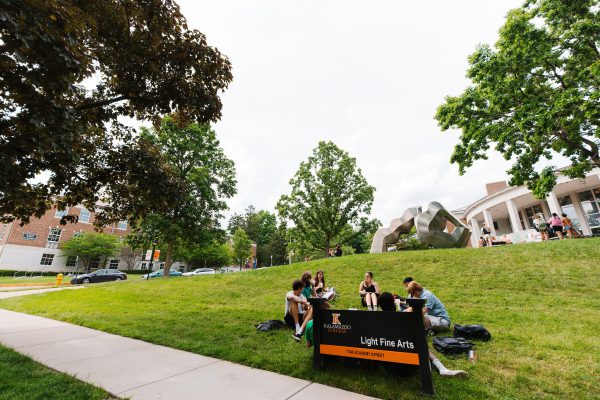
Students study outside Light Fine Arts on a spring day at Kalamazoo College.

A guide for college-bound students and families is recognizing Kalamazoo College as one of about 400 schools from across the country to earn high marks for top-notch undergraduate experiences.

K is included in the 2022–23 Colleges of Distinction online guide, which lauds schools for going beyond what typically drives rankings to offer a personalized education catered to students’ interests. It spotlights K through the K-Plan, the College’s framework for exceptional academics within the liberal arts and sciences.

“When we focus all of our attention on how schools stack up against one another, we lose track of what really matters: the students themselves,” Colleges of Distinction Founder Wes Creel said. “Every student has individual needs and their own environment in which they’re most likely to thrive. We want to extend our praise to the schools that prioritize and cater to students’ goals.” 

High school guidance counselors, college administrators and the Colleges of Distinction selection team nominate excellent schools for inclusion before each institution is vetted to determine its quality through its support for students in all aspects of their lives. Colleges of Distinction judges its nominees on their teaching quality, student engagement, community engagement and outcomes through a selection process that includes in-depth research and detailed interviews with the schools and stakeholders.

K received accolades in each area along with honors for its undergraduate programs in science, math and technology; health and medicine; arts and humanities; multidisciplinary studies and social science.

“We pride ourselves on being an institution that prioritizes hands-on student experiences inside and outside the classroom to reflect a well-rounded education through independent scholarship, study abroad opportunities, civic engagement, career development and more,” Dean of Admission Suzanne Lepley said. “When students enroll at K, they should feel confident we will do everything we can in their four years to set them up for success for the rest of their lives. This recognition from Colleges of Distinction confirms that.”

K is also recognized among the top Colleges of Distinction in terms of equity and inclusion as it caters to the unique needs of their students regardless of race, ethnicity, socioeconomic status, sexual orientation, gender or ability.

“A great undergraduate experience is more than just graduating and getting your first job,” the Colleges of Distinction website says. “Colleges of Distinction graduates are prepared for anything. They are strong writers, speakers and thinkers because their professors have encouraged and challenged them one-on-one. They have meaningful professional experience from internships and advanced research, and they know how to work together with people different than themselves because they have been active on campus, traveled abroad and pursued service opportunities. In other words, when you graduate from a College of Distinction you will be equipped to find better solutions in the workplace, your community and the world at large.”

K Ready to Make a Splash with New Natatorium

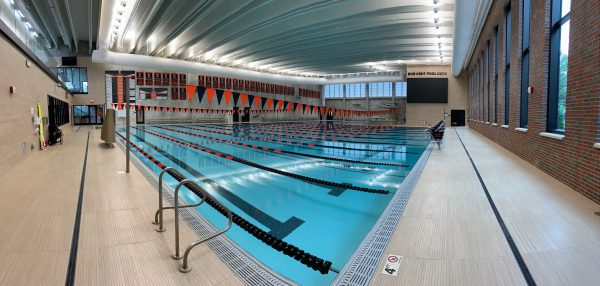
Pool Deck of Kalamazoo College's New Natatorium
Kalamazoo College will dedicate its new natatorium at 4:30 p.m. Friday, October 15.

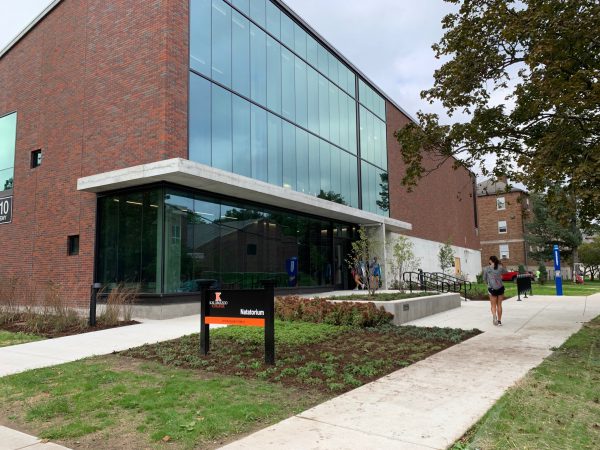
Kalamazoo College is ready to make a splash with student-athletes and the community thanks to the completion of an $18 million project years in the making. The College will dedicate its new natatorium, at 1010 Academy Street, during Homecoming weekend at 4:30 p.m. Friday, October 15.

The completed project will begin hosting competitions at 1 p.m. Saturday, October 16, as the men’s and women’s swimming and diving teams host a triangular meet against Saginaw Valley State University and Alma College.

In addition to the College’s athletics events, the natatorium will host local clubs and high school teams; open swimming for students, faculty and staff; and Swim for Success, an innovative partnership between Kalamazoo College’s Mary Jane Underwood Stryker Center for Civic Engagement and the City of Kalamazoo Parks and Recreation Department. Swim for Success provides affordable swimming lessons, particularly for children from low-income families who otherwise would not have access to this life-saving skill.

Exterior of Kalamazoo College natatorium
Kalamazoo College will dedicate its new natatorium at 4:30 p.m. Friday, October 15.

“We’re excited because the new natatorium will be a tremendous asset for our campus and for the Kalamazoo community,” Kalamazoo College President Jorge G. Gonzalez said. “We are deeply grateful to the donors—many of whom are alumni of the swimming and diving program—who have made an investment that will benefit K students for decades to come. We’re also proud that a profound, impactful program like Swim for Success will again have a home here.”

The 29,600-square-foot, two-story facility will feature eight competition lanes, a separate diving area with 1-meter and 3-meter boards, on-deck seating for athletes, a dryland training room, an office suite for coaches and meet management, a high-quality timing system and large scoreboard, varsity team locker rooms for swimmers and divers, a display space of awards in the lobby and LEED sustainable features and design elements.

The previous natatorium had been home for the College’s swimming and diving teams for five decades. The student-athletes on those teams included eight national champions, three National Divers of the Year, and 32 Michigan Intercollegiate Athletic Association conference championship teams. Swimming and Diving Coach Jay Daniels expects the new natatorium to help the Hornets continue that tradition of excellence.

“The former building was more than a pool to us,” Daniels said. “It was a space where student-athletes pursued their passion, formed long-lasting relationships and developed their fitness, drive and discipline. We know this natatorium will be that and more for us. It will help us recruit student-athletes to K, build on our competitiveness and ensure our future success.”

Wall Street Journal, Times Higher Education Rankings Laud K

Wall Street Journal Rankings
An engaging and diverse faculty provides Kalamazoo College students
with an experience important in the Wall Street Journal/Times
Higher Education rankings of the top U.S. colleges and universities.

Another analysis has placed Kalamazoo College as the top-ranked private higher education institution in Michigan as the U.S. Wall Street Journal/Times Higher Education 2022 College Rankings list was released this week.

The report places K among the top 22 percent of the nation’s colleges and universities ranked overall with methodology that balances issues such as:

  • Resources, examining whether a college effectively delivers teaching through its finances, its student-to-faculty ratio and faculty research papers.
  • Engagement, as determined through the results of a Times Higher Education U.S. student survey, which scrutinizes each student’s engagement with their studies, their interaction with their teachers and their satisfaction with the college experience.
  • Outcomes, measuring each institution’s value, graduation rate and academic reputation.
  • Environment, including student, faculty and academic staff diversity, international populations and student inclusion.

 The full WSJ/THE list can be found at the Wall Street Journal website.

Here’s What to Expect on Move-In Day

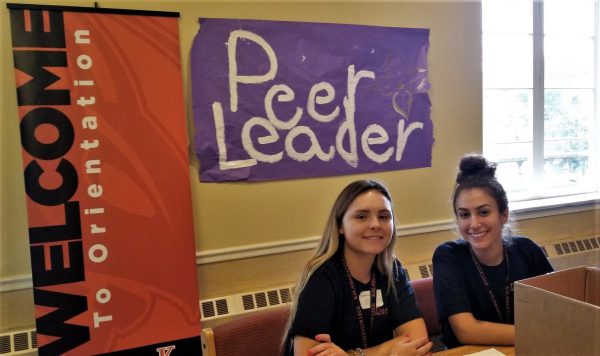
Two peer leaders assist students on move-in day
Resident assistants and peer leaders will welcome students and their families on move-in day.

Move-in day is an exciting time at Kalamazoo College as first-year students arrive. Orientation-related events will continue throughout the week; here’s what students and families can expect on Wednesday, September 8. Remember to bring a mask to wear inside campus buildings.

Report to your residence hall 

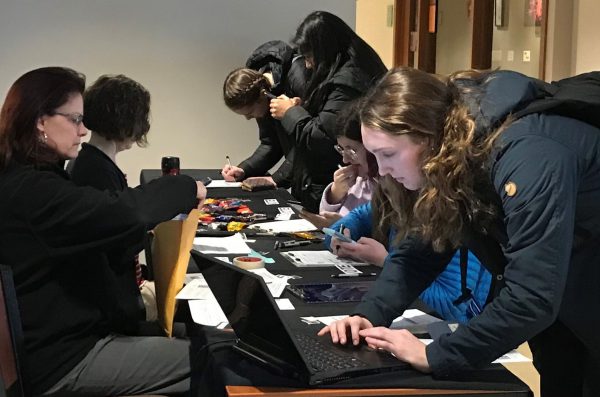
From 1 to 4 p.m., resident assistants and peer leaders will welcome students and their families at check-in tables at each residence hall. Pick up your orientation folder from peer leaders. Visit Residential Life staff afterward to collect your student ID and room key, check into your room and get settled. Health-verification forms must be completed before check in. Students with incomplete health requirements will be directed to the Health Center to complete any necessary requirements before they are permitted to check in. Health Center staff will be available until 4 p.m. at the Hicks Student Center for health-information verification and general consultations. 

Visit the Hicks Center 

Collect maps, schedules, directions and answers to your questions at the Hicks Student Center information table from 1 to 5 p.m. The Kalamazoo College Bookstore will offer 20 percent off K-imprinted items from 1 to 5 p.m. 

Find food and refreshments 

Stop by the Book Club Café on the first floor of the Upjohn Library from 1 to 4 p.m. for coffee, hot chocolate, tea or specialty espresso. Grab-and-go food options available include pastries, house-made salads, sandwiches and sides. From 1 to 5 p.m. at the Hicks Center, the Richardson Room will offer an extensive deli line with a variety of toppings and homemade soup. Grab-and-go options available will include sandwiches, salads, yogurt parfaits, fruit, sweet and salty snacks, and beverages. From 5 to 7 p.m., families are welcome to have dinner on campus at the Hicks Dining Center. Students may use their student ID, which serves as their meal card. Families may pay $11.15 per person at the Dining Center entrance. 

Get computer network assistance 

From 2 to 4 p.m. on move-in day, Information Services staff will be available in the Harmon, Hoben and Trowbridge residence hall main lounges to help students with network access and answer computer-related questions. 

Observe athletics practices 

Eight fall athletics teams—football, men’s and women’s soccer, volleyball, men’s and women’s golf, and men’s and women’s cross country—will be engaged in daily practices and competitions from 3 to 6 p.m. 

Free time 

Use your time from 7 to 11 p.m. to finish your room setup and relax before Orientation starts on Thursday. 

Dietitian Helps Students Address Physical, Emotional Wellness

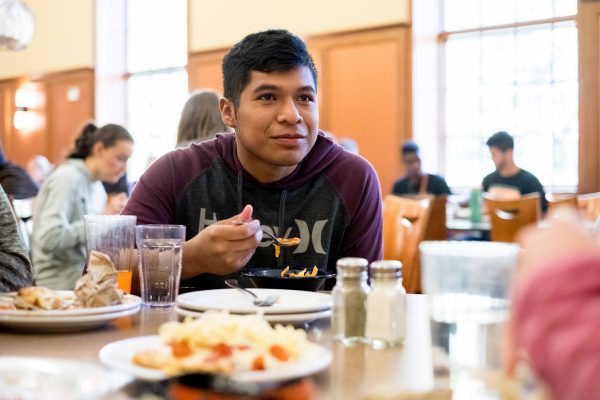
Student eating at Hicks Center cafeteria
Balanced eating can help students attain both physical and emotional wellness.

With National Wellness Month coming to an end and an academic year approaching, now is a good time for Kalamazoo College students to consider how they will maintain their physical, mental, emotional, spiritual, social and environmental well-being when they’re on campus.

One element to consider within that wellness spectrum might surprise some: food balance. And dietitian Gretchen Kauth is available to assist K and Western Michigan University students with their strategies.

“Food isn’t just critical to our physical health, it’s also a large part of our emotional health,” Kauth said. “Students come to me because they’d like to start being a vegetarian and want to know how to do that healthfully. Or they see me because their blood glucose or their cholesterol is high. They might want to lose or gain some weight. Those are the physically driven reasons. But more and more, especially during the pandemic, students want to know about the emotional part of food. A lot of us were and still are turning toward food as our entertainment, our comfort or our stress management.”

From Kauth’s point of view, “diet” refers to much more than the four-letter word associated with weight goals. Her strategy for assisting students instead addresses the purposes behind our eating to address wellness.

“I think that the traditional sense of how we use the word ‘diet’ usually has to do with weight or weight management,” she said. “I’ve really tried to take a non-diet approach to get away from the numbers and the counting. I want students to really look at the ‘whys’ of what and how they eat and how we can manage emotions without food.”

That’s not to say that food shouldn’t involve enjoyment. Quite the opposite, in fact, and balance is important. Students should have their cake and eat it, too.

“I don’t want to ever deny that food is pleasurable,” Kauth said. “It’s a part of our social world. If we think back evolution-wise, people once ate simply because they were hungry and they knew that eating sustained them. Then there are the reasons people eat as part of traditions and celebrations. Food can and should be a part of those celebrations, but food shouldn’t be the main reason we’re getting together.”

For some people, food can be comforting for emotional needs and helpful in managing stress. But emotional eating, when done too frequently or in large amounts, can create problems.

“I try to get students to think about the ‘why’ rather than always the ‘what’ behind eating,” Kauth said. “Even if we overeat or binge eat something healthy, like carrots—Yes, carrots are a better food to binge on than ice cream, but the behavior is not what we want. To help manage our emotions we need to develop non-food coping strategies – like meditation, yoga, visualization, and in some cases, seeking out a therapist. A healthy diet isn’t just about essential nutrients, fuel and reducing your risk for chronic illness. It’s about understanding our relationship to food and ensuring a healthy balance for physical as well as emotional health.” 

Virtual appointments are available at no cost for students on the College’s health insurance or $50 for students with private insurance. Kauth also is planning three free workshops this fall for all K students. “You vs. Illness: Win with a Healthy Immune System” is scheduled for 6:30 to 7:30 p.m. Tuesday, September 28. “Vegetarian Eating: Plants are Powerful” is planned for 7 to 8 p.m. Wednesday, October 6. “Emotional Eating: What Are You Hungry For?” will be from 4 to 5 p.m. Thursday, October 14. Signup for individual appointments or the workshops by emailing Kauth at gretchen.kauth@kzoo.edu.

“If students have been to the doctor and they’ve been referred for follow up, seeing a dietitian is a good thing,” Kauth said. “If you come into school with a chronic illness like diabetes or cystic fibrosis and you’ve never seen a dietitian, for sure come in, because it’s a good idea to get some care here. If you are interested in changing your diet in any way, or if you’re looking at the pandemic and you think you want to improve your immune system, then reach out. Anything that might have to do with your physical or emotional health—When you’re turning to food to manage emotions, that’s a really good time to seek out a dietitian.”

Princeton Review: Academics Place K Among Nation’s Best Colleges

Best 387 Colleges Book Cover
The Princeton Review cites Kalamazoo College’s
academics in naming the institution among
The Best 387 Colleges.”
Photo credit: The Princeton Review.

The Princeton Review is placing Kalamazoo College among the top 14 percent of institutions for degree-seeking undergraduates by featuring K in the education services company’s annual college guide, The Best 387 Colleges

The schools featured aren’t individually ranked. However, the publication praises K’s academics while giving faculty high marks—95 points on a 99-point scale—for student accessibility. 

“We salute Kalamazoo College for its outstanding academics and we are genuinely pleased to recommend it to prospective applicants searching for their ‘best-fit’ college,” said Rob Franek, the Princeton Review’s editor-in-chief and lead author of The Best 387 Colleges

The Princeton Review chooses colleges for the book, one of its most popular publications, based on data it annually collects from administrators about their institutions’ academic offerings, and its surveys of college students who rate and report on various aspects of their campus and community experiences. 

In those surveys, students credited faculty for presenting challenging information and working to achieve camaraderie with students. Students also said the K-Plan—the College’s personalized approach to education through a flexible, open curriculum featuring real-world experience, service learning, study abroad and an independent senior year project—allows them more time to explore exactly what they want to learn.  

In extra-curriculars, students said they can find their niche quickly in the small-school environment, allowing most to engage in work they care about.  

The Princeton Review’s school profiles are posted on its website, where they can be searched for free. The book is the 30th annual edition and is available for purchase online.