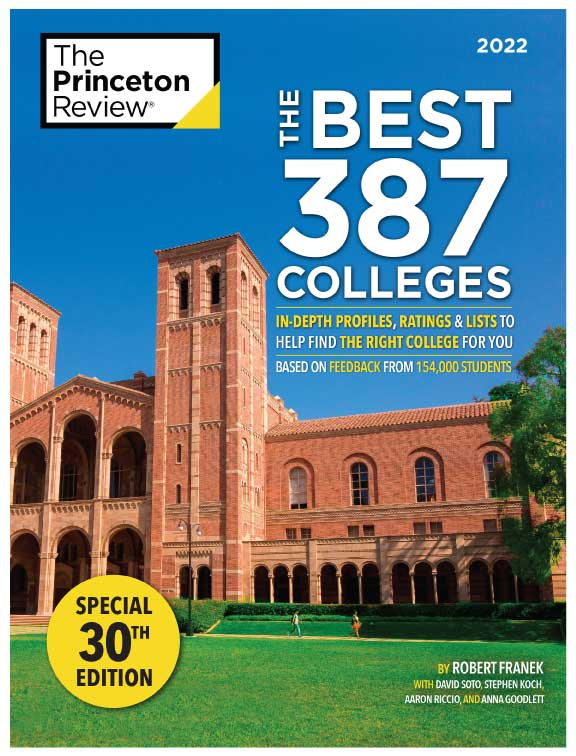
The Princeton Review cites Kalamazoo College’s academics in naming the institution among “The Best 387 Colleges.” Photo credit: The Princeton Review.
The Princeton Review is placing Kalamazoo College among the top 14 percent of institutions for degree-seeking undergraduates by featuring K in the education services company’s annual college guide, The Best 387 Colleges.
The schools featured aren’t individually ranked. However, the publication praises K’s academics while giving faculty high marks—95 points on a 99-point scale—for student accessibility.
“We salute Kalamazoo College for its outstanding academics and we are genuinely pleased to recommend it to prospective applicants searching for their ‘best-fit’ college,” said Rob Franek, the Princeton Review’s editor-in-chief and lead author of The Best 387 Colleges.
The Princeton Review chooses colleges for the book, one of its most popular publications, based on data it annually collects from administrators about their institutions’ academic offerings, and its surveys of college students who rate and report on various aspects of their campus and community experiences.
In those surveys, students credited faculty for presenting challenging information and working to achieve camaraderie with students. Students also said the K-Plan—the College’s personalized approach to education through a flexible, open curriculum featuring real-world experience, service learning, study abroad and an independent senior year project—allows them more time to explore exactly what they want to learn.
In extra-curriculars, students said they can find their niche quickly in the small-school environment, allowing most to engage in work they care about.
The Princeton Review’s school profiles are posted on its website, where they can be searched for free. The book is the 30th annual edition and is available for purchase online.
Thirty-two students known for their invaluable contributions to the Kalamazoo College community were honored April 30 at the 17th annual Senior Leadership Recognition Awards.
The recipients represent talented athletes, outstanding academic performers, members of the President’s Student Ambassadors and student-organization standouts. Here are the honorees:
Gold Afolabi nominated by Natalia Carvalho-Pinto, Intercultural Student Life
Katrina Arriola nominated by Liz Candido, Religious and Spiritual Life
Maya Banks nominated by Diomedes Rabago, Spanish; and Katie MacLean, Provost’s Office
Richard Brown III nominated by Francisco Villegas, Anthropology/Sociology; and Sandy Dugal, Kalamazoo College Fund
Isabelle Clark nominated by Katie Miller, Women’s Basketball
Adam Decker nominated by David Wilson, Physics
Vivian Enriquez (not pictured)
nominated by Alison Geist, Teresa Denton, Paulette Rieger, Emily Kowey and Moises Hernandez, Center for Civic Engagement; and Francisco Villegas, Anthropology/Sociology
Anna Gambetta nominated by Santiago Salinas and Anne Engh, Biology
Brendan Gausselin nominated by Mike Ott, Baseball; and Sandy Dugal, Kalamazoo College Fund
Merritt Hamann (not pictured)
nominated by Nick Giard, Men’s Basketball
Kaylee Henderson nominated by Dennis Frost, History
Maeve Hening nominated by Alison Geist, Teresa Denton, Paulette Rieger, Emily Kowey and Moises Hernandez, Center for Civic Engagement
Audrey Honig nominated by Jeffrey Haus, History and Jewish Studies; and Liz Candido, Religious and Spiritual Life
Denise Jackson nominated by Danielle Turner, Residential Life; and Jon Collier, Student Activities
Lisa Johnston nominated by Eric Nordmoe, Mathematics
Nicklas Klepser nominated by Brian Dietz, Student Development
Juanita Ledesma (not pictured)
nominated by Katie Miller, Women’s Basketball; and Natalia Carvalho-Pinto, Intercultural Student Life
Tristen Mabin nominated by Natalia Carvalho-Pinto, Intercultural Student Life
Nat Markech nominated by Jon Collier, Student Activities
Alonté Mitchell-Presley nominated by Jon Collier, Student Activities
Daniel Mota-Villegas nominated by Sandy Dugal, Kalamazoo College Fund, and Alison Geist, Teresa Denton, Paulette Rieger, Emily Kowey, & Moises Hernandez, Civic Engagement
Kelly Nickelson nominated by Sara Stockwood and Binney Girdler, Environmental Stewardship and Biology
Nikoli Nickson nominated by Ann Fraser, Biology
Aisat Oladokun nominated by Sandy Dugal, Kalamazoo College Fund, and Alison Geist, Teresa Denton, Paulette Rieger, Emily Kowey and Moises Hernandez, Civic Engagement
Sydney Patton nominated by Alison Geist, Teresa Denton, Paulette Rieger, Emily Kowey, & Moises Hernandez, Civic Engagement
Helen Pelak nominated by Sandy Dugal, Kalamazoo College Fund
Brynn Rohde nominated by Lisa Ailstock, Jennifer Combes, Deb Annen-Caruso, Cindi Anspach, Liza Escamilla, & Jennie Hill, Student Health Center
Asia Smith (not pictured)
nominated by Alison Geist, Teresa Denton, Paulette Rieger, Emily Kowey and Moises Hernandez, Civic Engagement, and Francisco Villegas, Anthropology/Sociology
Savannah Sweeney nominated by Jon Collier, Student Activities
Vanessa Vigier nominated by Tony Nelson, Center for International Programs
Brandon Wright (not pictured)
nominated by Vince Redko, Men’s Lacrosse, and Sandy Dugal, Kalamazoo College Fund
Alaq Zghayer nominated by Sandy Dugal, Kalamazoo College Fund; Brian Dietz, Student Development, and Jon Collier, Student Development
Destiny Hutcherson ’21 teamed up with peers from Albion and Hope colleges to build a series of Black History Month events titled “Reality is Wrong, Dreams are Real.
A Kalamazoo College student has developed a partnership with peers at Albion and Hope colleges to create a four-part series of Black History Month events which will run February 26 through March 1 titled “Reality is Wrong, Dreams are Real.”
Destiny Hutcherson ’21 said she feels it’s important for Black students to have a space where they can meet other Black students and talk about experiences that are unique to them, especially when there is a lack of Black representation on campus that Black students could turn to in times of need; representatives who understand their culture and customs, and most importantly, could relate to their struggles not only in college, but also the world. These events—planned with some guidance from the Kalamazoo College Council of Student Representatives, the Office of Student Activities and the Intercultural Center—could provide that, especially with other Great Lakes Colleges Association (GLCA) schools participating.
“What you want to do is turn to people who look like you when you need advice,” Hutcherson said. “I was fortunate to have a Black advisor as a first-year student, but a lot of students don’t get that. I wanted to make something that could close that gap in the pandemic and help students find someone they can relate to.”
The conference’s logo, done by Stanton Greenstone ’21, features a flower growing from concrete alongside the moon and a star. The flower symbolizes students growing even in tough situations. The moon and star represent faithfulness in Ghanaian art. The “Reality is Wrong, Dreams are Real” title refers to Tupac Shakur, who once talked about being a flower who grew in difficult circumstances. It also touches on something timely, Hutcherson said.
“Tupac rapped in the 90s, but this is something that’s even more apparent now,” she said. “The reality we have is rough and it’s not inclusive to Blackness sometimes. Even though that’s the reality, in some ways, it’s wrong because I feel like one day dreams will overtake that. I don’t want this just to be a sad event, looking at the realities of what’s happening to Black people. I want it to be about what Black people want to do with their lives. A dream can be as simple as graduating college for a Black person and that dream is reality. My dream was creating something that cultivates Black space.”
The Black History Month events are open to current K students and include:
Art Therapy with Kwame Akoto-Bamfo at 4:30 p.m. Friday. Akoto-Bamfo, a globally-famous Ghanaian sculptor, is known for projects such as an outdoor sculpture dedicated to the memory of the victims of the Transatlantic slave trade, on display at the National Memorial for Peace and Justice, which opened in 2018 in Montgomery, Alabama. Students participating in this session have received art materials provided through the mail.
Game Night at 8 p.m. Saturday. The night will begin with an ice breaker and mocktail hour for Black students to network. That independent time, Hutcherson said, will be especially important to Black students as most events also are open to allies. The rest of the night will involve games and possibly a showing of Coming to America, the 1988 comedy film starring Eddie Murphy and Arsenio Hall.
Seminar sessions that begin at 11 a.m. Sunday. The day will feature 10 to 11 breakout sessions, including topics that deal with being an ally, and identity-based discussions that deal with being Afro-Latinx, queer and Black, and more. A Black doctor will also speak about navigating the health care system as a Black person.
Balance, Beats and Breaks at 6 p.m. Monday. Students will enjoy mindfulness practices with raptivist Aisha Fukushima, a performance lecturer, social justice strategist and singer/songwriter.
“I know that we’re at a predominantly white institution, but my goal is that we have a good number of Black students registered for it,” Hutcherson said. “I’ve centered my focuses on identity-based events at K, and I believe this is another event that is designed for filling in a gap that Black students have not had in the past year, especially seniors.”
“In the future, in a perfect world, I would also like to open this to Black alumni so it’s not only events for students, but a larger affair with other thinkers who will come in and mentor Black students,” she added. “It would be about healing, education and networking, so that it’s tailored to be a conference on giving Black students hope emotionally, and sending them on a path to generational wealth. I’d like this event to be as joyous as an HBCU extravaganza.”
At K, Green Dot usually conducts in-person training for students, faculty and staff. At this event, students wrote their own green dots to cover a red dot, symbolizing a change toward preventing power-based personal violence. But with many still learning or working virtually, Green Dot must rely on the Kalamazoo College Council of Student Representatives and other organizations to spread awareness this term. When you see green in March, think of Green Dot.
Representatives instead want you to think of Green Dot, a comprehensive safety plan funded through the State of Michigan Campus Sexual Assault Grant Program, which depends on the power of bystanders to help achieve community safety. Green Dot sees everyone at K as a potential witness to power-based personal violence, and seeks to engage students, faculty and staff in prevention training.
At K, Green Dot usually conducts in-person training for students, faculty and staff. But with many still learning or working virtually, Green Dot must rely on KCCSR and other organizations to spread awareness.
“I want to get everyone on campus to know what Green Dot is exactly,” KCCSR representative Jamison Brown said. “If you go around campus and ask people what it is, most have a broad understanding that it’s about preventing sexual assault, but there’s way more to it.”
Imagine a red dot on a map is a person’s choice to harm someone else with their words or actions. When you have enough red dots, they create a tolerance for power-based personal violence. Green dots on that map, however, would represent small actions or interventions that stop or prevent a red dot. Even when they’re small, green dots draw power from one another, and together, they change communities. One of those communities is Kalamazoo College, as bystanders are trained in how to direct, delegate and distract safely through words and actions to intervene when they witness power-based personal violence.
To be direct means to talk directly to the perpetrator or would-be victim, calling out concerning behaviors. It might be appropriate to tell the perpetrator to stop or ask the victim if they need help. To delegate means to ask for someone else’s help. A bystander could intervene by calling the police or Campus Safety. They could also ask others to help in preventing the violence. To distract means to interrupt the attempted act of violence by diverting the perpetrator’s attention away from the would-be victim.
“We want to create a space where everyone feels like they don’t have to worry about sexual violence that could take away from their education,” KCCSR representative Sela Damer-Daigle said. “I think a lot of students at K choose it because of the atmosphere, and Green Dot adds to that safe atmosphere. Students can be themselves without having to worry as much about power-based violence.”
To help create such a space, KCCSR is conducting outreach through tabling at the Hicks Student Center in March, a month normally associated with green, to spread the awareness it wants to see. Engaging students new to K is especially important, so those students can continue Green Dot traditions going forward and seek training when it’s again available.
Watch for dates to be announced soon through email and campus calendars.
“KCCSR places a lot of importance on Green Dot because it has to do a lot with keeping our campus community safe and looking out for each other,” KCCSR representative Caitlyn Cooper said. “That’s a big goal of KCCSR: to provide a better environment for students. It’s important to me that I know how to be a bystander for other people and to know some signs that can help me protect myself.”
MacKenzy Maddock ’22 leads Kalamazoo College’s Virtual Kitchen every Thursday, giving students a chance to connect over prepared foods such as masoor dal, a spicy Indian red lentil soup. Photo credit: “Masoor Dal” by elstro_88 is licensed under CC BY-NC-ND 2.0. To view a copy of this license, visit https://creativecommons.org/licenses/by-nc-nd/2.0/.
A cooking show served with a dash of Kalamazoo College is available to students this term. If you’ve ever wanted student-suitable ideas for easy-to-make, inexpensive, palate-pleasing meals that offer a change of pace and a variety of flavors, make sure to tune in.
Every Thursday, from 6 to 7 p.m., MacKenzy Maddock ’22 leads K’s Virtual Kitchen via Microsoft Teams through the Office of Student Activities (OSA). In each show, at least one student staff member cooks meals while talking with other K students.
“I make a new meal every week and try to pick affordable ingredients as well as try to include options that are vegan and vegetarian friendly,” Maddock said. “My goal is to include as many students as possible and consider their financial capacity, accessibility to resources, and interests in food. Students that participate have the option to get a cooking kit provided by the school which includes utensils used in the kitchen.”
MacKenzy Maddock ’22, a chemistry and psychology double major and a Kalamazoo College volleyball player, leads K’s Virtual Kitchen every Thursday.
Masoor dal, a spicy Indian red lentil soup, was a recent featured recipe prepared by Alaq Zghayer ’21, and students can expect such diverse dishes in future editions of the Virtual Kitchen.
“I’m working on diversifying the event to be more inclusive to other cultures, religions and groups of people on campus as well as to just learn about other kinds of food,” Maddock said. “I’m doing this by collaborating with the many student organizations we have on campus, and I’m excited for what the next few weeks are going to be like. I think the event is constantly developing and I would love for more participants every week.”
The event’s evening time slot makes it accessible to students across the country. Recordings make it available to students around the world. Students can register for each Virtual Kitchen by emailing k18mm01@kzoo.edu or messaging Maddock on Teams to receive access to the cooking channel, which includes previous editions to the show as well.
“I would like to think that this event is an easy way to socialize while doing something that you need to have to survive, food,” Maddock said. “I also think cooking is a huge thing that brings people together and I think that is something that is really necessary right now.”
Maddock, a double major in chemistry and psychology and a volleyball player, understands the need to unplug from a busy schedule. “I am trying to make this space a safe place to decompress after a long day of work, school, sports, etcetera, and I think that that is really worth it to the students that participate.”
Other Homecoming events this Friday-Sunday include:
the Alumni Association Awards Ceremony at 7:30 p.m. Friday. Join us in the Dalton Theatre at Light Fine Arts to honor the award recipients for 2018 including Distinguished Service Award winner Rick Gianino ’78, Distinguished Achievement Award winner Sandra Greene ’74, Weimer K. Hicks Award winner David Barclay, Young Alumni Award winner Eli Savit ’05, and the Athletic Hall of Fame Awards honorees. The athletic awards honorees include Kristyn Buhl-Lepisto ’04 (women’s golf); Meaghan Clark McGuire ’05 (women’s tennis), Eric Gerwin ’00 (football), Scott Whitbeck ’04 (men’s swimming and diving), and the 1955, 1980 and 1981 men’s tennis teams.
reunions of the classes of 1968, 1973, 1978, 1983, 1988, 1993, 1998, 2003, 2008 and 2013.
receptions and gatherings for groups including the 1833 and Stetson societies, the Alumni of Color, the Emeriti Club, and alumni from specific academic departments.
guided campus tours of historical sites, the campus in general and the new hoop house.
performances by Monkapult, Cirque du K and theater seniors.
opportunities for alumni to tell their K stories in video through Story Zoo.
gatherings where alumni can offer advice and compare notes with current students.
Kalamazoo College tied for 11th in 2018 among small colleges and universities sending alumni to Teach for America, which recruits outstanding leaders to become lifelong advocates for educational equality in the U.S.
Kalamazoo College ranks 11th among small schools sending its alumni to Teach for America as seven from the class of 2018 joined the education organization’s corps.
Teach for America’s recruits work for at least two years in a low-income school district classroom, where they nurture students and build their own leadership skills. The experience helps recent graduates gain the context and clarity they need to move on to graduate school or continue developing educational equality in any sector. Recruits receive salaries and some receive student loan forgiveness.
The recruits, in 51 communities nationwide, will team up with more than 56,000 alumni leaders, who work as professional educators, policy makers, lawyers, business owners, nonprofit administrators, medical professionals and more, to expand children’s opportunities. Of the organization’s 3,600 recruits from more than 700 colleges and universities, seven recruits are 2018 K grads.
This year’s recruits are among Teach for America’s most diverse since its founding in 1990 with more than half the recruits identifying as people of color, about 45 percent coming from low-income backgrounds, and about a third being the first in their families to graduate from college.
Teach for America Recruitment Manager Jess Hernandez says K’s place in the rankings figures considering the sense the College’s students have for community engagement and the students’ highly respected educational achievements.
“We only accept about 14 percent of the recruits who apply, so Kalamazoo College should be proud it’s contributing such excellent numbers,” said Hernandez, who has worked with K students for about two years. “We’re looking for students who are leaders, and we’re looking for strong academics. Kalamazoo College students check off those boxes,” noting program and K alumni such as Michigan Rep. Darrin Camilleri.
“We see it in their civic engagement,” she added. “We see it in their orientation leaders. We know that (Teach for America) offers Kalamazoo College students an opportunity to continue their service work after college and that’s really attractive.”
The Kalamazoo College Festival Playhouse 55th season features the theme of Assumption and Confusion, highlighting the gap between what seems to happen and what really happens.
The Kalamazoo College Festival Playhouse features three professionally directed plays each academic year. “Intimate Apparel” concluded its 54th season. The 55th season will begin with “It Can’t Happen Here.”
The fall production, “It Can’t Happen Here,” Nov. 1-4 will be a Michigan premiere. The story is a cautionary political tale based on Sinclair Lewis’ 1935 satire of what could happen if Fascism spreads to the United States. The stage adaptation focuses on political candidate Buzz Windrip, who no one takes seriously until he promises to return America to greatness and prosperity. After he wins the presidency, his administration devolves into confusion and danger.
“Student Body,” written by Frank Winters and directed by guest artist Bianca Washington, will run Feb. 21-24, 2019. Ten college students discuss what to do when they find a video of a sexual encounter recorded at a party. They debate whether it shows a sexual assault, who they should tell about it, and their responsibilities of reporting it.
William Shakespeare’s “Twelfth Night or What You Will” is scheduled for May 16-19, 2019. The production, directed by Theatre Arts Professor Karen Berthel, is known as one of Shakespeare’s most provocative and complex examinations of love and gender identity. Viola, disguised as a man, woos Olivia on Orsino’s behalf. However, Olivia falls in love with Viola’s male identity, who in turn longs to be with Orsino.
All three shows will be performed at the Nelda K. Balch Playhouse. Tickets are $15 for adults, $10 for seniors 65 and older, and $5 for students in the general public. Tickets are free to patrons who present a Kalamazoo College ID. As they go on sale, tickets will be available at festivalplayhouse.ludus.com or by calling the box office at 269-337-7333.
Visit the Festival Playhouse’s website for more information on the upcoming theater season and additional student productions.