A historian whose work focuses on how France’s colonialism has affected its more recent history will deliver the 2018 Edward Moritz Lecture in History on Thursday, April 26, at Kalamazoo College.
Todd Shepard, the Arthur O. Lovejoy Professor at Johns Hopkins University, will deliver the 2018 Edward Moritz Lecture on Thursday in 103 Dewing Hall at Kalamazoo College.
Todd Shepard, the Arthur O. Lovejoy Professor at Johns Hopkins University, will speak on “Decolonization and the Sexual Revolution.” His 2017 monograph, “Sex, France and Arab Men 1962-1979,” addressed how in France, questions surrounding discussion about subjects including gay rights, sexual libertinism, sodomy and rape differed from those elsewhere during that period because of the central roles that invocations of Arab men and the former French African colony of Algeria played in them. Mass immigration of Algerians to France began after the colony gained its independence in 1962, and a 2011 census counted almost a half-million French residents of Algerian birth.
Shepard’s writings also include two books, “The Invention of Decolonization: The Algerian War and the Remaking of France,” published in 2006, and “Voices of Decolonization: A Brief History with Documents,” published in 2014. He is currently completing “Affirmative Action and the End of Empires: ‘Integration’ in France (1956-1962) and the Race Question in the Cold War World.” He has also published papers in numerous historical journals.
His honors include the Council of European Studies 2008 Book Prize and the American Historical Association’s J. Russell Major Prize for best work in English on any aspect of French history. He was also named one of the top young historians in North American by the History News Network in 2017.
The annual Edward Moritz Lecture, to be delivered at 7 p.m. in 103 Dewing Hall, pays tribute to the late professor Edward Moritz, who taught British and European history at Kalamazoo College from 1955 to 1988 and served for many years as the history department chair.
Kalamazoo College History Professor James Lewis has been named a finalist for the George Washington Prize, a $50,000 annual award that recognizes the authors of the past year’s most influential books about the nation’s founding era.
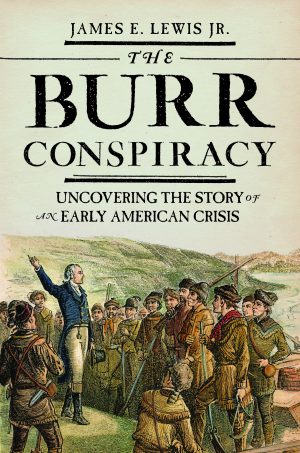
“The Burr Conspiracy: Uncovering the Story of an Early American Crisis,” written by K History Professor James Lewis, is a finalist for the George Washington Prize.
Lewis’s 2017 book, “The Burr Conspiracy: Uncovering the Story of an Early American Crisis,” explores former Vice President Aaron Burr’s travels through the Trans-Appalachian West in 1805 and 1806, gathering support for a mysterious enterprise, leading to his arrest and trial on treason charges in 1807. Rumors at the time stated Burr had enticed some people with plans to liberate Spanish Mexico, others with promises of land in the Louisiana Purchase, and others with talk of building a new empire beyond the Appalachian Mountains.
The book, available through many bookstores and online sites, also examines the political and cultural forces that shaped how Americans made sense of Burr’s intentions and movements, and the crisis after his arrest including concerns about the nation’s fragile union and uncertain republic.
Lewis has taught courses in U.S. history, Native American history, American environmental history, Revolutionary America, the American frontier and Western history, the history of U.S. foreign relations, post-World War II America, American political culture, the trial in American history and a senior seminar in history at K. He is a professional member of the American Historical Association, the Organization of American Historians and the Society for Historians of the Early American Republic.
Lewis’s other books include:
“The Louisiana Purchase: Jefferson’s Noble Bargain?” (2003);
“John Quincy Adams: Policymaker for the Union” (2001); and
“The American Union and the Problem of Neighborhood: The United States and the Collapse of the Spanish Empire, 1783-1829” (1998).
The George Washington Prize was created in 2005 through the Gilder Lehrman Institute of American History, George Washington’s Mount Vernon and Washington College. A news release from Washington College says the honor is one of the nation’s largest and most notable literary awards. In addition, “The finalists’ books combine depth of scholarship and broad expanse of inquiry with vivid prose that exposes the complexities of our founding narrative. Written to engage a wide public audience, the books provide a ‘go-to’ reading list for anyone interested in learning more about George Washington, his contemporaries, and the founding of the United States of America.”
Kalamazoo College History Professor James Lewis is the author of “The Burr Conspiracy: Uncovering the Story of an Early American Crisis,” which is a finalist for the George Washington Prize.
The other six authors named as finalists for the 2018 award are:
Max Edelson for “The New Map of Empire: How Britain Imagined America before Independence;”
Kevin J. Hayes for “George Washington: A Life in Books;”
Eric Hinderaker for “Boston’s Massacre;”
Jon Kukla for “Patrick Henry: Champion of Liberty;”
Jennifer Van Horn for “The Power of Objects in Eighteenth-Century America;” and
Douglas L. Winiarski, “Darkness Falls on the Land of Light: Experiencing Religious Awakenings in Eighteenth-Century New England.”
The winner of the 2018 George Washington Prize will be announced and all finalists will be recognized at a black-tie gala May 23 at George Washington’s Mount Vernon.
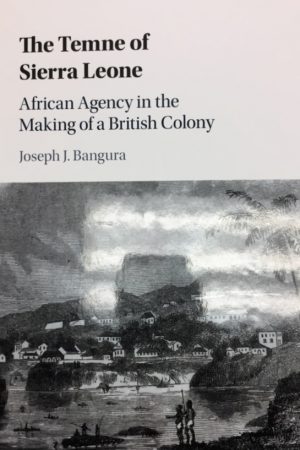
“The Temne of Sierra Leone: African Agency in the Making of a British Colony” promotes new perspectives on the formation and social history of Sierra Leone.
Associate Professor Joseph Bangura is the chair of the History Department and the director of African Studies.
A new book written by Kalamazoo College Associate Professor of History Joseph Bangura promotes new perspectives on the formation and social history of Sierra Leone.
Research regarding Sierra Leone typically focuses on the roles of the Creoles and/or Krio, who were descendants of ex-slaves from Europe, North America, Jamaica and Africa living in the colony. Bangura, however, examines the roles of the indigenous Temne-speakers through the socio-economic formation, establishment and evolution of Freetown in “The Temne of Sierra Leone: African Agency in the Making of a British Colony.”
Bangura’s analysis includes market women, religious figures and community leaders, and the complex relationships they developed. He also considers key issues such as the politics of belonging, African agency and the creation of national identities.
• The Politics of Sub-Saharan Africa; • Introduction to African Studies • Islam in Africa; • Civilizations of Africa; • Contemporary Africa; • Gender Relations in Africa; • Africa and the Atlantic Slave Trade; • African Christianity; • Globalization and International Politics; • Globalization and Africa; • War and Peace in Africa; and • The Cold War in Africa.
Bangura earned his master’s degree and Ph.D. from Dalhousie University, and his bachelor’s degree in history from the University of Sierra Leone. He co-edited two other books with Marda Mustapha, “Democratization and Human Security in Sierra Leone,” which was released in 2015; and “Sierra Leone beyond the Lome Peace Accord,” which was released in 2010.
Kalamazoo College History Professor James Lewis has released a new book through Princeton University Press about former U.S. Vice President Aaron Burr.
History Professor James Lewis is the author of “The Burr Conspiracy: Uncovering the Story of an Early American Crisis.”
“The Burr Conspiracy: Uncovering the Story of an Early American Crisis” is available through many bookstores and websites.
“The Burr Conspiracy: Uncovering the Story of an Early American Crisis” explores Burr’s travels through the Trans-Appalachian West in 1805 and 1806, gathering support for a mysterious enterprise, leading to his arrest and trial on treason charges in 1807. Rumors at the time stated Burr had enticed some people with plans to liberate Spanish Mexico, others with promises of land in the Louisiana Purchase, and others with talk of building a new empire beyond the Appalachian Mountains.
The book, available through many bookstores and online sites, also examines the political and cultural forces that shaped how Americans made sense of Burr’s intentions and movements, and the crisis after his arrest including concerns about the nation’s fragile union and uncertain republic.
Lewis has taught courses in U.S. history, Native American history, American environmental history, Revolutionary America, the American frontier and Western history, the history of U.S. foreign relations, post-World War II America, American political culture, the trial in American history and a senior seminar in history at K. He is a professional member of the American Historical Association, the Organization of American Historians and the Society for Historians of the Early American Republic.
Lewis’s other books include:
“The Louisiana Purchase: Jefferson’s Noble Bargain?” (2003);
“John Quincy Adams: Policymaker for the Union” (2001); and
“The American Union and the Problem of Neighborhood: The United States and the Collapse of the Spanish Empire, 1783-1829” (1998).
Lewis earned a bachelor’s degree in government and foreign affairs from the College of William and Mary, a master’s degree in history from the American University, and a Ph.D. in history from the University of Virginia. He has been teaching at K since 2003.
Kalamazoo College Family Weekend served as the backdrop for the College’s annual Honors Day convocation. More than 250 students were recognized Friday, Oct. 27, for excellence in academics and leadership in six divisions: Fine Arts, Foreign Languages, Humanities, Natural Sciences and Mathematics, Social Sciences and Physical Education. Recipients of prestigious scholarships were recognized, as were members of national honor societies and students who received special Kalamazoo College awards. Student athletes and teams who won Michigan Intercollegiate Athletic Association awards also were honored. The students receiving Honors Day awards or recognition are listed below.
The Honors Day Convocation, conducted Oct. 27 at Stetson Chapel, celebrated the achievements of more than 250 Kalamazoo College students.
FINE ARTS DIVISION
The Brian Gougeon Prize in Art Hannah Rainaldi
The Margaret Upton Prize in Music Joshua Gibson Jenna Sherman
Cooper Award Kate Kreiss
Sherwood Prize Cody Colvin
Theatre Arts First-Year Student Award Sophia Hill Alysia Homminga
FOREIGN LANGUAGES DIVISION
LeGrand Copley Prize in French Valentina Cordero Ravi Nair
Hardy Fuchs Award Matthew Flotemersch
Margo Light Award Annarosa Whitman
Romance Languages Department Prize in Spanish Joshua Gibson Kevin McCarty
Clara H. Buckley Prize for Excellence in Latin Mara Hazen
Provost’s Prize in Classics Clayton Meldrum
HUMANITIES DIVISION
O.M. Allen Prize in English Paige Coffing
John B. Wickstrom Prize in History Riya Bhuyan
Department of Philosophy Prize Lee Carter Emiline Chipman
L.J. and Eva (“Gibbie”) Hemmes Memorial Prize in Philosophy Rosella LoChirco
NATURAL SCIENCES AND MATHEMATICS DIVISION
Winifred Peake Jones Prize in Biology Brigette Berke Amelia Davis Dominic Gonzalez
Department of Chemistry Prize Kevin McCarty
First-Year Chemistry Award Kristen Amyx-Sherer Alyssa Heitkamp
First-Year Mathematics Award Michael Orwin William Tait
Thomas O. Walton Prize in Mathematics Allegra Allgeier
Cooper Prize in Physics Benjamin Behrens Valentina Harding Alexis Periman Justin Seablom Ethan Tucker
SOCIAL SCIENCES DIVISION
Departmental Prize in Anthropology and Sociology Paige Chung Shadaijah Grandberry-Payton Aliyah Jamaluddin Elizabeth Munoz Emiliana Renuart
C. Wallace Lawrence Prize in Economics Andrew Parsons Evelyn Wagner
C. Wallace Lawrence Prize in Business Jessica Penny Scott Roberts Garrett Swanson
Irene and S. Kyle Morris Prize Zachary Ray
William G. Howard Memorial Prize Sarah Gerendasy
Department of Psychology First-Year Student Prize Shannon Carley
PHYSICAL EDUCATION DIVISION
Division of Physical Education Prize Laura Hanselman Daniel Henry
Maggie Wardle Prize Elizabeth Munoz
COLLEGE AWARDS
Gordon Beaumont Memorial Award Cydney Martell Rumsha Sajid Cindy Xiao
Henry and Inez Brown Prize Alexandrea Ambs Emily Good David Vanderkloot
Virginia Hinkelman Memorial Award Sarafina Milianti Sep’tisha Riley
Heyl Scholars – Class of 2020 Andrew Backer Matthew Giguere Josephine Hosner Danielle Janowicz Samuel Meyer Hannah Pittman Stephanie Rauhoff Subi Thakali Dustin Tibbetts
Posse Scholars – Class of 2020 Alejandro Aguirre Alexandro Cruz Kahira Embry Moses Gonzalez Denise Jackson Trevor Loduem-Jackson Daniel Mota-Villegas Angela Pastor Enrique Robles Gabrielle Walton Schwartz
National Merit Scholar – Class of 2020 Ehren White
Alpha Lambda Delta – Class of 2019 Alpha Lambda Delta is a national honor society that recognizes excellence in academic achievement during the first college year. To be eligible for membership, students must earn a cumulative GPA of at least 3.5 and be in the top 20 percent of their class during the first year.
Logan Beck Benjamin Behrens Brigette Berke Riya Bhuyan Shannon Carley Iffat Chowdhury Valentina Cordero Austin Cramer Adelaine Dancer Matthew Flotemersch Amanda Gardner Joshua Gibson Dominic Gonzalez Martin Hansknecht Sophia Hill Kento Hirakawa Alysia Homminga Maria Katrantzi Zoe Larson Samuel Maddox Kathryn Martin Kevin McCarty Tamara Morrison Elizabeth Munoz Cayla Patterson Alexis Periman Victorialyn Regan Danna Robles-Garcia Orly Rubinfeld Danielle Sarafian Jenna Sherman Simran Singh Grant Stille Sarah Whitfield
ENLIGHTENED LEADERSHIP AWARDS
Performing Arts: Music Madeleine Armstrong Zachary Colburn Adam Decker Jennalise Ellis Stanton Greenstone Audrey Honig Isabel McLaughlin Katherine Miller-Purrenhage Natalie Minzey Julia Riddle Margaret Roethler
MICHIGAN INTERCOLLEGIATE ATHLETIC ASSOCIATION (MIAA) AWARDS
The following Hornet teams earned the 2015-2016 MIAA Team GPA Award. Team members achieved a 3.3 or better grade point average for the entire academic year.
The MIAA each year honors students at member colleges who achieve distinction in the classroom and in athletic competition. Students need to be a letter winners in a varsity sport and maintain at minimum 3.5 grade point average for the entire school year.
Cheyenne Allyn-White Alexandrea Ambs Georgie Andrews Ryan Andrusz Hunter Angileri Alberto Ayala Sonal Bahl Chase Baysdell Matthew Benedettini Jacob Bonifacio Kennedy Boulton Riley Boyd Andrew Bremer Allie Brodsky Molly Brueger Ian Bunker Matthew Burczyk Alexander Cadigan Charles Carson Madeleine Chilcote Jack Clark Elizabeth Clevenger Anthony Convertino Austin Cramer Anna Dairaghi Christina Dandar Elan Dantus Roger Darling Sabrina Dass Steven Davis Eric De Witt Dana DeVito Mikayla Doepker Guillermo Dominguez-Garcia Nathan Donovan Erin DuRoss Tristyn Edsall Emma Eisenbeis Michael Faust Anders Finholt John Fowler Christopher Francis Maria Franco Brett Garwood Cory Gensterblum Joseph Giacalone Jacob Gilhaus Anthony Giovanni Rachel Girard Beau Godkin Emily Good Monica Gorgas Mya Gough Andre Grayson Garrett Guthrie Alyssa Heitkamp Daniel Henry Kaiya Herman-Hilker Kyle Hernandez Mathew Holmes-Hackerd Allia Howard Nicole Huff Briana Huisken Claire Jensen Katherine Johnson Marylou Johnson Claire Kalina Maria Katrantzi Greg Kearns Samuel Kepes Benjamin Kileen Dahwi Kim William Kirchen Ian Kobernick Emily Kozal Matthew Krinock Stefan Leclerc Rosella LoChirco Nicholas Ludka Cydney Martell Eliza McCall Katherine McKibbon Branden Metzler Joshua Miller Suzanne Miller Madison Moote Zachary Morales Elizabeth Munoz Dylan Padget James Paprocki Cayla Patterson John Patton Bradley Popiel Nicole Prentice Zachary Prystash Erin Radermacher Zachary Ray Phillip Ritchie Scott Roberts Justin Roop Matthew Ryder Paige Sambor Aaron Schwark Jacob Scott Justin Seablom Anorah Seita Sharif Shaker Chase Shelbourne Alec Sherrill Gabrielle Shimko Grace Smith Adam Snider Kathleen Sorensen Sydney Spring Vethania Stavropoulos Grant Stille Shelby Suseland Matthew Suter Jacob Sypniewski Jack Tagget William Tait Emma Tardiff Benjamin Toledo Alyana Tomlinson Zachary Tornow Matt Turton Eva Ugelow Madison Vallan Kaela Van Til Joshua Vance David Vanderkloot Zachary VanFaussien Mitchell VanKoevering Travis Veenhuis John Vinson Sidney Wall Jacob Wasko John Wehr Alex White Madeline Woods Brent Yelton Julie Zabik Matthew Zhiss
Crain’s Detroit Business last week honored its 40 Under 40 honorees, and they include two Kalamazoo College alumni. They are:
Ed Mamou ’00, 39, who is the owner of the Root and Mabel Gray restaurants, vice president of GFL Environmental Recycling Services Inc., and vice president of Royal Oak Recycling. Mamou earned a degree in mathematics at K and later earned a master’s degree in applied math at the University of California-San Diego; and
Sean Mann ’03, 37, who is a former lobbyist and policy adviser in Michigan politics. Mann quit his job with Michigan Legislative Consultants in Lansing on Sept. 5 to become the full-time CEO of Detroit City FC, a semi-pro soccer club that could soon turn professional. He earned a bachelor’s degree in physics and history from K and holds a master’s degree in international relations from the University of Bristol.
Crain’s Detroit Business says all of its 40 Under 40 honorees are professionals who have made “big decisions and bold moves.” They’ve also reinvented themselves and their companies across a variety of sectors and challenges involving fields or attributes such as autonomous vehicles, educational attainment, regional transit, home mortgages and health care.
The honorees were selected by the Crain’s Detroit Business editorial team through nominations selected based on their impact and achievements in business. Read more about the honorees and hear in their own words what they think the next 40 years will hold for Michigan.
Kalamazoo College faculty members Binney Girdler and James Lewis have been promoted from associate professors to full professors.
Biology Professor Binney Girdler is one of two faculty members being promoted from associate professor to full professor.
Girdler, a biology professor, focuses her research on studying the structure and dynamics of terrestrial plant communities such as shoreline communities, grasslands and forests. She’s also interested in applied conservation biology, and develops relationships with area natural resource agencies and non-profit conservation groups to match her expertise and students with their research needs.
Girdler is a member of the Ecological Society of America and the Society for Conservation Biology. She has taught courses in environmental science, ecology and conservation, plant biology, population and community ecology, and senior seminars in environmental studies. She earned a bachelor’s degree from the University of Virginia, a master’s degree from Yale University and a Ph.D. from Princeton University.
Lewis, a history professor, has taught courses in U.S. history, Native American history, American environmental history, Revolutionary America, the American frontier and Western history, the history of U.S. foreign relations, post-World War II America, American political culture, the trial in American history and a senior seminar in history. Lewis is a professional member of the American Historical Association, the Organization of American Historians and the Society for Historians of the Early American Republic. He has written books including:
History Professor James Lewis is one of two faculty members being promoted from associate professor to full professor.
“The Louisiana Purchase: Jefferson’s Noble Bargain?” (2003);
“John Quincy Adams: Policymaker for the Union” (2001);
“The American Union and the Problem of Neighborhood: The United States and the Collapse of the Spanish Empire, 1783-1829” (1998); and
“The Burr Conspiracy: Uncovering the Story of an Early American Crisis” due out this fall.
Lewis earned a bachelor’s degree in government and foreign affairs from the College of William and Mary, a master’s degree in history from the American University, and a Ph.D. in history from the University of Virginia.
“Both Dr. Girdler and Lewis are respected teachers and scholars in the best tradition of the liberal arts and sciences,” Kalamazoo College Provost Mickey McDonald said of the faculty members promoted. “This promotion recognizes their sustained excellence and the impact they have had and will continue to have on Kalamazoo College and our students.”
Can there be a better metonym for — or higher measure of — the virtues of courage and love than the word immigrant? It is a question posed by the new Upjohn Library Commons exhibit titled “Immigrants and International Students at Kalamazoo College.” That history is a long one at K, beginning in the 1860s and continuing today. College Archivist Lisa Murphy ’98 is responsible for the library’s main-floor displays, which she alters term to term. And hers was the idea for this spring’s. However, the execution — including the research, writing, design and installation, was accomplished by senior political science major Shelby Long. Long has worked in the College’s archives for three years doing multiple tasks but never, until now, a museum-quality exhibit. “I wanted to be sure she had that opportunity,” says Murphy, who admits she will sorely miss her colleague after June’s commencement. “Shelby did a wonderful job on this timely display.” Preparation and installation required a month, and the most difficult task was choosing the few students (from many possibilities) that the display would feature.
Among Long’s favorites is Nagai Kafu, who attended K in 1904-05. “He became one of the most prominent writers in Japan in the 1920s and ’30s,” said Long, “described by some as Japan’s Ernest Hemingway. Fans of his work still visit the house on Elm Street where he lived when he studied at K.” Asked what strikes her most about K’s immigrant and international students, Long says: “All their remarkable accomplishments after they left, in the U.S. and in their home countries.
Sam Song Bo
Those countries (in addition to Japan) included Burma, Poland, Latvia, Nigeria, Kenya, Iceland, Iran and China. Sam Song Bo left China to attend college in the United States (first McMinnville College in Oregon, then K in 1881-82). He decried the discrimination Chinese immigrants endured in the United States, writing about that injustice some dozen years after Chinese workers helped complete the building of the transcontinental railroad. One of the earliest immigrant students to attend K (although one could consider all Americans immigrants) was Martha den Bleyker, class of 1863. At the age of nine she and her family arrived in Kalamazoo from the Netherlands. They were soon thereafter quarantined from cholera in a shack outside the city limits. All but one brother recovered from the disease. Martha’s father went on to establish Kalamazoo as a premier celery growing region.
Martha den Bleyker
Martha was an anomaly in that most 19th-century immigrant students at K were men. That began to change after World War II. One example is Hilda Arzangoolian who traveled from Iran to study chemistry and mathematics at K in 1946-47. She spoke six languages and had studied English a mere six months before arriving at K. In addition to her academic pursuits, she played excellent tennis for the College’s team. You can learn more about the history of K’s immigrant and international students by traveling no further than the first floor of Upjohn Library Commons. Shelby Long remains very interested in archival work, and plans to earn to Master in Library Science degree. Lisa Murphy will be seeking a student to take Long’s place. “It’s wonderful work,” says Long. Interested students should write to Murphy at archives@kzoo.edu.
PBS will premiere Van Gogh’s Ear on Wednesday, December 14, (check local listings) and, if you watch, see if you can find David Kessler ’70. The documentary is based on a recent book by Bernadette Murphy, which reveals much that was unknown or contested about the life of the famous painter. Among those mysteries: the accurate story behind the self-mutilation of his ear. What did van Gogh really do on the fateful night of December 23, 1888, in the town of Arles in southern France?
Murphy, an independent researcher living in Provence, had long been intrigued by van Gogh’s story and spent seven years piecing together a meticulous picture of his life in Arles (1888-89); person by person, house by house, exploring closely his friends and his enemies. Her detective work uncovered definitive long-lost evidence, the key document of which she found with the help of David Kessler in the University of California-Berkeley’s Bancroft Library, where David works.
The show, part of PBS’s Secrets of the Dead series, will reveal exactly what happened the night of December 23, who was involved and how it ultimately shaped van Gogh’s remarkable art. It provides answers to the mystery that has divided art historians for decades and reveals the artist’s roller coaster of emotions and his mental health, placing his actions in proper context for the first time. In the San Francisco Bay area, the show will be air on KQED at 10 p.m.. “I hope you get a chance to watch,” said David. “I’m hoping I manage to stay up that late myself!”
Nora Naranjo Morse will deliver the annual Phi Beta Kappa lecture at Kalamazoo College on Tuesday, October 11, at 8 p.m. in the Mandelle Hall Olmsted Room. The event is free and open to the public. Morse Morse is a sculptor, writer, and producer of video films that look at the continuing social changes within Pueblo Indian culture. Her talk, “Numbe Wahgeh,” focuses on the historical treatment of the Pueblo people and history retold by indigenous peoples.
An artist best known for her work with clay and organic materials, she has been trained in the Pueblo clay work tradition of the Southwest. Her installation exhibits and large-scale public art speak to environmental, cultural, and social practice issues. Beyond New Mexico, her work can be seen at the Heard Museum in Phoenix, the Minneapolis Institute of Art, and the Smithsonian’s National Museum of the American Indian, Washington, D.C.
She studied at the College of Santa Fe, where she received her B.A. degree in 1980, and is the recipient of an honorary degree from Skidmore College. In 2014 Naranjo Morse was awarded a Native Arts and Cultures Foundation Artist fellowship. She is the author of two books: a poetry collection, Mud Woman: Poems from the Clay, and a children’s book, Kaa Povi.
Morse will spend two days on K’s campus. In addition to her public lecture she will visit four classes and meet with various faculty and students.





 Nora Naranjo Morse will deliver the annual Phi Beta Kappa lecture at Kalamazoo College on Tuesday, October 11, at 8 p.m. in the Mandelle Hall Olmsted Room. The event is free and open to the public. Morse Morse is a sculptor, writer, and producer of video films that look at the continuing social changes within Pueblo Indian culture. Her talk, “Numbe Wahgeh,” focuses on the historical treatment of the Pueblo people and history retold by indigenous peoples.