Alumna Earns Prestigious NASA Hubble Fellowship

A Kalamazoo College alumna has been awarded a prestigious NASA Hubble Fellowship, an honor given to just 24 early-career scientists nationwide. 

Hayley Beltz ’18, a postdoctoral researcher at the University of Kansas, was selected from a pool of more than 400 applicants for the highly competitive program, which supports independent research in astrophysics

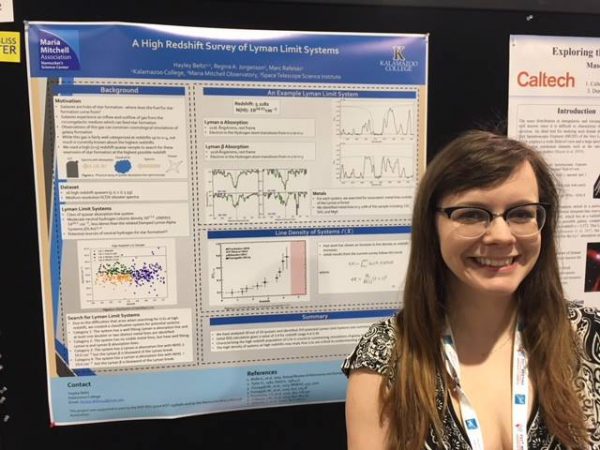
As a senior double majoring in physics and mathematics at K, Beltz received an Astronomy Achievement Student Award and a Chambliss Medal through the American Astronomical Society (AAS), recognizing her exemplary Senior Integrated Project (SIP) presentations at the organization’s meetings. Her SIP involved quasar spectroscopy, meaning she analyzed light that is billions of years old to find and measure the large concentrations of hydrogen that develop as stars form. 

“My time at Kalamazoo College gave me the strong physics and math background that I needed for graduate school,” Beltz said. “I loved working as a consultant for the Math and Physics Center, which helped me grow my skills as a mentor and teacher. Being able to try out research with multiple professors at K helped solidify my desire to continue my education and become a scientist. I am very grateful to all the faculty who answered my many questions in office hours, wrote me letters of recommendation, and helped shape me into the astronomer that I am today.” 

Beltz earned her doctorate from the University of Michigan in 2023. She then conducted postdoctoral research at the University of Maryland from August 2023 to January 2026 before moving to her current position in Kansas. Recently, her work has focused on “Hot Jupiters,” which are gas giant exoplanets about the size of Jupiter that orbit extremely close to their stars, completing an orbit in just a few days. Temperatures during their daytime can exceed 2,000 degrees. 

The Hubble Fellowship will support Beltz’s research for the next three years as she continues developing computer models of exoplanets beyond our solar system with a focus on how magnetic fields shape their atmospheres. 

“Learning about these other planets helps us understand the full range of planet formation in our galaxy,” Beltz said. “Magnetic fields are especially important because they play a key role in shaping environments like Earth’s, where life can exist.” 
 

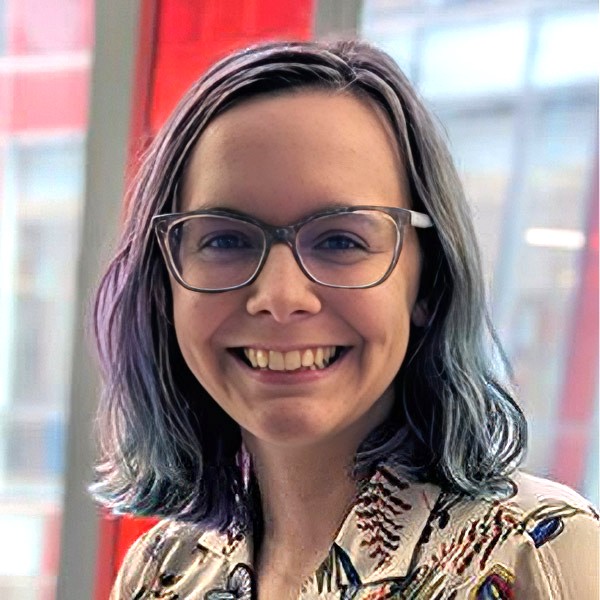
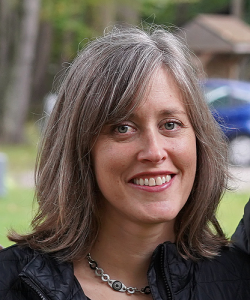
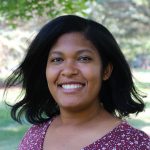
NASA Hubble Fellow Hayley Beltz portrait
Hayley Beltz ’18
Hayley Beltz Presents at Astronomers Meeting
In 2018, Beltz was one of just five undergraduates from across the country to earn a Chambliss Medal from the American Astronomical Society.

What’s for Lunch? 25 Years of Inspired Science in Schools

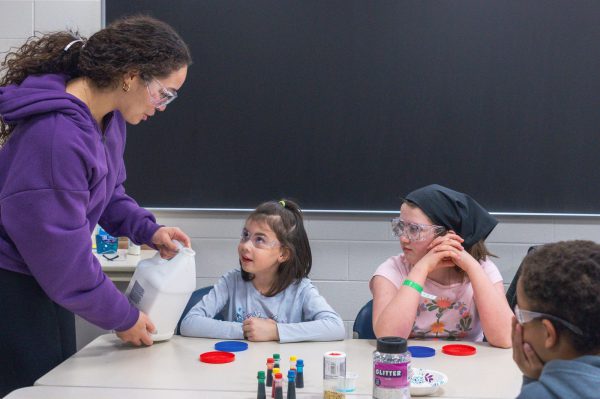
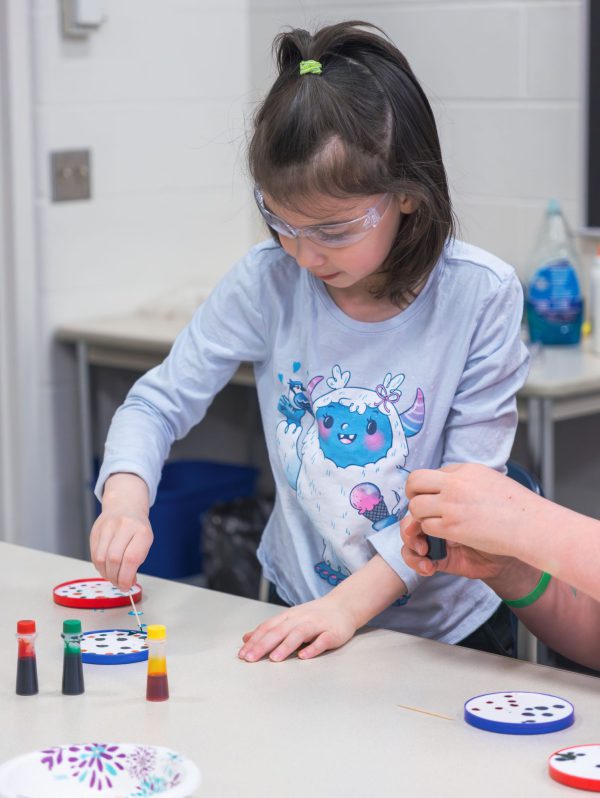
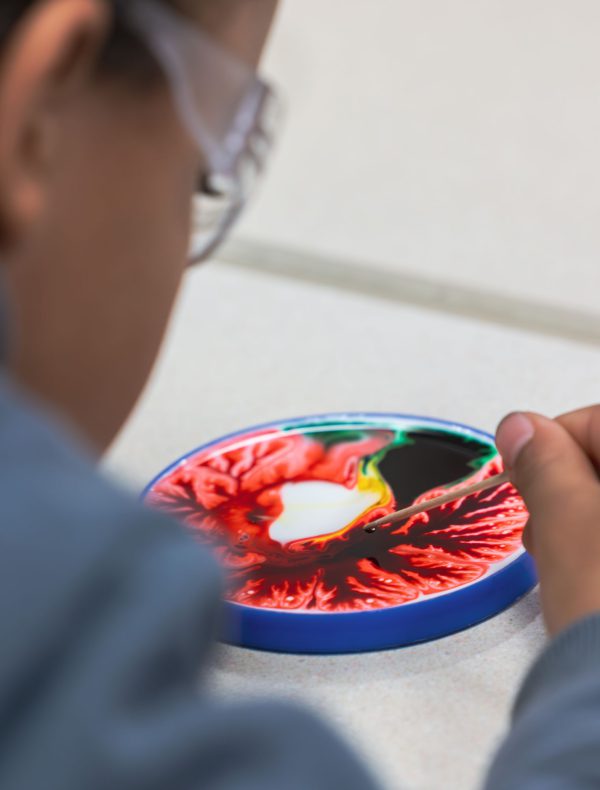
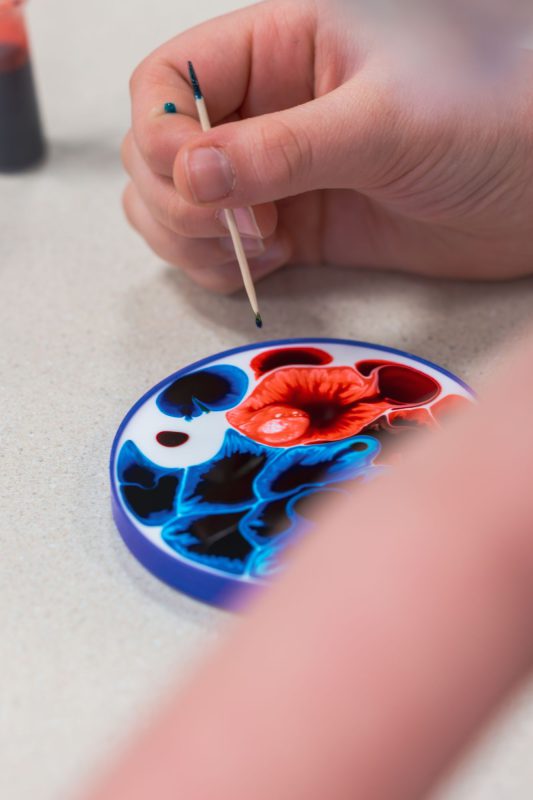
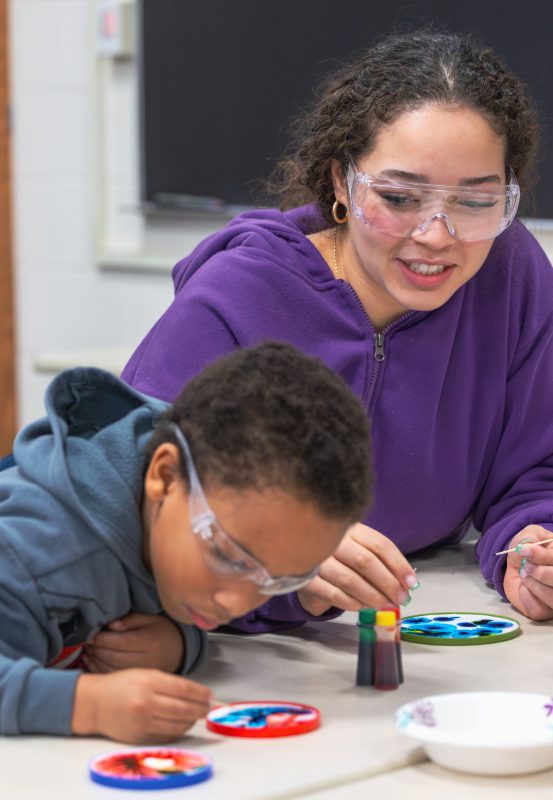
Sisters in Science experiment
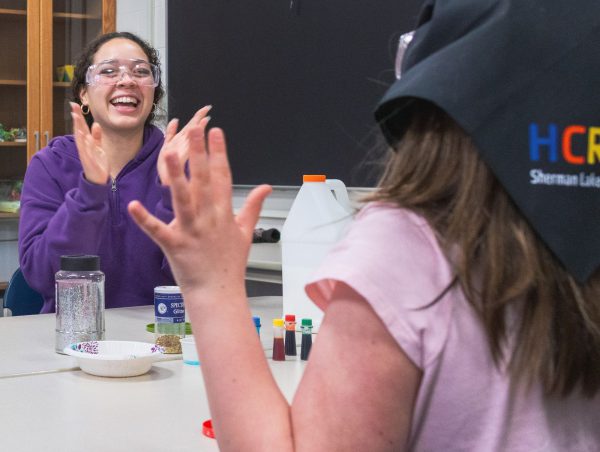
Pauline Hawkes ’26 leads Luella Tresca, Lu Moon and Adwin Williams in a science experiment.
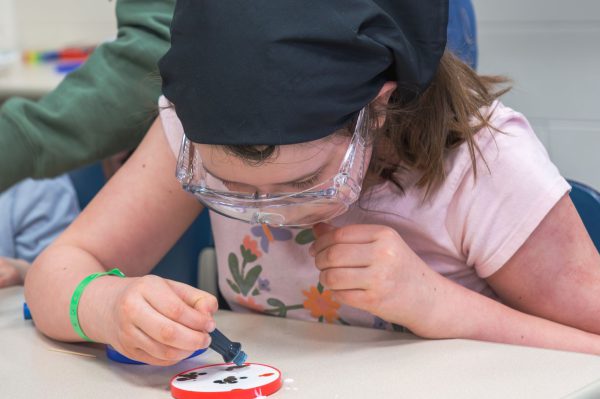
Sisters in Science experiment

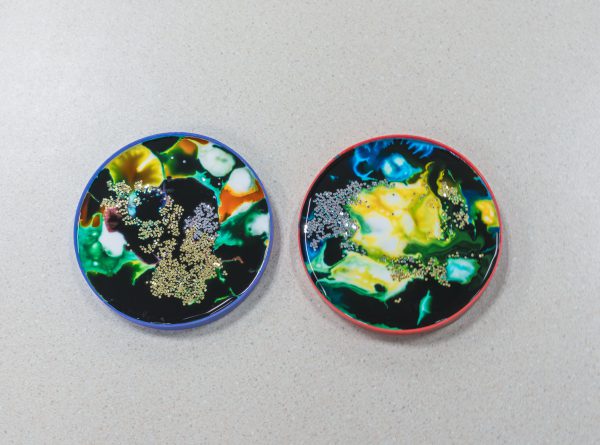
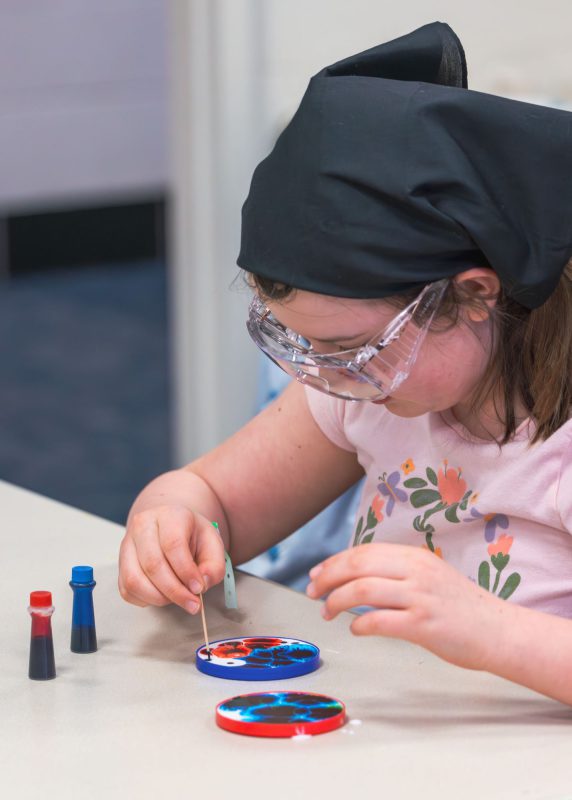
One recent afternoon at Northglade Montessori Magnet School in Kalamazoo, fourth and fifth graders gathered around a table for a simple science experiment involving water, soap and glitter. 

“Think about what happens when germs spread,” a college student presenting the experiment told them. 

Moments later, a finger dipped into the mixture, and the glitter scattered across the surface of the water. The room filled with laughter, surprise and a few delighted yells of “Whoa!” 

For the kids, it looked like magic. For the mentors leading the activity, it was something more powerful. It was a chance to spark curiosity about science through a lesson that showed just how quickly illnesses can jump from one person to another. 

The demonstration was one small moment in a program that has quietly shaped young learners in Kalamazoo for a quarter century. Sisters in Science—a student organization at Kalamazoo College—is celebrating its 25th anniversary of presenting hands-on STEM experiences to local kids. The group partners with Communities In Schools of Kalamazoo to visit youths at Northglade and Woodward Elementary, where K students run experiments and serve as mentors for children discovering science in new ways. 

A Founding Conversation 

Sisters in Science owes its existence to a chance conversation on a school sidewalk. Regina Stevens-Truss, the Dorothy H. Heyl Professor of Chemistry at K and the program’s faculty advisor since its founding, arrived at Northglade in 2001 to pick up her children. A sixth-grade teacher pulled her aside with a question that would stay with her. 

The teacher had noticed that her female sixth-grade students consistently outperformed the boys in math and science. But when she saw those same students again in ninth grade, something had changed. The girls who once loved science no longer seemed interested. She wanted to know why. 

Stevens-Truss couldn’t stop thinking about that conversation. Research backed what the teacher had observed: girls often lose interest in science and math during the transition from elementary school to junior high, as social pressures begin to reframe those subjects as less compatible with femininity. She brought the idea of a mentorship program to the chemistry department’s office coordinator, who suggested the name Sisters in Science, and then to Leslie Tung, who was serving as interim provost at the time. Tung pointed out that every department in the science division had at least one female faculty member, and he encouraged Stevens-Truss to build a program in which K students would mentor girls at Northglade. 

Sisters in Science launched as a one-on-one mentoring program, pairing individual K students with sixth-grade girls at the school in a big sister, little sister model. The pairs would meet weekly to talk about science, math and what it meant to be a young woman with those interests. As demand grew and the sixth grade was moved to the middle school, the model shifted from individual pairings to group sessions at Northglade, and now also at Woodward Elementary School. While the program originally focused on encouraging girls to pursue science, feedback from students led Northglade organizers to expand participation so boys could join as well. The college mentors remain the “sisters” leading the activities, but the sessions now welcome all students. The change reflects the program’s broader mission, which is to make science accessible to everyone. 

From Lunch Tables to Laboratories 

The program is simple but effective. Students bring their lunches into a classroom, where the college volunteers introduce a short experiment. Before long, the room becomes a laboratory filled with egg drops, slime, miniature rockets and glitter experiments. 

“They eat their lunch, and then they pretty much jump right into it,” said Emma Braford, a site coordinator at Northglade for Communities In Schools of Kalamazoo. “They’re always very hands-on. It’s all very fun and interactive things that get the kids really engaged with science and loving science in a way that’s not just textbooks.” 

The program typically serves about 30 elementary students across the partner schools, with three to five K students guiding activities each visit. Over the course of the school year, the mentors work with the same groups of children, building relationships along the way. That mentorship, Braford said, can be just as important as the science lessons themselves. 

“I think it’s cool for them to have that older peer mentor relationship,” she said. “The college students intentionally get to know four or five of the students really well over that time.” 

Opening Doors to Science 

Sisters in Science is led this year by Pauline Hawkes ’26 and Madison Vrba ’26. 

For Vrba, a biochemistry major, the organization represents a natural blend of two passions, science and mentorship. Before joining Sisters in Science, she worked as a pitching instructor for young softball players and discovered how empowering it could be for young girls to realize what they could do. 

“When girls feel confident exploring science and asking questions, it not only benefits them individually but also strengthens the entire scientific community,” Vrba said. 

Historically, STEM fields have been male dominated, she noted, which can make it harder for girls to picture themselves in those careers. Programs like Sisters in Science help change that narrative by introducing science early and making it approachable. 

Success, Vrba said, often comes in small moments. 

“If even one student walks away feeling more confident about science or more interested in learning how things work, I consider that a success,” she said. 

Inspired to Give Back 

For Hawkes, a biology major who hopes to pursue a career in physical therapy, the motivation to mentor younger students is personal. 

Growing up, she watched her mother navigate a series of back injuries and surgeries, which sparked her interest in the human body and how it works. She also had an influential role model close to home in her older sister, Isabelle Hawkes ’24, who was also involved in Sisters in Science. 

“I’ve always looked up to her,” Hawkes said. “She was able to answer questions and help me understand things when I was struggling. I want to be that resource for other people and open doors they might not know existed.” 

Each week during the academic term, Hawkes and other leaders visit partner schools for two days between classes. The goal isn’t simply to perform experiments, she said. “We’re just learning together,” Hawkes said. “It’s a safe, comfortable space where they’re not afraid to ask questions or try different things.” 

Learning Science Through Discovery 

But the lessons go beyond the experiments. Sometimes, students are surprised simply to learn that the College mentors are studying science themselves. 

“I’ve heard some of them say things like, ‘We didn’t know you could study this in college,’” Braford said. “It gives them a broader perspective of different career options that exist.” 

“It’s important for everyone to see what’s possible,” Hawkes said. “This is where you’re developing your interests.” 

That openness, along with the enthusiasm of both the college mentors and elementary students, helps explain the program’s longevity. 

One alumna whose connection to Sisters in Science continues to resonate is Caitlyn VanGelderen ’12. She was deeply devoted to the program during her time at K. Caitlyn loved combining her passion for chemistry with her commitment to mentoring younger students, and she found joy in helping elementary girls discover their own interest in science. Since her passing in 2020, her parents have honored that passion by making annual donations to support Sisters in Science in her memory, ensuring the work that meant so much to her continues to inspire new young scientists. 

“I think people want to be part of it,” Hawkes said. “There’s always going to be interest in teaching kids about science and letting them do experiments they might not otherwise have the opportunity to try.” 

A Spark for the Future 

As Sisters in Science marks its 25th anniversary, the leaders hope to celebrate the milestone with commemorative T-shirts for participants and increased visibility for the program. But the true impact is less tangible. It’s the moment when a student’s eyes widen during an experiment, the moment when a child asks a question no one expected, or the moment when a young student realizes science might be something they love. 

“Science can sometimes feel intimidating,” Vrba said. “But programs like this show students that it can also be creative, fun and something they’re a part of.” 

Stevens-Truss sees the secret to its longevity in the relationships it builds across multiple constituencies at once: the K students who join as first-year students and grow into leaders, the elementary students who see themselves reflected in the mentors above them, and the community partners who have been with the program since the beginning. 

Stevens-Truss said she does little to keep the program running year to year. Each spring, the current leaders identify their successors. Each fall, she reaches out to those students, and they take it from there. The group maintains its own website and keeps its supplies—reagents and materials for experiments—in a cabinet in the science building. 

“There’s never been a year since we started Sisters in Science that the program has not run,” she said. “I don’t hound them; they come to me.” 

And if the excitement in those classrooms is any indication, the next 25 years of Sisters in Science might inspire just as many future scientists as the first. 

Sisters in Science experiment
College student and child performing experiment
Sisters in Science experiment
Kids performing experiments

K Selects Four Faculty as Endowed Chairs

Kalamazoo College has appointed four faculty members as endowed chairs, recognizing their achievements as professors. Endowed chairs are positions funded through the annual earnings from an endowed gift or gifts to the College. The honor reflects the value donors attribute to the excellent teaching and mentorship that occurs at K and how much donors want to see that excellence continue. The honorees are as follows.

Sarah Lindley, Robert W. and JoAnn Stewart Chair

Lindley, a professor of art, previously received an endowed professorship when she was named the Arcus Social Justice Leadership Professor of Art in 2017.

Since 2001, Lindley has taught a range of ceramics and sculpture courses, and has managed and maintained K’s ceramics, sculpture and woodshop studios and equipment. Lindley served as an Arcus Center for Social Justice Leadership Faculty Fellow in 2010–11, and in that capacity helped found the Community Studio in downtown Kalamazoo’s Park Trades Center. She has had several solo, two-person and group exhibitions featuring her own work regionally, nationally and around the world.

Lindley earned her Bachelor of Fine Arts degree from the New York State College of Ceramics at Alfred University. She earned a Master of Fine Arts degree in ceramics from the University of Washington. 

Portrait of Sarah Lindley
Sarah Lindley

Morgan Loechli, Dow Trustee Chair

Loechli, an assistant professor of physics, arrived at K in 2023 from Washtenaw Community College, where she was a part-time physics instructor while earning her doctorate.

Since then, Loechli has led six students in summer research and taught courses including Introductory Physics I and II, Introduction to Relativity and Quantum Physics, and Introduction to Climate Science. She conducted climate science research while earning her Ph.D. in applied physics at the University of Michigan. Loechli also has a master’s degree in applied physics from the University of Michigan and a bachelor’s degree in physics and mathematics from Dickinson College.

Portrait of Morgan Loechli
Morgan Loechli

Carlos Vazquez Cruz, Lucinda Hinsdale Stone Junior Chair

Vazquez Cruz has been an assistant professor of Spanish at K since 2022. His teaching interests include Spanish creative writing, Latin American contemporary narratives, Latin American poetry and the visual arts and music in Spanish Caribbean literatures. He has also written one hybrid book of mixed genres, two collections of stories, two novels, three collections of poetry and one book of essays, along with research articles in peer-reviewed journals. Five of his books have been awarded by the Puerto Rico PEN, and he received the Banco Santander Spanish Creative Writing Fellowship (NYU, 2008-2010), the New Voices Award (Festival de la Palabra de Puerto Rico, 2014) and the Letras Boricuas Fellowship (Flamboyán Foundation and the Andrew W. Mellon Foundation, 2022).

Vazquez Cruz holds a Ph.D. in Latin American literature with a graduate certificate in digital humanities from the University of North Carolina at Chapel Hill, a Master of Fine Arts in Spanish creative writing from New York University and a bachelor’s in Spanish education from the University of Puerto Rico at Rio Piedras.

Portrait of Carlos Vazquez Cruz, endowed chairs
Carlos Vazquez Cruz

Lanny Potts, James Stone Senior Chair

Potts, a professor of theatre arts, arrived at K in 1987 as the technical director for K’s Festival Playhouse. In addition to teaching classes in areas such as scenic design, lighting design and stage management, Potts serves as artistic director of the Festival Playhouse Theatre.

The Arts Council of Greater Kalamazoo awarded Potts last fall with a Community Medal of Arts. He also has received six Michigan Wilde Awards for Best Lighting for his work at Farmers Alley Theatre. At K, he earned the 2024–25 Lucasse Fellowship for Excellence in Scholarship, honoring his contributions in creative work, research and publication.

Potts has a Master of Fine Arts degree from Michigan State University and a bachelor’s degree from Valparaiso University.

Portrait of Lanny Potts, endowed chairs
Lanny Potts

Lecture Spotlights Artificial Intelligence, Nobel Prize

A Kalamazoo College faculty member and expert in artificial neural networks, sometimes referred to as artificial intelligence, will discuss two of this year’s Nobel Prize in Physics recipients at 7:30 p.m. Wednesday in Olds-Upton Hall, room 207. 

Luce Professor of Complex Systems Studies Péter Érdi will talk about the work of John Hopfield and Geoffrey Hinton in an address titled “Nobel Prize for Physics in 2024: Interdisciplinary Science, Neurophysics and Learning Machines.” Hopfield created an associative memory that can store and reconstruct images and other types of patterns in data. Hinton invented a method that can autonomously find properties in data and perform tasks such as identifying specific elements in pictures. 

The lecture is free and open to the public. For more information, email Kristen.Eldred@kzoo.edu

Artificial intelligence lecture about Nobel Prize recipients
Luce Professor of Complex Systems Studies Péter Érdi

K’s Banner Year Elates Faculty, NSF Fellows

Kalamazoo College STEM-related academic departments are celebrating a banner year as the overall number of current students and alumni receiving National Science Foundation (NSF) graduate research fellowships reaches four, the most since 2016.

The Graduate Research Fellowship Program (GRFP) recognizes and supports outstanding students who pursue research-based master’s and doctoral degrees at accredited U.S. institutions. A five-year fellowship covers three years of financial support, including an annual stipend and a cost-of-education allowance to attend an institution along with access to professional-development opportunities.

About 2,000 applicants are offered a fellowship per NSF competition in fields such as chemistry, biology, psychology, physics and math. This is the first year since 2013 that two current K students, Claire Kvande ’23 and Mallory Dolorfino ’23, have earned awards. Two alumni also have earned fellowships, Cavan Bonner ’21 and Angel Banuelos ’21.

“The NSF Graduate Research Fellowship is a highly competitive program that is only awarded to about 16% of the applicants, who represented more than 15,000 undergraduates and graduate students across all STEM fields,” Roger F. and Harriet G. Varney Assistant Professor of Chemistry Blakely Tresca said. “Approximately 2,500 awards were offered this year across all STEM fields and the vast majority of them go to students at large research universities and Ivy League schools. It is rare to see more than one or two awards at an undergraduate-focused college, particularly at a small liberal arts school like K. It is exceptional for schools in the GLCA (Great Lakes Colleges Association) to have one award in a year, and four awards is a truly outstanding accomplishment for these students.”

Claire Kvande ’23

Kvande has been a double major in physics and chemistry with minors in math and French at K. She credits faculty members such as Dow Distinguished Professor of Natural Science Jan Tobochnik and Associate Professor of Physics David Wilson, along with a wide range of courses, for preparing her to receive an NSF fellowship.

“I like the nitty gritty of sitting down and figuring out how to approach a problem within physics even though it’s often hard,” she said. “I really like work that is grounded in real-world problems and it’s part of why I’m interested in the subfield of condensed matter. There’s a lot that stands to be applied to technologies that I think could improve our world and help a lot of people.”

Kvande will attend the University of Washington this fall, where she plans to extend her Senior Integrated Project (SIP) work, which examined how charge-density waves relate to superconductivity within condensed matter.

“Superconductivity is a tantalizing physics concept,” she said. “If we could realize superconductivity at room temperature, it would allow us to do a lot with energy saving and revolutionize how we use electricity. There are schools of thought that say charge-density waves would be helpful in achieving that and others that say it would be hurtful. Since we really don’t know how superconductivity works, this is worth investigating so we can hopefully better understand this powerful phenomenon.”

NSF fellow Claire Kvande presenting her SIP
Claire Kvande ’23 will attend graduate school at the University of Washington as a National Science Foundation fellow.

Mallory Dolorfino ’23

Dolorfino, a computer science and math double major, also will attend the University of Washington, where they will pursue a doctorate in math.

“I didn’t really like math until I came to K,” Dolorfino said. “I took calculus in high school and I was just not going to take any more in college until one of my senior friends told me when I was a first-year student to take linear algebra. I took that and Calculus 3 online during the first COVID term and I just kept doing math, so I switched my major. It’s not like other subjects because you can work for hours and not get anything done. That’s frustrating at times, but it’s fun to understand it enough to prove things logically.”

Dolorfino credits several faculty members for their growth and success at K, leading to their NSF opportunity. They include Tresca, who helped students keep track of their NSF application timelines and materials; Associate Professor of Mathematics Michele Intermont, who provided letters of recommendation and application assistance for research opportunities and graduate school; and Assistant Professor of Mathematics Stephen Oloo, who provided invaluable feedback regarding their research proposal and many conversations about math.

Dolorfino remains in contact with a professor they worked with in a math-focused study abroad program in Budapest. The two of them conducted a monthlong research project in algebraic number theory, which is a foundation in applications such as encryption and bar codes. Their NSF application proposes group theory work, which is what she based some research on last summer at Texas State University. They hope their NSF work will help them become a college professor one day. “There are a lot of math institutions on the West Coast and specifically in the Northwest, so I will have really good connections there,” said Dolorfino, who agreed the award is an honor. “I was grateful for the people at K who helped me apply.”
NSF fellow Mallory Dolorfino
Mallory Dolorfino ’23 will attend graduate school at the University of Washington as an NSF fellow.

Cavan Bonner ’21

Bonner has spent the past two years working as a research staff member in industrial and organizational psychology at Purdue University. His NSF fellowship will take him to another Big Ten school.

“My area of research involves personality development and how personality changes over the lifespan,” he said. “It’s a pretty small sub field and there are only a few doctoral programs where you can study the topic with an expert. The University of Illinois is one of them.”
Bonner further hopes the fellowship will propel his career toward a tenure-track job at a research university. He said K helped prepare him well for that trajectory through a broad range of subjects, not only in psychology, but in adjacent fields such as sociology and statistics. Bonner also credits his experience working as a research assistant for Ann V. and Donald R. Parfet Distinguished Professor of Psychology Gary Gregg, and Associate Professor of Psychology Brittany Liu for training him in skills that he frequently uses in his research work after graduation. 
“I was drawn to personality psychology because it provides an integrative framework to study many of the research questions I have about human development, aging and change over time,” Bonner said. “My SIP and research assistant experiences at K helped me realize that I could address these questions from a personality perspective, but my professors also exposed me to so many other fields and perspectives that inform my research. I primarily identify as a personality and developmental psychologist, but ultimately I hope that this fellowship helps me contribute to the broader science of aging and development.”

Portrait of Cavan Bonner
Cavan Bonner ’21 will attend the University of Illinois as an NSF fellow.

Angel Banuelos ’21

Banuelos, a biology major and anthropology/sociology minor at K, is in his second year at the University of Wisconsin, where he said he studies genetics—specifically the construction of the vertebrate brain and face—under an amazing mentor, Professor Yevgenya Grinblat.

“Live beings are built by cells that are informed by DNA,” Banuelos said. “At the beginning of embryonic development, the cells split into groups. One of those groups is called the neural crest cells. Those cells go on to contribute to a whole bunch of things such as pigment cells in the skin, and cartilage and bones in the face. My project is trying to understand how neural crest cells contribute to stabilizing the very first blood vessels of the developing eye.”

Ultimately, when his graduate work is finished, he would like to steer his career towards education.

NSF fellow Angel Banuelos in the lab
Angel Banuelos ’21, a newly-named NSF fellow, is in his second year of graduate school at the University of Wisconsin.

“I would like to bring research opportunities to people who don’t have higher education experience,” Banuelos said. “I would imagine starting with programs for middle schoolers, then high schoolers and adult learners. I want to be part of research addressing community problems and conducted by the people who live there.”

Banuelos credits inspiration for his career goals to the many mentors he had at K. Natalia Carvalho-Pinto, former director of the intercultural center, and Amy Newday, who provided guidance in food and farming justice, served as role models for applying theory to meet material needs.

“In my NSF application, I described meeting community needs as a central component of my scholarship,” he said. “Natalia and Amy are people who literally fed me while I was at K. They saw the student and the human. They handed me books, handed me plates, even welcomed my family. During a very difficult transition to grad school, they were there for me. When I’m a professor, I want to be like them. I’m grateful for the growth opportunities I had at K through the Intercultural Center and food and farming.”

‘It doesn’t happen every year’

Faculty members as a whole across STEM departments are taking great pride in these K representatives earning fellowships as it speaks to the quality of students at the College and their studies, especially as the number of recipients stands out.

“At K, it is exciting when even a single student wins a fellowship, and it certainly doesn’t happen every year,” Professor of Physics Tom Askew said. “It’s special to have four in one year.”

Fellowship, SIP Prompt K Student to Stop and Smell the Wildflowers

Eli Edlefson identifies wildflowers such as daisy fleabane
Eli Edlefson ’23 identifies daisy fleabane at the Lillian Anderson Arboretum, where he is surveying plants and pollinators for an Environmental Stewardship fellowship and his Senior Integrated Project. Although most flowers have seven petals at most, daisy fleabane can have between 30 and 100 petals per flower.
Eli Edlefson identifies wild indigo among the wildflowers at Lillian Anderson Arboretum
Environmental Stewardship Fellow Eli Edlefson ’23 identifies wild indigo, a native plant that is flourishing in one area of the pollinator rehabilitation project at the Lillian Anderson Arboretum. The wild indigo has distinctive flowers and heart-shaped pods. Edlefson is surveying plants and pollinators along the Powerline Trail for his fellowship and his Senior Integrated Project.
Portrait of Eli Edlefson
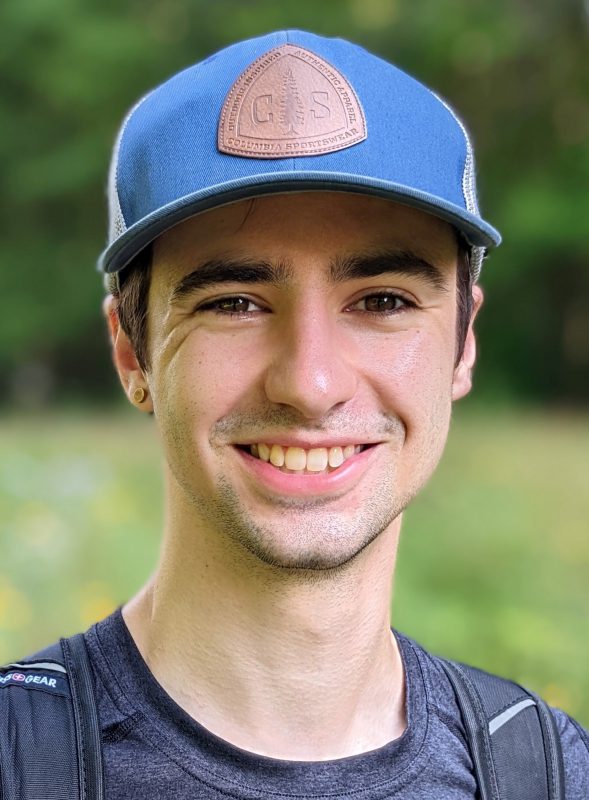
Biology and physics dual major Eli Edlefson ’23 is surveying plants and pollinators along the Powerline Trail in the Lillian Anderson Arboretum for his summer Environmental Stewardship fellowship and his Senior Integrated Project.

Eli Edlefson ’23 would like to apologize to his elementary school science teachers for doubting them. 

“In elementary school, teachers would say, ‘Science always starts with observation,’” Edlefson said. “Then you form a question. I was like, ‘I don’t really know how true that is. You’re just walking around and notice something?’ Then I got out here, and that is absolutely all I’m doing is walking around and noticing, ‘Oh, that’s weird.’ ‘Why is that there?’ ‘This plant has only interacted with this insect species; I wonder why.’ So I would like to apologize to all my teachers.” 

“Here” is the Lillian Anderson Arboretum, and while it’s not entirely accurate to say that all Edlefson does there is walk around and notice things, it is a crucial piece of his Kalamazoo College summer fellowship and Senior Integrated Project. 

Edlefson is continuing a native wildflower rehabilitation project begun by Professor of Biology Ann Fraser in 2019, which aimed to promote insect pollinator populations by planting a diverse mix of native plants. In 2019, Amy Cazier ’20 completed her SIP by conducting a plant survey and observing and recording plant and pollinator interactions.

Wildflowers Project One of Several Fellowships

Several Kalamazoo College students are completing summer 2022 Environmental Stewardship fellowships through the Larry J. Bell ’80 Center for Environmental Stewardship and we are featuring some of their projects at kzoo.edu. Read on to learn about one of the environmental fellowships making a difference in the local community.

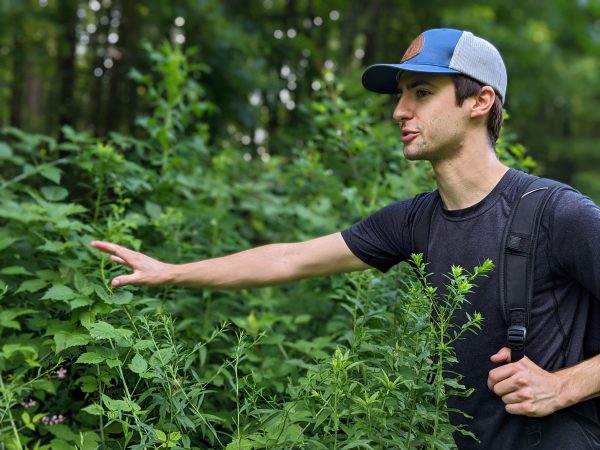
Eli Edlefson ’23 explains how blue vervain blooms
Environmental Stewardship fellow Eli Edlefson ’23 explains how blue vervain blooms over time from the bottom of the spike to the top. Edlefson is surveying plants and pollinators along the Powerline Trail in the Lillian Anderson Arboretum as part of a pollinator rehabilitation project.
For a summer Environmental Stewardship fellowship and Senior Integrated Project, Eli Edlefson ’23 is surveying plants and pollinators along the Powerline Trail in Lillian Anderson Arboretum. With almost no botany experience, Edlefson had to learn to identify all the flowering plants in the area with the help of a wildflower guide, Professor of Biology Ann Fraser and local botanist Russ Schipper.
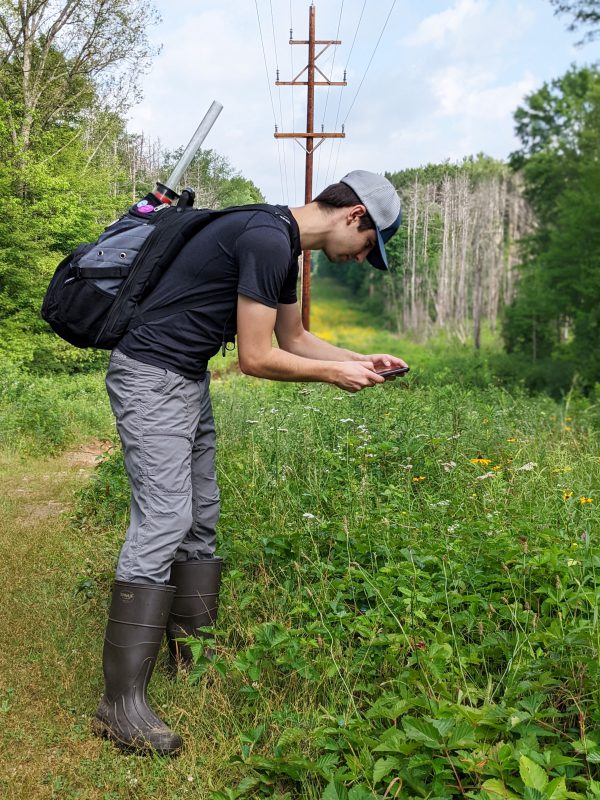
Eli Edlefson uses his phone to identify wildflowers
Eli Edlefson’23 uses the Seek app from iNaturalist to identify a plant in the Lillian Anderson Arboretum. Both the Seek and iNaturalist apps have proven valuable tools in Edlefson’s Environmental Stewardship fellowship and Senior Integrated Project this summer, surveying plants and pollinators along the Powerline Trail in the Lillian Anderson Arboretum.

Now, Edlefson is following in Cazier’s footsteps, while occasionally forging his own path, as he surveys the plants and pollinators to assess how successful the biodiversity efforts have been. By summer’s end, he intends to have a comprehensive survey of which plants are growing along the Powerline Trail, where they grow, and which pollinators interact with which plants, along with a comprehensive recommendation for what work is needed to improve the biodiversity of the area. 

“I’m comparing what Amy saw to what I see,” Edlefson said. “What’s taking hold? What did we put in the seed mix that I haven’t seen anywhere? Or, is this still a problem plant, like the invasive spotted knapweed?” 

Edlefson has also made it his goal to collect a sample of every plant specimen he finds and create a wildflower guidebook. 

“I’d like to have some details on the family and species, and some fun facts about it so you can actually connect to the life around you,” Edlefson said. “It’s so easy to walk by, like, ‘Oh, a flower,’ and keep going. I was guilty of that before. Now I know that this is a Deptford Pink, and if I tried really hard, I might be able to pull up a Latin name. When you know more, you appreciate being outside more.” 

Learning an interesting fact about a plant makes learning botany more engaging for Edlefson. For example, Native Americans made tea using a small, hanging orange flower called spotted touch-me-not or common jewelweed, which they used as a cure for laziness. 

A biology and physics double major who takes pride in having enjoyed “a charcuterie board” of classes in 11 different departments at K, Edlefson originally sought a research experience involving coastal or marine biology for his SIP. After meeting with Fraser, his class’s SIP coordinator, she connected him with the native wildflower rehabilitation project. 

While Edlefson has loved bugs his whole life, he had no formal entomology training and very little botany knowledge when he began the project. 

“In high school, I was in Science Olympiad, and every time the entomology event was open, I would hop on that,” Edlefson said. “It’s been nice getting a more formal identification process, having Dr. Fraser, who’s like our resident entomologist, and having it be my job to go and collect bugs. I’ve learned a lot already. I never knew how to distinguish wasps and bees besides just eyeballing it; now I know the bees have hairs that are feathered so they collect more pollen, so when you look at them under the microscope, it’s very obvious which one is which.” 

Similarly, when he began the project, “I would never have been excited about a plant,” Edlefson said. “If you had said, ‘What’s that flower?’ I would have been like, ‘Yellow.’” 

Edlefson has learned a lot about the plants along the Powerline Trail with the help of Fraser and local botanist Russ Schipper. About every other day, Edlefson drives out to the Arboretum on West Main Street and spends the morning surveying his area, which is about 750 meters long and encompasses all the meadow space on either side of the powerline. Initially, his surveys covered little ground, as he had to look up every plant. 

“My first day, Dr. Fraser was out here trying to teach me how to use my handy dandy wildflower guide,” Edlefson said. “Of course, she knew everything that was out here, and she was just patiently waiting for me to flip through all the pages and try to figure out what I was doing.” 

Now, he can cover his whole territory in a morning. Some days, Edlefson takes notes on what plants are blooming where and collects specimens to press. Other days, he conducts pollinator surveys, either walking 15-minute transects, recording what he sees and occasionally using a vacuum tube to collect specimens, or with a focal survey, sitting in one place and observing a specific plant for 15 minutes to watch for pollinators interacting with the plant. 

Sometimes Edlefson uses a camera from the lab to take clear photos of plants for identification. He also uses the iNaturalist app, and the related Seek app, to identify species, learn more and contribute useful data.  

Before the project ends, he hopes to conduct night surveys to see if the pollinator landscape is different at dusk. 

In the afternoons, Edlefson processes and examines his specimens and organizes his data in the lab. 

“The end goal is my candid suggestion about what looks good and what could be improved,” Edlefson said. “The goal of my project is to see if we’re bringing more pollinators in and supporting more of them; I’m looking for better quality and quantity.” 

Throughout the course of the summer, Edlefson has learned that he also has a series of deadlines to contend with as various flowers bloom and die. 

“If I want to look at a plant, I need to do that before the flowers go away,” Edlefson said. “Sometimes I realize a flower might not still be there next week, so I need to get out there and get a sample before then. It’s not something that I was expecting, to get an idea of what the bloom periods are, when plants are coming and going, and what I should be expecting to see. I’m learning more than I thought I would. 

“I’m very much enjoying my time out here. It is a million times better than sitting in an office or just the lab all day. I’m very lucky. It’s a great job.” 

To learn more about the project’s history and how you can help, visit the Pollinator Habitat Enhancement Project

Three Faculty Members Earn Tenure at K

Three Kalamazoo College faculty members from the history, sociology and physics departments have been awarded tenure.

The tenure milestone recognizes excellence in teaching, scholarship and service to the College, and signifies its confidence in the contributions these professors will make throughout their careers.

The following faculty members were approved this spring by the Board of Trustees for tenure and promotion to associate professor:

Christina Carroll Earns Tenure
Assistant Professor of History Christina Carroll has
earned tenure and will be promoted to associate professor.

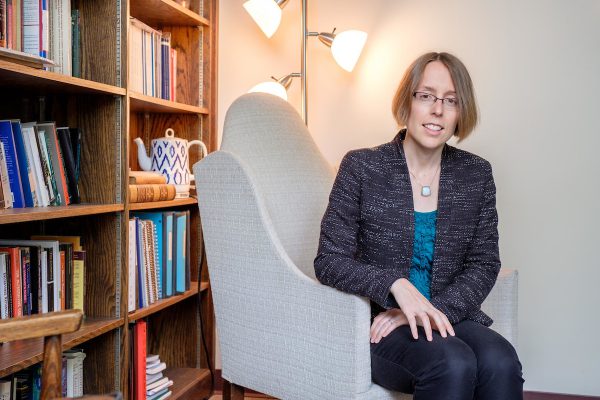
Assistant Professor of History Christina Carroll

Carroll is a historian of modern France with research and teaching interests in empire, memory and nationalism; she teaches a variety of classes at K on modern Europe and its empires, along with a class on the modern Middle East.

In her new book, The Politics of Imperial Memory in France, 1850–1900, Carroll examines how the memory of European imperial conquest under Emperor Napoleon Bonaparte shaped French debates over colonial expansion during the second half of the 19th century, and explains how and why French Republicans embraced colonial conquest as a central part of their political platform. She is now beginning a second book project, which focuses on historical figures who were transported from one colony to another, or from the French metropole to a colony, for political crimes.

Carroll holds a master’s degree and a Ph.D. in history from the University of North Carolina and a bachelor’s degree in history and English from Vassar College. She was a visiting assistant professor of history at Colgate University before arriving at K in 2016. She also served a three-year appointment at K from 2018–2021 as the Marlene Crandell Francis Assistant Professor of History.

Francisco Villegas Earns Tenure
Arcus Social Justice Leadership Assistant Professor of
Sociology Francisco Villegas has earned tenure and will
be promoted to associate professor.

Arcus Social Justice Leadership Assistant Professor of Sociology Francisco Villegas

Villegas specializes in the topics of immigration, citizenship, social movements, deportability and illegalization, and teaches courses in these areas along with qualitative research methods.

In the community, Villegas serves as advisory board chair with the Kalamazoo County community ID program, which began in 2018. The program allows residents to obtain an ID issued by local government regardless of their ability to obtain a state ID. He is also one of three K faculty members—joining Associate Professor of English Shanna Salinas and Professor of English Bruce Mills—behind a major grant from the Andrew W. Mellon Foundation. The grant provides new learning opportunities for K students and faculty seeking solutions to societal problems and promotes the critical role of the humanities in understanding and responding to social problems. The $1.297 million three-year grant funds the College’s Humanities Integrated Locational Learning (HILL) project, which is building student coursework rooted in K’s commitment to experiential learning and social justice to address issues such as racism, border policing, economic inequities, homelessness and global warming, while examining history, how humans share land, and the dislocations that bring people to a communal space.

Before joining K, Villegas was a sociology lecturer at the University of Toronto Scarborough from 2014– 2016. He has a doctorate in sociology in education from the Ontario Institute for Studies in Education at the University of Toronto, a master’s degree in Mexican American studies from San Jose University, and a bachelor’s degree in psychology and social behavior from the University of California Irvine.

David Wilson for tenure
Herbert H. and Grace A. Dow Assistant Professor of
Physics David Wilson has earned tenure and will
be promoted to associate professor.

Herbert H. and Grace A. Dow Assistant Professor of Physics David Wilson

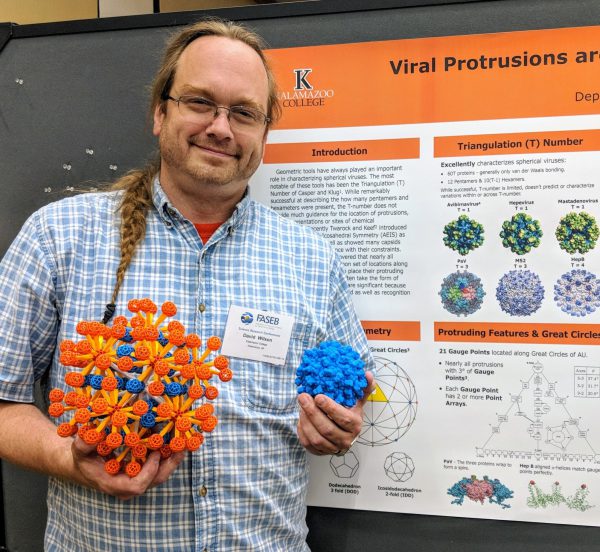
As a biophysicist who studies virology, Wilson first arrived at K as a visiting assistant professor in 2014. During his time at K, he discovered that all spherical viruses place their protruding spike proteins in a common set of locations. That work later continued in three publications, including one with Danielle Roof ’22, titled Viral Phrenology.

Wilson was a visiting assistant professor at Albion College in 2015–2016 and Grand Valley State University in 2016–2017 before he returned to K in the same role in 2017. He became an assistant professor of physics at K in 2018. He has taught courses including quantum mechanics, applications of physics in the biosciences and introductory physics, and often generates 3D printing in his research.

Wilson has been invited to share his work at Calvin University, Northwestern University, Denison University and soon at the Federation of American Societies of Experimental Biology (FASEB) Virus Structure and Assembly Conference in Southbridge, Massachusetts. He holds a Ph.D. in physics from the University of Michigan, where he also was a postdoctoral research scientist in chemistry from 2010­ –2013. He spent two years at the University of Washington doing master’s work before transferring to the University of Michigan. He earned his bachelor’s degree in physics and mathematics from Michigan Technological University.

To date, Wilson has worked closely on research projects with more than 34 students at K from biology, chemistry, physics, computer science and mathematics.

SIP of Water Grows Crops in Tanzania

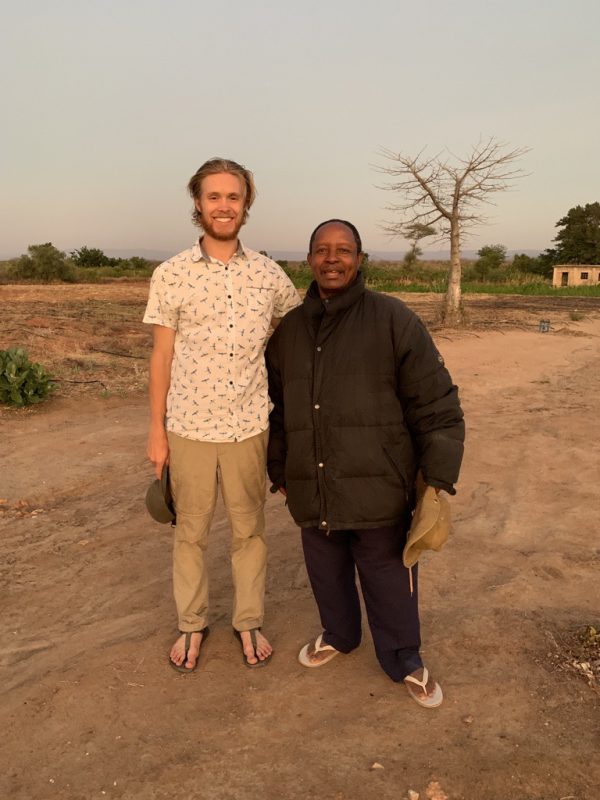
Sam Meyer and Father Evarist Thadei Mngulu in Tanzania for water irrigation project
Sam Meyer ’21 visited Tanzania last summer to help
Father Evarist Thadei Mngulu and his mission
build a sustainable irrigation system.

When you need inspiration for celebrating Earth Day, a Kalamazoo College student will often provide it. Take Sam Meyer ’21, a physics major. His Senior Integrated Project (SIP) applied gravity and physics theories not only to designing, but building—through in-person, international volunteerism—a sustainable irrigation system in Pawaga, Tanzania, that conserves the region’s scarce water resources.

Both on location and off, Meyer surveyed Tanzania’s Consolata Missionaries site, researched and studied fluid mechanics, aided the system’s design and installation, and secured project funding through K’s Collins Fellowship—which helps fund student projects abroad—and through donors from GoFundMe.

The project was still ongoing as Meyer returned home from Tanzania last summer after spending about seven weeks there. In that time, he said, Pawaga didn’t receive even a drop of rain. However, the system he created now sustainably irrigates about 3 acres of soil and has yielded a successful season of crops. In fact, his work might hold solutions for areas around the world that have trouble with implementing their own agriculture. Meyer’s system fills elevated reservoir tanks during the day through solar power, thereby powering an electric water pump, and uses gravity to irrigate the fields in the evening when the sun is low and the land is cooler, mitigating evaporation.

“Not only has the system limited the labor involved in the agriculture, it’s maximized itself to a point that the mission can grow crops regularly and have excess crops to share with a nearby elementary and primary school,” Meyer said. “Those students come to the compound every day, so the system promotes their education and combats malnourishment, which I think is just amazing.”

Tanzania is one of several African countries that lies along the East African Rift Valley (EARV), which features an arid and rocky ecosystem, causing frequent droughts, despite water’s general availability through lakes and rivers. Tanzania is one of the most developed countries in East Africa, but outside of its capital and urban centers, the villages and vast wilderness leave some populations isolated outside of schools and religious groups that offer some support. Scarcity causes national authorities to impose taxes to control water with some irrigation practices limited to restrictive or wasteful practices such as flooding fields or bucketing water by hand.

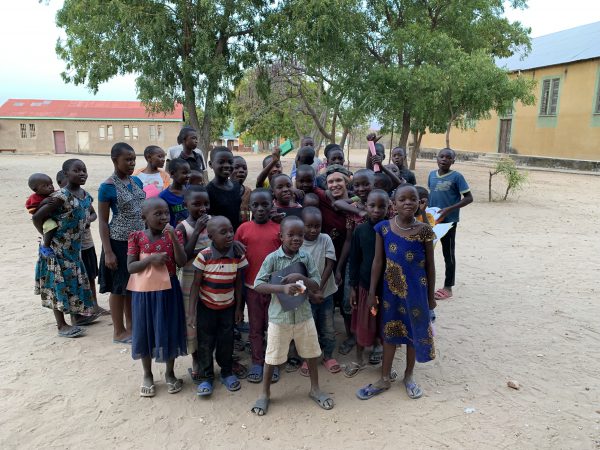
Sam Meyer with Children Who Benefit from Water Irrigation Project
Children from a nearby elementary and primary school are among the people who benefit from an
irrigation system Sam Meyer ’21 installed last summer in Pawaga, Tanzania.

Challenges from climate change to wildlife necessitate improving the nation’s sustainable approaches to agriculture. Volunteer organizations such as the World Wide Opportunities on Organic Farms (WWOOF) nurture agricultural practices to tackle these challenges in Tanzania. The organization’s worldwide movement links visitors, also known as WWOOFers, with organic farmers, promoting a cultural and educational exchange, and building a global community conscious of ecological farming and sustainability practices.

WWOOF has one chapter assisting Father Evarist Thadei Mngulu, whose Tanzania mission had failed in previous attempts to integrate an irrigation system and couldn’t afford an engineer’s estimate of $16,000 to install one. That lead Father Evarist to seek help from WWOOF, and WWOOF to finding Meyer while he was searching for SIP ideas.

Between the Collins Fellowship and GoFundMe, Meyer raised about $3,200, which funded his entire project. Even with a language barrier and Father Evarist being the only fluent English speaker among the Tanzanians who generally speak Swahili, the project was successful.

“Father Evarist wants to use the system as a way of educating other farmers in the area in irrigation practices because their practices now are to flood a field, which can produce a lot of runoff and waste, or bucketing water there,” Meyer said. “Through the system, he helps to strengthen the community through this new technology, which is a new aspect of the mission. That makes me very happy.”

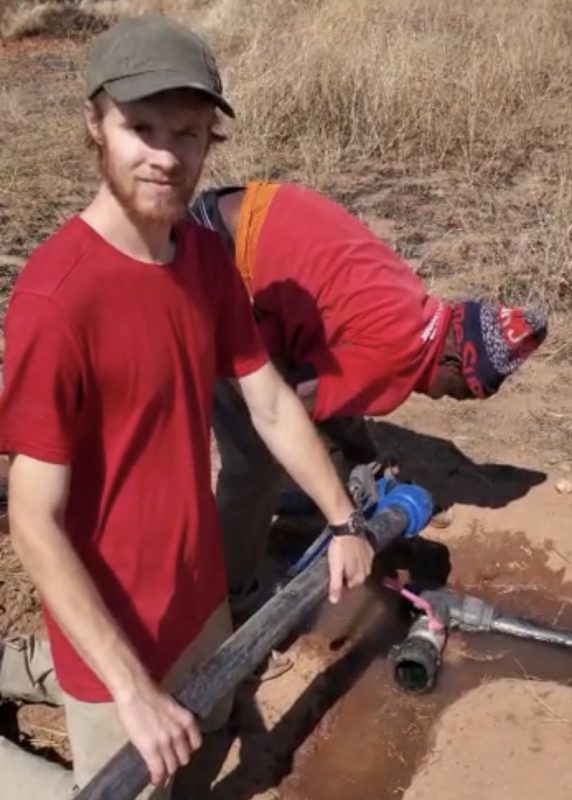
Sam Meyer with assistant and water pipes
Sam Meyer ’21 helped install the irrigation system
he designed for a mission in Tanzania.

As Meyer reflects on the irrigation system’s implementation, he has an offer on the table from an engineering firm in Austin, Texas. Mears Group Inc.—an infrastructure-solutions provider that offers engineering, construction and maintenance services to the oil and natural gas, electric transmission and distribution, telecommunications and wastewater industries—took notice of Meyer’s SIP, the work he performed in Tanzania and his interest in environmental engineering. Now, Meyer will begin life after K in a role that promises more opportunities to improve communities, while he continues to eye the progress he began in Tanzania.

“I promoted this project during my application process, and I believe it was a big part of me gaining the position,” Meyer said. “I mentioned the sustainability aspect of it and my potential interest in being an environmental engineer, and they were excited to hear about it. I think it was a huge piece in me getting that position.”

Beyond the practical and professional experience gained through the project, Meyer appreciates the relationships formed along the way. “The people of Tanzania are so welcoming and friendly that I had a great time. I still have some connections with friends I made there, including Father Evarist, and I’m still working on aiding him with anything else that comes up.”

Donations Accepted

Sam Meyer ’21 is continuing to collect donations through GoFundMe that will go toward supporting agricultural efforts including growing crops and teaching other communities about building their own sustainable irrigation systems. Visit his fundraiser to donate.

K Professor’s Book Earns High Rankings Abroad

K President Jorge G. Gonzalez applauds Professor Peter Erdi at Rankings Presentation
Kalamazoo College President Jorge G. Gonzalez applauded Henry R. Luce Professor of Complex Systems Studies Peter Erdi when Erdi presented his Lucasse Lecture in 2019, while giving a preview of his book, Ranking: The Hidden Rules of the Social Game We All Play.

If we compiled a list that ranks the coolest things Kalamazoo College faculty members have achieved as authors, Péter Érdi’s latest accomplishment would be on it.

Érdi, the Henry R. Luce Professor of Complex Systems Studies, wrote the 2019 book Ranking: The Hidden Rules of the Social Game We All Play. The book examines how and why humans rank certain aspects of our lives and how those rankings are viewed.

“We like to see who is stronger, richer, better and more clever,” Érdi said. “Since we humans love lists, are competitive and are jealous of other people, we like ranking. The book applies scientific theories to everyday experience by raising and answering such questions as ‘Are college ranking lists objective?’ ‘How do we rank and rate countries based on their fragility, level of corruption or even happiness?’ ‘How do we find the most relevant web pages?’ and ‘How are employees ranked?’”

The book has already been published in German and Chinese, both with simple and complex characters. Korean and Hungarian translations are in the pipeline. In Japan, however, Érdi’s book is creating the most buzz. Japanese officials have requested additional printings of the book and are negotiating the rights for an e-book.

Adding to that success is that Toyo Keizai, which is a weekly magazine about the Asian economy, and three large daily Japanese newspapers — Asahi, Nikkei and Youmiuri — have published reviews. Kalamazoo College Associate Professor of Japanese Noriko Sugimori notes that newspapers in Japan are extremely important to their society and it’s rare for all three papers to review the same book at the same time.

Youmiuri has a circulation just under 8 million, the largest in the world.

“Nowadays, accountability and transparency are emphasized, and society and companies tilt towards measurement and evaluation based on quantified index, including the use of ranking and pursuit of objectivity,” the Youmiuri review says, according to Sugimori’s translation. “This book touches on challenges of being objective consistently, but it does not deny the effectiveness of quantified index. The author advocates the rule of ‘trust, but carefully,’ and this is exactly the behavior pattern that is required in digital society.”

“Although it may contain something stupid, rankings are convenient in their own ways,” the Asahi review says. “Probably, we will cope with numerical estimations even more. Therefore, the author recommends that one should change the attitude of ‘not caring about evaluations.’ Whether you like it or not, evaluations are something one needs to self-manage. This book delineates such times and people who sustain the times.”

The Nikkei review states: “True rankings need to satisfy the following three requirements: Completeness, asymmetry and transitivity. Aside from a case such as the largest lake in the world, many actual rankings do not satisfy these requirements. Subjective standards intervene. There is a room to manipulate something to get the higher rankings. It is discernment that matters in handling with abundant rankings around them. Therefore, this book focuses on the rules of social games that are called rankings. This book showcases not only theories that are based on the rankings mentioned above, but also findings and discussions from human behaviors, cognition, social psychology, politics and computational neuroscience.”

Érdi has been a prolific researcher with more than 40 publications and two books published since joining Kalamazoo College. In that time, he has given more than 60 invited lectures across the world, and he received the 2018 Florence J. Lucasse Fellowship for Excellence in Scholarship, honoring his contributions in creative work, research and publication. He also has been the editor-in-chief of Cognitive Systems Research and served as a vice president of the International Neural Network Society.

“You can like it or not, but ranking is with us,” he said. “It is not a magic bullet that produces order out of chaos, but it is not the product of some random procedure. We are navigating between objectivity and subjectivity. It’s our very human nature to compare ourselves to others. The question is how to cope with the results of these comparisons. The reader will enjoy the intellectual adventure to understand our difficulties to navigate between objective and subjective and gets help to identify and modify her place in real and virtual communities by combining human and computational intelligence.”

Ranking: The Hidden Rules of the Social Game We All Play is available online through Oxford University Press.