Fellowship, SIP Prompt K Student to Stop and Smell the Wildflowers

Eli Edlefson identifies wildflowers such as daisy fleabane
Eli Edlefson ’23 identifies daisy fleabane at the Lillian Anderson Arboretum, where he is surveying plants and pollinators for an Environmental Stewardship fellowship and his Senior Integrated Project. Although most flowers have seven petals at most, daisy fleabane can have between 30 and 100 petals per flower.
Eli Edlefson identifies wild indigo among the wildflowers at Lillian Anderson Arboretum
Environmental Stewardship Fellow Eli Edlefson ’23 identifies wild indigo, a native plant that is flourishing in one area of the pollinator rehabilitation project at the Lillian Anderson Arboretum. The wild indigo has distinctive flowers and heart-shaped pods. Edlefson is surveying plants and pollinators along the Powerline Trail for his fellowship and his Senior Integrated Project.
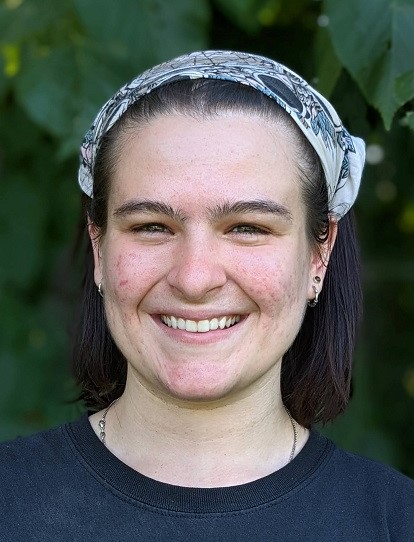
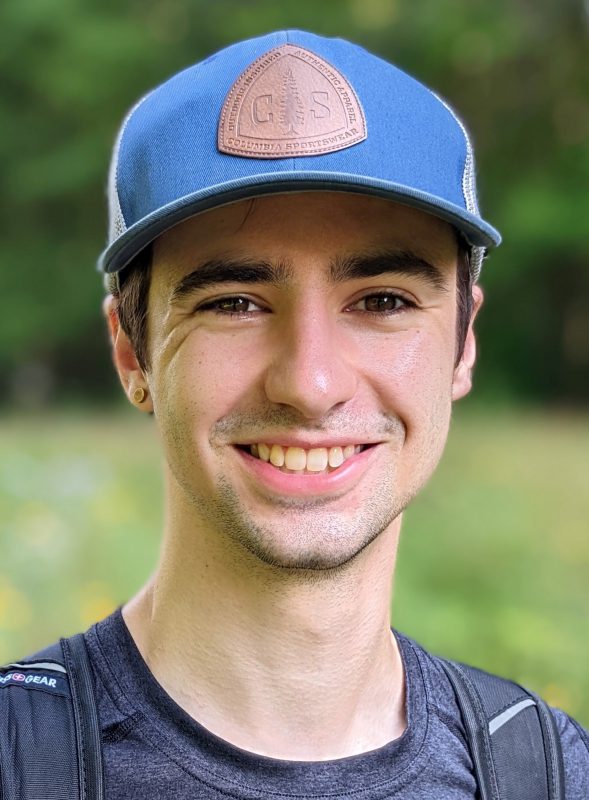
Portrait of Eli Edlefson
Biology and physics dual major Eli Edlefson ’23 is surveying plants and pollinators along the Powerline Trail in the Lillian Anderson Arboretum for his summer Environmental Stewardship fellowship and his Senior Integrated Project.

Eli Edlefson ’23 would like to apologize to his elementary school science teachers for doubting them. 

“In elementary school, teachers would say, ‘Science always starts with observation,’” Edlefson said. “Then you form a question. I was like, ‘I don’t really know how true that is. You’re just walking around and notice something?’ Then I got out here, and that is absolutely all I’m doing is walking around and noticing, ‘Oh, that’s weird.’ ‘Why is that there?’ ‘This plant has only interacted with this insect species; I wonder why.’ So I would like to apologize to all my teachers.” 

“Here” is the Lillian Anderson Arboretum, and while it’s not entirely accurate to say that all Edlefson does there is walk around and notice things, it is a crucial piece of his Kalamazoo College summer fellowship and Senior Integrated Project. 

Edlefson is continuing a native wildflower rehabilitation project begun by Professor of Biology Ann Fraser in 2019, which aimed to promote insect pollinator populations by planting a diverse mix of native plants. In 2019, Amy Cazier ’20 completed her SIP by conducting a plant survey and observing and recording plant and pollinator interactions.

Wildflowers Project One of Several Fellowships

Several Kalamazoo College students are completing summer 2022 Environmental Stewardship fellowships through the Larry J. Bell ’80 Center for Environmental Stewardship and we are featuring some of their projects at kzoo.edu. Read on to learn about one of the environmental fellowships making a difference in the local community.

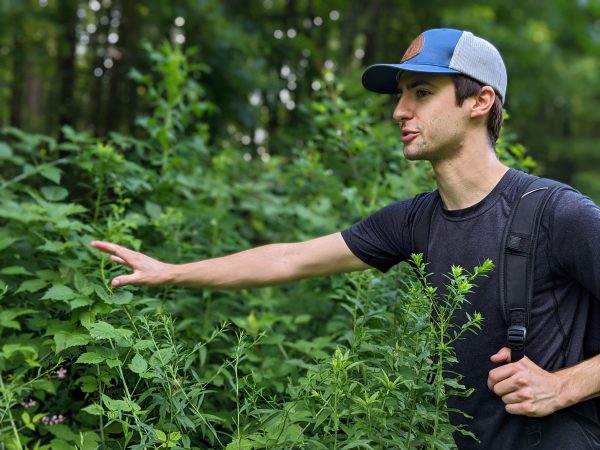
Eli Edlefson ’23 explains how blue vervain blooms
Environmental Stewardship fellow Eli Edlefson ’23 explains how blue vervain blooms over time from the bottom of the spike to the top. Edlefson is surveying plants and pollinators along the Powerline Trail in the Lillian Anderson Arboretum as part of a pollinator rehabilitation project.
For a summer Environmental Stewardship fellowship and Senior Integrated Project, Eli Edlefson ’23 is surveying plants and pollinators along the Powerline Trail in Lillian Anderson Arboretum. With almost no botany experience, Edlefson had to learn to identify all the flowering plants in the area with the help of a wildflower guide, Professor of Biology Ann Fraser and local botanist Russ Schipper.
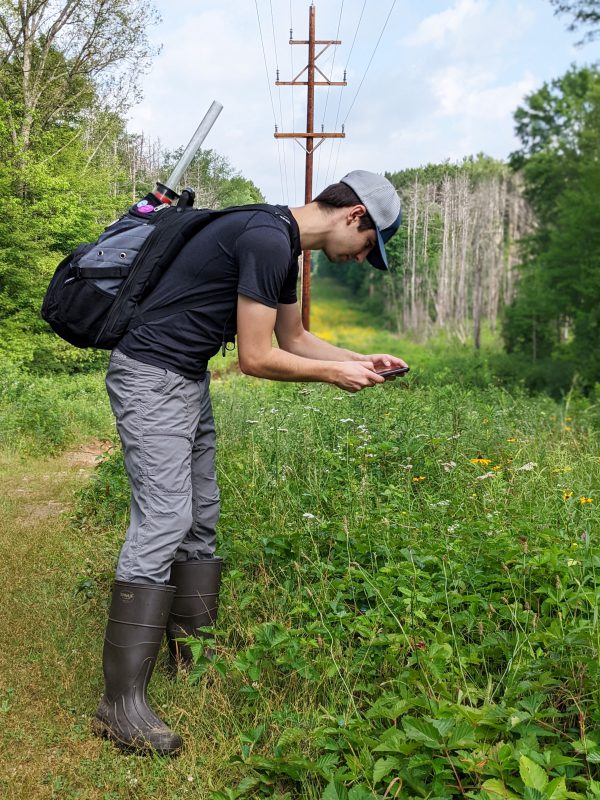
Eli Edlefson uses his phone to identify wildflowers
Eli Edlefson’23 uses the Seek app from iNaturalist to identify a plant in the Lillian Anderson Arboretum. Both the Seek and iNaturalist apps have proven valuable tools in Edlefson’s Environmental Stewardship fellowship and Senior Integrated Project this summer, surveying plants and pollinators along the Powerline Trail in the Lillian Anderson Arboretum.

Now, Edlefson is following in Cazier’s footsteps, while occasionally forging his own path, as he surveys the plants and pollinators to assess how successful the biodiversity efforts have been. By summer’s end, he intends to have a comprehensive survey of which plants are growing along the Powerline Trail, where they grow, and which pollinators interact with which plants, along with a comprehensive recommendation for what work is needed to improve the biodiversity of the area. 

“I’m comparing what Amy saw to what I see,” Edlefson said. “What’s taking hold? What did we put in the seed mix that I haven’t seen anywhere? Or, is this still a problem plant, like the invasive spotted knapweed?” 

Edlefson has also made it his goal to collect a sample of every plant specimen he finds and create a wildflower guidebook. 

“I’d like to have some details on the family and species, and some fun facts about it so you can actually connect to the life around you,” Edlefson said. “It’s so easy to walk by, like, ‘Oh, a flower,’ and keep going. I was guilty of that before. Now I know that this is a Deptford Pink, and if I tried really hard, I might be able to pull up a Latin name. When you know more, you appreciate being outside more.” 

Learning an interesting fact about a plant makes learning botany more engaging for Edlefson. For example, Native Americans made tea using a small, hanging orange flower called spotted touch-me-not or common jewelweed, which they used as a cure for laziness. 

A biology and physics double major who takes pride in having enjoyed “a charcuterie board” of classes in 11 different departments at K, Edlefson originally sought a research experience involving coastal or marine biology for his SIP. After meeting with Fraser, his class’s SIP coordinator, she connected him with the native wildflower rehabilitation project. 

While Edlefson has loved bugs his whole life, he had no formal entomology training and very little botany knowledge when he began the project. 

“In high school, I was in Science Olympiad, and every time the entomology event was open, I would hop on that,” Edlefson said. “It’s been nice getting a more formal identification process, having Dr. Fraser, who’s like our resident entomologist, and having it be my job to go and collect bugs. I’ve learned a lot already. I never knew how to distinguish wasps and bees besides just eyeballing it; now I know the bees have hairs that are feathered so they collect more pollen, so when you look at them under the microscope, it’s very obvious which one is which.” 

Similarly, when he began the project, “I would never have been excited about a plant,” Edlefson said. “If you had said, ‘What’s that flower?’ I would have been like, ‘Yellow.’” 

Edlefson has learned a lot about the plants along the Powerline Trail with the help of Fraser and local botanist Russ Schipper. About every other day, Edlefson drives out to the Arboretum on West Main Street and spends the morning surveying his area, which is about 750 meters long and encompasses all the meadow space on either side of the powerline. Initially, his surveys covered little ground, as he had to look up every plant. 

“My first day, Dr. Fraser was out here trying to teach me how to use my handy dandy wildflower guide,” Edlefson said. “Of course, she knew everything that was out here, and she was just patiently waiting for me to flip through all the pages and try to figure out what I was doing.” 

Now, he can cover his whole territory in a morning. Some days, Edlefson takes notes on what plants are blooming where and collects specimens to press. Other days, he conducts pollinator surveys, either walking 15-minute transects, recording what he sees and occasionally using a vacuum tube to collect specimens, or with a focal survey, sitting in one place and observing a specific plant for 15 minutes to watch for pollinators interacting with the plant. 

Sometimes Edlefson uses a camera from the lab to take clear photos of plants for identification. He also uses the iNaturalist app, and the related Seek app, to identify species, learn more and contribute useful data.  

Before the project ends, he hopes to conduct night surveys to see if the pollinator landscape is different at dusk. 

In the afternoons, Edlefson processes and examines his specimens and organizes his data in the lab. 

“The end goal is my candid suggestion about what looks good and what could be improved,” Edlefson said. “The goal of my project is to see if we’re bringing more pollinators in and supporting more of them; I’m looking for better quality and quantity.” 

Throughout the course of the summer, Edlefson has learned that he also has a series of deadlines to contend with as various flowers bloom and die. 

“If I want to look at a plant, I need to do that before the flowers go away,” Edlefson said. “Sometimes I realize a flower might not still be there next week, so I need to get out there and get a sample before then. It’s not something that I was expecting, to get an idea of what the bloom periods are, when plants are coming and going, and what I should be expecting to see. I’m learning more than I thought I would. 

“I’m very much enjoying my time out here. It is a million times better than sitting in an office or just the lab all day. I’m very lucky. It’s a great job.” 

To learn more about the project’s history and how you can help, visit the Pollinator Habitat Enhancement Project

Environmental Internships Fill in for Study Abroad

Environmental Internships
Natalie Barber ’22 was among the 20 juniors who missed out on study abroad this fall because of the pandemic. Instead, she worked in one of the environmental internships made available at the Kalamazoo River Watershed Council. In that position, she researched fresh water mussels like these.

Without study abroad available this year, Kalamazoo College faculty and staff got creative and developed a series of internships for 20 juniors who otherwise would’ve spent a term overseas, giving them experience through campus partners such as the Center for International Programs, Center for Career and Professional Development and the Center for Civic Engagement.

An additional group of students, whose interests could be connected with environmental opportunities, worked with the Center for Environmental Stewardship and Director Sara Stockwood.

“I think it’s been a valuable experience for everyone, even if they didn’t go on study abroad,” Stockwood said of the students who worked for organizations such as the Kalamazoo Watershed Council, the Michigan Lakes and Streams Association and Sarett Nature Center.

Michigan Lakes and Streams Association
The Michigan Lakes and Streams Association was one of three local organizations that helped four Kalamazoo College students earn environmental internships this fall.

“The students I’ve talked to said they’ve wanted to get an internship before, they just weren’t sure how to make it fit in their academic plan,” she said. “But when this class came up it fit well and it matched their class schedule. It was a challenge for them to figure out how to work virtually, and some of them felt a little lost at first, yet they gained the skills they needed to figure it out. I think that will help them in their classes and future jobs, especially if they have virtual components.”

Amanda Dow, a biology major, worked with Melissa DeSimone, the executive director of the Michigan Lakes and Streams Association (MLSA), which is a statewide nonprofit that unites individuals; lake, stream and watershed associations; organizations; and corporations that share an interest the preserving inland lakes and streams for generations to come. Her work experience included writing newsletter articles highlighting the organization’s virtual convention this year, contributing to its printed articles, and reformatting and updating several brochures.

“I have a background in writing so this was a good chance for me to practice in different mediums,” Dow said. “I wrote a review of the convention sessions along with a biography of myself for the newsletter. They also come out with a newspaper and the biggest chunk of my internship went to updating and reformatting their brochures. It helped a lot that when I first got there I could choose what I wanted to do.”

Environmental Internships at Asylum Lake
Asylum Lake served as a socially-distanced meeting point for Amanda Dow ’22 and Melissa DeSimone, the executive director of the Michigan Lakes and Streams Association, as Dow served in a virtual internship.

Andrew Wright, a German and biology major, said he felt a little directionless with where he wanted to apply his majors professionally after graduation, until he interned with the Kalamazoo River Watershed Council. The organization aims to protect, preserve and promote the Kalamazoo River and its tributaries for current area residents and future generations.

“Through developing a new interactive digital dashboard with the Kalamazoo River Watershed Council members, my work will help users see the different types of chemical contaminants in the Kalamazoo area and how they affect the types of fish here,” Wright said. “Following the motto of the Watershed, we want to make that information as accessible as possible so people can learn how their communities’ ecosystems have been impacted. The Kalamazoo River has unfortunately suffered its fair share of PCB runoff from paper mills and oil spills, and we want to create ways for people to be knowledgeable and be mindful of how we affect our surrounding environments.”

Natalie Barber, a biology major and psychology minor, joined Wright in working for the Kalamazoo River Watershed Council. She researched fresh water mussels, which filter small organic particles such as bacteria and algae out of lakes and streams, naturally purifying them. Part of that environmental research involved interviewing Daelyn Woolnough, a Central Michigan University biology faculty member and freshwater mussels expert, leading to website content and social media posts for the watershed council.

Asylum Lake
Asylum Lake in Kalamazoo served as a socially-distanced meeting point for Amanda Dow ’22 and her internship supervisor this fall.

With K’s academic schedule, it was important to Barber that she could undertake the internship as a part of her term and she hopes more students at the College will have the same opportunity.

“It’s important we know the effects of global warming and climate change and how they threaten mussels,” Barber said. “We especially have those threats in Kalamazoo because we had the paper mills that put all the PCBs in the water, plus we had the 2010 oil spill. Just knowing about those bigger issues, and also the lesser-known issues like invasive species, which is a big deal to freshwater mussels. Things the general public might not realize are such a big deal like moving boats from lake to lake without cleaning them, that’s important information we should share so we can protect the organisms within our areas. I felt like I was doing something positive toward my career goals. I think these internships should be offered every term because I thought mine was that useful.”

To conclude the class and their environmental internships, each student provided a final visual presentation with screenshots and pictures from their projects. Stockwood said students each had about three minutes to present what they did, what they learned and why it matters.

“They took it very seriously and it was fun because the students didn’t fully know what everybody else was doing,” she said. “They found a lot of similarities in their experiences over time with being lost in the beginning, independently working and having some ownership by the second half of their projects. I hope something like this will continue. It’s important to recognize that it’s not study abroad, but I think the experience was valuable, and I think the students feel it was valuable, too.”

Earth Day Connects Students, Environmental Justice

Environmentalism and environmental justice, involving the deepening and healing of our relationship with the land while acknowledging injustices within our current systems and trying to envision and embody alternatives, are important for students such as Orly Rubinfeld ’20. Rubinfeld sees Earth Day, celebrated every April 22, as a day to reflect more deeply on why our reconnection to the land is so important and why we work for change.

Orly Rubinfeld Earth Day story page
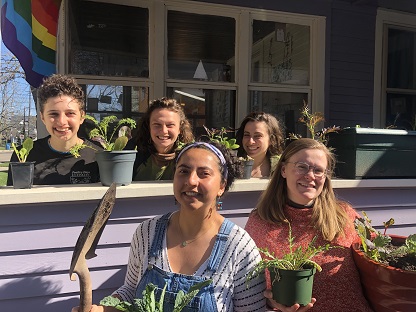
Housemates Orly Rubinfeld (top left), Aiden Voss and Maya Gurfinkel; and Yasamin Shaker (bottom left) and Madeline Ward display some of the plants they’re growing in Kalamazoo.

“Earth Day is an opportunity to re-center on our values,” said Rubinfeld, an independent interdisciplinary major in Environmental Studies. “But we have to remember we have only one Earth and we’ve been pretty unkind to it. If we only pay attention one day a year, we won’t solve our environmental problems. And not just planetary problems but how climate change and other environmental injustices are disproportionately impacting Black, Indigenous, People of Color (BIPOC) communities.”

This year, though, is adding a few challenges to K’s environmental efforts. For example, one way that students engage with food justice is through K’s gardens, including the hoop house. A hoop house, a little like a green house, is a year-round environment for growing vegetables, flowers and other cold-sensitive plants. With distance learning keeping students away from the campus hoop house, students are finding ways to bring that experience home.

Megan Earth Day Cold Frame Hoop House
Megan VanDyke ’22 assembled a cold-frame hoop house at her home in Seattle. The temporary structure stands just a few feet high, yet provides a similar environment to the hoop house at K.

Nora Earth Day plants
Nora Blanchard ’22, is tending to plants at her home this spring in Traverse City.

That’s where Rubinfeld and several students like her come in. She is one of eight housemates living in Kalamazoo’s Vine neighborhood this spring, sheltering in place together through Michigan’s “Stay Home, Stay Safe” order and continuing the work they began at the hoop house, a facility raised in fall 2018 through the Just Food Collective. The student organization, an effort of the Mary Jane Underwood Stryker Center for Civic Engagement, wants to increase student awareness about the challenges and inequities within the food system. This is done while targeting nutritional inequities, climate change and other environmental injustices.

Megan VanDyke plant
A plant begins to sprout at Megan VanDyke’s home in Seattle.

“Food insecurity has always been a problem,” Rubinfeld said. “But in this unique moment, well-resourced people are paying attention at unprecedented levels so I think that’s something we should try to take advantage of as we search for systems that allow people to have more sovereignty over their food systems.”

Rubinfeld and her friends, who all lived together in an environmental justice Living Learning House on campus their sophomore year, have taken on the responsibility of bringing home the lessons they learned at the hoop house to pots and planters on their porch and in their home.

“Our goal was to do something small where we are in our urban space,” Rubinfeld said.

And the Vine neighborhood roommates aren’t the only students planting this spring. Nora Blanchard ’22, is tending to plants at her home in Traverse City. Plus, Megan VanDyke ’22 assembled a cold-frame hoop house at her home in Seattle. The temporary structure stands just a few feet high, yet provides a similar environment to the hoop house on campus.

Efforts like these might seem small, but they represent how the spirit of Earth Day, a time to demonstrate support for environmental protection and environmental justice, endures for the K community.

“I can’t imagine a large-scale effort until I’ve seen it on a small scale,” Rubinfeld said. “How can we expect large change until we see small changes? If my seven housemates and I can do this, imagine what could happen if everyone in our neighborhood could do that. We could be in a very different type of place. I think if everyone had access to the means to grow own own food, we would be much closer to individuals having sovereignty over what they put in their bodies and having access to just, local, and sustainable food for humans and the land.”

More in a Summer: A “Quality” Internship at MDEQ

Gabrielle Herin ’’18 in her K summer internship at the Michigan Department of Environmental Quality.
Gabrielle Herin ’18 in her K summer internship at the Michigan Department of Environmental Quality.

[By McKenna Bramble ’16]

With a major in biology and a concentration in environmental studies, Kalamazoo College student Gabrielle Herin ’18 is interested in all of us – individuals and institutions alike – reducing our environmental impact. In order to learn more about the processes behind environmental laws and policies that can help with this, Gabrielle is completing an internship this summer with the Michigan Department of Environmental Quality (MDEQ).

Her summer internship was arranged through K’s Center for Career and Professional Development Internship Program.

Gabrielle has spent her summer collaborating with more than 20 other college interns and their supervisor, MDEQ Environmental Education Coordinator Tom Occhipinti, on seven projects, four of which she heads as project manager.

One project is publishing the first edition of the Department of Natural Resources (MDNR) “Friends Newsletter.” Gabrielle says working on the newsletter has not only provided her the opportunity to research the goals and projects of the MDNR, but has also allowed her to develop some practical and organizational skills.

“My work on the newsletter has made me see how my writing abilities have improved since being at K,” she says. “Tom even complimented my writing in the newsletter. I feel a lot more confident that in the future, if I were to be asked to write something like this, I could definitely complete it.”

Gabrielle is a rising junior at K who plans to study abroad in France in spring 2017.

She’s also looking at life after K. Because of her K internship and the exposure she’s had to the work of the MDEQ’s Water Resources Division and Environmental Education Division, she said she is interested in exploring both as possible career options.

“Interning here is prepping me for what I would do in a potential career,” she says.

McKenna Bramble ’’16
McKenna Bramble ’16


McKenna Bramble ‘16 graduated from Kalamazoo College with a B.A. degree in psychology and currently works as the post-baccalaureate summer assistant in the College’s Center for Career and Professional Development. She enjoys writing and reading poetry, hanging out with friends and eating chocolate. In the fall she plans to apply to M.F.A. degree programs for poetry. This is one of a series of profiles she is writing about K students and their summer internships.