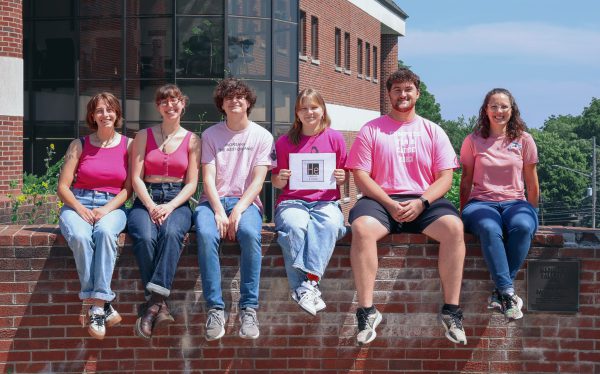
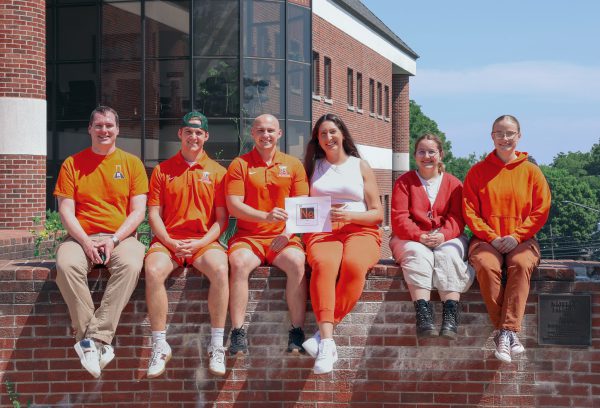
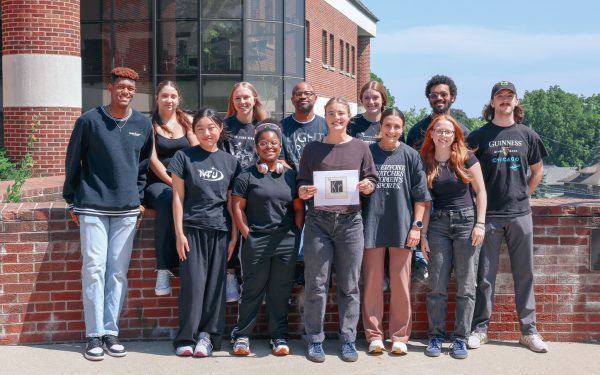
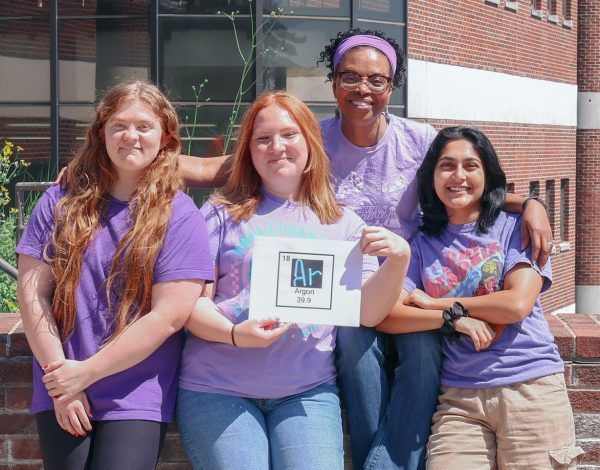
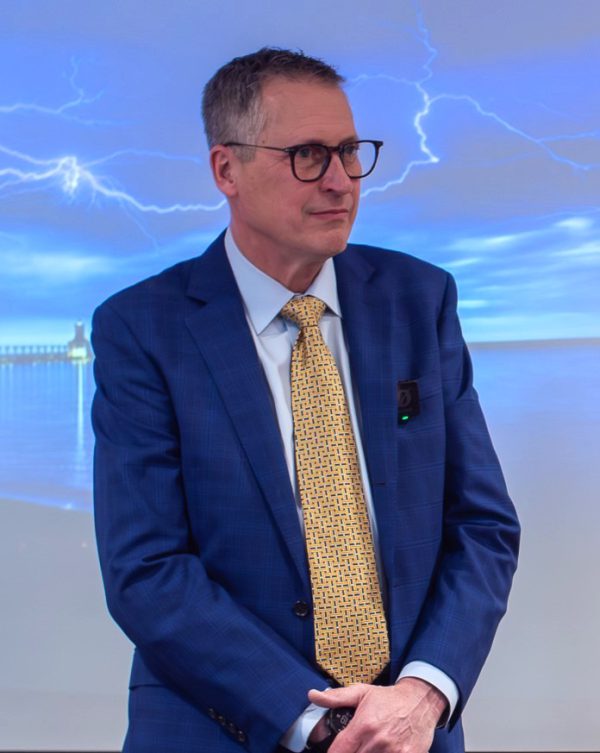
President Jorge G. Gonzalez flips the switch to mark the completion of Kalamazoo College’s electrical upgrades.
Partners including engineering designer Abonmarche Byce, construction manager Owen-Ames-Kimball, and electrical contractor Hi-Tech Electric helped make the upgrades possible.
Kalamazoo College has completed a major multi-year project to modernize its electrical infrastructure, strengthening the safety and reliability of campus power while also building capacity for future growth.
Engineering for the project began in early 2022, with construction starting in fall 2023. The project introduced a new 8,320V power service and modernized medium-voltage switchgear across campus. All new underground cabling was designed in a two-loop configuration to enhance reliability, and new main distribution panels were installed so that each building can operate independently. In addition to reliability and safety, the project also supports K’s sustainability goals. New transformers use mineral oil for insulation and cooling, eliminating risks of contamination in the event of a leak. For the first time, the College can also monitor and measure energy consumption in every building—an important step toward meeting the goals outlined in the College’s Climate Action Plan.
This work was made possible with the support of several partners: engineering designer Abonmarche Byce, construction manager Owen-Ames-Kimball, and electrical contractor Hi-Tech Electric. Funding support came in part from The Herbert H. and Grace A. Dow Foundation, whose $2 million grant supported the project as well as enhancements to K’s science facilities.
“This infrastructure modernization will contribute greatly to the reliability and safety of our campus electrical system. Some of the components that were replaced were 80 years old,” said President Jorge G. Gonzalez at a ceremony to celebrate the switchover to the new system. “Together, we’ve brought this project from blueprint to reality. Lux Esto!”
Ceremony attendees were treated to cookies shaped like light bulbs.
The Herbert H. and Grace A. Dow Foundation helped support the electrical project with a $2 million grant that also supported enhancements to K’s science facilities.
When Olivia DiGiulio ’25 arrived at Kalamazoo College, Michigan was new to her. She was a Portland, Oregon, native with a budding interest in civic engagement and a curiosity about how policy could shape communities. Just four years later, she is growing local roots and works in what has become an ideal full-time role in youth advocacy.
The bridge between those two points was a Community Building Internship (CBI) through the Mary Jane Underwood Stryker Center for Civic Engagement (CCE) at K. In summer 2024, DiGiulio was placed with the Kalamazoo Youth Development Network (KYD), a nonprofit that supports after-school and summer programs across the city. The organization acts as an intermediary for dozens of community programs, ranging from the YMCA to the Kalamazoo Nature Center while providing training, coaching and professional development for program leaders.
Each summer, the CBI program supports students and CCE community partners by offering immersive paid roles developed with the organizations exclusively for K students. Since 2009, with funds from donors and K’s Center for Career and Professional Development, the CCE has offered about 20 internships a year in positions that promote social change and equity in Kalamazoo. In these six- to eight-week experiences, students gain exceptional professional skills and knowledge of local and global issues, while building community capacity to address food security, youth development, the creative arts, health equity, neighborhood planning, neurodiversity, community gardens and childcare policy, among others.
“It was a great opportunity to get the lay of the land for Kalamazoo grassroots, community-based movements,” DiGiulio said. “I could see all the ways their internal network supported the external network of programs in the area. It was energizing and beautiful to witness all the amazing work they were doing.”
Finding Her Place in Kalamazoo
DiGiulio’s internship gave her a firsthand look at the joy behind youth development and revealed the systemic barriers that keep many young people from participating, chief among them was transportation.
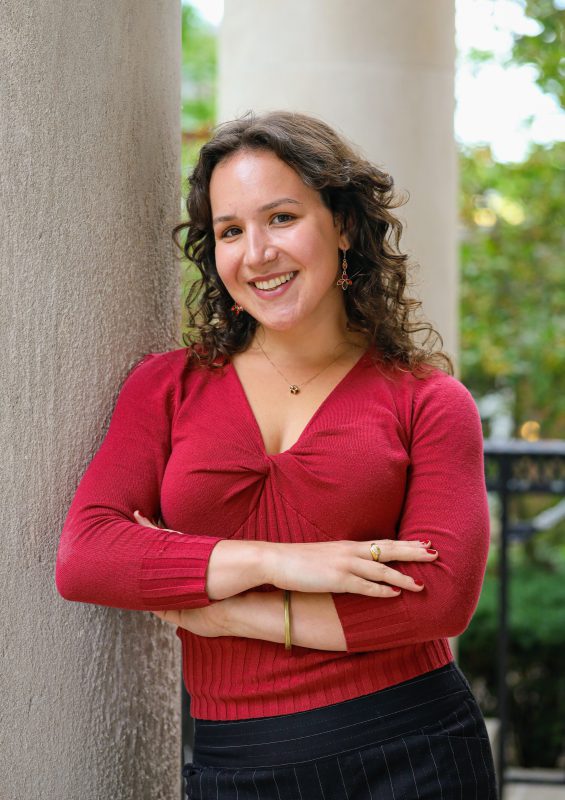
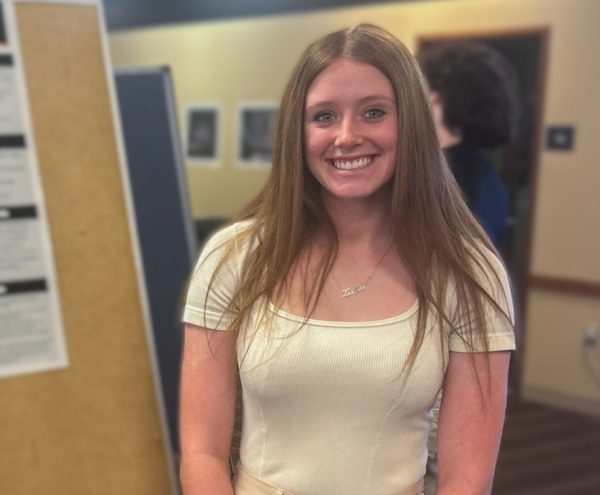
Olivia DiGiulio ’25 found an internship at Kalamazoo Youth Development Network through the Mary Jane Underwood Stryker Center for Civic Engagement before turning the experience into a dream career with the Michigan After-School Partnership.
“There are a lot of youth in Michigan who don’t have access to after-school or summer programs because of the limitations related to transportation,” DiGiulio said. “That realization led me into conversations about policy and advocacy that reaffirmed my desire to support systems-level barrier removals as part of my career.”
DiGiulio’s daily schedule at KYD rarely ever repeated itself day to day. Some mornings began with a drive out to observe summer programs, where she helped assess the quality of activities. Other days, she tabled at community events such as the National Day of Summer Learning at Bronson Park, connecting with families and showcasing opportunities for youth. Back in the office, DiGiulio helped process evaluations from youths and families, and supported staff with program-improvement efforts. But what stood out most to her was the culture of the organization.
“KYD Network is very focused on ensuring staff develop as people as much as professionals,” she said. “We had team meetings where we reflected on our values and how to live them out authentically in our work. Seeing my coworkers build such trustworthy and meaningful relationships with community partners was really inspiring.”
Through KYD Network, DiGiulio supported a transportation affinity group that brought together leaders and advocates to think about solutions. The Michigan After-School Partnership (MASP) is a statewide organization that does for Michigan what KYD does for Kalamazoo by supporting out-of-school programs, advocating for funding and pushing for systemic change. By the time graduation rolled around, MASP offered her a full-time position as a policy and advocacy coordinator.
“Truly, this is my dream job,” she said. “I have to pinch myself that I get to do this work. And it all started with that summer internship.”
The Long Game of Change
Today, in her MASP role, DiGiulio leans on those lessons. Advocacy, she said, is rarely about quick wins. Instead, progress comes in steady steps with incremental policy changes, persistent conversations with legislators, and deepening relationships with program directors across the state.
“Measuring success in this work means recognizing that it’s the long game,” she explained. “It’s about building transformational relationships and keeping the drumbeat of advocacy going so momentum continues to build.”
One of her current priorities is transportation equity, which ensures that young people across the state can get to the programs designed for them. Another is securing increased funding for after-school and summer programs. Both, she said, are multi-year efforts.
“I break it down into what can I do this week, what I need to plan for next month, and what has to be set up for the next budget cycle,” she said. “It’s about moving the vision forward one step at a time.”
Seeds Planted Before College
DiGiulio’s passion for civic engagement was first nurtured back home in Portland. In high school, she worked with the Blanchet House, a nonprofit offering free meals and addiction-recovery programs. As a student ambassador, she designed projects that introduced middle school students to issues of food insecurity and houselessness.
“That experience helped me realize I love building connections with people and also analyzing the systems shaping their lives,” she said. “I wanted to find a way to bring relationship building and systems change together. That’s what led me to policy and advocacy.”
K turned out to be the right fit to grow those interests. She took part in CCE programs such as Club Grub, volunteered with Building Blocks of Kalamazoo, and enrolled in courses such as Urban Planning as a Liberal Art, taught by then-CCE Director Alison Geist and local city planners.
“K really values experiential learning,” DiGiulio reflected. “And the friendships I made across disciplines were just as transformative. My friends in biochemistry, public health, and music all shaped how I see the world and the work I want to do.”
Though she never expected it, Kalamazoo—and Michigan more broadly—have become a second home. She cherishes the green spaces, the walkable neighborhoods and the friendships that stretch beyond campus.
“As someone who didn’t grow up here, it’s been special to see the city through the eyes of young people who call it home,” she said. “I feel like I’ve built a community both at K and in Kalamazoo itself.”
Looking Back and Ahead
As DiGiulio settles into her role at MASP, she often thinks back to that pivotal summer in 2024 and the CBI program that made it possible. Her story is a reminder of what CBIs are designed to do as they give students a chance to learn from the community, serve in meaningful ways, and sometimes discover the work they were meant to do all along.
“I’m extremely grateful for the CBI program,” she said. “It fostered meaningful connections with the Kalamazoo community and opened the door to my career. The relationships I found at K have been transformational in my life.”
A nonprofit organization honored Kalamazoo College President Jorge G. Gonzalez this weekend with an award that recognizes his efforts to support and create greater opportunities for students in Kalamazoo.
El Concilio, established in 1981, serves the local Latinx community by providing culturally sensitive social services, advocacy and programs that foster self-sufficiency, preserve cultural heritage and support the community’s economic well-being. Gonzalez received its Nezahualcoyotl Award, an annual honor granted to a Latinx professional leader, at the Nuestras Raices Gala on Saturday at the Radisson Plaza Hotel of Kalamazoo.
In a letter to Gonzalez, El Concilio Chief Executive Officer Adrian Vazquez-Alatorre noted that as president of K, Gonzalez has worked to create a path for many generations of students to walk and achieve their dreams. He also cited the College’s partnership with El Concilio through the Mary Jane Underwood Stryker Center for Civic Engagement, which works to build experiential education opportunities to help students develop the knowledge, attitudes and skills of social responsibility, intercultural understanding, lifelong learning and leadership.
“In collaboration with Kalamazoo College, we had over 50 student volunteers and interns in the last few years,” Vazquez-Alatorre said. “Thank you for all you have done for the Latinx students inside and outside of Kalamazoo College.”
“I am deeply honored to receive the Nezahualcoyotl Award from El Concilio, an award named after leader, poet and visionary whose legacy still echoes through centuries,” Gonzalez said. “This recognition reflects the shared commitment between Kalamazoo College and our community partners to empower students through education, opportunity and cultural pride. Receiving the Netzahualcoyotl Award reminds me of his timeless words: ‘Let us leave at least flowers, let us leave at least songs.’ As I prepare to retire from Kalamazoo College, I hope that our work leaves behind something beautiful—something that uplifts not only individuals, but entire generations and echoes beyond today.”
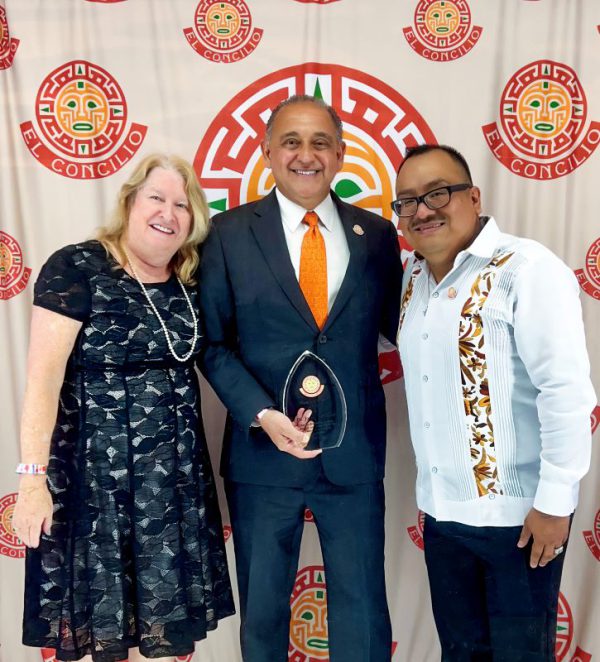
Suzie Gonzalez ’83 (from left), President Jorge G. Gonzalez and El Concilio CEO Adrian Vazquez-Alatorre were among the people attending El Concilio’s Nuestras Raices Gala on Saturday where President Gonzalez received the Nezahualcoyotl Award.
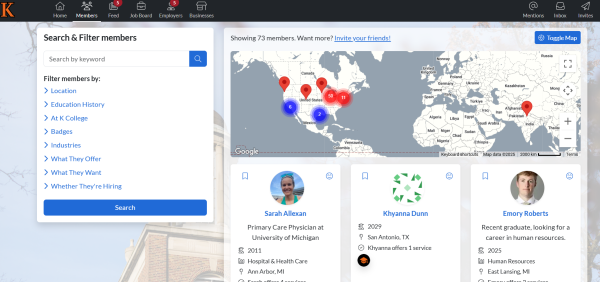
Kalamazoo College is bringing its tight-knit community even closer together with the launch of a new social media site designed exclusively for students, faculty, staff and alumni. This LinkedIn-style platform provides a professional space to build connections, seek career advice and share opportunities with fellow K Hornets.
KConnect, designed through the platform AlumniFire, grew out of a desire to strengthen the K network and build relationships. Through it, alumni have options to share one-time advice or serve as ongoing advisors as they control how often they want students to contact them. They also can review students’ resumes, provide interview tips and join a community for fresh ideas, collaboration and partnerships. Students then can explore career paths through conversations with alumni in their prospective fields, get tips on searching for jobs and professional life, set up virtual conversations and in-person meetups, build confidence by networking in a low-pressure space and help fellow students by sharing personal experiences.
In KConnect, alumni can share one-time advice or serve as ongoing advisors to students as they control how often they want students to contact them. It’s also a place where alumni can make connections with former classmates.
“Alumni reach out to us often and say, ‘I don’t want to just wait for students to find me on LinkedIn. I want to have career conversations with students because I navigated a difficult situation with my career, and I don’t want other students to have to go through that,’” CCPD Director Valerie Miller said. “If we can direct alumni to this platform, they can say exactly what they want to offer students, and students can find them more quickly.”
Although K alumni and students have always been proud of having strong connections, the new platform offers a digital home for those interactions to flourish. KConnect ensures that students won’t need a LinkedIn Premium account or an appointment with a career coach to reach out to alumni. And because K alumni sign up for it specifically to provide mentoring and more, students know that the alumni want to be contacted. It’s also a great tool for alumni to connect with old friends, contact each other with career questions, and post about their businesses in the business directory.
CCPD Associate Director Rachel Wood added that the platform provides students with a tool to prepare for their careers sooner in their years at K.
“We used to see students engaging a little bit with career stuff their first year, and a little more their sophomore year before doing so heavily into their senior year,” Wood said. “We want to help students approach that differently. We think of KConnect as a great place for sophomores to have those career conversations earlier at K, around the time that they’re making decisions about their majors. It’s not that a major equals what someone does in their career, but if they want to go into finance, for example, they’re going to want to have an internship in that field, so they’re going to want to make connections with folks that work in finance earlier on. Students can do that in KConnect.”
“We have students who come to K with great professional networks, and potentially, the skill to log into KConnect and know exactly what to do with it,” Wood said. “But for those who are new to networking, this platform comes with us doing work on the back end to teach students how to use it, as they all will receive access to it. That elevates what you get from being a K student and it opens doors for people who might not have a professional network coming into K.”
Miller and Wood credit CCPD Assistant Director for Experiential Opportunities Richard Sylvester with doing much of the behind-the-scenes work to select a platform, test it with stakeholders and ensure that it meets the needs of students and alumni.
“One of the biggest initial challenges was selecting the right platform—one that would not only meet the current needs of students and alumni but also scale with us as we grow,” Sylvester said. “We didn’t take that decision lightly. We explored and evaluated several options and AlumniFire stood out as the partner best aligned with our goals and vision for students.”
From start to finish, the process of building KConnect took about seven or eight months, which Sylvester said speaks to the care the CCPD took to set it up right. The result is an exciting and easy-to-use platform. In fact, once they’re registered, participants won’t even have to log in to the platform to use it should they choose only to exchange messages. They can receive email alerts when they get messages and simply reply to them while automatically replying to the message on KConnect at the same time.
Students, faculty, staff and alumni can find instructions for KConnect and register for it through the CCPD website. Registering is possible with a kzoo.edu email address or, for alumni, with a personal email address.
“A platform like KConnect, which will eventually serve hundreds, if not thousands, of alumni and students, needs broad support and trust across campus,” Sylvester said. “We knew this tool had the potential to address a long-standing challenge: reducing the friction that often exists in connecting students with alumni for mentorship, networking, career exploration and experiential learning opportunities like internships and job shadows. Because of the platform’s potential impact, we invested time in meeting with people, demoing the platform, listening to feedback and concerns, and making sure everyone felt confident in the direction we were heading.”
As the platform continues to grow, the CCPD hopes it will serve as an example of the power of a liberal arts community that fosters relationships, sparks collaboration and ensures that Hornets always are buzzing with opportunities to share with each other thanks to having shared experiences as students.
“I often tell the story that I went to a large university and, despite the massive size of my network, I don’t have the network that K grads have because there just isn’t the same kind of alumni affinity for my university,” Miller said. “Here, if somebody says, ‘I did this on the Quad or at Red Square,’ everybody knows what that means. There’s a recognition and a connection that students can share with alumni before they even meet.”
The CCPD won’t measure its success with KConnect by the number of users it has, even though Sylvester admits he would love to see thousands of people using it over time. It’s more about fulfilling a deeper promise of what it means to be a student or alum in the K community.
“When someone chooses K, they’re not just choosing a school, they’re joining a community that cares about them,” Sylvester said. “It’s a community that’s invested in their success during their four years on campus and through the rest of their lives. Just by creating a profile and being willing to offer a bit of your wisdom, your story or your perspective, you will help create a rich, supportive network for students and fellow alumni. That’s how we build the kind of community we all want to be a part of one connection at a time.”
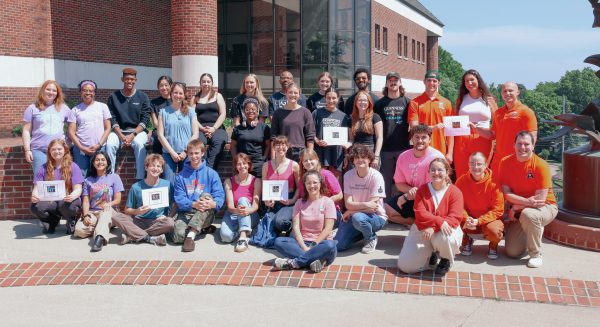
About 25 students and five faculty members from the Department of Chemistry and Biochemistry performed summer research together this year.
Summer was not a laid-back break for many of the students and faculty who put the sciences in the liberal arts and sciences at Kalamazoo College. It’s traditionally the time of year when students and professors often collaborate in Dow Science Center labs to advance research projects that could lead to important discoveries for the world.
“During the school year, our time to do research is limited,” said Daniela Arias-Rotondo, K’s Roger F. and Harriet G. Varney Endowed Chair in Natural Science, an assistant professor of chemistry. “And while we keep making progress, the summer is when we can really dig deep. When students have uninterrupted time to do this work, we can start looking at more questions. We can go down some rabbit holes that maybe during the school year we avoid because we have less time. It’s fantastic for the students and a transformative experience for them.”
Student participants often work full-time, with most earning stipends that allow them an immersive experience that builds critical thinking and technical skills. Many of the projects will form the basis of students’ Senior Integrated Projects (SIPs). Some may even result in publications in academic journals or clarify career paths and strengthen graduate school applications. Students also present their findings at national conferences and in peer-reviewed publications, gaining recognition that often extends well beyond campus.
This kind of high-impact learning was on full display this summer through the work of five faculty from chemistry and biochemistry and about 25 students in their labs. The faculty included Assistant Professor of Chemistry Daniela Arias-Rotondo, Associate Professor of Chemistry Blake Tresca, Kurt D. Kaufman Associate Professor of Chemistry Dwight Williams, Dorothy H. Heyl Professor of Chemistry Regina Stevens-Truss and Assistant Professor of Chemistry Cecilia Vollbrecht.
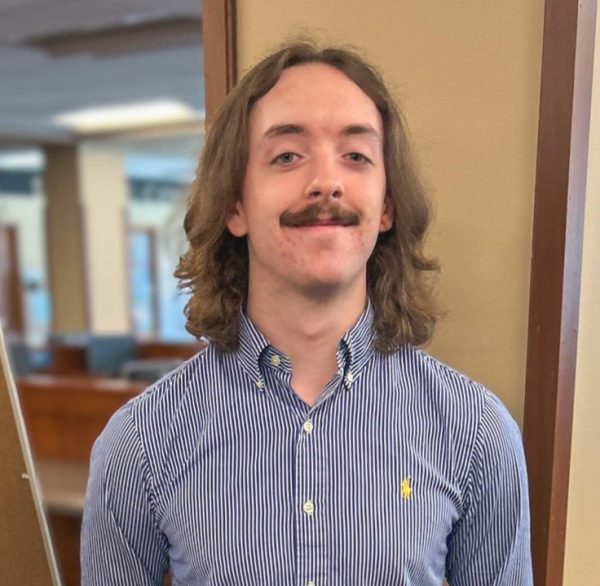
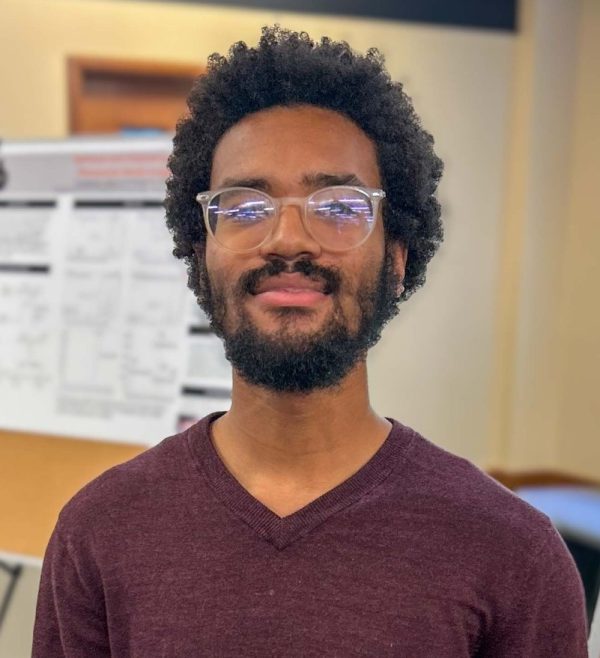
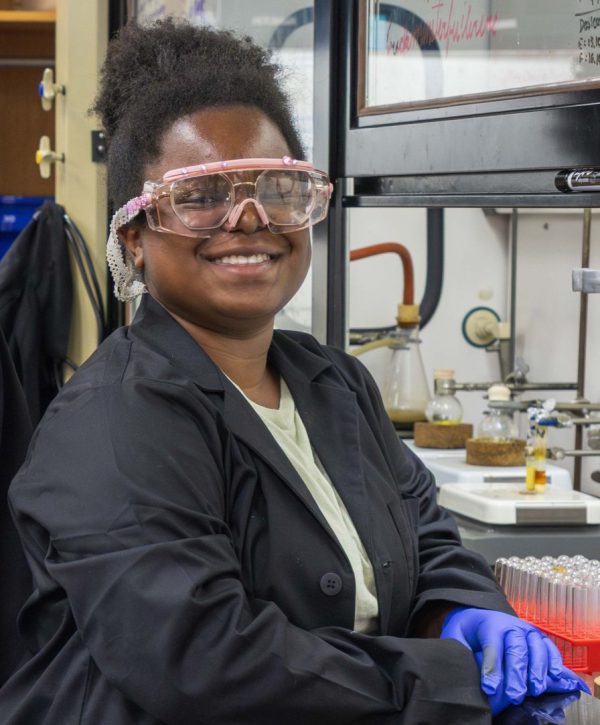
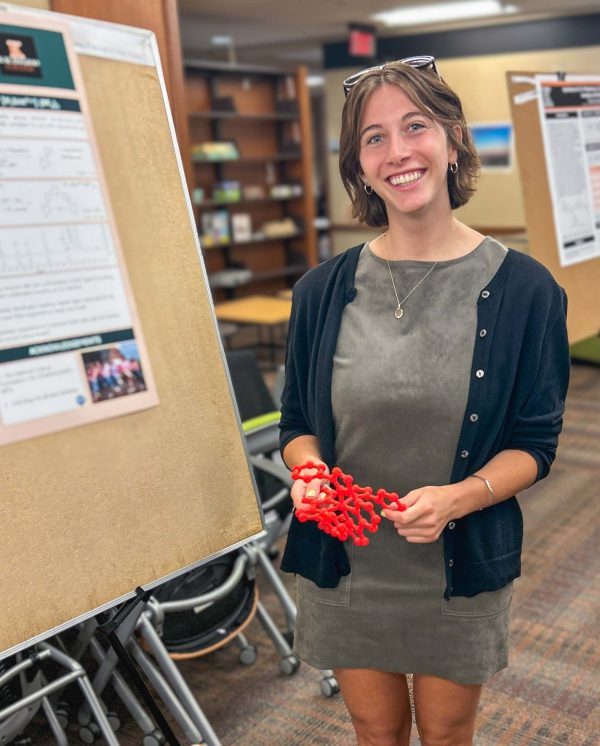
Bea Putman ’26 (from left), Ava Schwachter ’27, Will Tocco ’26, Kate Suarez ’28 and CJ Aldred ’26 worked with Daniela Arias-Rotondo, the Roger F. and Harriet G. Varney Endowed Chair in Natural Science, who is an assistant professor of chemistry at K.
Daniela Arias-Rotondo
Arias-Rotondo’s synthetic inorganic chemistry lab worked to find ways to convert light into electrical or chemical energy. In the 2024–25 academic year, that work—funded by a National Science Foundation grant—led to national recognition for her along with one of her students, Maxwell Rhames ’25, as they examined what alternative metals could possibly be used to make things like solar panels less expensive. Will Tocco ’26, Bea Putman ’26 and Kate Suarez ’28 continued that work this summer.
For Putman, the work represents her SIP. She said first-row transition metals such as manganese could hold the solutions she’s seeking because the metals are cheap and Earth abundant. Tocco, meanwhile, praised Arias-Rotondo—affectionately known to her students as Dr. DAR—for her guidance and leadership in the lab.
“A lot of people imagine their boss as a big, scary person who rags on them when they do something wrong,” Tocco said. “Dr. DAR is not like that at all. If something goes wrong, it simply went wrong. It’s all about falling forward and asking, ‘What did you learn? What can you do next time instead?’ It’s very instructive, and as a student, I get to learn a lot. Even when I fail, there’s always a bright side.”
CJ Aldred ’26 and Ava Schwachter ’27 also worked on a project for which Arias-Rotondo earned funding, this time through the ACS Petroleum Research Fund. For this project, molecules they designed acted as catalysts and unlocked chemical transformations through a process called photoredox catalysis. In this case, the transformations involved petroleum byproducts—the waste left behind after crude oil is extracted—and how those byproducts might be used.
Schwachter, much like Tocco, credited Arias-Rotondo for empowering students.
“When you make a mistake, she will ask, ‘Did you die?’ and ‘What did you learn?’” she said. “The mindset of her lab is safety first. That’s the top priority. The next priority is learning and then whether we get the product we expected. We want to move toward our goal, but the top priorities are safety and learning. It’s easy to feel high pressure because you want to succeed, but because the focus is so much on learning and safety, I feel like there’s less.”
Associate Professor of Chemistry Blake Tresca (from left) worked with Jack Bungart ’26, Max Plesscher ’26, Devi DeYoung ’26, Jocelyn Suranyi ’28 and SEED student Rowan Hagenbuch in his lab this summer along with Caleb Moore ’27 (not pictured).
Blake Tresca
In 2024, Tresca earned a National Science Foundation grant that provided three of his lab students with a stipend this summer while also covering the cost of a robot that made their research faster, easier and safer. Together, Jack Bungart ’26, Max Plesscher ’26 and Caleb Moore ’27 used organic compounds called diene amines to create peptoid nanomaterials, which are molecules showing promise in detecting harmful substances in water or people, for example.
In an independent project, Devi DeYoung ’26, a Heyl scholar from Portage, synthesized and computationally modeled peptoids to look for relationships between structural sequences and exhibited properties.
Even high school students occasionally have opportunities at K thanks to Project SEED, the American Chemical Society’s effort to provide lab experiences to underrepresented students. Jocelyn Suranyi ’28 in the past had been one of those SEED representatives and this summer mentored high school senior Rowan Hagenbuch in Tresca’s lab.
The two did similar work, but on different projects. Suranyi synthesized peptoids that will be used in the lab of Stevens-Truss. Hagenbuch synthesized peptoids that could help remove PFAS chemicals from water. PFAS are widely used in various consumer and industrial products due to their ability to repel water, grease and stains.
“I enjoy doing this work because it helps me develop more lab skills and working with people,” Hagenbuch said. “In a high school lab, I don’t necessarily get to experience what I’m doing this summer, so it helps me build my confidence.”
Suranyi was thrilled with her opportunities to perform research and with a chance to get to know Hagenbuch.
“I know what it’s like to come in as a random high school student and she’s understanding so much more than I did,” she said. “I look at her and I think how happy I am that she’s doing so well. It’s fantastic to work with her.”
Suranyi plans to formally declare a chemistry major and Chinese minor during her sophomore year, which begins this fall. She also enrolls as a guest student at Western Michigan University, which allows her to perform with the Bronco Marching Band.
“I’ve talked to people at Western and I’ve told them I’ve been doing lab research for the past three years,” Suranyi said. “They say, ‘That’s a crazy good experience. I can’t believe K lets so many undergraduates do that and without prior experience.'”
Trustin Christoper ’26 (back row, from left), SEED student Lizbeth Mares-Castro, Olivia Cannizzaro ’26, Kurt D. Kaufman Associate Professor of Chemistry Dwight Williams, Landrie Fridsma ’27, Isaac Duncan ’27 and Jake Asnis ’26, along with Alyson Ramillano ’26 (front row, from left), SEED student Dorian Roberts, Anni Schnell ’26, Julia Kozal ’27 and Eleanor Andrews ’26 were representatives of the Williams lab this summer.
Dwight Williams
You might’ve heard that too many cooks in the kitchen can spoil a dinner, but the same theory will never apply to the Williams lab at K.
Twelve students, the largest of any lab in the Department of Chemistry and Biochemistry this summer, worked with the associate professor of chemistry fondly known by students as Dr. D.
Those students combined their efforts on three projects, Williams said. One project designed novel antibacterial agents to hopefully make headway against antimicrobial resistance. Another designed molecules that might one day treat neurodegenerative diseases by inhibiting a specific pathway. The last designed new molecules that might be useful for treating Chagas disease and diabetes.
Alyson Ramillano ’26, a Posse Scholar from Los Angeles, was one of the students working in the first group. Specifically, she investigated the natural product Aquamyacin G, an antibiotic showing promise to see whether it can be made synthetically.
“Right now there is a need to identify novel antibiotics because antibiotic resistance has been an ongoing benefit crisis, but there isn’t a lot of financial incentive to invest in antibiotic discovery,” Ramillano said. “From my understanding, that motivated the Williams lab to look into an affordable synthetic that would lower the barriers of entry for further research into this compound.”
Ramillano added that she never would’ve thought she would be doing such research when she started college. Eleanor Andrews ’26, a biology major, didn’t originally plan on doing research this summer in the Williams lab either.
“I was going to do some shadowing at Bronson Hospital because I want to be a nurse,” Andrews said. “But a soccer teammate of mine worked in this lab last year, and I went and listened to her present her SIP. I fell in love with the idea of working here. I loved her project with how she was working to find things that fight antibiotic resistance.”
Andrews added that her lab work consisted of mixing two molecules together to see whether she can create an antibiotic.
“This excites me because it’s really hands on,” she said. “I’m a hands-on kind of person. The thought of sitting back isn’t really for me, so I’m trying find a solution by working on it and figuring out an interesting puzzle.”
Emily Dalecki ’26, Morgan Paye ’26, Dorothy H. Heyl Professor of Chemistry Regina Stevens-Truss and Anoushka Soares ’26 worked together in the Stevens-Truss lab this summer.
Regina Stevens-Truss
The Stevens-Truss lab worked in drug-discovery testing to help figure out whether science might be able to develop new antibiotics. She said her students explore by investigating whether antimicrobial peptides that are about 26 to 30 amino acids in length can kill or prevent bacteria from growing. They also analyzed the hybrid compounds synthesized in the Williams lab and the peptoids developed in Tresca’s lab to see whether they can kill bacteria.
“We’ve started working with a whole subset of bacteria known as ESKAPE pathogens,” Stevens-Truss said. “Each letter in ESKAPE stands for a different microorganism that has at least one antibiotic resistance. We know that you can go to the hospital and take penicillin because it cures certain things. But there are some penicillin-resistant bacteria that penicillin won’t kill, and many are now becoming resistant to more than one antibiotic. We’re looking at compounds now to see which of them can still kill antibiotic-resistant bacteria.”
Three of Stevens-Truss’ students—Emily Dalecki ’26, Morgan Paye ’26 and Anoushka Soares ’26—are hoping to eventually go to medical school with such research being vital to their admission applications.
“Research is just something I’ve always enjoyed,” said Soares, a Heyl scholar from Portage. “It’s not something I had a lot of experience with outside high school, so I was curious about it when I got to K. As a first-year student, Dr. Truss had me in General Chemistry II and asked me if I wanted to do research. I told her that would be perfect for me because I was getting more interested. I thought I was going to be a biologist until Dr. Truss made that offer. I thought it was fantastic, all-encompassing and something I wanted to look into more.”
Paye said she was in a science enrichment program last year making this summer a big change for her thanks to a better overall experience and more collaboration.
“Dr. Truss had offered me a spot in her lab so I could start my SIP research when I had never actually had her as a professor before,” Paye said. “In fact, it was the first time we had ever met, so it was amazing that she had offered me the spot. We blend super well together.”
Dalecki said K is a place where students aren’t just numbers, so faculty know students’ names and are interested in student growth. Dr. Truss, however, is special.
“I felt like Dr. Truss really wanted me to become confident in my lab work and as a chemist,” she said. “I really appreciated that. I’ve had a lot of things going on outside of K that some of my professors didn’t notice. But Dr. Truss noticed that and cared about me. She wanted me to come out of my shell and believe in what I’m doing.”
What Students Said About Summer Research
Julia Kozal ’27
“I would say that working in the lab provides the best opportunity for undergraduates to know themselves better as workers and scientists. I’ve learned that I work best when I’m in the lab constantly and not taking breaks outside just so I can get in the flow of the work. It’s also important to build relationships with your classmates. I think biochemistry can be very intimidating as a major, but if you get to know the people you’re working with well, you have a built-in group of friends for the summer.”
Julia Kozal ’27
Landrie Fridsma ’27
“I took Organic Chemistry this year with Dr. D. He helped me challenge myself in a way I never have before and do things I never thought I would be able to do. When I heard about his research, I was intrigued and excited to keep learning in that way. I learned how to problem solve in his class and it has continued in the lab. I’m learning life skills that I don’t think I would get anywhere else.”
Landrie Fridsma ’27
Anni Schnell ’26
“I think being in the lab has helped me develop a new appreciation for patience. It gives me a different kind of determination when I have to figure something out. I sometimes fail, but I can figure out how to keep getting back on track, and with having other good students in the lab, it’s a low-pressure environment.”
Anni Schnell ’26
Olivia Cannizzaro ’26
“I’m familiar with this department and all the professors are wonderful. Their projects are super interesting and definitely have implications for the future. It’s fulfilling to be a part of something where long-term applications are important. It’s also a good time. You get to know the professors during the year, and then you spend the summer with them. It’s a really good way to have references in the future, because you spend so much time with them. They know you really well. They can speak to your skills. It’s important to have these people for your future as well beyond K.”
Olivia Cannizzaro ’26
Jake Asnis ’26
“I’ve been playing lacrosse since I was in second grade, and I had a teammate in high school who just graduated from K. He told me to reach out to the coach to see if I could play here. It’s definitely a great opportunity to be here because we get to do research. I’m a chemistry major, so with this research, I can get ready for grad school and do my SIP. It’s tough to do that during the academic year. With lacrosse, we have fall ball through about Week 7, and we’re practicing three to four times a week with other classes on top of that. We then start practicing for the spring sport in January and we go all the way through April, so the summer is a perfect time to do research where we can. We don’t have to worry about other academics and we can focus solely on research.”
Jake Asnis ’26
Isaac Duncan ’27
“I applied to a bunch of small schools similar to K, but specifically, I really liked that K has an excellent track record when it comes to sending students to medical and graduate schools. Like a lot of small schools, you can really get to know your professors here. I particularly love my professors in the chemistry department, they’re all just wonderful to be around. Sometimes it’s frustrating because the chemistry isn’t easy, but there’s always help if you look for it. All my peers are incredibly kind, and everyone is struggling together! I never feel like I’m completely on my own.”
Isaac Duncan ’27
SEED student Dorian Roberts
“I thought being in a lab this summer would be a great opportunity to get a jump start on learning how college labs work and how I can better plan for time management. I like how forward Dr. D is with his lessons. I appreciate how he doesn’t sugar coat things, because I think that can sometimes cause overconfidence in some areas or make you not want to better yourself, so he allows me to grow as a person and as a scientist.”
SEED student Dorian Roberts; will attend Eastern Michigan University in fall
Bea Putman ’26
“It’s rigorous, but I think it’s interesting. I’m at college to learn and I want to be proud of my SIP. I want to feel like I put a lot of work into it, and that I used my degree and the brain that I earned from my college degree to put forth this pinnacle of everything that I’ve learned. I wanted to make sure that it accurately relayed all the work that I’ve been doing throughout my years here.”
Bea Putman ’26
Cecilia Vollbrecht
Teige Bredin ’28 and Luke Barnum ’27 have gone from taking their first chemistry course, General Chemistry I, to working in Vollbrecht’s lab in less than a year. Alongside Vollbrecht, they wanted to develop an instrument that can analyze their materials and quickly test how successful they are at capturing pollutants from water or the air.
Some of the pair’s work might have seemed like engineering and physics as much as it did chemistry.
“There’s a bunch of critical thinking where they need to ask themselves, ‘How do we make this instrument work?’” Vollbrecht said. “It’s not just a recipe to follow. We have to figure out how to make these parts fit together, optimize parts, and troubleshoot unexpected problems. They’re learning how to think on their feet while putting together different aspects of their research. We’re not just using our chemistry skills, but physics and math. My students are learning a lot of coding, which I think is fun and a good skill for the future, too.”
Bredin began the summer by using an optical setup and spectrometer to separate light into individual wavelengths. Barnum optimized the mirrors by attempting to make them smaller and even more reflective, so the wavelengths could tell them more about the materials they analyze.
Teige Bredin ’28 (left) and Luke Barnum ’27 (right) worked with Assistant Professor of Chemistry Cecilia Vollbrecht in her lab this summer.
The partners admitted they won’t necessarily find a lot of the answers they want during their time at K. Their subject matter might require years of research, although their summer duties were more than worthwhile to them.
“I’m trying to learn not only about the materials, but the science behind them and our research culture to preview whether I would survive and enjoy a job in this kind of environment,” Barnum said.
And despite being only done with his first year, Bredin knows attending K was a smart decision for him.
“Kalamazoo College has definitely been the right place for me because I’m getting these kinds of opportunities,” he said. “I don’t think I would be meeting the same people and be exposed to the same kinds of things had I not gone here.”
Beyond the Research Lab
The summer culminated in the annual Summer Science Symposium, where students presented their research to peers, faculty and the public. It provided a moment of pride and reflection, along with a celebration of the countless hours spent in the lab to give the faculty a reason to feel good and the students to feel accomplished.
“I was just talking with students about K versus a big school,” Tresca said. “We have a lot of spots for students per capita. In the senior class alone, at least half of our majors are doing research for their SIPs this summer in chemistry or biochemistry. Comparatively, big schools have a very small percentage of their students in labs. That makes us special.”
“Students take ownership of their projects during summer in a way that we don’t see at the very beginning, because as they keep going, they start realizing that they have agency,” Arias-Rotondo said. “They start making their own mistakes, their observations and learning from those mistakes as they come up with alternatives, possible solutions and things they want to try. That’s when they really take ownership of their projects and when they really grow as scientists. They stop being a pair of hands, doing what we tell them to do, and they really become scientists.”
Corey Garrison ’26 was among the students presenting his research at the Summer Science Symposium.
A recent discovery is absolutely the bee’s knees for Kalamazoo College Assistant Professor of Biology Clara Stuligross.
Stuligross is a bee ecologist who studies how the insects respond to environmental stressors such as climate change and pesticides. Her research combines field work, lab experiments and collaboration with students to understand how such pressures affect bees.
“I love studying bees because they are charismatic, incredibly diverse in their biology, and also are essential for ecosystems because of their role as pollinators,” she said.
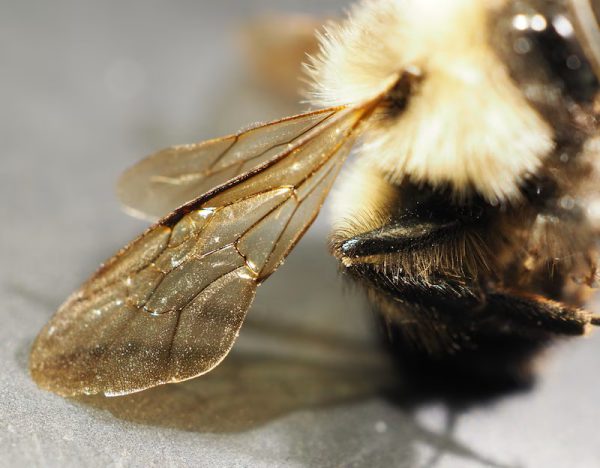
So, when alumnus Nathan Rank ’83 brought her what he believed to be a recently deceased rusty-patched bumble bee, she was excited. The species hadn’t been officially documented in Michigan since 1999, when the insects were last found in Washtenaw County. Together, Stuligross and Rank—a professor of entomology and ecology at Sonoma State University in California—examined the specimen he found in a local driveway while visiting relatives.
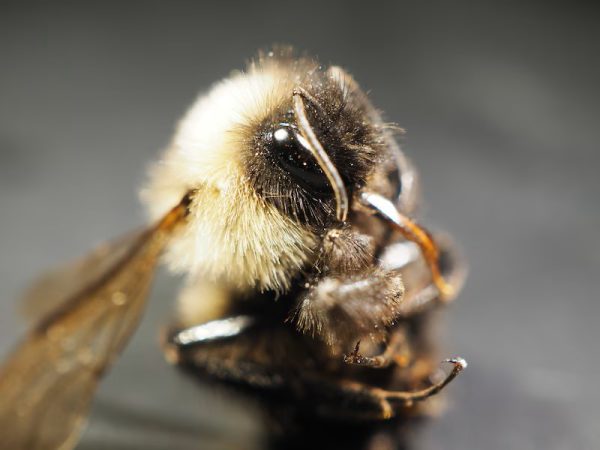
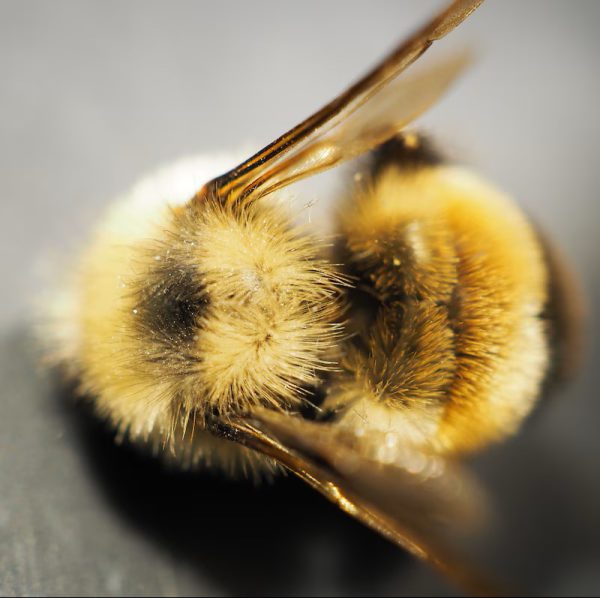
Rusty-patched bumble bees are identifiable through distinctive rusty-orange-colored patches on the abdomen of workers and males, which also have a black head and a mostly yellow thorax with a black band between their wings. Through high-resolution photography, Stuligross and Rank agreed on Rank’s original conclusion, confirming the species.
“Finding a rusty-patched bumble bee in Kalamazoo is incredibly exciting because it was listed as a federally endangered species in 2017 and it hasn’t been documented in Michigan for over 25 years,” Stuligross said. “As someone invested in pollinator conservation, this finding is a hopeful sign that more may be out there, which would be exciting news for the future of the species.”
Rusty-patched bumble bees are exceptional pollinators, especially for wildflowers and Michigan crops such as blueberries and cranberries. Pollinator insects in general are ecologically important because they move pollen from the male parts of plants and flowers to the female parts, allowing for seed production. Bumble bees of all types are especially important to agriculture because of their unique buzz pollination technique, which is required to pollinate certain plants such as tomatoes and cranberries. They are also more active in cold weather than other bee species, making them particularly valuable in Michigan for pollinating early spring plants.
Ongoing surveys in the area now are looking for more rusty-patched bumble bees, but so far, only the one individual has been found.
“The rusty-patched bumble bee used to be common in Michigan, but it has been lost from about 90% of its historic range,” Stuligross said. “That’s why this sighting is so exciting and a reminder that conservation efforts are so important to protect our biodiversity. We will keep looking in hopes of finding additional bees or even a colony, and we will be watching closely again next spring when new colonies appear. Community members can play a role by planting native flowers, reducing pesticide use and keeping an eye out for these bees in their gardens and on flowers in the area.”
Community members can further help by spending time in nature to observe native bees while taking photos and uploading images to the iNaturalist app or Bumble Bee Watch website. Rusty-patched bumble bees typically are found in prairies, woodlands, marshes and agricultural areas. They feed on nectar from a variety of flowering plants, including asters, goldenrods and bee balms.
“This discovery reinforces how important it is to learn about and conserve the biology in our own backyards,” Stuligross said. “The bee was found in someone’s driveway, and it was discovered because someone was curious and wanted to learn more. For students studying biology, it is essential to see concrete examples of conservation successes, like the finding of this endangered bee, as encouragement to continue the work that we do. It’s also a reminder that science is not something that happens far away. It’s something that happens right here in our own backyards and everyone can be a part of it. Finding this bee is also a reminder to students and the broader community that conservation work is essential. We are always working to conserve habitat and provide resources for wild pollinators to thrive.”
Kalamazoo College Assistant Professor of Biology Clara Stuligross and alumnus Nathan Rank magnified a recently deceased bumble bee to confirm that the insect Rank found in a local driveway is a rusty-patched bumble bee.
Finding a rusty-patched bumble bee is significant because the insect hasn’t been documented in Michigan since 1999.
Community members can help scientists look for more rusty-patched bumble bees like this one by taking pictures of native bees and sharing them through the iNaturalist app or the Bumble Bee Watch website.
Kalamazoo College is again drawing national attention for its quality in higher education with three national publications—Forbes, Washington Monthly and Money—ranking the institution among the top colleges and universities in the country.
Forbes placed K as the top private school in Michigan and listed it third in the state overall through the 2026 America’s Top Colleges list. That recognition places the College No. 153 in the country regardless of size, location or public/private status. The business, finance and investing publication emphasized return on investment, alumni success, graduation rates, post-graduation debt and student outcomes in selecting the 500 institutions honored. Forbes also ranked K 46th among the nation’s top schools with fewer than 4,000 students and credited the College on its list of 25 private schools that award generous financial aid.
K is featured on two lists through Washington Monthly, finishing 30th on both: TheBest Liberal Arts Colleges for Your Tuition (and Tax) Dollars and Best Bang for the Buck Colleges (Midwest). Washington Monthly editors have touted their lists of top colleges as an antidote to the U.S. News & World Reportrankings. U.S. News heavily considers factors such as colleges’ reputations, wealth and their students’ SAT scores, which are often correlated with the income of students’ families. In comparison, Washington Monthly’s rankings are meant to measure accessibility, affordability and commitment to certain social ideals, with data points including colleges’ voter-registration rate and the percentage of degrees they award in fields such as health and education.
Forbes, Washington Monthly and Money are honoring Kalamazoo College among the top national institutions of higher education.
Money revamped its Best Colleges in America ranking system two years ago into a star-ratings list. Of the 2,400 institutions the publication analyzed in 2025, 732 four-year public and private nonprofit institutions—including K—received at least a two-star rating based on 25 factors such as graduation rates, cost and what alumni can expect to earn. With three and a half stars, this is the third consecutive year K has been among the institutions ranked by Money.
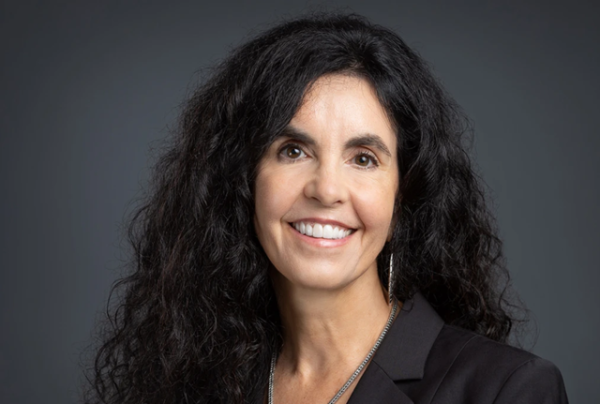
Cristin Reid, Chair and CEO of Capitol National Bank in Lansing, Michigan, will deliver the keynote address at Kalamazoo College’s 2025 Convocation on September 11 at 3:30 p.m.
Reid, a 1990 graduate of Kalamazoo College, has built a distinguished career spanning finance and law. Her early work in the legal field led to her appointment as counsel for a newly formed bank holding company led by her family; today, she serves as chair and CEO of that company, Capitol National Bank, where her leadership has been recognized nationally and statewide. Under her guidance, the bank was named a top five finalist in the country for “Extraordinary Bank of the Year” and was ranked by S&P Global in the top 100 banks in the country based on 2023 and 2024 performance. Reid was recognized by American Banker at the 2024 Most Powerful Women in Banking Gala and that year she and Capitol National Bank also were selected for the Influence and Impact Award in the Greater Lansing Entrepreneurial Awards. In 2025, she was named a Notable Leader in Finance by Crain’s Detroit Business.
In addition to her role at Capitol National, Reid is managing director of Access BIDCO, a regulated financial organization that delivers both financing and management consulting to small businesses, primarily across Michigan. She has served on the board at Access since 1994.
Cristin Reid ’90, the chair and CEO of Capitol national Bank in Lansing, Michigan, will deliver the 2025 Convocation keynote address at 3:30 p.m. Thursday, September 11, on the Quad at Kalamazoo College.
Her commitment to economic inclusion and community vitality also extends into the nonprofit sector. Reid is the founder of the Capitol Foundation, which offers immediate gap financing to small businesses and individuals who do not qualify for traditional bank loans. Since its start, the foundation has returned over $1.2 million back to the community. She serves on several boards, including the Lansing Economic Area Partnership Board and the Michigan Bankers Association Board.
Reid holds a bachelor’s degree in biology from Kalamazoo College, a juris doctor from the University of Toledo College of Law and an MBA from the University of Michigan.
Convocation marks the start of the academic year and formally welcomes the matriculating class of 2029 into the Kalamazoo College community. President Jorge G. Gonzalez, Vice President for Student Development J. Malcolm Smith, Provost Danette Ifert Johnson, Director of Admission Shannon Milan, Chaplain Elizabeth Candido, the Convocation speaker, faculty, staff and President’s Student Ambassadors will welcome students and their families. All students, families, faculty and staff are invited to attend in person or via livestream.
Kalamazoo College has appointed four faculty members as endowed chairs, recognizing their achievements as professors. Endowed chairs are positions funded through the annual earnings from an endowed gift or gifts to the College. The honor reflects the value donors attribute to the excellent teaching and mentorship that occurs at K and how much donors want to see that excellence continue. The honorees are as follows.
Sarah Lindley, Robert W. and JoAnn Stewart Chair
Lindley, a professor of art, previously received an endowed professorship when she was named the Arcus Social Justice Leadership Professor of Art in 2017.
Since 2001, Lindley has taught a range of ceramics and sculpture courses, and has managed and maintained K’s ceramics, sculpture and woodshop studios and equipment. Lindley served as an Arcus Center for Social Justice Leadership Faculty Fellow in 2010–11, and in that capacity helped found the Community Studio in downtown Kalamazoo’s Park Trades Center. She has had several solo, two-person and group exhibitions featuring her own work regionally, nationally and around the world.
Lindley earned her Bachelor of Fine Arts degree from the New York State College of Ceramics at Alfred University. She earned a Master of Fine Arts degree in ceramics from the University of Washington.
Sarah Lindley
Morgan Loechli, Dow Trustee Chair
Loechli, an assistant professor of physics, arrived at K in 2023 from Washtenaw Community College, where she was a part-time physics instructor while earning her doctorate.
Since then, Loechli has led six students in summer research and taught courses including Introductory Physics I and II, Introduction to Relativity and Quantum Physics, and Introduction to Climate Science. She conducted climate science research while earning her Ph.D. in applied physics at the University of Michigan. Loechli also has a master’s degree in applied physics from the University of Michigan and a bachelor’s degree in physics and mathematics from Dickinson College.
Morgan Loechli
Carlos Vazquez Cruz, Lucinda Hinsdale Stone Junior Chair
Vazquez Cruz has been an assistant professor of Spanish at K since 2022. His teaching interests include Spanish creative writing, Latin American contemporary narratives, Latin American poetry and the visual arts and music in Spanish Caribbean literatures. He has also written one hybrid book of mixed genres, two collections of stories, two novels, three collections of poetry and one book of essays, along with research articles in peer-reviewed journals. Five of his books have been awarded by the Puerto Rico PEN, and he received the Banco Santander Spanish Creative Writing Fellowship (NYU, 2008-2010), the New Voices Award (Festival de la Palabra de Puerto Rico, 2014) and the Letras Boricuas Fellowship (Flamboyán Foundation and the Andrew W. Mellon Foundation, 2022).
Vazquez Cruz holds a Ph.D. in Latin American literature with a graduate certificate in digital humanities from the University of North Carolina at Chapel Hill, a Master of Fine Arts in Spanish creative writing from New York University and a bachelor’s in Spanish education from the University of Puerto Rico at Rio Piedras.
Carlos Vazquez Cruz
Lanny Potts, James Stone Senior Chair
Potts, a professor of theatre arts, arrived at K in 1987 as the technical director for K’s Festival Playhouse. In addition to teaching classes in areas such as scenic design, lighting design and stage management, Potts serves as artistic director of the Festival Playhouse Theatre.
The Arts Council of Greater Kalamazoo awarded Potts last fall with a Community Medal of Arts. He also has received six Michigan Wilde Awards for Best Lighting for his work at Farmers Alley Theatre. At K, he earned the 2024–25 Lucasse Fellowship for Excellence in Scholarship, honoring his contributions in creative work, research and publication.
Potts has a Master of Fine Arts degree from Michigan State University and a bachelor’s degree from Valparaiso University.
A recent honor handed to Mary Jane Underwood Stryker Center for Civic Engagement Director Sashae Mitchell ’13 will help students continue strengthening community partnerships beyond Kalamazoo College through critical engagement and collaborative learning for years to come.
Mitchell is one of 18 faculty and staff from 13 states selected for the 2025–26 cohort of engaged scholars through Campus Compact’s Engaged Scholars Initiative. The effort is a professional-development program that supports early-career faculty and staff in strengthening their community-engaged efforts and programs.
Scholars were selected this year based on their commitment to centering equity in their civic- and community-engagement work. In applying, members of the cohort were asked to outline their interest in the program and share how they expect to grow with it.
“I am truly honored and elated to have been selected for the fifth cohort of Campus Compact’s Engaged Scholars Initiative,” Mitchell said. “It’s a privilege to work alongside an amazing group of faculty and staff from across the country who are deeply committed to advancing community engagement in higher education. This opportunity aligns closely with one of my core professional goals of developing my identity and practice as a community-engaged scholar and researcher, so I’m excited to grow through this experience.”
Throughout the academic year, Mitchell will participate in virtual meetings, in-person retreats and collaborative scholarly work to strengthen her own scholarship and, in turn, empower K students, faculty and staff and lead change in the Kalamazoo area.
“What excites me most about this opportunity is that it not only supports my own professional development, but also directly benefits the work of the CCE,” Mitchell said. “One of our ongoing priorities has been to amplify the impactful work happening through the CCE, both on campus and in the broader community, and being part of this national cohort will help us elevate our story, share our successes, and identify areas for growth.”
Sashae Mitchell ’13 has been selected for the 2025–26 cohort of engaged scholars through Campus Compact’s Engaged Scholars Initiative.
Mitchell earned a bachelor’s degree in mathematics at K, where she was actively involved in the CCE as a Civic Engagement Scholar through Community Advocates for Parents and Students (CAPS), a grassroots community organization that provides tutoring opportunities to Kalamazoo Public Schools (KPS) students who live at Interfaith Homes. It offers a structured but fun environment with relationship-based homework help, literacy and math support, field trips and information about getting into colleges. After graduating, Mitchell worked with the W.E. Upjohn Institute in Kalamazoo, where she contributed to research teams analyzing data on the Kalamazoo Promise and other aspects of KPS.
Mitchell later earned a master’s degree in international education and development from the University of Pennsylvania. Since then, she has worked with organizations in the U.S., South Africa and her home country of Jamaica, conducting research on educational disparities. She has also implemented and evaluated interventions and innovative solutions to address these inequities.
As the CCE’s director, Mitchell promotes, develops, manages, funds and evaluates sustainable and effective academic and co-curricular programs while building strategic relationships with community partners and faculty, overseeing programming, collaborating with on- and off-campus partners, and leading CCE teams.
“By learning alongside peers from across the country, I’ll gain new insights into best practices in community-engaged scholarship and programming,” Mitchell said. “These lessons will inform how we support our student leaders, strengthen our community partnerships, collaborate with faculty and deepen the impact of our work. Ultimately, this honor helps position the CCE to be even more intentional, reflective and sustainable in serving both our students and the community.”
Campus Compact Vice President Nicole Springer said each engaged scholar, including Mitchell, already has demonstrated an impressive level of dedication and passion for civic and community engagement.
“Each year, our engaged scholars learn with and from each other, engage in scholarship production, and connect in collaborative ways that contribute to their own individual leadership and the growth of the field of higher education civic and community engagement,” Springer said. “I can’t wait to see how this group progresses over the next year as they engage in this transformative process.”