A Grammy-award winning musician and storyteller will team up with a Grammy-award winning string quartet for a concert coming soon to Kalamazoo College with support from the Department of Music.
Robert Mirabal—an elder of the native American Taos Pueblo community—and ETHEL will share a united performance at 7 p.m. Thursday, November 13, at Stetson Chapel. The collaborators, through years of friendship, have developed a blend of joy, compassion and virtuosity in their previous programs including Music of the Sun, The River and Song for Taos.
Together, they offer a ceremony of original music, movement and wisdom through a new program titled The Red Willow, commissioned by the Taos Chamber Music Society. The pinnacle of the program is the central work, The Red Willow Suite.
ETHEL and Mirabal have performed across the United States, Europe, Africa and Asia together, and are sure to be appreciated by local audiences. Advance tickets are available online through the Connecting Chords Festival website. General admission is $22; seniors, veterans and active military are $18; ages 25 and under are $5; and a family of two adults and children are $40. Tickets also will be available at the door for $25, $20, $5 and $40 for these same groups.
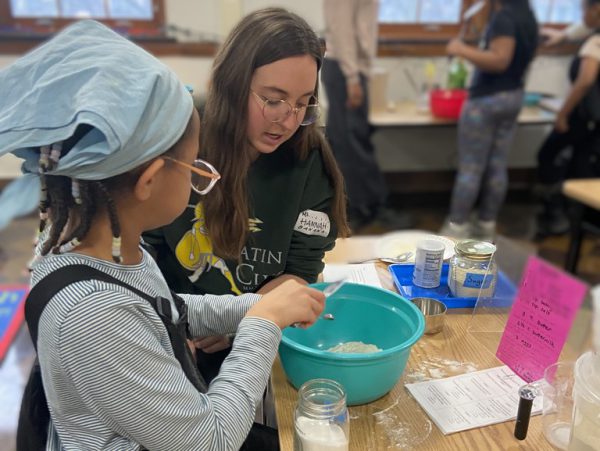
Civic Engagement Scholar Hannah Parsons ’26 and some Club Grub participants from Woodward School learn to cook new recipes in the Club Grub kitchen.
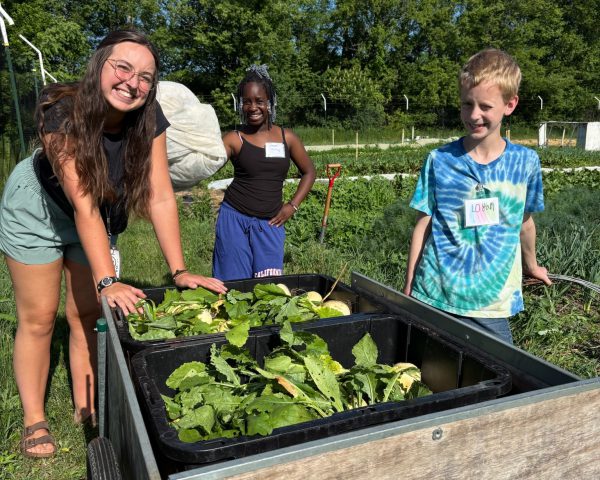
Parsons and two Dig it at DeLano participants harvested radishes at Delano Farms.
When a group of second and third graders at Woodward Elementary slices fresh tomatoes or pulls mint from the school garden, Kalamazoo College student Hannah Parsons ’26 sees more than an after-school activity. She sees the roots of community.
“They are certain it’s magic,” Parsons said. “We start Club Grub with piles of tomatillo vines, and two hours later, they’ve cooked a full meal for 20 people. They’re so proud of what they’ve made.”
That magic moment when a child realizes food comes from the Earth and not just a store shelf has shaped Parsons’ time at K. What began as volunteer work through the Center for Civic Engagement’s (CCE) Club Grub program has blossomed into a deep passion for food education, community partnership and public health.
“I was able to volunteer all through sophomore year, and now I’m the program’s Civic Engagement Scholar through the CCE,” she said. “It’s special to help lead a program that means so much to me.”
That enthusiasm carried into last summer when a Community Building Internship (CBI) allowed Parsons to continue her food education work with children. With her community partners at the Kalamazoo Nature Center—including Laurel Wong and the Fair Food Matters Program—she helped design and run Dig it at DeLano, a four-week experience about food, sustainable agriculture and the environment. At DeLano Farms, Parsons helped children grow vegetables, learn about local agriculture, and explore how food connects to the world around them.
“We spent long, sunny days out on the farm, which does a lot of community-supported agriculture work,” she said. “It brought together everything I loved about Club Grub, just on a much bigger scale.”
Club Grub describes itself as a cooking and gardening after-school program, but to Parsons, it’s much more.
“It’s about food, but it’s also about access, education and curiosity,” she said. “In my role as a Civic Engagement Scholar, I have led multiple workshops with my Club Grub volunteer team, and through these structured reflections, we talk a lot about food sovereignty and food apartheid— when communities are denied equal access to nutritious foods through oppressive historical practices. That’s very real here in Kalamazoo.”
She sees Club Grub as a way to uproot those inequities.
“I love seeing the kids get to experience so many types of food at such a young age,” she said. “The kids we work with are in second and third grade—peak Oreo and Cheeto time. But that’s also when you start forming habits that you’ll carry into adulthood. Showing them where food comes from, how it grows and what’s in season, that’s powerful.”
The Club Grub curriculum centers on seasonal produce, international cuisines and hands-on experiences. When guest chefs visit, the lessons become even more personal, and the children’s reactions keep Parsons motivated.
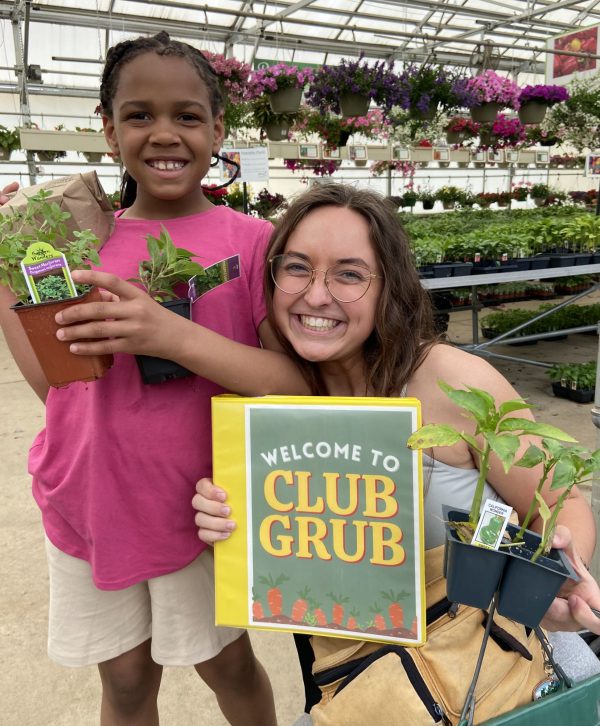
Parsons and a Club Grub participant visited Wedel’s Garden Center in May 2024 to learn about and buy vegetables and herbs for Woodward Garden.
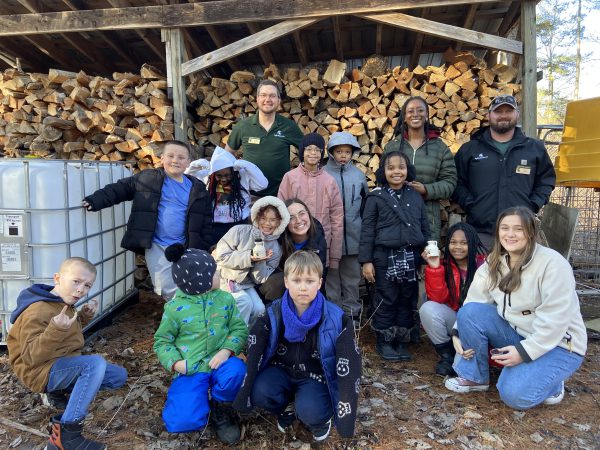
Woodward students and teachers joined Parsons in visiting Michigan State University’s W.K. Kellogg Experimental Forest to learn about maple syrup and buy some to use at Club Grub.
“Every time I walk into Woodward, they run up gushing about the dishes we’ve made or the field trips we’ve taken,” Parsons said.
Parents are often just as amazed.
“They’ll joke, ‘You cooked all that in two hours? Why don’t you do that at home?’” Parsons said.
For many children, Club Grub’s field trips are a unique chance to explore the wider community while connecting places with their food.
“They love piling into the van and discovering a new place just 15 minutes away,” she said. “A lot of them had never been to places like Woods Lake or the AACORN community farm. It’s such a joy to see them and the Kalamazoo College student participants experience that.”
Parsons also treasures how the program gives children ownership of their space.
“When we’re in the Woodward Garden, they get to plant, water and care for the beds,” she said. “The returning third graders love showing the second graders around. It’s this little moment of leadership that happens naturally and it’s something they can carry with them through school.”
Through her summer CBI, Parsons saw how her work fit into the broader network of Kalamazoo’s food systems.
“I learned how much community involvement goes into things we take for granted like where our cafeteria food comes from,” she said. “Seeing DeLano Farms producing so much food without heavy machinery or chemicals and then realizing that produce might end up at K or at the Valley Hub at Kalamazoo Valley Community College was eye-opening. Everything is connected.”
The CBI experience also deepened her understanding of reciprocity and humility in community engagement.
“It’s easy as a college student to slip into the mindset of thinking you know more than others because you are taking higher education classes,” Parsons said. “But the community is the expert of its own needs and desires. You have to show up, be curious, listen and build trust. My internship locked that in for me.”
She described her approach as meeting people where they are.
“I think it’s about asking, ‘How can we work together toward shared goals?’” she said. “I’m a temporary resident here, but the people I work with are permanent ones. I’ve learned that anywhere you go, you shouldn’t assume you’re the most important person in the room. Everyone’s knowledge matters and it’s important to look out for who doesn’t have a seat at the table.”
Those lessons are shaping Parsons’ path. She recently applied to the Master of Public Health program at Grand Valley State University, where she hopes to focus on community health education.
“My K-Plan has led me down a path of food and education,” she said. “I want to be a health educator and program developer, someone who helps people build healthier relationships with their bodies, their communities and their environment. I don’t know yet if that will be through a nonprofit, a hospital or a local government, but my experience with the CCE has shown me how all of those worlds connect.”
Parsons encourages other students to get involved with the CCE in whatever way fits their schedule.
“When I was a first-year student, I knew everyone in the CCE was super involved and I was afraid I couldn’t commit to that level,” she said. “But once I dipped my toe in, I realized there are so many ways to engage through classes, internships or programs like Club Grub.”
Her advice to fellow students is simple and heartfelt.
“If you care about food, which we all should because we eat every day, get involved. Club Grub is such a literal, ground-up way to connect with Kalamazoo. And if you love kids, this is the place for you. They’re hilarious and they remind me every day to stay curious.”
As for the Dig it at DeLano experience, she calls it one of the best opportunities she’s had at K. She also encourages other students to pursue a CBI.
“It’s flexible, it’s paid and it’s the best networking experience I’ve had,” Parsons said. “You get to meet community partners who really care about working with students, and you see how your ideas can make an impact. It’s a great way to embed yourself in the city, and I feel like I learned so much about what types of jobs exist in the world, especially those little niche ones. I could go and be one of 100 interns at Google, and that would be cool, but 99 other people would have that experience. These internships are one of a kind. They put a unique spin on working.”
Reflecting on it all, Parsons summed up what she’s learned from three years of digging, cooking and growing alongside Kalamazoo kids.
“Food brings people together,” she said. “When we share food and stories, we’re not just feeding ourselves, we’re building community.”
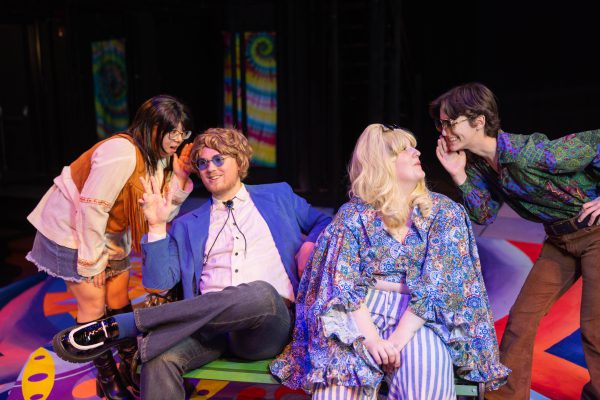
Jack Dewey ’27 will have a handful of flamboyant costumes to wear, including a bright blue velvet suit, when he plays a not-so-typical King Ferdinand of Navarre in the Shakespearean Love’s Labour’s Lost, coming to the Festival Playhouse.
Running November 6–November 9, the show takes the Bard’s witty comedy about love and vows and spins it into a vibrant 1970s spectacle filled with music, dancing and retro flair.
“We’ve got flashing lights, dance numbers, sequined costumes—everything is colorful, loud and alive,” Dewey said. “It’s less like seeing Shakespeare and more like watching Mamma Mia.”
Originally written in the 1590s, Love’s Labour’s Lost follows four noblemen who swear off women and worldly pleasures to focus on their academic studies—until a visiting princess and her ladies arrive, undoing their oaths. In this production, Dewey and his fellow lords are reimagined as having the swagger and energy of college fraternity brothers, complete with banter, bravado and bad decisions.
“I’ve never played someone who’s just an absolute jerk before,” Dewey laughed. “In most of my roles, I’ve been the hopeless romantic or the sad guy. This time I get to be a switchblade-comb-wielding, smooth-talking, terrible flirt, and it’s so refreshing.”
The cast of the Shakespearean comedy “Love’s Labour’s Lost” includes Hannah Ulanoski ’26 as Marcade (from left), Jack Dewey ’26 as King Ferdinand of Navarre, Morgan Smith ’29 as the Princess of France and Max Wright ’26 as Boyet.
The decision to set the play in the 1970s, Dewey said, came from the creative team’s desire to capture an era defined by liberation and self-expression.
“All of our costumes are incredibly sequined and shiny,” he said. “The ’70s were about freedom and individuality, and that fits perfectly with the play’s humor and feminist themes.”
A native of Minneapolis, Minnesota, Dewey said he hadn’t heard of Kalamazoo College until he began receiving recruitment emails. One campus visit changed his future, helped in part by having family living in southwest Michigan.
“I stepped foot on campus and thought, ‘This is what I want my college experience to look like,’” he said.
Since becoming a student at K, Dewey has performed in Eurydice and Little Shop of Horrors. Even with that experience, Love’s Labour’s Lost is his most physically demanding role.
“We’re running, sliding and lunging, all while speaking in Shakespearean English,” he said. “It’s wild, but this cast makes it so much fun.”
That cast includes several first-year students, including Morgan Smith as the princess of France; Jey Trebley as Berowne; Sam Pattison as Dumaine; Dewen Luo-Li as Rosaline; Laurel Stowers as Maria; and Abram Haynes as Longaville. Dewey said their energy has transformed rehearsals into what he calls the best kind of organized chaos.
“Half the cast are first-years, and they’re so loud, outgoing and funny,” he said. “It’s incredible to see the youngest people leading the charge.”
He also credits acting leaders such as Bernice Mike ’26 as Katherine, Owen Ellis ’27 as Costard and Max Wright ’26 as Boyet for the experience they bring to the cast. Despite the challenges of Shakespeare’s language, Dewey said the company’s modern take makes the story accessible and hilarious.
“I don’t always know what every word means, but I know what my character is trying to say,” he said. “That’s what makes it fun, translating Shakespeare’s intentions into something audiences can feel.”
For anyone hesitant about seeing Shakespeare, Dewey insists this production will change their mind.
“If anyone wants to dip their toes into Shakespeare, this is the play to see,” he said. “It’s an hour of chaos, comedy and color.”
Love’s Labour’s Lost will be staged at 7:30 p.m. Thursday, November 6–Saturday, November 8, and at 2 p.m. Sunday, November 9. Tickets are available through the Festival Playhouse box office website and by phone at 269.337.7333. For more information on the production, contact Theatre Company Manager Kirsten Sluyter at Kirsten.Sluyter@kzoo.edu.
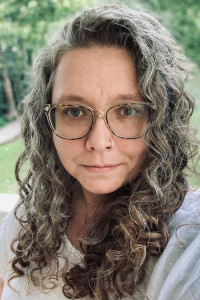
Henry Ford built cars, but author and scholar Kati Curts will highlight in an upcoming Kalamazoo College event how religion often drove him.
Curts, an assistant professor of religious studies at the University of the South, will deliver the 2025 Armstrong Lecture, titled How Ford Transformed Religion in America, at 4:15 p.m. Tuesday, November 4, in the Olmsted Room in Mandelle Hall. This event, presented by the Department of Religion, is free and open to the public.
In her book Assembling Religion: The Ford Motor Company and the Transformation of Religion in America, Curts explores Ford’s life as a devout Episcopalian, reader of New Thought philosophies, and fervent believer in efficiency as a moral duty with his business functioning as a kind of ministry. Her public talk will provide a religious history of Ford and the Ford Motor Company, repositioning them within critical studies of religion and examining how Ford helped transform American religious life in the 20th century.
The Armstrong Lecture series at K is made possible by the Homer J. Armstrong Endowment in Religion, established in 1969 through generous donations honoring Armstrong, an eminent pastor and longtime trustee of the College.
For more information, contact Academic Office Coordinator Sarah Bryans in the Department of Religion at Sarah.Bryans@kzoo.edu.
Kati Curts, an assistant professor of religious studies at the University of the South, will deliver the 2025 Armstrong Lecture at Kalamazoo College.
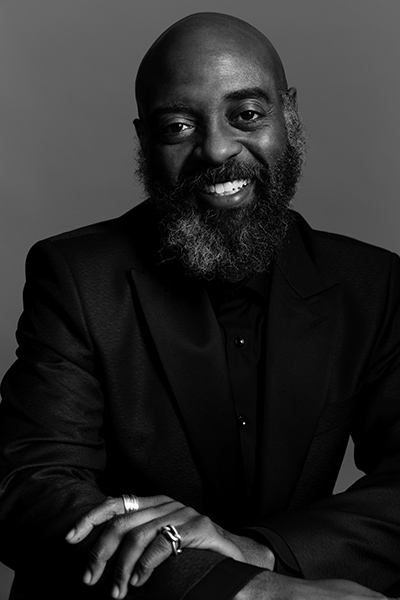
Kalamazoo College will help explore how art and paper can help us imagine freedom as the Arcus Center for Social Justice Leadership partners with the Kalamazoo Institute of Arts (KIA), Western Michigan University (WMU), and Kalamazoo Valley Community College to welcome Reginald Dwayne Betts for a series of community events in November.
Betts—an author, MacArthur Fellow, Yale Law School graduate and the founder of Freedom Reads—has transformed access to literature in prisons across the country. Since its founding in 2020, Freedom Reads has opened more than 500 Freedom Libraries in 13 states with support from the Andrew W. Mellon Foundation. The facilities offer spaces for conversation and reflection that connect incarcerated people with the power of books and imagination.
Betts’ Kalamazoo visit will coincide with the KIA exhibition Washi Transformed: New Expressions in Japanese Paper, which explores the expressive potential of Japanese handmade paper through the work of nine contemporary artists. Betts’ solo theatre piece, Felon: An American Washi Tale, similarly draws on the creative and liberatory possibilities of paper, incorporating a set designed from “prison paper” made from the clothing of incarcerated men.
Public events will include the following:
7–8:30 p.m. Wednesday, November 12: Betts will discuss his latest poetry collection, Doggerel, at WMU’s Multicultural Center in the Adrian Trimpe Building, 1003 Ring Road South. A book signing will follow.
7 p.m. Thursday, November 13: Betts will deliver a public lecture at the KIA, discussing Felon: An American Washi Tale, and performing an excerpt from the show.
2 p.m. Wednesday, November 19: The KIA’s Meader Fine Arts Library will host a discussion of Felon. Please note that Betts will not attend this event.
All programs are free and open to the public; some additional events are offered specifically for college students, including a student meet-and-greet at the Arcus Center before the Friday night discussion of Doggerel and a college tour of Washi Transformed: New Expressions in Japanese Paperon Thursday, November 13. Learn more and register at kiarts.org/betts.
A variety of musicians and ensembles will welcome audiences to several Kalamazoo College Department of Music fall concerts in November.
Academy Street Winds, The Roaring 20s
The Academy Street Winds will perform music from the Jazz Age at 4 p.m. Sunday, November 9, in Dalton Theatre at Light Fine Arts.
The concert will be headlined by Kurt Weill’s Suite from Three-Penny Opera, which reflects new musical trends that followed World War I.
The ensemble functions as a beloved creative outlet for woodwind, brass and percussion students. Community musicians joined the ensemble in winter 2016 to expand the group’s sound and capabilities. Adjunct Assistant Professor of Music Greg Bassett serves as the group’s director. Admission is free, but donations are appreciated.
College Singers, Harvesting Joy
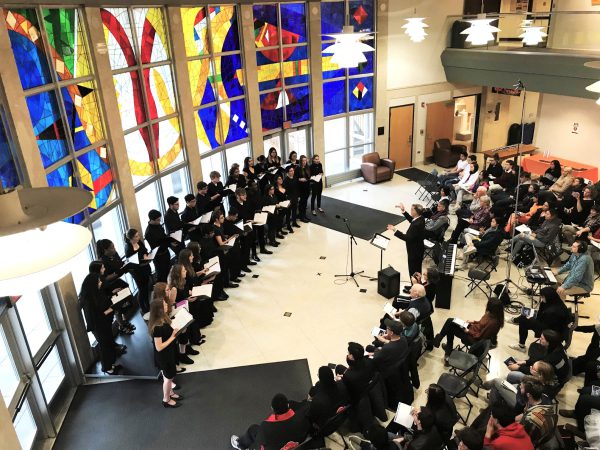
The College Singers, directed by Associate Professor of Music Chris Ludwa, invite audiences feeling anxious over current events to participate in a brief respite with a concert that promises melodies, harmony and poetry from humanity’s great traditions of wisdom.
Join this ensemble composed of mixed soprano, alto, tenor and bass voices representing music majors and non-music majors alike at 7:30 p.m. Wednesday, November 12, at Stetson Chapel. Adult tickets at the door are $15. K students are admitted for free.
The Kalamazoo College Singers will perform one of several music department fall concerts in November. Its performance is scheduled for 7:30 p.m. November 12 at Stetson Chapel.
Jazz Band, One Big Beautiful Biosphere
The Kalamazoo College Jazz Band, directed by Visiting Instructor of Music Sandra Shaw, will celebrate the intricacies of amazing cultures through music from the regions of North America, West Africa, Europe, the Middle East and Asia. The program includes pieces by popular artists such as Duke Ellington, Billy Strayhorn and Chick Corea.
Listeners are encouraged to dance if the music inspires them during the show at 7:30 p.m. Friday, November 14, in the Dalton Theatre at Light Fine Arts. Admission is free, although donations are appreciated.
Kalamazoo Philharmonia, Honor Your Elders
The Kalamazoo Philharmonia will feature composers who learned from the greats before them in its fall concert at 3 p.m. Sunday, November 16, in the Dalton Theatre at Light Fine Arts. Composers and pieces will include:
Maurice Duruflé: Trois Dances
Paul Dukas: The Sorcerer’s Apprentice
Andy Akiho: “in that space, at that time” from Sculptures
William Grant Still: Symphony No. 1, Afro-American
Founded in 1990 as the Kalamazoo College and Community Orchestra, the Philharmonia—directed by Professor of Music Andrew Koehler—brings together students, faculty, amateur and professional musicians of all ages to perform great music. Tickets at the door are $7 for general admission and $3 for students. Students with a valid Kalamazoo College ID will be admitted for free.
Kalamazoo College welcomed local and state officials, business leaders, community partners and friends to campus on Friday, October 24, for the College’s annual Community Breakfast. The event brought together representatives from more than 40 organizations, reflecting the strong relationships that connect K with the greater Kalamazoo area.
Each year, the College partners with local schools, nonprofits, and businesses to strengthen the region through learning, service, and collaboration. From community-based courses and paid internships to arts performances, athletics, and sustainability initiatives, the College generates both social and economic impact in Kalamazoo—contributing financially to the local economy, hosting events that drive tourism, and preparing graduates who continue to live and work in the area. Together, these efforts reflect K’s centuries-long role as an anchor institution and a contributor to the community’s growth and sustainability.
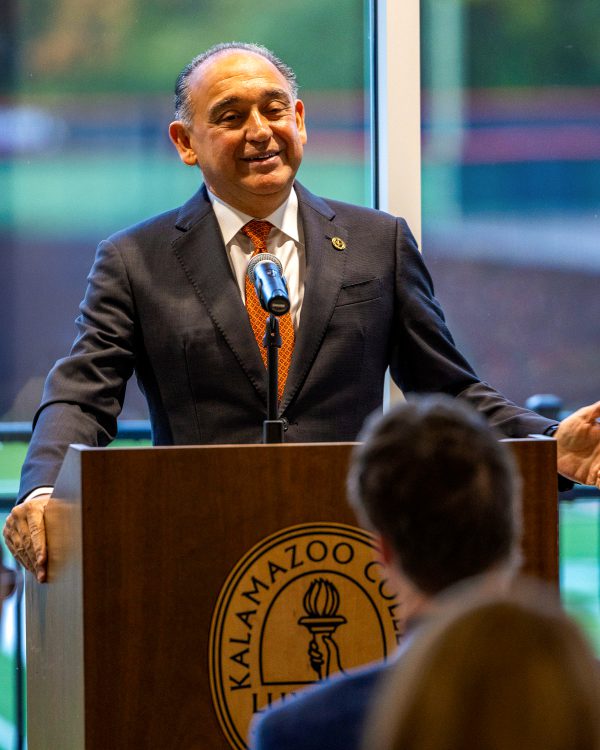
In his remarks, President Jorge G. Gonzalez, who will retire from the institution in June, reflected on the progress K has made since the start of his tenure.
“In the decade since I came to K, a lot has changed—new programs, new partnerships, new challenges,” Gonzalez said. “But one thing has remained the same: Kalamazoo College’s unwavering commitment to preparing students for lives of meaning and impact.”
Gonzalez shared that nearly 1,300 students began classes this fall, including 341 first-year students representing 20 states and six countries. The class is one of the most diverse in recent history, including 33% who are first-generation college students and 37% who are Pell Grant eligible, highlighting the College’s commitment to providing access to students of all backgrounds.
While K’s student body comes from across the U.S. and around the world, Gonzalez noted that K is home to 85 Kalamazoo Promise students who graduated from the Kalamazoo Public Schools, as well 26 Heyl Scholars. These numbers underscore K’s work to show local students that they can experience a transformative education and global opportunities right here in Kalamazoo.
These experiences were highlighted when Gonzalez recognized the conclusion of a four-year, $1.297 million initiative supported by the Andrew W. Mellon Foundation. Envisioned by Associate Professor of English Shanna Salinas, Associate Professor of Sociology Francisco Villegas and Professor Emeritus of English Bruce Mills, the HILL project fostered site-based collaboration among students, faculty, and community partners in Kalamazoo, New Orleans, St. Louis, and San Diego, exploring how the humanities engage with place, displacement, and community.
Several representatives of those community partners were in attendance at the breakfast as they kicked off a weekend-long conference to mark the project’s culmination.
Of the HILL project, Gonzalez said, “Students had the chance to step out of the classroom, partner with organizations here in Kalamazoo and across the country and see firsthand how their scholarship can make a difference.”
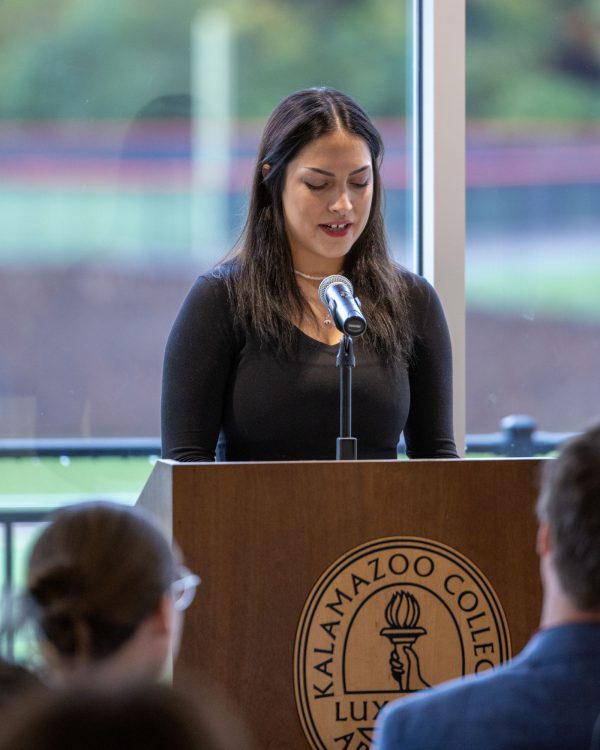
This experience was highlighted by recent graduate Melissa Preston ’25, a Kalamazoo native and critical ethnic studies and French double major who participated in the HILL project and traveled to New Orleans with the program.
“It’s one thing to learn about history, but I believe it is even more crucial to live, to see, to experience the reality these histories created,” Preston said. “My time in New Orleans was incredible; everything that we saw, learned, tasted, heard, did, and experienced was so rich. This experience was truly monumental in my own academic journey.”
Today, Preston is a bilingual teller at a local credit union, where she assists Francophone members throughout the state of Michigan. She noted that her experiences at K within an interdisciplinary program, “challenged me to rethink my own thought processes, sharpened my critical thinking and shaped my empathy toward others. It fueled my passion for learning, growing and always asking why…It exemplifies the liberal arts model and sets K apart in a way that should be supported and celebrated.”
Gonzalez closed the program by urging attendees to continue investing in education and the partnerships that make transformative experiences possible for college students like Preston.
“So many indicators of success—wealth, health, upward mobility, involved citizenship—trace back to education,” he said. “It is the foundation upon which individuals and communities rise…We can teach, we can inspire, we can communicate value, but we cannot do it alone. Our colleges and universities are ultimately community efforts.”
President Jorge G. Gonzalez welcomes 2025 Community Breakfast attendees to Kalamazoo College.
Alumna Melissa Preston ’25 talks about her student experiences with the Humanities Integrated Locational Learning (HILL) project at the 2025 Community Breakfast.
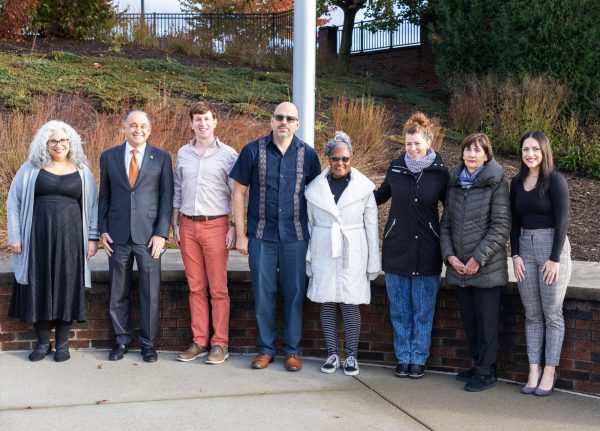
Community partners of the HILL project attended the 2025 President’s Community Breakfast. Pictured are Associate Professor of English Shanna Salinas (from left), President Gonzalez, Benjamin Looker of St. Louis University, Associate Professor of Sociology Francisco Villegas, Gloria Ward of Ms. Gloria’s Garden in New Orleans, People for Public Art Executive Director Monica Rose Kelly, Macrina Cardenas Montaño of Coalición Pro Defensa Del Migrante in Tijuana, Mexico, and alumna Melissa Preston ’25.
Kalamazoo College student Joe Caton ’26 has turned his lifelong interest in radio technology into an innovative conservation project at Sarett Nature Center in Benton Harbor, Michigan. For his Senior Integrated Project (SIP), Caton built a low-cost telecommunications system to help the center monitor its population of Eastern box turtles.
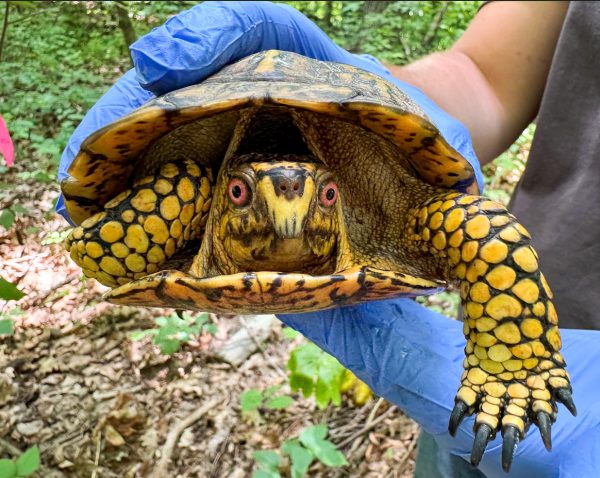
Sarett is home to several types of turtles, and some, including the Eastern box turtle, are listed as threatened species in the state thanks to humans changing their habitats and predators threatening their safety.
Eastern box turtles play subtle but significant roles in their ecosystems. As omnivores, they help control insect populations and disperse seeds from berries and other wild plants. Their presence affects the food web as both consumers and prey, and their nesting habits intersect with larger environmental issues. At Sarett, turtles have contributed to booming raccoon populations, which can overconsume eggs and disrupt long-term turtle survival.
Sarett staff and volunteers have long tracked the reptiles using older analog equipment that emits radio pings, requiring searchers to walk toward the sound to locate individuals.
Caton, who is a computer science major with a telecommunications background, saw an opportunity to modernize the process and make it more accessible for conservation groups with limited resources.
“Once I found out Sarett was still tracking these turtles, I reached out to see if I could help,” he said. “The receiver technology was the area with the least work being done, so that’s where I focused.”
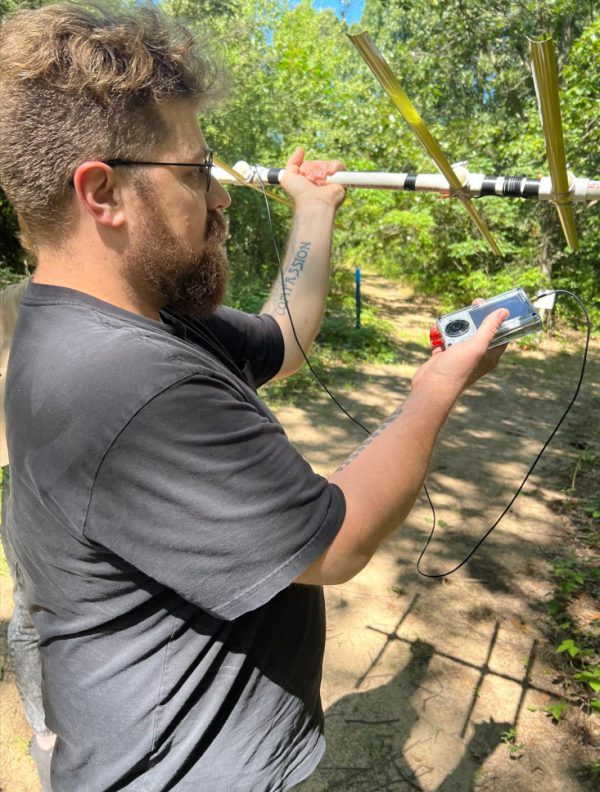
Caton sourced a software-defined radio device called a Hack RF, which can detect signals across a wide frequency range. He paired it with a screen for visualizing the turtle transmitters’ radio signals and built a homemade antenna using PVC pipe and a metal tape measure. When he and Sarett staff tested the system in the field, they were able to match pings to specific turtles based on recorded frequencies.
The equipment offers Sarett a flexible, open-source alternative to commercial radio trackers, which are costly and difficult to replace or replicate. Caton’s prototype can be produced at a fraction of the cost by printing circuit boards from existing online plans, making the approach scalable for other nature centers, research projects or youth-education programs.
Although Caton’s role focused on technology, he says his work has changed how he thinks about conservation.
“I hadn’t given a lot of thought to how computer science could be used this way,” he said. “Now I realize you don’t just have to use tools that already exist, you can make them yourself and tailor them to the work.”
Caton grew up in Three Rivers, Michigan, and first attended Glen Oaks Community College in nearby Centreville. He originally planned to pursue another degree path, but when Glen Oaks launched a computer science and cybersecurity program in 2020, he became one of its first computer science students. After completing his associate degree, Caton worked for a few years before deciding he wanted to finish a bachelor’s degree.
He had always been intrigued by K.
“When I was younger, I just wanted to go to K because everyone I knew was going to Western (Michigan University) and I wanted to be different,” Caton said with a laugh. “But as I got older and actually started reading about it and hearing graduates’ stories, it sounded like a place I would actually want to go.”
On a whim, he applied to K, assuming it would be too expensive. But the opposite proved to be true.
“I got this financial aid package in the mail that made it not only an option, but the cheapest option,” he said. “That pretty much answered the question for me.”
As a non-traditional transfer student at age 40, Caton expected to feel out of place at K. Instead, he again was surprised.
“The only person who ever brought up my age was me,” he said. “Once I stopped mentioning it, nobody else did either. Nobody looked at me funny or treated me differently. That made it a lot easier to just be a student.”
He quickly connected with computer science faculty including Professor Pam Cutter and Associate Professor Sandino Vargas-Pérez. Their accessibility and encouragement built his confidence to take on projects like the one at Sarett. Caton has also worked on campus in Media Services while balancing coursework and his home life.
Eventually, his SIP provided opportunities that Caton didn’t expect. He has been networking with professionals at the intersection of ecology and technology, and he plans to continue refining his prototype with Sarett. Using a Raspberry Pi—which is a low-cost, credit-card-sized computer—he hopes to combine radio tracking with image-recognition software being developed by WMU students to identify turtles by their unique shell patterns.
Caton’s SIP is complete, but the project continues and so does his enthusiasm.
“If you assume something like the conservation of Eastern box turtles doesn’t matter just because you don’t see the connection right away, you’re going to miss something important,” he said. “We don’t always know what role a species plays until it’s gone. That’s why this work matters.”
Q&A with Sarett Nature Center Executive Director Nate Fuller
Sarett Nature Center—less than an hour from Kalamazoo College between Benton Harbor and Coloma—is a nonprofit conservation organization dedicated to providing quality environmental education to the community. It has more than 1,000 acres along the Paw Paw River and is home to several state and federally endangered animals in addition to a rich variety of flora and fauna, representing much of what can be found in southwest Michigan. Children are free and admission is $3 for adults who want to hike the trails and visit the welcome center, which has animal displays and feeding stations that are enjoyable for all ages.
Executive Director Nate Fuller answered some questions for us about the nature center, the importance of eastern box turtles and Joe Caton’s contributions to their conservation efforts.
Question: Why are eastern box turtles important within their ecosystems?
Answer: Eastern box turtles are important because they act as seed dispersers, regulate prey populations, and serve as an indicator species for environmental health. Their role in dispersing seeds helps maintain plant diversity, while their omnivorous diet helps control insect and other small prey populations. Because they are so sensitive to changes in their environment, their presence or absence can signal the overall health of their woodland, wetland and field habitats.
Q: How threatened are these turtles?
A: Eastern box turtle populations are declining at all levels—nationally, regionally and locally. They can be found across much of the eastern United States, but they have some level of protected status in nearly half of the states where they’re found. In Michigan, the eastern box turtle was recently moved from “special concern” to “threatened” status due to their increased decline.
Eastern box turtles seem to be doing much better at Sarett Nature Center than anywhere else that they’re studied. By studying Sarett’s population, officials hope to better understand what the turtles need to thrive.Caton built a homemade antenna using PVC pipe and a metal tape measure.Caton sourced a software-defined radio device called a Hack RF (above), which can detect signals across a wide frequency range, and paired it with a screen for visualizing the turtle transmitters’ radio signals (below).Fuller had this to say of Caton’s work: “Joe’s work has the potential not just to make the research being done on Sarett’s box turtle population more effective and efficient, but it could also be a game changer for conservation efforts for all projects using telemetry.”
Q: Why is it important for Sarett to protect them?
A: Box turtles seem to be doing much better at Sarett Nature Center than anywhere else that they’re studied. By studying Sarett’s population, we hope to better understand what they need to be successful. Also, Sarett’s population is large enough that we have an opportunity to study their behaviors in a way that just isn’t possible at sites with smaller populations.
Q: What hands-on work is being undertaken at Sarett to help these turtles?
A: Work started a few years ago when Sarett hired John Rutger and his turtle dogs to help us find turtles. The idea was to demonstrate how working dogs help with conservation. We had no idea how many turtles he would find! The dogs found more than 60 turtles in four days at the nature center, and we had an inkling we were onto something special. Over the years since, we’ve documented more with few repeats while drawing attention from conservation professionals and researchers.
Maarten Vonhof at Western Michigan University is overseeing multiple research projects that are looking at genetics, shell patterns, habitat use, range sizes, nest-site selection, scent communication, disease and social behaviors. Watervliet High School Robotics Club members are working on micro-GPS trackers to add to turtles that already have transmitter beacons on them to better understand their daily movements. Sarett staff and volunteers are working on invasive plant species control to improve nesting and foraging habitats. And we are making plans for students, staff and volunteers to help identify, mark and monitor box turtle nests this upcoming spring.
Visitors to the nature center have been helpful in documenting box turtles. We also worked with WMU to set up an app for anyone who finds a box turtle to add them to our project. They can use their phone to take its picture and upload it to our database so we can build up our image catalogue and track locations of individuals.
Q:Has Sarett reached any important milestones in protecting the turtles?
A: We have hit some impressive milestones regarding the numbers of individuals we’ve identified at Sarett Nature Center. After four years of one-week surveys, we identified more than 300 individuals. After four weeks of intensive surveys in 2025, we were able to add more than 250 individuals to our inventory! We are still working on the data, but it looks like we have 600 individuals catalogued, which is many times more than any other single location documented anywhere.
The bloodwork collected this summer marks the largest genetic assessment of a box turtle population ever. The scent data collected is also the largest ever and will be the most comprehensive study ever done looking at box turtle communication via scent.
Q:How would you rate Joe Caton’s work and the importance of it in Sarett’s efforts?
A: Joe’s work has the potential not just to make the research being done on Sarett’s box turtle population more effective and efficient, but it could also be a game changer for conservation efforts for all projects using telemetry.
The costs of tracking are not just in designing the equipment used. A bigger expense comes from the time it takes humans to use the equipment, everything from training on how to use it to time in the field spent tracking down the animals. With more than 70 transmitters, it’s easier and more efficient to find transmitters in the field, and it will save us thousands of dollars. If you project that out to others using this technology, it could be a huge benefit for wildlife conservation.
A grant from the Andrew W. Mellon Foundation, provided to Kalamazoo College in 2022, will culminate this week with community partners from New Orleans, San Diego, St. Louis, Kalamazoo and more gathering at the College to share the successes of the Humanities Integrated Locational Learning (HILL) project.
The Learning in/from Place and Community Conference will take place Friday–Sunday, October 24–26. By bridging academic inquiry with local partnership, place-based practice, and regional perspectives, the conference offers a model for how liberal arts institutions can engage meaningfully with broad social themes.
“After four years of our students learning from community partners in each of these sites, we are excited to host many of them in Kalamazoo,” Associate Professor of Sociology Francisco Villegas said. “Here, they will be able to meet one another, connect with people doing similar work in Kalamazoo and across Michigan, and share lessons from their work. Each organization has substantial knowledge that is grounded in their geographic location and we hope the conference will further collaborations that will support our respective communities.”
The public is invited. No registration is necessary. Opening remarks will begin at 4:30 p.m. Friday in Dewing Hall, room 103, with a screening of the film BODEWADMI NDAW. A discussion will follow with filmmaker Davis Henderson ’25, artist Jason Wesaw of the Pokegon band of the Potawatomi tribe, and leaders from local Indigenous communities.
Saturday’s highlights include a plenary address by Jamala Rogers, the executive director of the Organization for Black Struggle, at 10 a.m. at the Arcus Center for Social Justice Leadership. Additional panels throughout the day will cover history and preservation, local priorities and cultivating community.
Moderators on Saturday will include K faculty members Christina Carroll, associate professor of history; Espelencia Baptiste, associate professor of anthropology; and Marquise Griffin, associate director of the Mary Jane Underwood Stryker Center for Civic Engagement. Panelists will include:
Lulu Urdiales of the Chicano Park Museum and Community Center in San Diego, Ben Looker of St. Louis University, Amber Mitchell of the Henry Ford Museum and Dylan AT Miner of the University of Michigan from 11:15 a.m.–12:45 p.m.
Jazmin Ortiz-Ash of the Kalamazoo County ID program, Macrina Cardenas Montaño of Coalición Pro Defensa Del Migrante in Tijuana, Mexico, Kenlana Ferguson of the Michigan Transformation Collective, and Sashae Mitchell of the Center for Civic Engagement from 2–3:30 p.m.
Gloria Ward of Ms. Gloria’s Garden in New Orleans, Hristina Petrovska of Kalamazoo Valley Community College, Jackie Mitchell of Integrated Services of Kalamazoo and Shane Bernardo from Food as Healing in Detroit at 3:30 p.m.
Associate Professor of Sociology Francisco Villegas
Associate Professor of English Shanna Salinas
Sunday will feature a digital humanities and student research exhibition from 9–10 a.m. at the Arcus Center. A plenary with People for Public Art Executive Director Monica Rose Kelly will follow along with a place-based art workshop featuring Kelly and Destine Price of the FIRE Arts Collaborative in Kalamazoo. The conference concludes with closing remarks at 12:30 p.m.
In 2022, the Mellon grant helped the College’s HILL project organizers design student coursework rooted in K’s commitment to experiential learning and social justice. The program addressed issues such as racism, border policing, economic inequities, homelessness and global warming, while examining history, how humans share land, and the dislocations that bring people to a communal space.
The project was envisioned by Villegas, Associate Professor of English Shanna Salinas and Professor Emeritus of English Bruce Mills. They invited K faculty to build curricula that reflected how power structures produce destabilizing dynamics and the collective responses of affected communities.
Students then had opportunities—locally and at sites across the country—to immerse themselves in heritage, culture, landscapes and community experiences through course materials, collaborative faculty-student research, community engagement, the development of program assessments and the sharing of oral histories tied to partnering projects and organizations. The Beyond Kalamazoo course clusters focused on themes of location and dislocation, emphasizing place-based learning through an integrated travel component in New Orleans, St. Louis or San Diego. The Within Kalamazoo cluster emphasized social issues in the Kalamazoo community. A digital humanities hub published, archived and assessed outcomes in coursework and partnerships.
The Learning in/from Place and Community Conference aims to show how the HILL project has deepened understanding of the humanities’ relevance to society by advancing innovative responses to interconnected issues through students and faculty. For more information, contact Salinas at Shanna.Salinas@kzoo.edu or Villegas at Francisco.Villegas@kzoo.edu.
Kalamazoo College is putting its commitment to sustainability into action with the construction of two new residence halls that will showcase energy efficiency and environmentally conscious building strategies when they open in fall 2027.
The structures are part of an effort to meet a growing need for affordable, on-campus housing as off-campus housing costs continue to increase. The project will provide space, primarily for juniors and seniors, for 218 beds. Associate Vice President for Facilities Management Susan Lindemann said the two buildings represent a major step in the College’s long-term goal of achieving carbon neutrality by 2050.
“At every stage of planning, we asked, ‘how can we lower our carbon footprint and create better living conditions for students?’” Lindemann said. “Our commitment to the environment goes back years, yet our housing stock hasn’t always reflected that because of its age. With these new halls, we’re putting our money where our mouth is and showing what our values look like in physical form.”
Geothermal System Replaces Fossil Fuels
The most significant feature distinguishing these residence halls from conventional buildings is a geothermal heating and cooling system that eliminates the need for fossil fuels. Instead of running on natural gas, the buildings will use a network of underground loops where fluid circulates through the ground to pick up or release heat. That steady baseline temperature drastically reduces the energy required to regulate an indoor climate.
Electric heat pumps bring the fluid to a desired temperature, and electric backup boilers provide support only during extreme cold.
“There is no gas line going to these buildings,” Lindemann said. “That’s important because it means we are not using fossil fuels to heat or cool them. We’re literally using the earth as a battery to stabilize temperatures, and then we only need a small amount of electricity to fine-tune it. In Michigan winters, there might be days when geothermal alone can’t keep up, but even then, our backup system is electric boilers, not gas. This is a huge step forward in lessening our reliance on fossil fuels.”
The geothermal field is being installed under what will be a parking lot, maximizing space and protecting the system from weather and wear.
Two new residence halls will have several features that support the College’s sustainability efforts when they open in fall 2027.
Work is progressing on the site of the new residence halls along West Main street.
Mass Timber Reduces Embodied Carbon
The structures will also use fire-rated mass timber as their primary structural material. Unlike traditional steel framing, mass timber is made from layers of smaller, sustainably harvested trees laminated together. This method allows builders to use farmed coniferous wood rather than cutting down old-growth forests or using large-diameter timber.
The cross-lamination process also strengthens the beams by alternating the grain, creating components that perform much like steel.
“It’s important to say that there is some steel in the building—there are pieces that are just very difficult to do in timber,” Lindemann explained. “But the largest part of the structure is mass timber, and that dramatically reduces embodied carbon. Embodied carbon is basically the carbon footprint associated with the lifecycle of building materials. These are laminated wood products, often made from smaller trees that otherwise couldn’t be used structurally. Instead of cutting down old-growth oaks, we’re taking coniferous trees from farmed sources and engineering them into beams that are incredibly strong. And because we sourced them domestically, east of the Mississippi River, we’re cutting down on the transportation footprint as well.”
Solar Power Designed to Meet Building Demand
To further reduce reliance on the electrical grid, the College is installing a bank of solar panels, designed as canopy-style carports over parking spaces, on the north side of the new lot. Because K owns and manages its own utility infrastructure, any excess generation can be redirected to other buildings on campus. The site has been designed so additional solar can be added as funding allows.
“This one bank of solar panels is designed to entirely sustain the building at peak demand,” Lindemann said. “That means this building can run on renewable energy alone when the sun is at its highest production. It’s also worth saying that this is a truly responsible way to do solar. We’re not taking farmland out of production or clearing forests to put panels up. We’re using a parking lot, which protects the geothermal field underneath while also giving us renewable energy.”
Native Landscaping and Green Roof Elements
The project’s landscaping features only native or climate-adapted plant species, eliminating the need for irrigation and reducing strain on groundwater resources. As climate zones shift with climate change, some plants traditionally native to areas farther south than Michigan are also used as naturalized selections that will continue to thrive in future conditions.
A portion of the connector building between the two residence hall towers will also incorporate trays of green roof vegetation.
“It’s not the entire roof,” Lindemann said. “The towers have pitched roofs, so we can’t do full green roofs there. But the flat connector is designed for trays of vegetation, which will insulate the building and help with air quality. It’s another way the building itself will be working toward sustainability.”
In addition, the project will create new outdoor spaces for students, including a small second Quad between the new buildings and Crissey and Severn halls, along with a front terrace where students can eat and spend time outside.
Built-In Fresh Air and Waste Reduction
Unlike most modern commercial buildings, these buildings will feature operable windows that will allow students to regulate temperature and reduce reliance on mechanical heating and cooling when weather permits. Sensors in each room will help manage temperature and reduce wasted energy when windows are open.
“We wanted students to have the ability to get fresh air, not just rely on HVAC,” Lindemann said. “In a lot of modern buildings, you can’t even open a window. Here, students will have that option, and the system is designed to sense what’s happening in the room and adjust. That way, students can use outside air to cool down rather than running air conditioning.”
Waste reduction is also top of mind in the design. The halls will include space and access for pickup by the College’s commercial composting partner, an option not currently available elsewhere on campus.
“Students will be able to compost food waste easily, which is a huge step forward,” Lindemann said. “Between composting, fresh-air circulation and renewable electricity, the way students live in this building will inherently be more sustainable.”
Supporting Students and the Broader Community
The new residence halls are designed not only to reduce energy use but also to shift student housing patterns in the surrounding neighborhood. Many students currently live in older off-campus houses that are poorly insulated, heated with fossil fuels and expensive to maintain.
“When students live in these old houses, they’re often paying high rents to landlords who aren’t affected by how much it costs to heat the place because the students pay the utility bills,” Lindemann said. “Older homes can be incredibly inefficient. Heat goes right out the roof, out the windows, out the walls. By moving students into high-efficiency halls, we’re not only lowering their carbon footprint but also opening those houses for families, who are more likely to renovate, insulate and make the houses sustainable in the long run. That’s good for the community and the environment.”
Tree Stewardship and Replanting
Lindemann anticipated concerns in the community about tree removal early in the planning process. She noted that many of the trees removed were in decline and unlikely to survive construction. Plus, newly planted trees that had been added along Catherine Street were carefully relocated to other parts of campus rather than chipped or discarded. New plantings will also take place.
“For every tree we took down, we’re replanting four,” Lindemann said.
Sustainable Transportation Options
To make lower-impact commuting more accessible, the new parking area includes a secure bike storage facility with key-card access. The enclosure will protect bikes from weather and theft and will be open to all students, not just residents of the new halls.
“A lot of students have told us they’d like to bike, but they don’t have a secure or covered place to store a bike,” Lindemann said. “So, we’re building an enclosed structure with card access where students can lock bikes, keep them dry, and feel confident using them.”
An Investment in the Future
Locally sourced materials, renewable energy systems, and high-efficiency design required a significant upfront investment, one that Lindemann said aligns with campus values.
“This building could have been built less expensively in the financial sense,” Lindemann said. “But we chose to walk the walk and spend money on things that would use less energy and lessen our carbon footprint. When you look at geothermal, mass timber, solar, native landscaping and composting, I think we were able to include some really impactful items without pricing ourselves out of reach. It’s painting a picture of who we are as a college.”
Lindemann noted that as we approach future projects, there is not a one-size-fits-all approach to sustainability.
“Every building has its own story,” she said. “In this case we had the open land to install geothermal and solar, so we took that opportunity. Another project might look different. But what will stay consistent is our dedication to being as sustainable as possible in every container we have to work with.”