What’s for Lunch? 25 Years of Inspired Science in Schools

Sisters in Science experiment
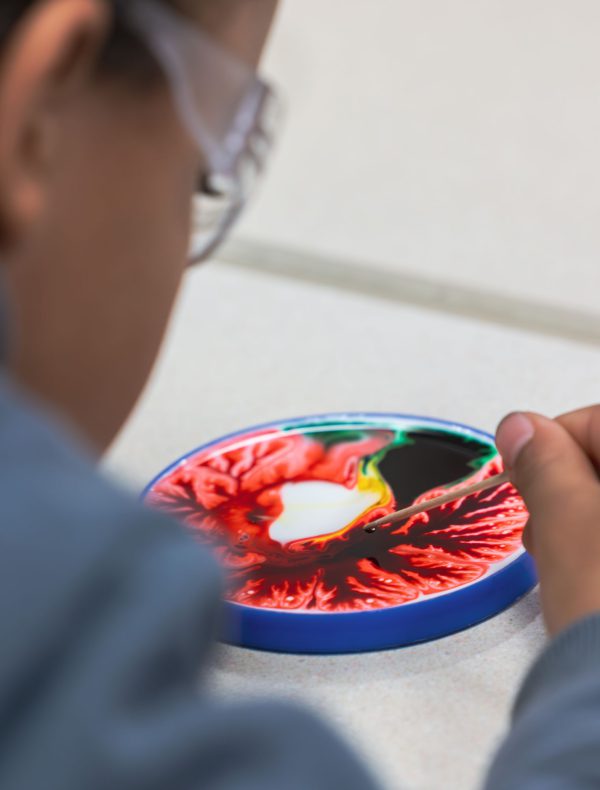
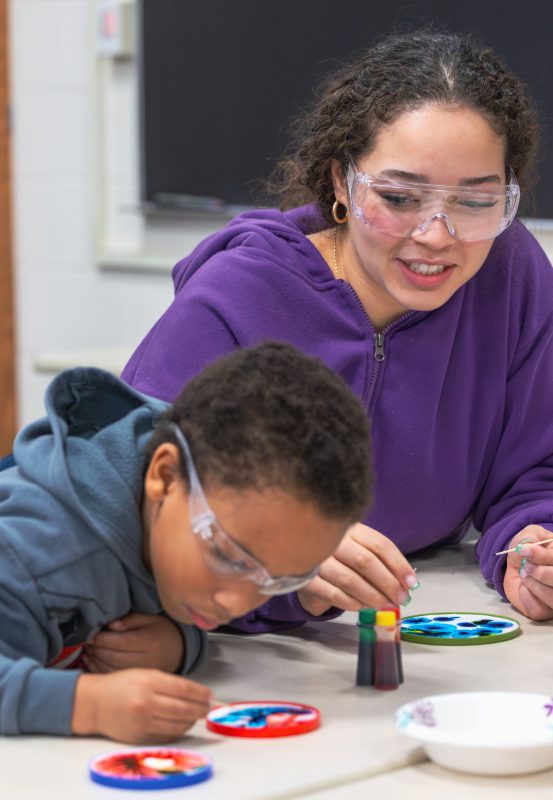
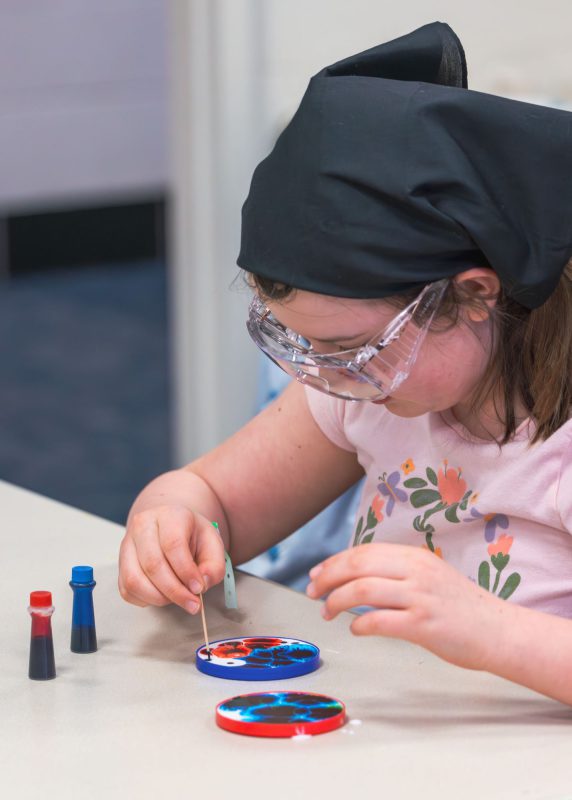
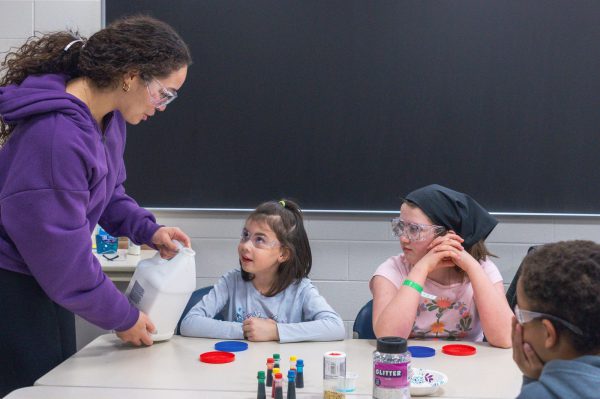
Pauline Hawkes ’26 leads Luella Tresca, Lu Moon and Adwin Williams in a science experiment.
Sisters in Science experiment

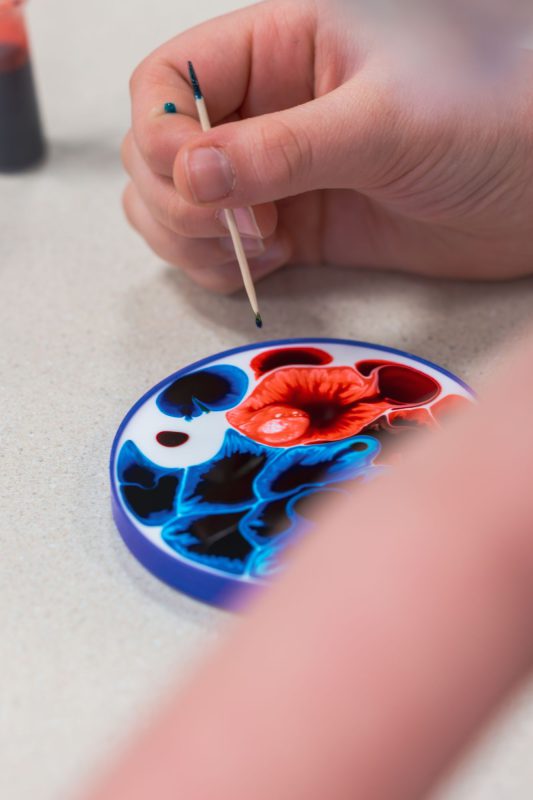
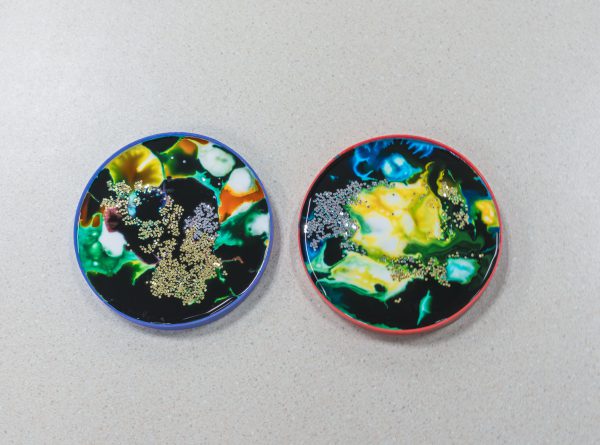
One recent afternoon at Northglade Montessori Magnet School in Kalamazoo, fourth and fifth graders gathered around a table for a simple science experiment involving water, soap and glitter. 

“Think about what happens when germs spread,” a college student presenting the experiment told them. 

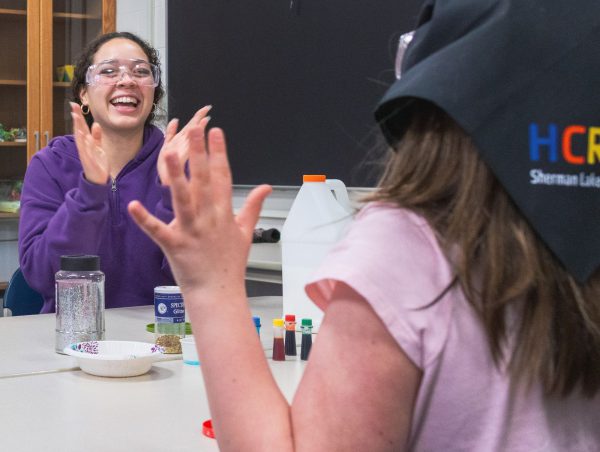
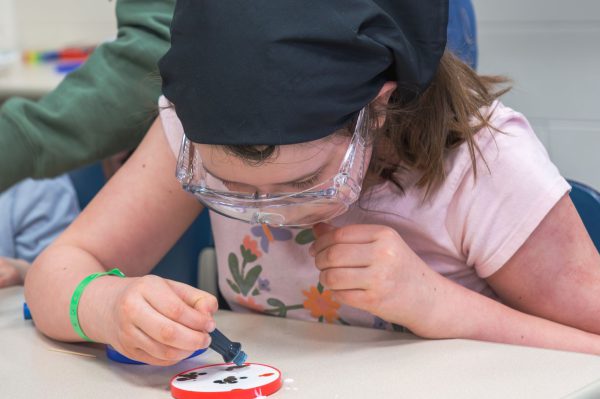
Moments later, a finger dipped into the mixture, and the glitter scattered across the surface of the water. The room filled with laughter, surprise and a few delighted yells of “Whoa!” 

For the kids, it looked like magic. For the mentors leading the activity, it was something more powerful. It was a chance to spark curiosity about science through a lesson that showed just how quickly illnesses can jump from one person to another. 

The demonstration was one small moment in a program that has quietly shaped young learners in Kalamazoo for a quarter century. Sisters in Science—a student organization at Kalamazoo College—is celebrating its 25th anniversary of presenting hands-on STEM experiences to local kids. The group partners with Communities In Schools of Kalamazoo to visit youths at Northglade and Woodward Elementary, where K students run experiments and serve as mentors for children discovering science in new ways. 

A Founding Conversation 

Sisters in Science owes its existence to a chance conversation on a school sidewalk. Regina Stevens-Truss, the Dorothy H. Heyl Professor of Chemistry at K and the program’s faculty advisor since its founding, arrived at Northglade in 2001 to pick up her children. A sixth-grade teacher pulled her aside with a question that would stay with her. 

The teacher had noticed that her female sixth-grade students consistently outperformed the boys in math and science. But when she saw those same students again in ninth grade, something had changed. The girls who once loved science no longer seemed interested. She wanted to know why. 

Stevens-Truss couldn’t stop thinking about that conversation. Research backed what the teacher had observed: girls often lose interest in science and math during the transition from elementary school to junior high, as social pressures begin to reframe those subjects as less compatible with femininity. She brought the idea of a mentorship program to the chemistry department’s office coordinator, who suggested the name Sisters in Science, and then to Leslie Tung, who was serving as interim provost at the time. Tung pointed out that every department in the science division had at least one female faculty member, and he encouraged Stevens-Truss to build a program in which K students would mentor girls at Northglade. 

Sisters in Science launched as a one-on-one mentoring program, pairing individual K students with sixth-grade girls at the school in a big sister, little sister model. The pairs would meet weekly to talk about science, math and what it meant to be a young woman with those interests. As demand grew and the sixth grade was moved to the middle school, the model shifted from individual pairings to group sessions at Northglade, and now also at Woodward Elementary School. While the program originally focused on encouraging girls to pursue science, feedback from students led Northglade organizers to expand participation so boys could join as well. The college mentors remain the “sisters” leading the activities, but the sessions now welcome all students. The change reflects the program’s broader mission, which is to make science accessible to everyone. 

From Lunch Tables to Laboratories 

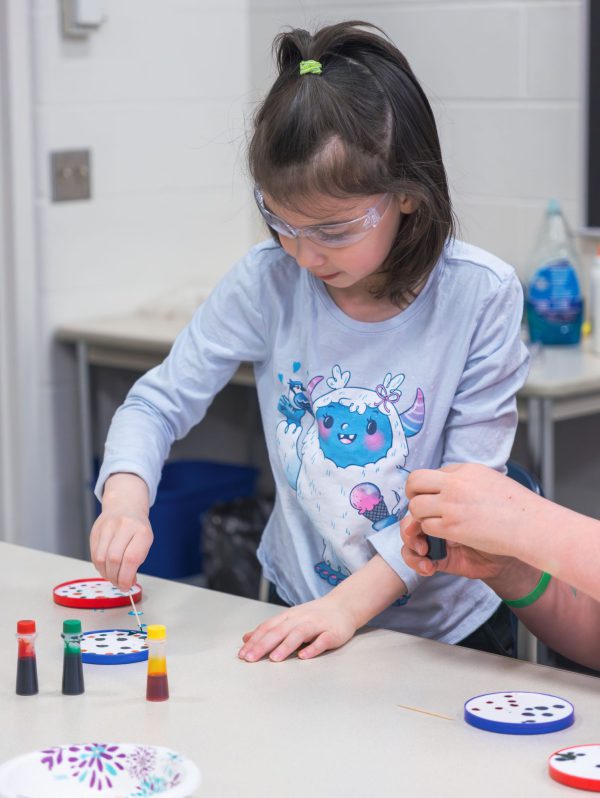
The program is simple but effective. Students bring their lunches into a classroom, where the college volunteers introduce a short experiment. Before long, the room becomes a laboratory filled with egg drops, slime, miniature rockets and glitter experiments. 

“They eat their lunch, and then they pretty much jump right into it,” said Emma Braford, a site coordinator at Northglade for Communities In Schools of Kalamazoo. “They’re always very hands-on. It’s all very fun and interactive things that get the kids really engaged with science and loving science in a way that’s not just textbooks.” 

The program typically serves about 30 elementary students across the partner schools, with three to five K students guiding activities each visit. Over the course of the school year, the mentors work with the same groups of children, building relationships along the way. That mentorship, Braford said, can be just as important as the science lessons themselves. 

“I think it’s cool for them to have that older peer mentor relationship,” she said. “The college students intentionally get to know four or five of the students really well over that time.” 

Opening Doors to Science 

Sisters in Science is led this year by Pauline Hawkes ’26 and Madison Vrba ’26. 

For Vrba, a biochemistry major, the organization represents a natural blend of two passions, science and mentorship. Before joining Sisters in Science, she worked as a pitching instructor for young softball players and discovered how empowering it could be for young girls to realize what they could do. 

“When girls feel confident exploring science and asking questions, it not only benefits them individually but also strengthens the entire scientific community,” Vrba said. 

Historically, STEM fields have been male dominated, she noted, which can make it harder for girls to picture themselves in those careers. Programs like Sisters in Science help change that narrative by introducing science early and making it approachable. 

Success, Vrba said, often comes in small moments. 

“If even one student walks away feeling more confident about science or more interested in learning how things work, I consider that a success,” she said. 

Inspired to Give Back 

For Hawkes, a biology major who hopes to pursue a career in physical therapy, the motivation to mentor younger students is personal. 

Growing up, she watched her mother navigate a series of back injuries and surgeries, which sparked her interest in the human body and how it works. She also had an influential role model close to home in her older sister, Isabelle Hawkes ’24, who was also involved in Sisters in Science. 

“I’ve always looked up to her,” Hawkes said. “She was able to answer questions and help me understand things when I was struggling. I want to be that resource for other people and open doors they might not know existed.” 

Each week during the academic term, Hawkes and other leaders visit partner schools for two days between classes. The goal isn’t simply to perform experiments, she said. “We’re just learning together,” Hawkes said. “It’s a safe, comfortable space where they’re not afraid to ask questions or try different things.” 

Learning Science Through Discovery 

But the lessons go beyond the experiments. Sometimes, students are surprised simply to learn that the College mentors are studying science themselves. 

“I’ve heard some of them say things like, ‘We didn’t know you could study this in college,’” Braford said. “It gives them a broader perspective of different career options that exist.” 

“It’s important for everyone to see what’s possible,” Hawkes said. “This is where you’re developing your interests.” 

That openness, along with the enthusiasm of both the college mentors and elementary students, helps explain the program’s longevity. 

One alumna whose connection to Sisters in Science continues to resonate is Caitlyn VanGelderen ’12. She was deeply devoted to the program during her time at K. Caitlyn loved combining her passion for chemistry with her commitment to mentoring younger students, and she found joy in helping elementary girls discover their own interest in science. Since her passing in 2020, her parents have honored that passion by making annual donations to support Sisters in Science in her memory, ensuring the work that meant so much to her continues to inspire new young scientists. 

“I think people want to be part of it,” Hawkes said. “There’s always going to be interest in teaching kids about science and letting them do experiments they might not otherwise have the opportunity to try.” 

A Spark for the Future 

As Sisters in Science marks its 25th anniversary, the leaders hope to celebrate the milestone with commemorative T-shirts for participants and increased visibility for the program. But the true impact is less tangible. It’s the moment when a student’s eyes widen during an experiment, the moment when a child asks a question no one expected, or the moment when a young student realizes science might be something they love. 

“Science can sometimes feel intimidating,” Vrba said. “But programs like this show students that it can also be creative, fun and something they’re a part of.” 

Stevens-Truss sees the secret to its longevity in the relationships it builds across multiple constituencies at once: the K students who join as first-year students and grow into leaders, the elementary students who see themselves reflected in the mentors above them, and the community partners who have been with the program since the beginning. 

Stevens-Truss said she does little to keep the program running year to year. Each spring, the current leaders identify their successors. Each fall, she reaches out to those students, and they take it from there. The group maintains its own website and keeps its supplies—reagents and materials for experiments—in a cabinet in the science building. 

“There’s never been a year since we started Sisters in Science that the program has not run,” she said. “I don’t hound them; they come to me.” 

And if the excitement in those classrooms is any indication, the next 25 years of Sisters in Science might inspire just as many future scientists as the first. 
Sisters in Science experiment
College student and child performing experiment
Sisters in Science experiment
Kids performing experiments

Study Abroad Leads to Marine Research Adventure

A student and professor performing marine research in the Galapagos Islands
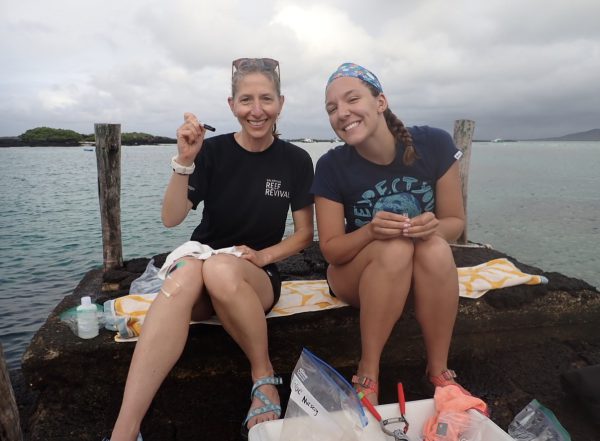
Hailey Yoder ’26 (right) teamed up with Cheryl Logan, a professor at Cal State Monterey Bay, on labeling tubes for data collection in the field.
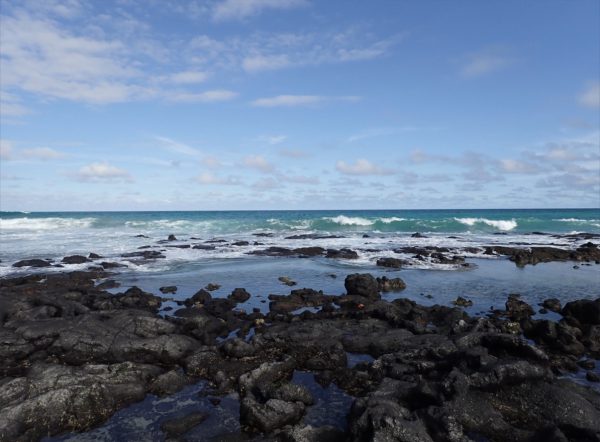
A view from the shore in the Galapagos Islands where Hailey Yoder performed marine research
Yoder’s favorite hike in the Galapagos Islands took her to a tide-pooling area where she saw starfish, small fish, crabs and small octopi.

When Hailey Yoder ’26 tells people she researches coral reefs, their response is often the same: “You live in Kalamazoo, Michigan. How do you do that?”  

For Yoder, a Kalamazoo College double major in biology and Spanish, the answer is both simple and extraordinary: It started with sending an email.  

That email, sent during her study abroad program in Ecuador, connected her with Margarita Brandt, a biology professor at the Universidad de San Francisco de Quito, who works with Galápagos Reef Revival. What began as a conversation about potential research ideas soon evolved into an opportunity to study coral reef restoration in the Galápagos Islands.  

“We just clicked and worked really well together,” Yoder said. “She invited me onto a project, and I really was just hoping that it would work out.”  

Bringing Coral Reefs Back to Life  

Yoder’s research starts with how climate change and ocean acidification have affected coral reefs in the Galápagos. The islands once boasted several coral reefs, but many have been wiped out by bleaching, leaving remaining structures vulnerable to complete destruction.  

The restoration process involves collecting coral fragments from around the islands and growing them in underwater gardens, where they’re suspended from ropes and nourished by ocean currents. Once mature, researchers implant them into the seafloor in organized patterns. To assess the impact, Yoder used GoPro cameras mounted in waterproof cases and weighted with zip ties—nothing fancy, she noted—placing them at consistent locations near restored coral sites. Through snorkeling expeditions, she positioned the cameras to capture the ecosystem unfolding around eight or nine individual corals. All the research was done under permits from Galápagos National Park and CITES, the Convention on International Trade in Endangered Species.  

The results have been striking. At the first site Yoder analyzed, two new fish species appeared after restoration. Afterward, four or five additional species flourished.  

Community at the Center  

What distinguishes this research is its deep connection to local communities. The project employs Galápagos residents, including one community member who maintains and monitors the corals year-round. Researchers also lead programs bringing women and children—particularly those without previous opportunities to explore their island’s underwater world—on snorkeling expeditions to witness the restoration firsthand.  

“There are intricacies to coming into someone else’s home to perform research,” Yoder said. “I tried to focus on community and the local knowledge that people have.”  

This community-centered approach culminated in a symposium in the Galápagos, where Yoder presented her research entirely in Spanish. She created a Spanish-language research poster and discussed her findings with community members invested in their island’s ecological future.  

“They were all super excited about it and thought it was really cool,” she said. “It was pretty fun to be able to have that connection, too.”  

Taking Marine Research to the National Stage  

Yoder’s work has gained recognition beyond the islands. This January, she traveled to Portland, Oregon, to present a poster at the Society for Integrative and Comparative Biology (SICB) conference, arriving just before K’s winter term began and returning during the first week of classes.  

The conference provided invaluable networking opportunities. A postdoctoral student from Boston’s National Institute of Health, who had previously worked with the same corals and researchers, offered career guidance and suggestions for future research directions. Yoder connected also with fellow undergraduates navigating similar paths.  

“With these conversations, I recognized that there’s not necessarily a right or wrong path to going into some sort of research like this,” Yoder said. “That was reassuring.”  

K’s Role in Marine Success  

Yoder credits K’s biology and Spanish departments along with the Center for International Programs with making her research possible. In all, they provided funds through: 

  • The Betty R. Gómez Lance Award in Latin American Studies, which was established by Lance after her retirement from K. It has been awarded posthumously until her passing in 2016; 
  • Jim and Deanna Tiefenthal Endowed Foreign Study Fund: established by Jim and Deanna (members of the class of 1966) in 2016 to support student international learning opportunities through K’s study abroad program; and 
  • Seminary Hill Sustainability Internship: established by Doug Doetsch ’79 and his wife, Susan Manning, to fund internships focused on sustainable agriculture or architecture.    
Marine research team poses near the ocean after a day of collecting data
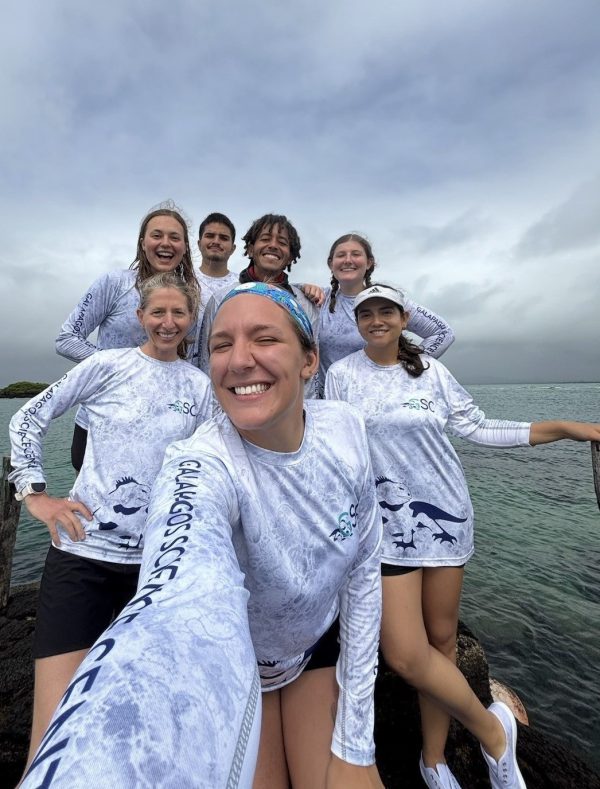
Emma Saso (back row, from left), Daniel Velasco, José Barrios and Ava Besecker with Logan (front from left), Yoder and Catalina Ulloa after a full day of collecting data for marine projects.
Student in snorkeling gear while performing marine research
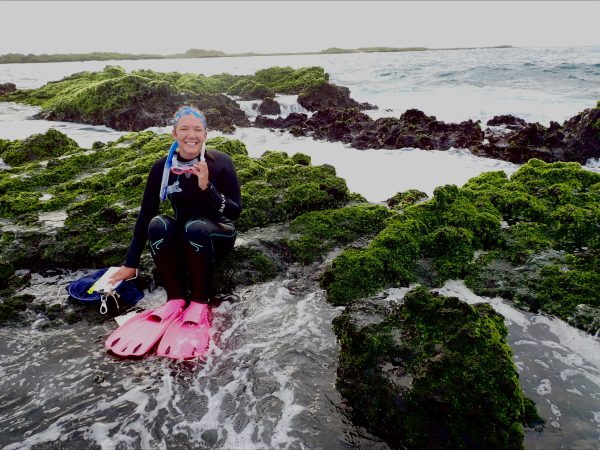
Yoder waited on the rocks right off of the bay where the coral sites are located, just after placing video cameras. “We waited here for 15 minutes as to not disturb the fish community and be out of the way before recollecting the cameras,” she said.
Student prepares to perform research in a wet suit
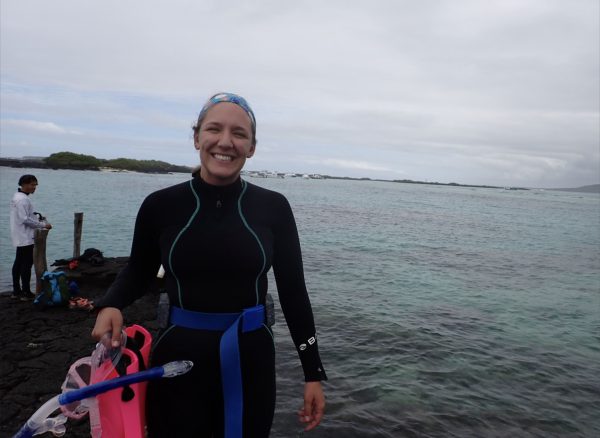
Yoder prepares to place cameras before snorkeling around to get a feel for the location and different plots and determine the most efficient way to take quality videos. 
An underwater view of a coral reef and a shark
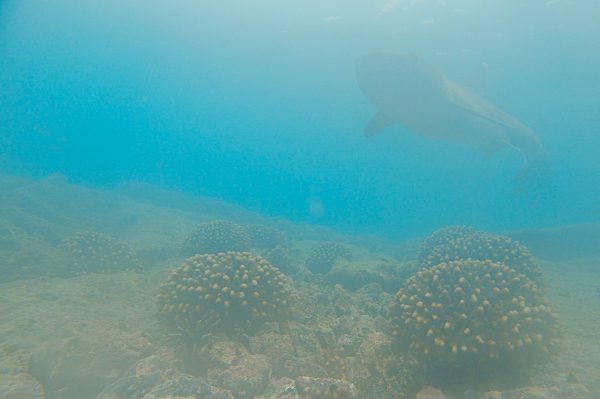
Yoder had GoPro cameras mounted in waterproof cases and weighted with zip ties so they could be placed at consistent locations near restored coral sites.

Associate Professor of Biology Santiago Salinas has been particularly supportive, helping Yoder refine her research question while providing guidance as she writes her SIP. Professor of Biology Binney Girdler has assisted with data visualization and helped Yoder narrow her focus. The department also helped fund her Portland conference trip.  

“They were supportive and beyond excited for me,” Yoder said. “To have a professor you look up to say that you’re doing something they’re proud of is so cool.”  

An Unexpected Love for Corals  

Yoder admits she initially gravitated toward sharks within the field of general biology, not coral reef or fish. However, the research transformed her perspective.  

“I gained this strong love for corals, because the way they work is so interesting, and they provide so many amazing services for the land and fish that they’re near,” she said.  

Her biology major, enhanced by marine research experience, positions her well for graduate school. She has applied to a master’s program to work with a different researcher studying the same coral reefs, with hopes of returning to the Galápagos over the next year to collect data from different reefs and expand her video collection. Her ultimate goal is to publish her research.  

“My knowledge is so much stronger because of the undergrad opportunity,” Yoder said. “But this master’s program will be a huge thing as well, because it will allow me to dive into the specifics and work more closely with coral scientists.”  

Advice for Future Hornets  

For prospective biology students, Yoder emphasized the opportunities available to those willing to pursue them. But opportunity requires initiative.  

“Sending the first email was just the first step of all of the things I’ve had a chance to do, because K gives you so many opportunities,” Yoder said. “You just need to be able to take advantage of them. Those resources will be there, but you have to reach out and ask for them. The answer is going to be ‘yes,’ if they can make it work.”  

Her message is clear: “Send the email and do the thing you want to do. Advocate for yourself.”  

For Yoder, that single email led to underwater gardens in the Galápagos Islands, international research presentations, professional connections across the marine biology field, and a future dedicated to understanding and protecting coral reef ecosystems—all from Kalamazoo, Michigan.  

Pitcher’s Thistle Protectors Collaborate on Beaver Island

Three students taking notes on plants on Beaver Island
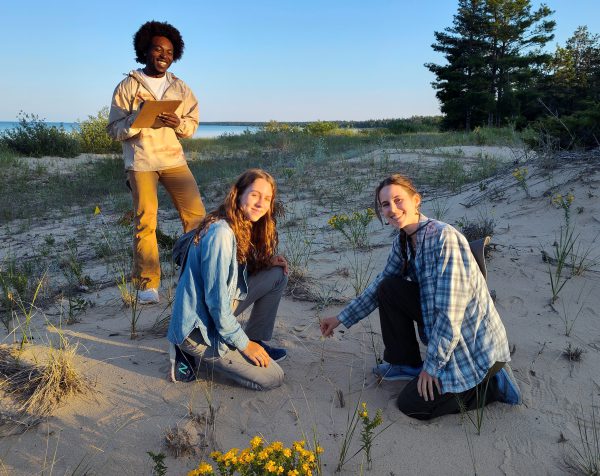
By the end of the summer, Caleb Jenkins ’26, Willow Hayner ’27 and Mairin Boshoven ’25 had recorded data on nearly a thousand Pitcher’s thistle seedlings, some barely a half-centimeter tall, on Beaver Island.
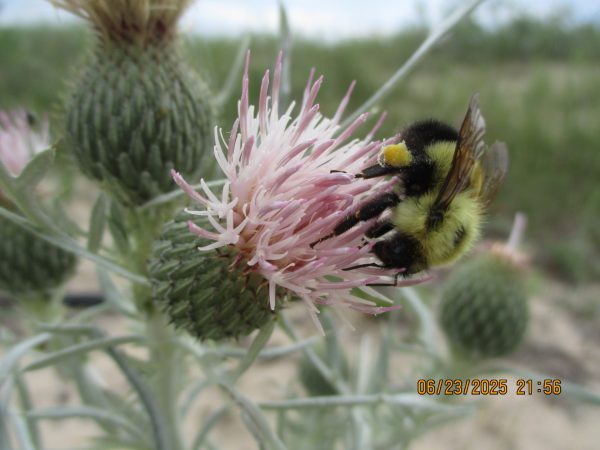
A bee gathers pollen from a Pitcher's thistle plant
Pollinators such as bees, monarchs and hummingbirds rely on Pitcher’s thistle for food in the early spring before much else blooms.

Surrounded by the waters of Lake Michigan, between the state’s Upper and Lower Peninsulas, three Kalamazoo College students spent their summer with Professor of Biology Binney Girdler, studying a small species of plant that fulfills big roles.

Caleb Jenkins ’26, Willow Hayner ’27 and Mairin Boshoven ’25 devoted their days to researching and protecting Pitcher’s thistle, a rare and threatened yet important plant on Beaver Island, where the students spent a couple of months at a remote hub for scientific activity: Central Michigan University’s Biological Station.

Pitcher’s thistle grows only on the shores of the western Great Lakes, Jenkins said, where it began to spread thousands of years ago as a huge glacier traveled northward, depositing minerals and sand.

“As the glacier melted, it gave us our Great Lakes,” Jenkins said. “From that, Pitcher’s thistle established roots deep within the Earth. As it grows, it collects more and more sand as the sand drifts and storms wash up deposits, assisting dune grasses in building dunes. Those dunes have developed into areas like the Sleeping Bear Dunes and Wilderness State Park.”

Studies in Wisconsin have shown that entire swaths of Pitcher’s thistle have been wiped out by an invasive weevil called Larinus planus, which destroys the plant’s seeds. Beaver Island is unique because researchers have yet to find any evidence of the weevils there. Their absence helps make the island an ideal spot for the pollinators that rely on Pitcher’s thistle for food in the early spring before much else blooms. It also provided Jenkins, Hayner and Boshoven with a perfect environment for their research, conducting tests and measurements that contribute to the plant’s conservation.

Even the deer on Beaver Island, whose growing numbers are hurting populations of other plants, seem to be having less impact on Pitcher’s thistle.

“The seedlings of the Pitcher’s thistle tend to be the most vulnerable,” Boshoven said. “The deer might step on a few or bite them, but the plants tend to be very resilient. Humans would be much more of a threat to the plant’s population than deer.”

CMU’s Biological Station is a nucleus for scientists and students from across the country. Hayner said K’s representatives were collecting data during the day while evenings brought talks from visiting researchers from organizations like the National Oceanic and Atmospheric Administration (NOAA) and the Michigan Natural Features Inventory.

“These groups often gave lectures on their research, and it was amazing to meet them and learn about their work,” Hayner said. “We also got to work in Binney’s lab, right next to the shores of Lake Michigan. As an added bonus, we were able to participate in the end-of-summer open house and poster show to present our research to the public.”

Much of the team’s daily work involved close observation—very close observation.

“There was a lot of crawling involved,” Jenkins recalled with a laugh. “We’d be hunched over the plants in the sand, and when people walked by asking what we were doing, we’d pop our heads up like groundhogs and say, ‘We’re measuring plants!’”

By the end of the summer, the group had recorded data on nearly a thousand seedlings, some barely a half-centimeter tall. Beyond the data, the project connected the students with the island community, whose residents deeply value Beaver Island’s natural plant and animal systems and appreciate research on species vital to the island’s ecology.

“You don’t have to convince anyone there why conservation matters,” Boshoven said. “They already know. One of my favorite moments was sharing our findings at the open house and seeing how excited people were about the research. It felt like conservation was happening in real time.”

All three students credit Girdler for fostering an environment that balances challenges with encouragement.

“Binney never pressured us just to produce results,” Jenkins said. “I could lay out what I’d learned and what I understood and say, ‘Here’s where I am.’ She was more than happy to meet us in the middle. That level of understanding is an extra bit of humanity you usually don’t get in academic settings.”

“She met us where we were and encouraged us to keep going, even when things went wrong.” Hayner added. “She’s an outstanding mentor. I learned so much just being part of her lab and hope to continue working with her on data analysis this year.”

For Boshoven, the experience has been transformative.

“My first summer there opened my eyes to what fieldwork could be,” she said. “Now I know I want to go to grad school not just for the degree, but for the process of doing the research. It really taught me how and why I want to structure my work in the future.”

Boshoven expects such enthusiasm to spread to the next generations of K students.

“The program Dr. Girdler has built is so well thought out,” Boshoven said. “Academically, it’s a great experience; she will follow it through with you all the way to publishing research, which is impressive for undergraduates. It has made me an exponentially better researcher. On the other hand, it was also just a great time.”

Jenkins said the experience solidified his own dream of becoming a conservation biologist.

“Anyone who knows me knows I’m a plant guy,” he said. “If I can spend the rest of my life studying plants and teaching people about them, I absolutely will.”

Hayner, too, found the project has influenced her long-term goals.

“I’m not totally sure where I’ll end up, but I know I want to keep doing fieldwork,” she said. “This showed me how passionate I am about plant ecology.”

Three students research Pitcher's thistle on Beaver Island
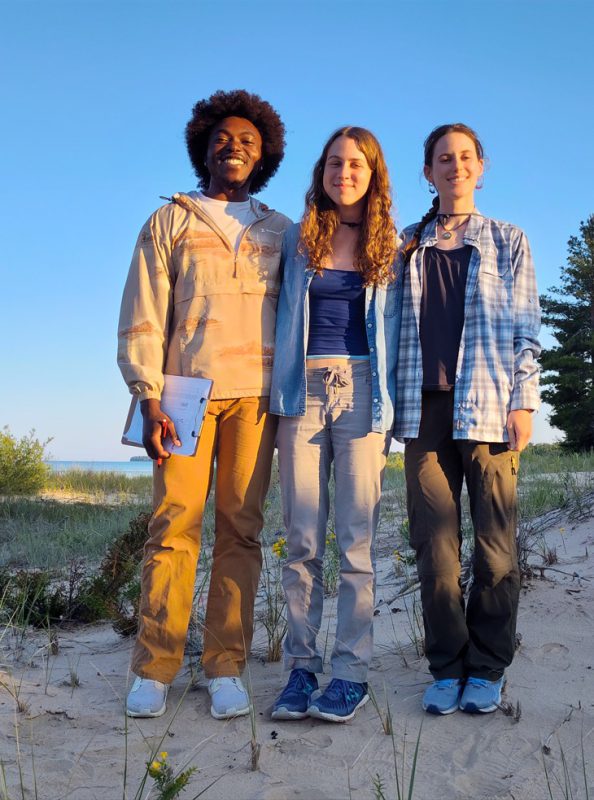
Jenkins, Hayner and Boshoven joined Professor of Biology Binney Girdler this summer on Beaver Island to research Pitcher’s thistle, a threatened species of plant.
Three people on a ferry to Beaver Island
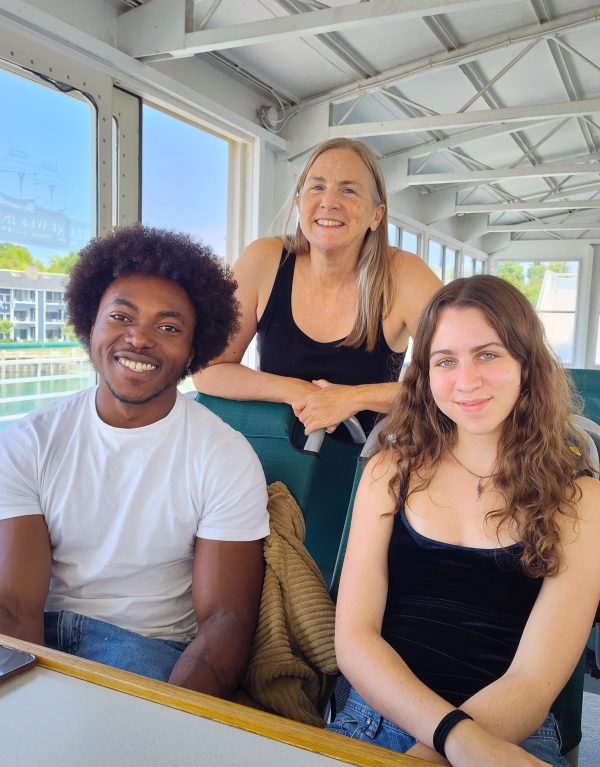
The remote location of Beaver Island required the research team to take a ferry from Charlevoix, Michigan, to their summer home.

Professor Proud of Students, Beaver Island Research

Professor of Biology Binney Girdler said she’s proud of all of her students who perform research, especially Jenkins, Hayner and Boshoven, who did so in such a remote place.

“From Kalamazoo, it’s a three-and-a-half-hour road trip followed by a two-hour ferry ride,” she said. “There is one small grocery store on the island, one gas station where gas is $6 a gallon and four restaurants. But on the plus side, the students had 300 feet of sugar sand Lake Michigan beach at their disposal, and the lake to go jump in whenever they wanted. I was incredibly proud of each of them for their creativity and dedication. Each student had their own piece of the puzzle. I was really impressed with what a great team these three scholars made. Even though they each had ownership of a different part of the project, they coordinated their work well so that they traded jobs and supported each other through challenges, especially when I was off-island. My students were professional and engaging, and community members told me what a great job they did presenting.”

What is Pitcher’s Thistle?

  • Named after: Zina Pitcher, a U.S. Army surgeon at Fort Brady and an amateur naturalist. He discovered the plant in the 1820s along Lake Superior.
  • Scientific name: Cirsium pitcheri or CIPI for short.
  • Range: Native only to the dunes of Lakes Michigan, Huron and Superior.
  • Status: Federally threatened in the U.S., federally endangered in Canada.
  • Ecological role: Stabilizes sand dunes with deep roots; blooms early to feed pollinators such as bees, monarchs and hummingbirds.
  • Biggest threat: Shoreline development and a seed-eating invasive weevil, Larinus planus.
  • Why Beaver Island matters: It’s one of the few places with no reports of weevil damage, offering a refuge for healthy populations.
  • Kalamazoo College connection: Professor of Biology Binney Girdler and her students have studied the species for years, contributing to its conservation.

K Welcomes New Faculty for 2025

Kalamazoo College is pleased to welcome the following faculty members to campus this fall: 

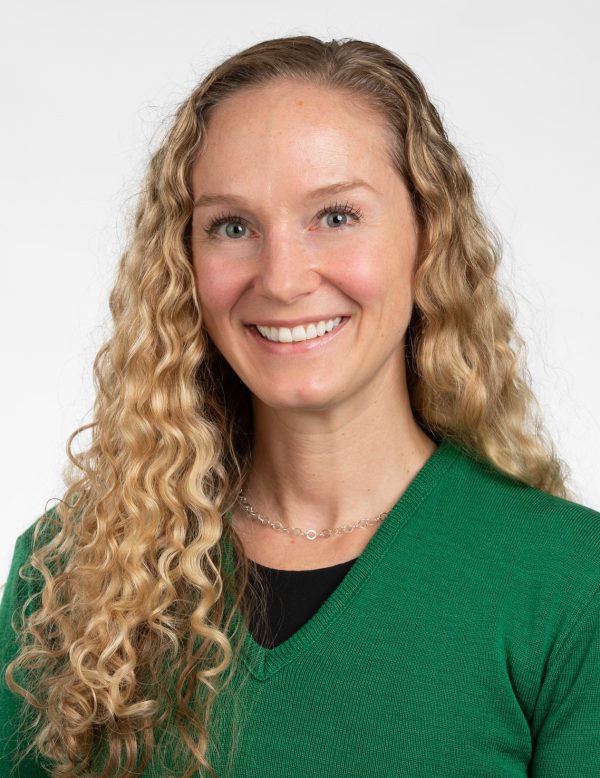
Visiting Assistant Professor of Biology Bonnie Ebendick

Ebendick arrived at K after earning her Ph.D. in biological sciences in August from Western Michigan University (WMU). She previously earned a bachelor’s degree in biochemistry and molecular biology/biotechnology, with a specialization in microbiology, from Michigan State University.

Before attending WMU, Ebendick worked as a research scientist at Michigan State, the University of Toledo and Iontox, LLC, beginning in 1999. Her teaching experience includes positions as a lecture teaching assistant and recitation teaching assistant at both Michigan State and WMU.

Visiting Assistant Professor Bonnie Ebendick
Visiting Assistant Professor of Biology Bonnie Ebendick joins the Kalamazoo College faculty.

Visiting Assistant Professor of English Kevin Fitton

Fitton recently earned his Ph.D. in English creative writing from WMU. He also holds a bachelor’s degree in English from Hope College, a master’s degree in New Testament from Gordon-Conwell Theological Seminary, and a Master of Fine Arts from Bennington College.

Before arriving at K, he taught first-year writing, children’s literature and creative writing workshops as a graduate assistant at WMU; courses in creativity and literature at Grand Valley State University; and academic writing at Olivet University.

Visiting Assistant Professor of English Kevin Fitton
Visiting Assistant Professor of English Kevin Fitton joins the Kalamazoo College faculty.

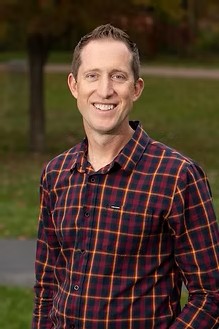
Assistant Professor of Chemistry
and Biochemistry Andrew Jensen 

Jensen arrived at K from the University of Michigan, where he was a postdoctoral researcher, a mentor for graduate and undergraduate researchers, and a guest lecturer for courses in chemical analysis, physical properties of analysis, environmental chemistry and mass spectrometry. He previously served as a graduate research assistant at the University of Colorado, Boulder and an undergraduate research assistant at Davidson College in North Carolina. 

Jensen earned a Ph.D. in analytical, environmental and atmospheric chemistry at the University of Colorado, Boulder and a bachelor’s degree in chemistry from Davidson College. 

Assistant Professor of Chemistry and Biochemistry Andrew Jensen
Assistant Professor of Chemistry and Biochemistry Andrew Jensen joins the Kalamazoo College faculty.

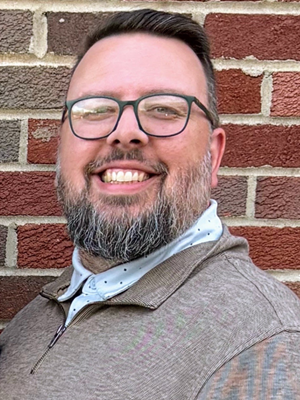
Visiting Assistant Professor of Economics and Business Matthew Schultz 

Schultz has prior teaching experience at Kellogg Community College, where he was an adjunct instructor for business courses specializing in economics; Lakeview School District, Climax-Scotts Community Schools and Battle Creek Central High School, where he taught marketing, accounting, entrepreneurship, business law, finance, business management, career preparation and computer science; and with the MiSTEM Network/Code.org, where he facilitated teacher training for the AP Computer Science Principles curriculum. 

Schultz received a Ph.D. in education from Indiana Wesleyan University, a master’s degree in career and technical education from WMU, and both a Master of Business Administration and a bachelor’s degree in business management from Cornerstone University. 

Visiting Assistant Professor of Economics and Business Matthew Schultz, new faculty, 2025
Visiting Assistant Professor of Economics and Business Matthew Schultz joins the Kalamazoo College faculty.

Assistant Professor of Spanish Language and Literature Brayan Serratos García

Serratos García recently earned a Ph.D. in Spanish and Portuguese Language and Literature from Vanderbilt University, where he also completed a master’s degree in the same field. He holds a bachelor’s degree in World Languages and Cultures with an emphasis in Spanish from Iowa State University. His research explores transoceanic connections among Europe, Asia, and the Americas during the Early Modern period, with particular emphasis on the contributions of Indigenous and local knowledge-producers.

Serratos García has held teaching positions as instructor, adjunct faculty, teaching assistant, and course coordinator at Vanderbilt University and Fisk University, as well as a teaching appointment at Beijing Normal University. He has taught a wide range of courses from introductory language classes to advanced seminars on Spanish and Portuguese literature and culture. In addition to Spanish and Portuguese, he speaks Chinese and Italian and has lived, studied, and conducted research across Latin America, Asia, Europe, and the United States.

Assistant Professor of Spanish Language and Literature Brayan Serratos García, new faculty 2025
Assistant Professor of Spanish Language and Literature Brayan Serratos García

Bee-lieve it: Rare Find Excites K Faculty Member, Alumnus

A recent discovery is absolutely the bee’s knees for Kalamazoo College Assistant Professor of Biology Clara Stuligross. 

Stuligross is a bee ecologist who studies how the insects respond to environmental stressors such as climate change and pesticides. Her research combines field work, lab experiments and collaboration with students to understand how such pressures affect bees. 

“I love studying bees because they are charismatic, incredibly diverse in their biology, and also are essential for ecosystems because of their role as pollinators,” she said. 

So, when alumnus Nathan Rank ’83 brought her what he believed to be a recently deceased rusty-patched bumble bee, she was excited. The species hadn’t been officially documented in Michigan since 1999, when the insects were last found in Washtenaw County. Together, Stuligross and Rank—a professor of entomology and ecology at Sonoma State University in California—examined the specimen he found in a local driveway while visiting relatives. 

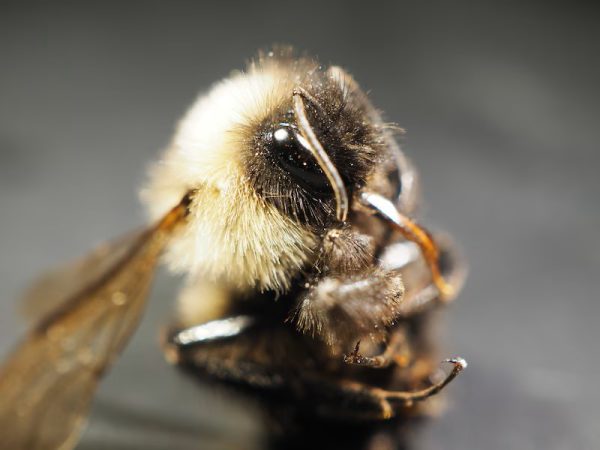
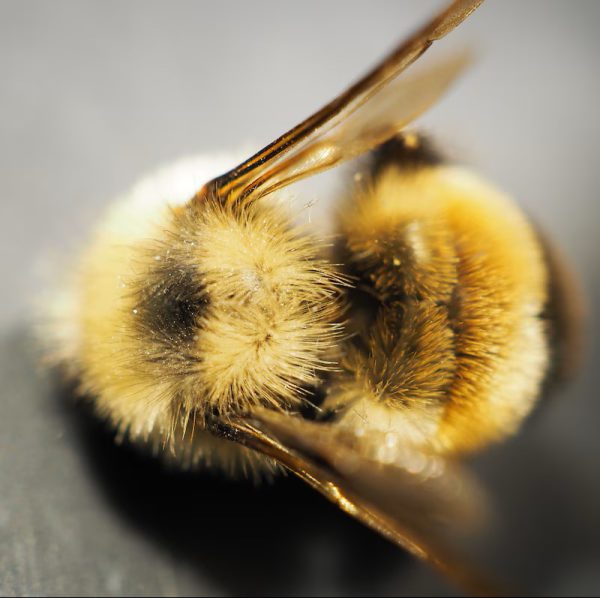
Rusty-patched bumble bees are identifiable through distinctive rusty-orange-colored patches on the abdomen of workers and males, which also have a black head and a mostly yellow thorax with a black band between their wings. Through high-resolution photography, Stuligross and Rank agreed on Rank’s original conclusion, confirming the species. 

“Finding a rusty-patched bumble bee in Kalamazoo is incredibly exciting because it was listed as a federally endangered species in 2017 and it hasn’t been documented in Michigan for over 25 years,” Stuligross said. “As someone invested in pollinator conservation, this finding is a hopeful sign that more may be out there, which would be exciting news for the future of the species.” 

Rusty-patched bumble bees are exceptional pollinators, especially for wildflowers and Michigan crops such as blueberries and cranberries. Pollinator insects in general are ecologically important because they move pollen from the male parts of plants and flowers to the female parts, allowing for seed production. Bumble bees of all types are especially important to agriculture because of their unique buzz pollination technique, which is required to pollinate certain plants such as tomatoes and cranberries. They are also more active in cold weather than other bee species, making them particularly valuable in Michigan for pollinating early spring plants. 

Ongoing surveys in the area now are looking for more rusty-patched bumble bees, but so far, only the one individual has been found. 

“The rusty-patched bumble bee used to be common in Michigan, but it has been lost from about 90% of its historic range,” Stuligross said. “That’s why this sighting is so exciting and a reminder that conservation efforts are so important to protect our biodiversity. We will keep looking in hopes of finding additional bees or even a colony, and we will be watching closely again next spring when new colonies appear. Community members can play a role by planting native flowers, reducing pesticide use and keeping an eye out for these bees in their gardens and on flowers in the area.” 

Community members can further help by spending time in nature to observe native bees while taking photos and uploading images to the iNaturalist app or Bumble Bee Watch website. Rusty-patched bumble bees typically are found in prairies, woodlands, marshes and agricultural areas. They feed on nectar from a variety of flowering plants, including asters, goldenrods and bee balms. 

“This discovery reinforces how important it is to learn about and conserve the biology in our own backyards,” Stuligross said. “The bee was found in someone’s driveway, and it was discovered because someone was curious and wanted to learn more. For students studying biology, it is essential to see concrete examples of conservation successes, like the finding of this endangered bee, as encouragement to continue the work that we do. It’s also a reminder that science is not something that happens far away. It’s something that happens right here in our own backyards and everyone can be a part of it. Finding this bee is also a reminder to students and the broader community that conservation work is essential. We are always working to conserve habitat and provide resources for wild pollinators to thrive.” 

Rusty-patched bumble bee magnified
Kalamazoo College Assistant Professor of Biology Clara Stuligross and alumnus Nathan Rank magnified a recently deceased bumble bee to confirm that the insect Rank found in a local driveway is a rusty-patched bumble bee.
Rusty-patched bumble bee magnified
Finding a rusty-patched bumble bee is significant because the insect hasn’t been documented in Michigan since 1999.
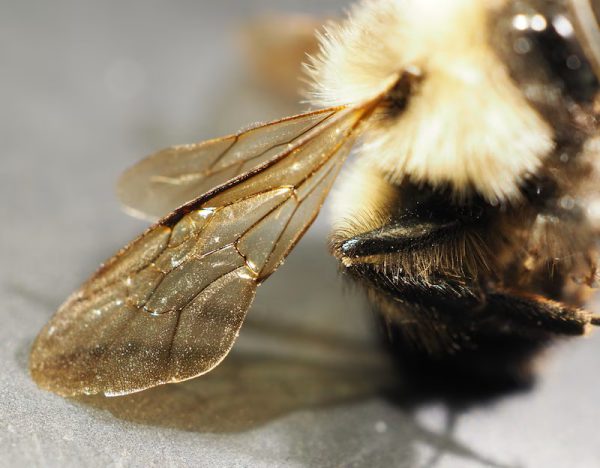
Rusty-patched bumble bee magnified
Community members can help scientists look for more rusty-patched bumble bees like this one by taking pictures of native bees and sharing them through the iNaturalist app or the Bumble Bee Watch website.

Hive Five! K Student Wins Bee Hotel Contest in Spain

What began as a year on study abroad at the Universidad de Extremadura in Cáceres‎, Spain, ended in an international triumph for Annaliese Bol ’26, a Heyl scholar from Kalamazoo College.  

Bol, a biology and Spanish double major, blueprinted a bee hotel—a small structure designed to provide nesting, shelter and a safe space to lay eggs for solitary pollinators—and entered it into the Insectopia Festival held from June 2–6 in Jarandilla de la Vera, Spain. The event included a contest among representatives of eight universities across Europe to see who could diagram the best insect hideaway while contributing something educational to humans and helpful to local pollinator health and biodiversity.  

The design for Bol’s hotel featured a honeycomb pattern with a QR code that could lead interested passersby to the Insectopia website to learn more about the organization and how it supports pollinators.  

“Trying to implement large-scale change to support bees is very difficult,” Bol said. “My project’s goal was to lead people to little solutions that hopefully would compound into something bigger.”  

The only problem was that she was returning to the U.S. on June 5, while the festival was still ongoing. However, with some community engagement support from a professor and a master’s student, Bol and her team won the contest.  

“I was shocked, honestly,” she said. “I was traveling when my teammates called and asked, ‘Have you checked your email? We won!’”  

Bol’s reward is that Insectopia is now building her design, which measures about 18 inches high by 18 inches wide. It includes paper straw and wood blocks that will be important to pollinators in Spain because of its arid climate, especially with a lack of tall trees where pollinators normally can nest. The fact that the bee hotel directs others to the Insectopia website is important, too, as judges required entrants to include a plan for activating the community.  

“I like insects, but the artistic part of the project appealed to me because I don’t get to think creatively every day with my studies,” Bol said. “I also liked doing the research to figure out the best materials, and it was educational.”  

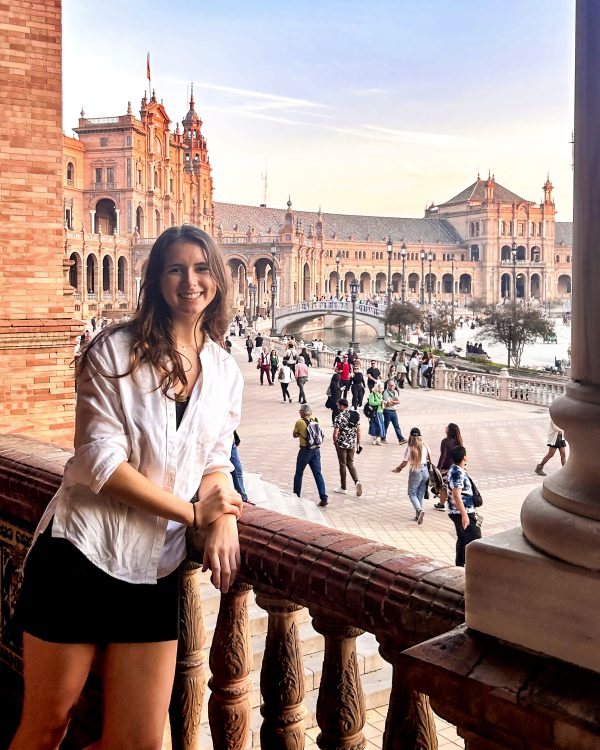
Bee hotel contest winner Annaliese Bol at the Plaza de España in Seville, Spain
Heyl scholar Annaliese Bol ’26 spent the 2024-25 academic year studying abroad in Spain. During that time, she competed with representatives of eight universities from across Europe to see who could diagram the best bee hotel to support pollinators and educate the public about bees. On her way back to the U.S., she found out she won the contest.

While abroad, Bol began working on an intercultural research project in which she developed a composting program at the Universidad de Extremadura to decrease waste. Simultaneously, she created a community garden that local teachers could use as a tool for their classrooms.  

At that time, some of her contacts, including a professor, mentioned the Insectopia contest, although Bol initially didn’t give it another thought. An Insectopia director later asked Bol what she would be doing this summer upon returning to the U.S. Her response: Working with Clara Stuligross, assistant professor of biology, on bee research for her Senior Integrated Project.  

“He said that Insectopia is all about bees, so I should be involved in it,” Bol said. “I said, ‘OK, cool,’ and they set me up. They gave me all the information and told me the goal was to design an environmentally friendly, but also educational, bee hotel.”  

As she reflects on her experience, Bol affirms the idea that study abroad widens one’s perspective and changes how students think about themselves and other cultures.  

“It was interesting and fun,” Bol said. “I made a lot of friends among Spanish students and other Europeans as well. It also made me appreciate my home here, too, in certain ways. I feel that in the United States, we have a perception of Europe being a much more advanced place to live. Maybe it was just because I was in a small Spanish town in the countryside, but it made me appreciate how we address problems here. Maybe it’s just from me attending K, but I feel like we’re always asking, ‘Why is something that way?’”  

At K, Bol is a cross country runner and a Crochet Club participant. This fall, she would like to form a K chapter of Women in Wildlife, a student organization consisting of women and non-binary people who want to work in wildlife-associated fields. Bol’s varied interests and commitment to community building have served her well both at home and abroad. Her time in Spain highlighted K’s distinctive approach to study abroad, with programs designed to foster that same kind of meaningful engagement she values on campus.  

“I met other American students while I was in Cáceres‎ and traveling around Europe,” Bol said. “When we talked about shared experiences, I asked what they did in their free time, and they didn’t have a lot to say. But K, especially in this program in Spain, makes it a goal to get you ingrained in the community. We could say we were tutoring kids or working on our volunteering projects. That really made my experience special.”  

Alumna Equips the Fight Against Parkinson’s

A Kalamazoo College alumna is among the people playing important roles in the fight against Parkinson’s disease (PD) at The Michael J. Fox Foundation for Parkinson’s Research (MJFF), headquartered in New York City. 

The foundation, which launched in 2000, says it’s dedicated to finding a cure for PD—a progressive chronic neurological movement disorder—through an aggressive research agenda that also ensures the development of improved therapies for those living with the disease today. As the organization’s director of research resources, Nicole Polinski, Ph.D. ’12 ensures that industry and academic researchers have access to the biology tools—called reagents—and preclinical models that they need for performing biology and chemistry experiments.

High-quality research tools are vital for successful, reproducible science. MJFF’s Research Tools Program team, including Polinkski, works with the research community to understand the gaps in the research tool space, develop and distribute reagents and models to fill these gaps, and better understand the characteristics of available research tools.

“I think my biggest challenge is to make sure that our limited resources have the biggest impact possible,” Polinski said. “It’s trying to identify what we need as we get suggestions for where we should focus our laboratory-tool development. It’s trying to connect the dots between different things you’re hearing from different folks to make sure that we prioritize and select the programs that have the potential to impact a lot of labs. Figuring out what to prioritize and who to work with on those programs.” 

The early signs of Parkinson’s disease include tremors, often in the hands or fingers; a loss of smell; trouble moving or walking, including stiffness and balance problems; constipation; a reduction of facial expressions; dizziness or fainting; sleeping problems and stooping or hunching over. Polinski said Parkinson’s is diagnosed through such traditional motor systems, but until recently, it’s pathology could only be confirmed at autopsy. As a result, misdiagnosis or delayed diagnosis is still all too common. 

“The two pathological hallmarks that are confirmed in an autopsy are in the brain,” Polinski said. “One is the presence of a protein that’s normally in the brain, but it starts to clump abnormally with Parkinson’s. It’s the presence of those clumps and then the loss of a specific brain system, which consists of a circuit that deals with movement.” 

Research, though, through MJFF and its partners, is beginning to provide more methods for diagnosis as well as treatment. 

Parkinson's Researcher Nicole Polinski
Nicole Polinski ’12

National Parkinson’s Awareness Month 

April is Parkinson’s Disease Awareness Month. Organizations such as The Michael J. Fox Foundation, the National Institute of Neurological Disorders and Stroke, and the American Parkinson Disease Association host events and campaigns, provide resources for people living with Parkinson’s, and support research efforts in the fight against the ailment, which afflicts more than 10 million people worldwide including about 1 million in the U.S.

In 2023, an international coalition of scientists led by MJFF discovered a Parkinson’s biomarker—a tool that can detect the earliest biological signs of the disease in living people.

“We need better ways to diagnose it, and I think we’re making good headway,” Polinski said. “There’s now a test with cerebrospinal fluid that can detect those clumps. It’s still not perfect. A lumbar puncture to collect the fluid is not easy. Hopefully, we might be able to use saliva and blood or other bodily fluids that require less invasive procedures in the future.” 

Michael J. Fox is widely known as an actor for his role as Alex P. Keaton on the 1980s situation comedy Family Ties. He later became a movie star with roles in Teen Wolf, Back to the Future, The Secret of My Success and Casualties of War. In 1991, Fox developed a tremor in his pinky finger. He consulted a neurologist and was diagnosed with Parkinson’s disease at just 29 years old. Still, he found a way to channel that life-changing news into a way to help others. 

“I’ve met Michael a number of times and he came to our all-staff meeting earlier this year for a fireside chat,” Polinski said. “He talked about his experience and where he’s at now. You know how he feels about the work and all that the foundation he established has accomplished. It’s always great to see him. He’s as nice as he is portrayed.” 

In her early years at K, Polinski knew she wanted to major in biology, but no one in her family had a science background, and her exposure to the medical field was primarily through medical doctors. She assumed she would also go to medical school and become a physician herself until she started her Senior Integrated Project (SIP).  

“I ended up doing a summer internship at a spinal cord injury lab at The Ohio State University and I really liked being in the lab,” Polinski said. “After that, I started looking more into graduate schools and went on to get a Ph.D. in neuroscience.” 

Shortly after graduate school at Michigan State University, she began working for The Michael J. Fox Foundation as a research program officer, advancing to associate director and senior associate director before earning her current position. It’s a role she relishes, knowing her work contributes to an important fight. 

“We’re well on our way to improving ways to diagnose Parkinson’s disease with some recent breakthroughs, and we have more diverse therapeutic strategies in testing than ever before,” Polinski said. “On top of that, we’re identifying new pathways to tackle Parkinson’s disease by looking at patient bio samples to better understand the disease at a basic biological level. I’ve been here almost nine years, and no two days ever look the same. It’s a field that is ever evolving, and even within my laboratory tools space, new technologies and targets are popping up that need support with new players in the field. It’s something that’s always changing, and I really enjoy that challenging feature of this work. I never get bored, and I love my job.” 

Teamwork Measures the Benefit of a Forest Through the Trees

Four students from two academic departments have combined forces this year to measure how Kalamazoo College’s Lillian Anderson Arboretum benefits the local fight against climate change.

Lucas Priemer ’25, a biology and Spanish double major from Berkley, Michigan, is working on a Senior Integrated Project (SIP) that measures the circumference of specific trees at the arboretum to estimate how much carbon they capture and how that compares with measurements taken in previous SIPs that have been repeated about every five years. 

Priemer also works at the arboretum and loves spending time there, making this project an ideal fit for him. 

“The best thing about the arboretum is that it’s an escape from just being here on campus,” Priemer said. “Some people get a little cooped up, especially in the winter here, so it’s nice to get outside. I think getting outside and exploring nature is one of the best things that we can do to alleviate stress, especially in a big academic environment.” 

The project he’s working on is sometimes referred to at K as “the tree-hugger SIP” because students put their arms around trees and use a tape measure at a standard height to gather their data. Using that information in a standard formula allows students like Priemer to calculate a tree’s above-ground biomass. A carbon conversion factor, based on a tree’s species and wood density, then estimates the amount of carbon it stores—or sequesters—preventing the greenhouse gas from polluting the environment. 

Using a mapping app, Priemer locates the focal trees in each of the plots he’s analyzing. Within 20 meters, he measures all trees larger than 30 centimeters. Within 10 meters, he measures trees between 10 and 30 centimeters. Within 5 meters, he measures trees between 2.5 and 10 centimeters. 

“We haven’t made a ton of conclusions yet because we’re still working on the statistical analysis,” Priemer said. “But we’re hoping to find an increase in the carbon sequestration over the past years’ SIPs as the trees grow. I think the state of the arboretum is pretty good, so hopefully, we’ll see some good results.” 

Lucas Priemer poses among trees at the Lillian Anderson Arboretum
Lucas Priemer ’25 is working on a Senior Integrated Project that uses tree measurements at the Lillian Anderson Arboretum to help determine how much carbon trees there are sequestering in the local fight against climate change.

His efforts are receiving assistance from Juniper Pasternak ’27, Judah Karesh ’25 and Teddy Jacobson ’27, who were in the fall 2024 computing for the environment and social justice course led by Sandino Vargas Perez, an associate professor of computer science. The class studies concepts and techniques from computer science to address and understand problems in environmental science. It explores topics such as how computational intelligence is applied to environmental data; current solutions to create, collect, store, process, model and distribute data and information; and the environmental impacts of computers such as electronic waste. 

Together, the team of three completed their final project for the course by building a web-based app for their client, Biology Professor Binney Girdler, which helps Priemer record his data and analyze it, note tree varieties and health, and preserve the information for future biology students who repeat the SIP. 

“There were other choices for final projects, but this one seemed like we would be creating something that would be consistently used, something that would have long-term benefits, and help out the biology department,” Pasternak said. “We also knew we would indirectly help fight climate change by helping ecologists and biologists track what our trees are doing and learning more about carbon sequestration.” 

The project was especially challenging in the beginning, Jacobson said, considering that the team was starting from scratch. 

“You just have to start from nothing and go,” Jacobson said. “It all started with us designing the database. We used a whiteboard to plan the rough ideas of what we thought we would need. Then, through our conversations with Dr. Girdler, we figured out exactly what was required. From there, we set up an agile development system and our project management. We’d then meet up weekly as a group to discuss what we’ve done, where we need to continue and try our best.” 

The final product made the whole project worthwhile. Karesh felt communication was key to producing excellent work that they could confidently present to Girdler. 

“The three of us had worked together before, but honestly, I think we did a better job with this one because our communication was so good,” Karesh said. “A lot of the challenge was trying to keep the scope limited. I’m happy that we worked on something that’s actually being used, and it’s going to be around for a while.” 

Priemer said he’s grateful for the assistance from the computer science students and they will be thanked in his SIP, which will have strong benefits for fighting climate change on and off campus. 

“I want the arboretum to be protected and safe moving forward,” Priemer said. “There are green spaces around that aren’t exactly protected, so doing research like this provides evidence for why we should keep it and other green spaces in Kalamazoo.” 

Local Grants Help the Arboretum Bloom 

Binney Girdler’s unpopular opinion is that she prefers the Not-So-Magnificent Pines to the Magnificent Pines. 

And if you know what that means, then you—like Girdler, a professor of biology and the director of the environmental studies program at Kalamazoo College—are probably already a fan of “the Arb.” 

The Lillian Anderson Arboretum, located about five miles west of campus at 7787 W. Main St., encompasses 140 acres of forest, fields and wetlands, with five miles of walking trails. K faculty and students have long treasured the Arboretum as a living learning laboratory for courses as diverse as biology, German and art. 

Over the past few years, the Arboretum has increasingly taken its place as a valuable community resource as well. During the pandemic, when families and individuals sought outdoor recreation at unprecedented levels, nearby residents discovered the beauty of the Arb like never before—and as COVID-19 restrictions eased, they continued to take advantage of the free access to a variety of natural settings. 

While the Arb is a private facility, K welcomes its use by members of the public—and yet, increased use means accelerated wear and tear. Hikers track in invasive species. More cars and trail users cause faster degradation of the parking area and pedestrian surfaces. 

Sara Stockwood, director of the College’s Larry J. Bell ’80 Environmental Stewardship Center and the Lillian Anderson Arboretum, therefore appreciates community support that helps keep community access possible. Local foundations have contributed more than $100,000 in grant support for projects and physical improvements at the Arb over the past two years. 

Collaboration and partnership with the Consumers Energy Foundation, ENNA Foundation, Irving S. Gilmore Foundation, Kalamazoo Rotary Club and Seminary Hill Sustainability Internship as well as Stryker and Zoetis through the Kalamazoo Nature Center have enabled entrance trail upgrades, a new welcome sign, installation of a new well, replacement of the Batts Pond bridge, continuation of pollinator habitat research, a three-year sheep-grazing research project, and development of a land-management plan. 

“The Arb is part of the College’s operating budget,” Stockwood said. “That helps with our maintenance costs and keeping things safe. The local foundation grants really allow it to flourish, improving the experience for both college students and community visitors. The grant funds allow us to dream about what we could do and help give some momentum to making progress toward our goals.” 

Physical improvements 

Grant-supported physical improvements over the past couple of years have included replacing and upgrading some aging features.  

Erosion from rain and snow melt off the parking lot, in addition to regular use, necessitated regrading the entrance trail and adding another layer of crushed asphalt millings.  

The hand-pumped well went offline several years ago after a failed water-quality test, and a new well had to be drilled to provide visitors with fresh drinking water.  

Two additional photo monitoring sites, where visitors are encouraged to take and submit pictures to help the College track how the landscape changes over time, were installed—one on the Power Line Trail and one on Old Field.  

The bridge over Batts Pond desperately needed a replacement. The original bridge was more than 20 years old, and every few years, high water levels have submerged it under as much as a foot of water. 

“We’d been trying to figure out how to manage a bridge where the water levels change so much,” Stockwood said. “You have to be able to get across there. It’s a spot where classes do research and it’s one of our big access points, close to Oshtemo Township Park. We were spending so much time trying to make extension bridges, and then they would float away, and we would go get them and bring them back.” 

The new bridge, supported by grant funds, is fixed on either end, with a floating dock in the middle, made from the same material as the Arb’s wetland boardwalk. That will allow the bridge to rise and fall with the pond’s changing water level, keeping it accessible year-round and minimizing ongoing maintenance. 

“These projects are all big, and anything that has infrastructure related to it has maintenance and upkeep,” Stockwood said. “The local grants have allowed us to make that a focus, so that as our numbers are increasing, as people are spending more time out there, we’re able to accommodate and focus on the trails feeling accessible and safe and welcoming.” 

Four students gaze up at the trees during a class at the Lillian Anderson Arboretum
Binney Girdler, a professor of biology and the director of the environmental studies program at Kalamazoo College, conducts some classes at the Lillian Anderson Arboretum.
A family, surrounded by tall trees, walks on one of the trails at Lillian Anderson Arboretum
During the pandemic, when families and individuals sought outdoor recreation, nearby residents discovered the beauty of the Arboretum like never before.
A butterfly perches on a sign that says Lillian Anderson Arboretum
The Arboretum is a tremendous asset for both the College and the community. 

Arboretum Projects 

Grant funding also supports new and continuing projects at the Arboretum, notably pollinator research, a grazing study and development of a land-management plan. 

One long-term project involves pollinator research along the power line. For many years, Arb staff and students have managed a stretch of the power line, working to remove invasive species, plant a native prairie ecosystem, and survey pollinator activity. Many students have completed internships and Senior Integrated Projects while taking part in the ongoing research. 

New over the past couple of years is a research project, also along the power line, to compare a hands-off land-management approach to traditional mowing and to sheep grazing. Girdler, Stockwood and Ann Fraser, emerita professor of biology, have worked with Lauren Burns, owner of local contract grazing company Tending Tilth, to coordinate the project with student involvement. 

Planned to run for a minimum of three years, the project consists of data collection from vegetation surveys, soil sampling, pH monitoring, evaluation of carbon sequestering, and growth rates on plots of land that are mowed, grazed by Burns’ sheep, or left alone. 

“It pushes students to use what they’re learning in class in a tangible way,” Burns said. “They’ve had hands-on experience in what it’s like to design a study and perfect it over a couple years and what it looks like when a student adopts a project started by another student, what to focus on, how to avoid losing data. I hope to inspire young people to pursue careers in agriculture and science, and I think this really supports that.” 

The benefits go far beyond those directly experienced by Burns and K students. 

“It’s a benefit to Lauren because it has the potential to prove that her business model is good for the planet,” Girdler said. “It’s great for students to be exposed to this approach. For me, intellectually, it’s very cool to work with a farmer and businessperson who’s willing to take this approach. That’s a personal benefit. It’s a benefit to the Arboretum, because it’s helping us understand better ways to manage the Arboretum. That can have knock-on effects, especially if we are able to publish our results for other land managers and for scientists generally, for the field of vegetation management and trying to do things without as much fossil fuels, in the face of climate change and the face of invasive species, a lot of the wicked problems we’re going to need to tackle in this adaptive way.” 

The College is working with the Kalamazoo Nature Center to develop a five-year land-management plan for the Arb that should be complete this spring. The plan follows the Open Standards for the Practice of Conservation, a widely adopted set of principles and practices. 

“We’ve been identifying goals and targets and figuring out how that all matches with our values,” Stockwood said. “That will give us some targeted areas of the Arb that we want to focus on, especially with invasive species removal, and it’ll continue some things that we’ve been doing.” 

The plan also includes some new types of monitoring, including deer and avian health. 

“Having a land-management plan gives us direction, versus just tackling things as they come up,” Stockwood said. 

Of course, some things will still come up. Trees will fall across trails and need to be dealt with in the moment. A management plan, however, will aid in more proactive scheduling of maintenance and improvement work. 

“It also ties in our values and gives us reasoning for why we’re doing what we’re doing,” Stockwood said. “That could help us make a case for other projects and grants. I’m hoping that we can tie in more classes, too; if we have specific monitoring goals, we can ask a class to help us with that. It doesn’t just have to be the student trail crew or a staff member, we can bring in different parts of our community to help us reach the management goals if it’s clear what we’re doing and why we’re doing it.” 

Common ground 

The Arb is a tremendous asset for both the College and the Kalamazoo-area community.  

“Since I got here in 2001, almost every class I have taught has used the ecosystems out there as a laboratory,” Girdler said. “I’m an ecologist, so of course it offers a lot for my classes, but also, a lot of first-year seminars go out there. Art classes use it. We just had a German class go do some forest bathing, which is a particularly German idea of connecting with nature. Student groups meet and hike there. Students work on the Arb Crew. It’s part of campus, and once they know it’s there and it’s theirs, students will often pile in a car and just go to be away from the world a little bit, which is what I do when I go out there.” 

Along the trails of the Arb, town and gown can coexist peacefully and even support each other. 

“I think it’s a really important community asset that folks can visit, dawn to dusk, anytime of the year,” Stockwood said. “It’s a place for recreation and relaxation, that’s part of campus, but not on campus; part of the College, but away from the rigor of daily campus life. A free outdoor space that is maintained for walking, outdoor recreation, and is used very heavily by the community. 

“With the amount of people that we see coming through, there’s maintenance that has to happen to keep up, and the grants really, really help support the community. I hope that visitors learn something while they’re out there, either through some of our interpretive signage, or by meeting a student or staff member, or just seeing something and being curious and exploring it.” 

Perhaps they’ll climb Gathje Hill or encounter grazing sheep along the power line. Maybe they’ll stop to snap and submit photos at the monitoring sites. Most likely, they’ll pause to admire one or both stands of pines, where they can form their own opinions. 

“I don’t know why people think they’re not so magnificent,” Girdler said with a shrug. “It’s a matter of taste, I guess.” 

Alumna Finds Where Birds of a Feather Flock Together

Update: Rockwell’s presentation now is available online.
Click the link and use the password v1R$ErPy to watch it.

A Kalamazoo College alumna will deliver a public virtual presentation through the Redwood Region Audubon Society (RRAS), highlighting the incredible journeys of two varieties of migratory birds including one that was found through her research to fly from Oregon to Brazil and back.

Dr. Sarah Rockwell ’02 works for Klamath Bird Observatory (KBO), a scientific nonprofit research organization in Ashland, Oregon, that focuses on achieving bird and habitat conservation through science, education and partnerships. Rockwell’s program, “To Southern California, Brazil, and Back: First GPS Tracking of Oregon Vesper Sparrow and Western Purple Martin Migration,” will be available through Zoom at 10:30 p.m. Eastern time Thursday, January 16, at rras.org.

Rockwell joined collaborators from the U.S. Forest Service, the U.S. Geological Survey and Cape Arago Audubon to work after dusk with purple martin bird colonies along the Oregon coast and at Fern Ridge Reservoir. Equipped with headlamps, they captured adult birds roosting in their nest boxes between about 9 p.m. and 1 a.m. and tagged them with a small GPS device. The next morning, after sleeping in tents, Rockwell and her collaborators observed the tagged birds to ensure their normal behavior, including flying and feeding their nestlings.

Separately, Rockwell worked with KBO Director of Conservation Jaime Stephens to study Oregon vesper sparrows. Together, they set up a mist net near a perching spot in a male’s territory and placed a speaker playing a vesper sparrow song under it. The birds perceived the song as a rival male, often causing them to fly into the net while trying to chase away the false intruder, allowing Rockwell and Stephens to band them.

With both species, Rockwell and her collaborators made harnesses so the birds could comfortably wear the GPS tags like a backpack with loops going around their legs. Rockwell then waited almost a year for the birds to complete their round-trip migrations so they could be collected for data retrieval as GPS tags for birds this small are too lightweight to transmit data, only store it.

Their efforts have proven successful.

“Before this study, we did not know where purple martins from Oregon went during migration and winter,” Rockwell said. “The unique subspecies of the western purple martin is estimated at just 3,500 pairs in the Pacific Northwest states, and it is considered to be of conservation concern. We had the same questions for the Oregon vesper sparrow, another subspecies unique to the Pacific Northwest that is currently under review for listing as threatened or endangered due to its small population size and declining trend. These are the first studies of their kind with these subspecies, tracking them with GPS tags year-round.”

As a student at K, Rockwell participated in the ecology and environment study abroad program in Ecuador. Through that program, she participated in field trips with an ornithologist that helped her and other students spot and identify birds. At the Tiputini Biodiversity Station in the Amazon, she also participated in a three-week bird survey, spending time in canopy towers counting birds and adding to the inventory at the station.

Two scientists wear headlamps while working with birds at night
KBO Senior Research Biologist Sarah Rockwell ’02 (left) works with birds alongside Field Technician Sam Webb on a boat at the Fern Ridge Reservoir. Photo by Daniel Farrar.
Scientist stands in water while retrieving birds in their nesting boxes with a pole
Rockwell retrieves purple martin nest boxes at Fern Ridge Reservoir. Photo by Sam Webb.
An Oregon vesper sparrow perches with a GPS antenna attached to it. Photo by Frank Lospalluto.

“It is hard not to fall in love with tropical rainforest birds like parrots, toucans, tanagers and hummingbirds,” Rockwell said. “When I returned, I took a vertebrate biology class with Dr. Paul Sotherland, which had a substantial bird component. When I found that I also loved learning the birds of Michigan, I took that as a good sign. My first field jobs after college were working with sea turtles and then endemic forest birds on the big island of Hawai’i at Volcanoes National Park. This is where I learned how to mist-net and capture birds. The first time I held a wild bird in my hands, I was hooked.”

Rockwell earned a job with KBO after completing her Ph.D. at the University of Maryland and Smithsonian Migratory Bird Center. Fast forward 12 years and she’s now working there as a senior research biologist. In her position, she hires and supervises field crews and conducts field work from April-July. That means getting up early and spending a lot of time hiking and studying birds outdoors. The rest of the year, she pursues data management and data analysis using statistical software, writes reports and peer-reviewed publications, seeks grant writing opportunities, and plans for the next field season.

In her upcoming presentation, Rockwell said attendees can expect to see photos and maps from her research, and peek into where western purple martins and Oregon vesper sparrows go during the annual voyages they undertake.

“These first few birds have returned with fascinating information, revealing new discoveries about their incredible journeys, including unexpected lengthy fall stopovers, and for purple martins, winters on the beach in southeastern Brazil,” she said. “Determining the factors that limit population size in a migratory bird species can be challenging. It requires understanding what threats they may face in different parts of the year, and thus, the first step is knowing where they are throughout their annual cycles. A better understanding of overwintering locations and migratory stopover sites used by Oregon vesper sparrows and western purple martins, and potential threats originating during the non-breeding season, are key information gaps needed to target conservation actions.”