Some remodeled newspaper boxes—including one at Kalamazoo College—are once again worthy of front-page news. And this time, they have the potential to save lives.
Haley Mangette, K’s assistant director of student success for wellness, works with the Kalamazoo County Opioid Coalition. Supporting the Coalition’s mission, the Community Outreach Prevention and Education (COPE) Network and Bronson Healthcare refurbish the boxes and install them around town as sites for the public to quickly and anonymously obtain naloxone.
The nasal spray, also known by the brand name Narcan, rapidly reverses an overdose by blocking the effects of opioids. It works within two to three minutes for a person whose breath has slowed or even stopped. A person can’t get high from using naloxone and it’s safe for practically anyone.
K’s newly installed box is located at Lovell Street and Campus Drive behind the Hicks Student Center.
“With fentanyl overdoses harming many people, the more accessible naloxone is, the more people are prepared to respond to an overdose and potentially save someone,” Mangette said. “A person can only move toward recovery if they’re alive.”
Naloxone was already available on campus through AED boxes in administration and classroom buildings, and at residence halls through resident assistant first-aid kits. The box, however, expands the spray’s availability, even for those who live beyond the campus’ borders.
“The U.S. has seen a decline in overdose deaths with the introduction of naloxone and the widespread promotion and training of individuals delivering it,” Mangette said. “COPE Network and Bronson Hospital have been able to install several boxes around the county, and ours will ease access for those around our area.”
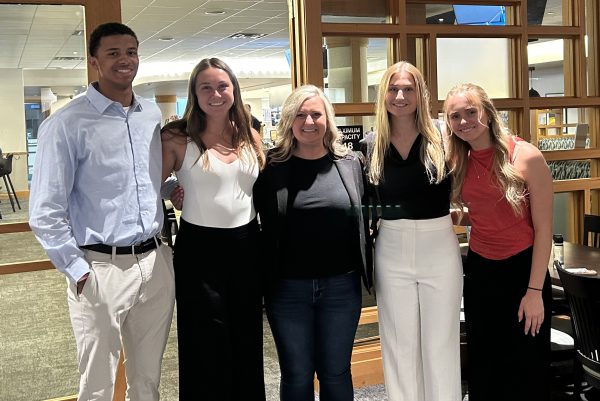
Sam Douma ’26 (from left), Assistant Director of Student Success for Wellness Haley Mangette and Zane Jones ’27 stand with a new naloxone box at K.
Mangette works with students Sam Douma ’26 and Zane Jones ’27, who help her as peer educators in Student Development. Douma is a psychology major who has strong interests in writing, philosophy, and the intersection of computer science, new media and neuroscience. Outside of academics, he’s involved with K’s bike co-op and rock climbing. Jones volunteers with K Votes—the College’s non-partisan coalition that informs K students, faculty and staff members about voting and civic engagement—and works at Woodward Elementary School through the Mary Jane Underwood Stryker Center for Civic Engagement. They join Mangette in praising the installation and recognizing its potential to save lives.
“Having a naloxone box on campus is a perfect example of minimal effort, maximum impact preventative care,” Douma said. “A major part of our philosophy is based in harm reduction. In the event of an overdose, being prepared is critical. Having a naloxone box available could be lifesaving, whether for a student or someone from the surrounding neighborhood. Given Lovell Street’s visibility and traffic, placing a naloxone box there could make it a well-known resource, and not just for our campus, but for the broader community.”
“I’ve talked to my friends about it, and most of them didn’t know we had naloxone on campus until now,” Jones said. “I hope this makes it an accessible resource so it gets pushed to the people who need it, especially if we can offer some training with it.”
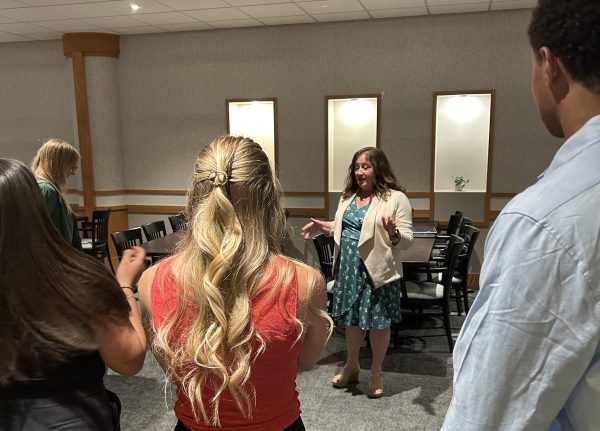
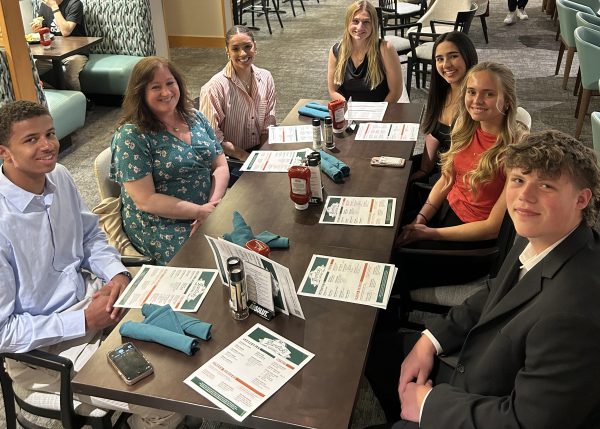
Douma and Jones meet with students individually, digitally through social media and the College’s website, and at various student events where they provide information and resources to help navigate complicated scenarios where they might face substance use on a college campus.
Help from them is only a click away should a student need it at their website or Instagram page. Mangette also is reachable at haley.mangette@kzoo.edu or by calling Student Development at 269.337.7209 for more information.
“We think it’s important to have peer educators because it’s easier for a student to talk to another student, and realistically, a student’s going to listen to someone their age rather than an authority figure,” Jones said. “It’s less scary for a student to come to someone like me on campus and I can just be real at the same time. We also love helping out in the community. I use the word resource a lot, but I believe we are good resources and it’s a great thing for us to do. It makes me feel good because I feel like I’m benefiting our community.”
Shruti Debburman ’26 has found a home away from home on study abroad in Clermont-Ferrand with her host parents, Arielle and Stéphane Calipel, pictured here on the Puy de Combegrasse volcanic peak.
Study abroad in Clermont-Ferrand has been a dream come true for Debburman, pictured here with Olivia Cannizzaro ’26 at vendanges (grape harvesting).
A double major in French and psychology with a minor in music, Debburman has studied pipe organ at the conservatory of Clermont-Ferrand during her study abroad.
Living in France is everything Shruti Debburman ’26 dreamed of since she was 9 years old.
In fact, Debburman had been in Clermont-Ferrand on study abroad from Kalamazoo College for only two weeks before she started to feel that the six-month study abroad program—which had seemed overwhelming in advance—would not be long enough.
“I got here at the end of August, and once I was here, time went by so differently,” Debburman said. “Time started to move very quickly, and I knew that in six months I was not going to be ready to leave, and that I would want more time. I am so happy here; I don’t want to leave when there’s so much to do that I’m not going to be able to have done by February. I wouldn’t be fluent enough, and I don’t want to leave not being as fluent as possible. And I thought, this is a once-in-a-lifetime opportunity, why not take full advantage of it?”
With the support of program administrators, her parents and her host family, Debburman extended her stay from a February end date into the middle of May.
“I want to make the most of it, to really speak French without giving in to English, to push myself in terms of grammar and vocabulary and speaking correctly,” Debburman said. “I would like to make some more French friends, and I’m excited to travel more.”
Growing up in Lake Bluff, Illinois, as a fan of both reading and baking, Debburman got hooked on France thanks to a French cookbook of her mom’s from Le Cordon Bleu culinary institute.
“It’s really complicated, all the types of doughs you can make, all the types of sauces, all the types of creams,” Debburman said. “I read the thing cover to cover, and I was like, ‘I must learn how to do this. And I need to learn about France, because all of this is so cool, and it must be an interesting country that it comes from.’ I was at a Montessori school and we didn’t have a language class, but what’s incredible about Montessori is that it encourages students to spend time pursuing their interests during the school day, so for example, our assistant teacher had studied French in college, so she was giving me little French lessons on the side.”
K appealed to Debburman based on small class sizes, flexible curriculum and emphasis on study abroad. While her intention to major in French persisted, she took advantage of the ability to explore other areas of interest, considering a second major first in history, then in classics, then music. Currently, she has declared a double major in French and psychology with a minor in music.
For study abroad, Jan Solberg, professor of French and Francophone studies, encouraged Debburman to consider Clermont-Ferrand.
“It’s a very immersive program, but it’s also a small and very supportive program,” Debburman said. “I think she knew it was the right place for me.”
The Clermont-Ferrand program runs during K’s fall and winter terms in partnership with Institution Saint Alyre, an educational establishment that includes primary and secondary schools as well as higher education. Students live with host families and take classes in French language, culture and civilization designed especially for K students as well as classes in French literature and philosophy or modern world history and economy alongside Saint-Alyre students. They complete an Integrative Cultural Project (ICRP) and volunteer at the international short film festival held in Clermont in early February before returning to Kalamazoo for spring term.
An anxious flier, Debburman remembers feeling surprisingly calm while soldiering through the journey to France, including a long flight delay, being met at the airport by the program’s resident director and her host dad, and her host dad driving her to their home. There she met her host mom and a younger daughter who lives on her own but came for dinner and brought her boyfriend—and the travel caught up with her.
“It was such a long day, and I gave everyone the most scatterbrained impression of myself,” Debburman said. “I’m normally pretty put together on the outside, but I was so worried about making a good impression that I kind of forgot how to speak French. My host mom is fluent in English, thankfully, so there were some moments of half English, half French going on, and it was a lot. But everyone was wonderful, incredibly welcoming and kind. I was worried about being an imposition, and they did such a good job making me feel like I was not intruding or an imposition and I felt like part of the family right away.”
Her host family has been a highlight of her time in Clermont. Having grown up as an only child, Debburman relishes the opportunity to experience family dinners, game nights and life with siblings.
She also loves getting to know Clermont-Ferrand, which she finds an interesting city with a manageable size. The city’s population of just under 150,000 is roughly double the population of Kalamazoo, but with a size of about 16 square miles, it covers between half and three quarters as much land as Kalamazoo.
“You can walk most places downtown,” Debburman said. “I have a 10-minute walk most places, because I’m close to the middle. If you’re going somewhere farther out, there is decent public transportation. It’s not super cosmopolitan, so you have to speak French and get good at it quickly.”
Improving French fluency is also necessary in the coursework, which Debburman found challenging at first.
“Classes were more lecture heavy than in my classes at K. In French, especially, and in the rest of the humanities, K classes are mostly discussion based. It also felt fast. The first couple of weeks, I was just writing stuff down as fast as possible, without having a clue what I was writing. But then it got easier. The more I was around the language, I started understanding it better, until it felt like I was actually learning the material in class.”
The study abroad program at Clermont-Ferrand proved a perfect fit for Debburman, pictured at the Mémorial de Caen.
Debburman, pictured at the Loire River, extended her study abroad in Clermont-Ferrand when she decided six months was not enough time.
In Clermont-Ferrand, Debburman visits the Chateau de Chavaniac, the Marquis de Lafayette’s childhood home, with Jacob McKinney ’26, Françoise Evangelista, resident director, and Didier Croze, civilization teacher.
Learning French literature and economics alongside French students offers an intriguing contrast for Debburman—one class right in her wheelhouse, the other brand new to her, and both with a distinctively French perspective.
In addition, Debburman and (until February) the other two K students studying in Clermont-Ferrand this academic year attend a French language class, a French culture and civilization class, and a time set aside for extra support with the economics teacher, where they review material from class or go deeper on topics that are relevant to their interests.
“Those classes are very flexible,” Debburman said. “It’s what we need to learn or what we want to learn.
Our teachers are absolutely fabulous. They’re so engaging.”
Debburman also takes pipe organ lessons at the Regional Conservatory for music, dance and theatre, and she completed her ICRP at the Conservatory, researching and writing about the history and current state of the pipe organ in France.
For the ICRP, each student chooses a topic or question of interest to him or her and completes 40 hours of work on a site and 10 interviews with professionals in the field, often tied to an internship. Having played piano since she was 5 years old and viola since high school, Debburman grew interested in the academic side of music at K and started pipe organ lessons during her first year.
“I didn’t realize how absolutely in love I would end up with the instrument,” Debburman said. While true mastery of many instruments requires an early start, pipe organists often begin as teenagers, because they need to have achieved their full height and a level of piano competence.
“It’s usually a weird connection—in French, they call it ‘un coup de foudre,’ which is like love at first sight,” Debburman said. “It literally translates to crack of lightning, so it’s like love struck; you hear it or you play it for the first time, and it’s like destiny, you just know it’s your instrument.”
Struggling to find 10 pipe organ professionals in Clermont even with her contacts at the Conservatory, Debburman expanded her interviewees to include students of the pipe organ, which enriched her final product.
“I didn’t think of doing that at first, but I found that the students put a lot of thought into it, they answered very thoroughly, and I feel like some of the insights that I got from them were more creative and out of the box,” Debburman said. “The kids still have that enthusiasm in them, a spark. It was interesting to have the kids explain how they fell in love with it while it’s still fresh for them.”
Debburman did get to meet (and interview) professionals—people who are important in the pipe organ world—and she had the opportunity to play historic instruments in the process.
In her time abroad, Debburman has traveled to many places; Normandy, Florence and London were highlights for her, offering natural beauty, architecture, history and amazing food.
“We went skiing in the Alps,” Debburman said. “I think that would be a collective highlight for all of us. I’d never skied in my life. I was terrified, and it was really fun. It’s the coolest possible place to try it.”
Since the two other K students left Clermont in February, some things have stayed the same for Debburman—her host family was happy to extend her stay; most of her classes remained consistent—while other things have shifted. In addition to adjusting to the absence of her fellow Hornets, Debburman has been thinking about her Senior Integrated Project (something related to medieval feminist literature), started a French book club with her former resident director, and added a Latin class with high school students to her schedule.
“That’s been an interesting experience, because translating Latin to English is one thing, but translating Latin to French, one language that is not my first language to other language that’s not my first language, is complicated,” Debburman said. “It’s also interesting being with high school kids, because they have so much energy. They talk differently, and they’re a lot more willing to test out their English. They ask a lot of questions that tell you a lot about how French people see the U.S.”
Her K-specific classes are now one-on-one, opening opportunities to explore topics of particular interest for Debburman.
“In French, we don’t have much grammar to do, and the teacher has been bringing in documents on all these different French women of interest, like one of the lawyers who was instrumental in legalizing abortion, a female artist, female scientists. I’m focusing on a lot of medieval history with my history teacher. It’s very flexible, very individualized, which is a special opportunity, because that’s not usually how school works. This is unique, and I think it’s valuable to my education.”
Debburman’s experiences in France have improved her fluency, flexibility, communication and confidence.
“Study abroad has changed my life,” she said. “I’m so grateful for everything that’s happened and will happen for the next couple of months. I have a family here for life now, I’ve gotten to see incredible places, I’ve met wonderful people. I’ve gotten to play organs that are 200 years old. I’ve made new friends. I’ve reconnected with old friends from high school, and that’s been lovely as well. It’s very much a dream come true to be here and to be enjoying it so much. I am sure that little me would be so proud and absolutely over the moon.”
She hopes other French students will consider Clermont-Ferrand.
“It’s an extremely special program, and all the people in the program, the teachers, the families, the satellite families you can do activities with, they’re all wonderful,” Debburman said. “There are so many unique opportunities, and you will not regret going there. It was one of the best decisions of my life.”
Connecting Back: From France to Kalamazoo
While reflecting on her study abroad experience in Clermont-Ferrand, Shruti Debburman ’26 also appreciates other opportunities K has offered her, both on and off campus.
“Being part of Kalamazoo Philharmonia, K Phil, has been a big part of my time at K. I did not get in on my first try, but got in on the second try, so it felt very fulfilling. I play viola, and K Phil is mostly community members with a pretty small group of students, which means that we as students get close. Some of the closest friends I have at K are from orchestra.”
Debburman has worked in the Music Department office as well as the Office of Religious and Spiritual Life (ORSL), through which she also takes part in Interfaith Student Leaders.
“ORSL was another place I made some of my closest friends,” she said. “When I first came to K, I was not sure that K was the right place for me. My second term, I found Interfaith, and it’s been a community that has made my experience at K so wonderful. It’s made me grow and think, and it’s pushed me, and I love that.”
In the ORSL Cavern space, Liz Candido, College chaplain, has proven an important mentor for Debburman.
“She’s been supportive throughout my ups and downs at K, and also so open and encouraging of all the weird questions I throw at her,” Debburman said. “I have a tendency to walk into the Cavern at the start of my shift and have some theological question that I’d been thinking about, and she is so kind and talks me through it. We go into the history and the language, like the Greek, and it’s so interesting. She’s been very encouraging of my interest in theology and helpful whenever I’ve done something in classes that involves something religion-related.”
In the French department, Jan Solberg, professor of French and Francophone studies, has offered invaluable support and connection.
Debburman, Cannizzaro and Adrien Chandioux, a Saint-Alyre student, visit the Manoir de Clos Lucé, Leonardo da Vinci’s home.
“She was my first French professor at K, and the way she taught French, it made me keep loving the language,” Debburman said. “I had definitely had my moments of hating it; every single year of high school, I said, ‘I’m going to drop French next year.’ She helped me love the language, and she’s been incredibly supportive of me academically; she’s helped me through some of my decisions and classes. In terms of life, she’s been there for me throughout my time at K and has been super supportive. And she’s in orchestra, too, so that’s fun. She’s there in every part of my life.”
During the summers, Debburman has completed an internship at the National Alliance on Mental Illness in their North suburban office of Chicago and research at Rosalind Franklin University in West Chicago.
Returning to Kalamazoo for her last year, Debburman looks forward to returning to Interfaith and collective music making as well as tackling her Senior Integrated Project. Beyond that, she plans to apply for a fellowship or scholarship that would allow her to spend more time abroad post-graduation exploring her interests before settling into a Ph.D. and research path.
Join vocalist, multi-instrumentalist, producer and songwriter Isabella Pellegrom ’25 when she shares new music from her upcoming second album, tentatively titled Lavender Bushes. The event—at 7 p.m. Friday, April 18, in Recital Hall at Light Fine Arts—will serve as her Senior Integrated Project concert performance.
Pellegrom released her first album, Nomadic Tendencies, in 2022. She said she decided to produce a second album for her SIP with inspiration from her brother, Jory, who she says is a fabulous guitarist and songwriter himself.
“I have distinct memories of sitting beside him as he played and wrote,” Pellegrom said. “There are three songs on the album—For a Cent, Oil Spills and Lines in Between—that were originally written by him. As he never had a chance to produce them himself, I wanted to take his songs and make them my own, whether that be in the arrangement for the studio version or getting to collaborate with him on finalizing lyrics. The album was then filled up with songs that I wrote throughout my years at Kalamazoo College.”
Pellegrom notes that some of the songs, such as the title track and In My Back Pocket, have been stashed away for an album since her first year at K, meaning they’re more polished. Others—such as Rainbows, So Sweet, Ocean Tides and Better Left Unknown—she fell in love with because they had a certain lyric or feel while going with the healing, introspective nature of the new album.
Pellegrom is a biochemistry and music double major and a member of the Chemistry Club at K. She’s also been a President’s Student Ambassador, representing the College at formal events for community leaders, alumni and donors as an extension of the president’s office. Plus, she has participated in inorganic chemistry research and completed a summer clinical research program at the Institute for Exercise and Environmental Medicine at the University of Texas Southwestern.
As a musician, Pellegrom is a member of the Academy Street Winds, the Kalamazoo Jazz Band, the College Singers and the Limelights a cappella group. However, the songs on her SIP album are special, she said, because they are a representation of the creative growth she has experienced over the past four years.
“I wrote them during experiences of joy, sadness, confusion and clarity; all the while discovering more about who I am and who I want to be,” Pellegrom said. “Since writing my last album, I have continued to feel grounded in songwriting and I’ve found inspiration in nature.
“The biggest difference from the last album is that this one feels even more rooted in my personal emotions and events. I want to keep finding my voice through my lyrics and my sound through how I am feeling. This album is an exploration of the beauties found within the world. Even more, to me this album represents healing in its many forms and the ways in which I heal. I find healing through joyous moments with friends, through love felt in relationships, through support during moments of hardship and most of all through music. I hope that these songs are in any way healing for those who listen as well.”
Isabella Pellegrom ’25 sang music from “Nomadic Tendencies” during Founders Day in 2023.
Lavender Bushes Demos
Get a taste of whatPellegrom will perform at 7 p.m. Friday, April 18:
Amy McNutt ’25 is being honored as one of 232 students from across the country for her exceptional efforts to advance nonpartisan student-voter registration, education and turnout efforts at Kalamazoo College in the 2024 election cycle.
The ALL IN Campus Democracy Challenge has named McNutt, a Civic Engagement Scholar with K Votes, to its fourth annual ALL IN Student Voting Honor Roll. K Votes is a non-partisan coalition that informs K students, faculty and staff members about voting and civic engagement through the Mary Jane Underwood Stryker Center for Civic Engagement (CCE). This is the third-consecutive year that a K Votes Civic Engagement Scholar has received the award.
By integrating nonpartisan voter registration and education into campus life, colleges and universities can have a measurable impact in encouraging students to become active and engaged citizens. McNutt helped her peers register to vote, learn about the issues at stake, and find information on critical ballot measures in local and state races in 2024 through K Votes.
“Working in voting education and mobilization spoke to me when I took this role because it was a way for me to use my political science education to help my community here at K,” McNutt said. “Helping other students register to vote, facilitating meaningful conversations about our political systems, and evaluating current events with students has allowed me to share this knowledge and learn many lessons from my peers.”
The CCE has worked with dozens of faculty and staff for more than 15 years to support student-voter engagement. In recent years, CCE staff and paid student Civic Engagement Scholars have built community connections and campus structures with K Votes. Those efforts have helped hundreds of students through quarterly voter education events, democratic advocacy and activism, and the countless individual efforts by students to get their votes cast.
Amy McNutt ’25 (middle) helped her fellow Kalamazoo College students register to vote last fall. For her efforts in that and more as the K Votes Civic Engagement Scholar, she has received recognition on the ALL IN Student Voting Honor Roll.
“Rather than being a divisive topic, our events about politics have created rich learning environments where students of all backgrounds have learned from one another,” McNutt said. “Working with young adults—some of the voters with the most barriers to voting in the nation—is one of the most important aspects of this work to me. Building a campus that is civically engaged not only helps remedy this age disparity in voting, it gives students the tools to be civically engaged citizens for a lifetime.”
The ALL IN Campus Democracy Challenge empowers colleges and universities to achieve excellence in nonpartisan student civic engagement. With the support of the ALL IN staff, campuses like K that join the ALL IN Campus Democracy Challenge complete a set of action items to institutionalize nonpartisan civic learning, voter participation and ongoing engagement in our democracy on their campus. The ALL IN Campus Democracy Challenge engages more than 1,000 institutions that enroll more than 10 million students in all 50 states and the District of Columbia.
“Whether they hosted nonpartisan voter registration drives or early voting celebrations, the students honored today made sure their peers did not sleep in on Election Day,” said Jen Domagal-Goldman, executive director of the ALL IN Campus Democracy Challenge. “With 100,000 local elections happening across the country in 2025, ALL IN students continue to ensure that everyone on their campuses has the information they need to cast their ballot. The 232 Student Voting Honor Roll honorees lead by example, making nonpartisan voter participation a lifelong habit for themselves and their peers.”
Congratulations to the following Kalamazoo College students who achieved a grade point average of 3.5 or better for a full-time course load of at least three units, without failing or withdrawing from any course, during the Winter 2025 academic term. Students who elect to take a letter-graded course on a credit/no credit basis (CR/NC) are not eligible for Dean’s List consideration during that term. Nor are students who receive an F, NC or W grade for that particular term.
Students with incomplete (I) or in-progress (IP) grades will be considered for the Winter 2025 Dean’s List upon receipt of their final grades. Dean’s List recognition is posted on students’ transcripts.
Kudos to the entire group for Winter 2025.
Congratulations to the students who qualified for the Winter 2025 Dean’s List.
Winter 2025
A
Callie Abair Tahmina Ahadi Fuzail Ahmed Isaac Ahn Maya Alkema Zoe Allen Adnan Alousi Mahmoud Alsafadi Altanshagai Altankhuu Emiliano Alvarado Rescala Zahra Amini Paige Anderson Unayza Anika Connor Anspach Jeremy Ardshahi Louis Asmus Emily Auchter Clarke Austin James Azim
B
Gabrielle Baldori Johanna Balingit Carter Bandemer Zoie Banger Leila Bank Grace Barber Luke Barnum Lena Barrett Gabriella Barry Joseph Basil Anar Bayanmunkh Sekai Beard Ava Bechler Annabel Bee Josephine Belsky Shelby Bennett Cassandra Bennett Jane Bentley Thomas Bentley Alexandrea Bernal Eleanor Bernas Josephine Bischoff Henry Black Derek Blackwell Douglas Blackwood Cara Boissoneault Daphne Bos Jack Boshoven Sotirios Bougioukos Eleni Bougioukou Juliette Bournay Adelaide Bowen Jaylen Bowles-Swain Ella Boyea Jay Breck Teige Bredin Anakah Brice Chloe Briggs Ellie Britt Lukas Broadsword Avery Brockington Blair Brouwers Aubrey Brown Chloe Brown Ava Buccafurri Anna Buck Kali Bunce Leah Bunnell Victoria Burnham Eamonn Burns Sara Bush Ava Butera Matthew Butterly Zachary Butters
C
Amaia Cadenas Bailey Callaway Grace Cancro Raymond Cargill Samantha Carpentier Caleb Caul Abigail Caza Daniel Celedon Haziel Cerroblanco Alexandra Chafetz Bo Chambers Savannah Chapie Yongwan Cho Trustin Christopher Yaire Cisneros Tovar Nathaniel Clark Thomas Clark Alisha Clark Lourdie Clark Maya Clarren Brendan Clinard Louise Colin Sloman Logan Coller Toby Comensoli Courtney Cotter Cate Cotter Cameron Couch Derek Courtney Sebastian Courtright Hannah Crawford Connor Creech Cameron Crosby Isabella Cross Skye Crowell MacKenzie Cruz Maria Curcuru
D
Ethan Daugherty Jasmine Davis Avery Davis Griffin Davis Maya Davis Asha Dawson Zachary Dean Tara Dean-Hall Carson Deines Enrique Delzer Lora Derian Maansi Deswal Jack Dewey Caitlin Dodde Charles Doyle Jack Duggins Isaac Duncan
E
Jacob Eicholtz Abigail Eilertson Rebecca Elias Evelyn Ellerbrock Owen Ellis Adaora Emenyonu Francis Ernzen Ryan Everham Dilynn Everitt Chad Ewing Bradley Eziuka
F
Claire Farhi Madalyn Farrey Max Feliks Blake Filkins Julia Fitzgerald Jordan Flink Mathias Florian Stephen Flynn Ross Fooy David Fooy Jessica Forbis Kinga Fraczkiewicz Caroline Francis Matthew Freels Landrie Fridsma Caden Frost
G
Dillon Gacki Valeria Garcia Ingrid Gardner Isaac Garza William Geiger Mallory Gentry Arlo Getachew Maira Ghaffar Nathan Gleason Makala Goddard Laura Goia Maxwell Goldner Brizza Gonzalez Charles Gordon Charles Graves Cecilia Gray Westin Grinwis Elizabeth Grooten Cassandra Grotelueschen Madyson Groth Cole Grupenhoff Sarah Guerrero Gorostieta Fiona Guikema-Bode Oliver Gutierrez
H
Aiden Habboub Sydney Hagaman Isabelle Hahn Avery Hall Ethan Hall Austin Hamilton Blu Haney Alison Hankins Kaylee Hanson Rachel Harman Sarai Harper Bridie Hart Jack Hartung James Hauke Pauline Hawkes Beatrice Hawkins Willow Hayner Thelma Hazen Jacob Hazlewood Zachary Heikka Elizabeth Henderson Megan Herbst Jay Hernandez Tyler Herrejon Maya Hester Ashlen Hill Timothy Hollern Jaelyn Horn Gavin Houtkooper Jakob Hubert Megan Hybels Kennedy Hynde
Teddy Jacobson Nolan Jannenga Rex Jasper Ryleigh Jaworski Amelia Johnson Anne Catherine Johnson Johe Newton Johnson Caroline Johnson Luke Johnson-Sears Hayden Johnston Zane Jones Maxwell Joos Ayako Jurgle
K
Kiana Kanegawa Judah Karesh Eliza Karlin Thomas Kartes Seth Keana Jackson Keefer Lillian Kehoe Alyson Kemery Mphumelelo Khaba Hibah Khan Vivian Kim Joshua Kim Dong Eun Kim Si Yun Kimball Ava King Samuel King Caleb Kipnis Elizabetta Klein Mart Klenke Cole Koryto Katya Koublitsky Marissa Kovac Emma Kovacevic Jaden Kowalski Julia Kozal Katherine Kraemer Daryn Krause Jason Krawczyk Jack Kreckman Loden Krueger Shay Kruse Annabelle Krygier
L
Kathleen La Prad Nicholas LaFramboise Daikan Lale Rylee Lambert Jordon Larco Olivia Laser Braeden Lavis Madeleine Lawson Elijah Layne Son Le Dinh Truong Grace Leahey Jonah Lederman Huin Lee Maya Lee Seonha Lee Margaret Lekan Ellie Lepley Sage Lewis Aidan Liedeke Peja Liles Alex Lloyd Ava Loncharte Katelyn Long Alondra Lopez Maya Lopez Grace Lounds Madeline Lovins Mairead Lynch Jacob Lynett Addison Lyons Isabella Lyskawa
M
Ellie MacE Lauren MacKersie Gionna Magdaleno Kyler Maiorana Larson Makie Andrew Mallon Lesly Mares-Castro Anthony Mares-Viveros Ariadne Markou Isabel Martin Stephanie Martinez Kate Martinez Isabelle Mason Alexandria Mason Matthew Matuza Zachary Maurice Benjamin Maurice Lily May Cedric May Carter Mayne Jay McDaniel Fallon McFarland Amy McNutt Gina Mehling Sophia Merchant Jacey Merkle Meadow Meskil Rachel Meston Estelle Metz Gabriel Meyers Bernice Mike Brittany Miller Elizabeth Miller Ella Miller Jackson Mitchell Elana Mitchell Carsen Moat Aliah Mohmand Stephanie Moranko Elizabeth Morgan Meena Moritz Wyatt Mortensen Maren Mosher Mary Ellen Muenzenmaier Elizabeth Muenzenmaier Andrew Munger Ryan Muschler Ella Myers
N
Sebastian Nelson Chloe Nelund Robert Newland Yen Giang Nguyen Mia Nicoson Theodore Niemann Malin Nordmoe Allison Nutt Alex Nutt
O
Mary Oduor Akinyi Okero Sharon Olvera Tyler Omness Kevin Oneill B Osborne Aryka Ostroski
P
Chelsea Paddock Maren Palmer Eron Palmer Brennan Pannucci Rachael Pashturro Maya Pasillas Juniper Pasternak Logan Pearson Marcus Pedde Audrey Pegouske Kaden Peot Alex Pepin Sandra Perez Patrick Perez Frida Perez Flores Addison Peter Noah Peters Katarina Peters Paige Peterson Indigo Philippe Anna Phyo Timothy Pinches William Plesscher Elaine Pollard Mario Pomorski Madelyn Portenga Lucas Preston
Q
Alex Quesada Brody Quinn
R
Elizabeth Rachiele Lachlan Rae Akaash Raghunath Jennifer Rairigh Alyson Ramillano America Ramirez Cory Rapp Sadye Rasmussen Spencer Rasmussen Sara Reathaford Laura Reinaux Silva Oliveira Julia Reisor Micahaia Reynolds Claire Rhames Jaycee Rider Cody Rigley Sheldon Riley Ella Ringel Michael Robertson Jackie Rodriguez Karina Rodriguez Nevaeh Rodriguez-Vergel Madison Roland Amelia Rooks Luke Rop Charlotte Ruiter Miriam Ruiz Kahle Nathaniel Rulich Wyatt Ruppenthal McKenna Ryan-Elbert
S
Amelie Sack Abigail Samson Ryan Sanborn Leslie Santos Simon Sawyer Maxwell Saxton Cecilia Schihl Leo Schinker Olivia Schleede Annika Schnell Arden Schultz Audrey Schulz Ava Schwachter Aurora Scott Brendon Shaffer Darby Shawhan Morgan Shearer Eric Sheppard Halen Sherwood Veda Shukla Clara Siefke Mo Silcott Julia Sitz Kiersten Sjogren Colby Skinner Meganne Skoug Kendall Slamka Jamie Smith Owen Smith Jillian Smith Maja Smith Jonah Spates Florian Stackow Lauren Stallman Adam Stapleton David Stechow Katelyn Steinbrecher Jaegon Stevens Joseph Stevenson Meredith Steward Jacquelyn Stoddard Pavel Stojanovski Calvin Strader Donovan Streeter Katherine Suarez Maeve Sullivan Ryan Swarthout Grace Sweet
T
Ella Talaski Charlotte Tatara Lucien Taylor Jovanay Taylor Levi Thomas William Thomas Elizabeth Tiesworth Emily Tiihonen Phoebe Tozer Samuel Tremaglio Dean Turpin
U
Christopher Ulrich Gabrielle Unger-Branson
V
Tony Vaisanen Anthony Valade Eli Van Drie Gavin Van Kampen Samantha Vande Pol Lucy Vandemark Hannah Vander Lugt Lauren Vanderstelt Ella VarnHagen Francesca Ventura Anna Veselenak
W
Lucinda Wallis Annslee Ware Nina Warrow McKenna Wasmer Haley Watson Jadon Weber Riley Weber Charlie Weisser Jordan Wesaw Emerson Wesselhoff Kiersten West Charles Wester Grace Westerhuis Benjamin Whitsett Jay Wholihan Ava Williams Ruth Wilson Gretchen Wilson Ruby Winer Sierra Winter Alexa Wonacott Darius Wright Emma Wrobleski
Brooke Dolhay ’25 (center) was accepted into a summer program at the Institute for Marine Research (IMR), where she performed her Senior Integrated Project while scuba diving and researching corals off the small island Negros Oriental in the Philippines.
Dolhay had daily scenes like this to look forward to after taking a week to receive advanced certification in scuba diving.
Dolhay’s work is helping IMR research how it can help coral reef, which are dying as a result of warming waters caused by climate change.
Growing up in Chicago, Brooke Dolhay ’25 enjoyed reading about the world’s oceans, but her Midwest location never allowed her to take much of a deep dive into them.
That continued into college as she followed her parents, Amy ’95 and Kevin Dolhay ’94, to Kalamazoo College. From a distance perspective, the move got her only marginally closer to making waves along saltwater shores in her chosen field of biochemistry. Then a whale of an opportunity came along for her Senior Integrated Project (SIP).
Influenced by her study abroad experience in Oaxaca, Mexico, Dolhay decided to investigate programs overseas.
“I saw the SIP as an opportunity to do exactly what I wanted to do and create my own experience, so I started randomly Googling phrases like ‘diving internships,’ and I came across the Institute for Marine Research (IMR), which is in the Philippines,” Dolhay said.
She decided to apply to the institute and was accepted into IMR’s summer program, conducting research into the coral reef there and why so many of them are dying. The only issue she needed to resolve in advance was funding an experience in the Philippines, which she discussed with her SIP advisor, Regina Stevens-Truss, a professor of chemistry and department co-chair.
“She said the college actually has a lot of different ways to fund a SIP experience, so I emailed a bunch of people about it,” Dolhay said. “I talked to the Center for Career and Professional Development. They had an unpaid internship stipend, so I applied to tha.t. The Center for International Programs has a list of grants on its website for SIP-related funding, so I also applied for the Hough Grant through the Hough Foundation. That helped me, too, and the experience ended up being fully funded, which was awesome.”
Dolhay had days off from her research to visit waterfalls, hike on a mountain and explore rain forest.
Negros Oriental’s remote location, where cars are uncommon, required her and some of her fellow diving researchers to ride around on a moped with the nearest town being about 40 minutes away.
Negros Oriental is known for its natural beauty along with Apo Island Marine Sanctuary, the Manjuyod White Sandbar and Mount Talinis, a dormant volcano with old-growth forests and five lakes in the vicinity.
With financing concerns behind her, accepting the one-month opportunity was a no-brainer.
“I was excited because I also traveled to Europe with family, but I’d never been as far away from home as the Philippines,” Dolhay said. “I really loved my study abroad experience, too, so I knew I could travel alone, and I thought ‘why not?’”
IMR is located on the small island of Negros Oriental, which required her to take flights from Chicago to Los Angeles, Los Angeles to the Philippines capital of Manila, and Manila to Negros Oriental. The remote location, where cars are uncommon, forced her to ride around on a moped with the nearest town with a mall being about 40 minutes away.
Once settled, though, Dolhay found her first order of business was to prepare for her research by earning an advanced certification in scuba diving. For her first six days, she completed two dives in the morning and two in the afternoon in a physically demanding process.
Then came her research. Going in, she knew that algae and corals have a symbiotic relationship. Typically, algae provide corals with food and photosynthesis, and the corals give algae access to sunlight and a protected environment. Climate change, however, is warming ocean waters. That causes corals to bleach and then expel algae. The processes are killing off some varieties of fish and are affecting humans, too, as island communities have less fish to eat and less protection from disasters such as hurricanes and tsunamis.
Armed with this knowledge, it was Dolhay’s job to operate a variety of underwater cameras while scuba diving before using software to collect data and analyze the pictures.
Most of the methodologies Dolhay and her fellow researchers used while scuba diving involved varieties of cameras including a GoPro to examine the ocean floor.
Climate change is warming ocean waters and causing corals to bleach and then expel algae. The processes are killing off some varieties of fish and affecting humans, too, as island communities have less fish to eat and less protection from disasters such as hurricanes and tsunamis.
Dolhay received advanced certification in scuba diving during her time in the Philippines.
“We were looking at the corals, the fish and also the ocean floor,” Dolhay said. “Nearly all of IMR’s methodologies involved a kind of camera. For the fish, we had a long metal bar that had two cameras on either side of it. For the ocean floor, we had a GoPro we used along a transect line where we would take pictures about every meter or so. For the corals, we would swim along a transect line and look for different obstructions.”
IMR will continue the research that she helped start for a few more months yet. But within the data, a variety of scientists like Dolhay are finding reason for hope.
“There are labs at different universities that are trying to genetically modify corals so they can grow in the increasing water temperatures,” she said. “IMR also is growing baby corals under water in a coral nursery and using the larvae to try to respawn areas that haven’t been doing well. There’s a lot of cool science going on between genetic modification and artificial development with scientists dropping cages like the ones fishermen use to replant corals using zip ties. A lot of the fish are attracted to that because it works like a real reef.”
The opportunity in the Philippines, Dolhay said, clearly wouldn’t have been available to her had she decided to attend a school other than K.
“I’ve talked with friends who have gone places like the University of Tampa and the University of Illinois,” she said. “They don’t have this kind of experience at all. They might work in a lab with a professor, but I don’t hear of them speaking about outside opportunities where they can get involved and be supported by the college at the same time. I really love that I could do that.”
Coral reef are key to protecting beneficial algae and fish in the Philippines while also protecting island communities during hurricanes and tsunamis.
Dolhay expects the experience she had in the Philippines to be beneficial as she applies for master’s programs in environmental science at institutions such as DePaul University, the University of Colorado at Boulder, and the University of Illinois Chicago.
Dolhay said some scuba diving scientists are introducing artificial coral reefs in ocean environments by dropping cages, like the ones fishermen use, to replant corals using zip ties.
And now, she expects the experience will be beneficial as she applies for master’s programs in environmental science at institutions such as DePaul University, the University of Colorado at Boulder, and the University of Illinois Chicago.
“I’m really interested in decarbonization and the chemical side of being a biochemistry major because the CO2 that we emit is directly affecting the oceans and the way that the corals grow,” she said. “I’m also looking into ocean acidification and how we can try to mitigate that because it just keeps happening as a result of our carbon emissions. In the meantime, I’m trying to find ways to educate others on the importance of being aware of your carbon footprint and doing the little things throughout the day that can help the planet.”
If you’ve ever believed that you’re just not good at science, math, English or whatever your least favorite subject might be, Senchen Subba ’25 and his Senior Integrated Project (SIP) might convince you otherwise.
Subba, a business and computer science double major from Nepal, is the creator of The Senchy Review, a blog with a series of self-contained essays in global politics, psychology, technology and personal development. The essays allow him to analyze complex subjects through clear and engaging ideas, providing an approach that he says mirrors the exploratory nature of real-world learning. It also invites others to engage with his ideas.
Subba calls it a kind of Bildungsroman experience, like where a literary character comes of age through formative years or an education.
“I thought if I could combine my writing with building a website for my SIP, that would be very cool,” he said. “I feel it’s the best way for me to encapsulate my experience in college. If I took a history class, for example, it would be difficult for me to write an entire SIP on what I learned. But I could have an entire SIP on different tidbits of topics and each topic could be self-contained.”
Senchen Subba ’25, a business and computer science double major from Nepal, is the creator of The Senchy Review, a blog that allows him to write a series of self-contained essays in global politics, psychology, technology and personal development.
The variety of the essays reflect Subba’s natural inclination to write, be curious and explore. While he appreciates everything he learns in a familiar subject like computer science, even that once was an experiment with something new.
“When I came here, I wasn’t thinking about taking computer science,” Subba said. “I thought I would try one class and continue if I enjoyed it. But then I found out that computer science just makes sense. If you want to build a website, there are certain pieces of it that fit together like a recipe. I enjoy how logical it is. And if I make an app, I can publish it. If I make a website, I can share it.”
Yet if you scan his list of essays, you will find titles that share ideas regarding the pleasures of trial and error, how to make reading a habit, the complexities of addiction, the ins and outs of corporate finance, strategies for weightlifting, finding satisfaction in life, and the essence of public speaking.
“As a thinker, I’ve learned that I don’t know many of these concepts I write about as well as I thought,” Subba said. “Writing leaves no room for my confusion to hide. It has made me realize how much I appreciate clear, concise and engaging writing, and how challenging it is to accomplish. The ones that stand out to me right now are the writings regarding corporate finance and gym lifts—corporate finance because it was technical, fun and challenging to break down ideas down into fundamentals, and weightlifting because I’ve recently gotten into it more, so my writing has helped clarify my training philosophy.”
If he finds the subject interesting, he will consider writing about it regardless of what it is. Such topics make it evident just how much Subba loves to write and the freedom of the liberal arts, making K a perfect fit for him.
“If you want to be really good at just one topic, you can study just one subject,” Subba said. “But I think for myself, it’s helpful to have a wide breadth of knowledge. That doesn’t mean you can’t be really good at one thing. But I’ve noticed that the people who are really good at, let’s say, programming, they have other interests outside of that one field. I would say the liberal arts have helped me a lot. I’m sure it provides a lot of benefits to other people, too.”
He even dabbles with a podcast through the opportunities he has at K. It shares interviews with K students, faculty and staff regarding their areas of expertise. His latest interview was with Wen Chao Chen Professor of East Asian Social Studies Dennis Frost.
“I find that If I want to do something at K, the resources or the help I need to do it will come out if I just ask about it or talk to enough people,” he said.
Subba said he has been visiting Kalamazoo since he was a child because his uncle, Mahendra Lawoti, is a political science professor at Western Michigan University.
“I still remember coming here and driving around Kalamazoo with him,” Subba said. “He would point toward K’s campus and say, ‘There’s a really nice college over here, too.’ I forgot about that for three or four years until I was applying for colleges, and I got in at K.”
Since then, he has had great experiences with friends and faculty, while staff assistance has come from places as far ranging as K Dining and the Center for International Programs, which provides support and programming for international students like him. In fact, he’s grateful for every friend and family member he’s had in his life.
Come graduation in June, he hopes he can start building a career—and perhaps a business of his own—that helps people through an online platform like The Senchy Review.
“I want my career to be built on the idea that a person can enjoy what they’re doing while also enriching people’s lives,” Subba said. “I feel there are certain businesses that do well financially but aren’t the most helpful. I’d rather think that if I give people enough good value, earnings will come automatically and be more of a metric of success.”
As International Women’s Day approaches on March 8, leaders of Kalamazoo College’s Professional Women’s Club (PWC) are reflecting on a successful term of empowering female-identifying students to explore their future career goals.
Open to all majors, PWC brings together students who are seeking to succeed in a variety of professional spaces, especially those where women remain underrepresented.
“With the diversity in academics at a liberal arts school like K, you have the ability to pursue many different passions,” said PWC co-President Alexa Wonacott ’25, who double majors in business and Spanish. “I think our club is cool because you’re working with biology students, psych students and more, and we all have something in common that we want to work on within ourselves. I think it’s awesome that K offers all these different paths, yet you still find a group of people that you have something in common with.”
Recent PWC events have included LinkedIn and résumé-writing workshops. They’ve also involved conversations with Amy MacMillan, who is the L. Lee Stryker Associate Professor of Business at K, and her daughter, Lindsay, a former vice president at Goldman Sachs, and current keynote speaker, author, writing coach and creative leadership expert. Lindsay’s discussions, for example, included elements regarding how to bring creativity into the corporate world.
The Kalamazoo College Professional Women’s Club leadership board includes Alexa Wonacott ’25 (from left), Bailey Callaway ’25, Grace Westerhuis ’26 and Amelia Rooks ’26.
PWC member Grace Westerhuis ’26 and co-President Bailey Callaway ’25 noted they were especially inspired by Lindsay’s message regarding how to fail successfully, and they said their experiences in the group as a whole have been beneficial.
“I thought it was important for me to practice my professional skills and try networking,” Westerhuis said. “Then, I really enjoyed connecting with other female-identifying students, learning about their majors and working together to create this environment where we’re all supporting each other and figuring out our careers and futures.”
“As a business major, I’ve noticed that there are always just a select few female-identifying students within any of my courses because we’re choosing a predominantly male field,” Callaway said. “I felt like it was very important to foster an environment where it was accepting of the women in our school, where we could have our ideas supported and uplifted.”
All three students said PWC has helped them figure out how they plan to proceed when they jump into careers as women in life after K. Callaway, for example, wants to work in hospital or healthcare administration.
“I’ve been surrounded by healthcare my entire life, but I definitely am not the type of person to go in on the clinical side,” she said. “I’ve enjoyed pursuing business, especially at K, so I want to help people, but maybe more in the background by being an administrator.”
Westerhuis, as a junior, still has some time to figure out what she wants to do, although she has enjoyed pursuing ethics and business development.
“I’m looking into finding a consulting path I enjoy, maybe in B to B, so I would like to give advice on how to practice good business ethics because I think our world needs that right now,” she said. “I also love to travel, so anything that can get me to another country sounds great.”
Like Westerhuis, Wonacott enjoyed her study abroad experience and loves to travel.
“I’m hoping to go back abroad after graduation,” she said. “I recently applied for a program that would take me back to Spain to teach for about a year. After that, I’d love to work in international business. I’m interested in large global markets, so some kind of intersection between leadership, travel and big business would be ideal.”
International Women’s Day can trace its roots to February 28, 1909, when the now-dissolved Socialist Party of America organized the first National Woman’s Day. In 1910, a German woman named Clara Zetkin proposed the idea of a global International Women’s Day, so that people around the world could celebrate at the same time. In 1975, the United Nations—which had dubbed the year International Women’s Year—celebrated International Women’s Day on March 8 for the first time. Since then, the U.N. has encouraged more countries to embrace the holiday and its goal of celebrating “acts of courage and determination by ordinary women who have played an extraordinary role in the history of their countries and communities,” according to the U.N.’s website.
Workplace inclusion and decision-making power remain key issues of discussion on International Women’s Day in 2025. In 2024, an S&P Global analysis of more than 1,100 companies showed that women hold about 25.1% of senior management or leadership roles. That figure is up slightly from 24% in 2022 and 23% in 2021, although representation clearly remains low, especially with women of color who hold only about 7% of all c-suite positions at major corporations. Women also hold only about 29% of all revenue-generating management roles in the U.S. and 24.9% of businesses’ board positions.
Wonacott, Westerhuis and Callaway agree that it’s important for PWC to present role models when helping other women learn how to succeed in business despite such odds. They point to alumnae such as Michelle Fanroy ’88, who occasionally visits business classes at K. She is the vice president of the Alumni Association Engagement Board, a member of the Kalamazoo College Board of Trustees, and the founder and president of Access One Consulting, which provides leadership development, mentoring program design and diversity planning and training to corporations.
Wonacott added that the group’s impact grows when students are able to engage one on one with the topics presented at each meeting.
“If somebody can come to our career workshop and leave feeling good about their résumé or their LinkedIn profile, that feels successful to me in the sense that we’re making sure everybody feels like they’ve gotten a lot out of a meeting,” she said.
Callaway emphasized that International Women’s Day is a chance for PWC to highlight and amplify important stories on campus, around the country and around the world.
“We throw around the word celebration a lot, but I feel like that is a good word to describe what the day is about,” she said. “That’s what we try to do as an organization on campus is just uplift, support and promote women.”
Four students from two academic departments have combined forces this year to measure how Kalamazoo College’s Lillian Anderson Arboretum benefits the local fight against climate change.
Lucas Priemer ’25, a biology and Spanish double major from Berkley, Michigan, is working on a Senior Integrated Project (SIP) that measures the circumference of specific trees at the arboretum to estimate how much carbon they capture and how that compares with measurements taken in previous SIPs that have been repeated about every five years.
Priemer also works at the arboretum and loves spending time there, making this project an ideal fit for him.
“The best thing about the arboretum is that it’s an escape from just being here on campus,” Priemer said. “Some people get a little cooped up, especially in the winter here, so it’s nice to get outside. I think getting outside and exploring nature is one of the best things that we can do to alleviate stress, especially in a big academic environment.”
The project he’s working on is sometimes referred to at K as “the tree-hugger SIP” because students put their arms around trees and use a tape measure at a standard height to gather their data. Using that information in a standard formula allows students like Priemer to calculate a tree’s above-ground biomass. A carbon conversion factor, based on a tree’s species and wood density, then estimates the amount of carbon it stores—or sequesters—preventing the greenhouse gas from polluting the environment.
Using a mapping app, Priemer locates the focal trees in each of the plots he’s analyzing. Within 20 meters, he measures all trees larger than 30 centimeters. Within 10 meters, he measures trees between 10 and 30 centimeters. Within 5 meters, he measures trees between 2.5 and 10 centimeters.
“We haven’t made a ton of conclusions yet because we’re still working on the statistical analysis,” Priemer said. “But we’re hoping to find an increase in the carbon sequestration over the past years’ SIPs as the trees grow. I think the state of the arboretum is pretty good, so hopefully, we’ll see some good results.”
Lucas Priemer ’25 is working on a Senior Integrated Project that uses tree measurements at the Lillian Anderson Arboretum to help determine how much carbon trees there are sequestering in the local fight against climate change.
His efforts are receiving assistance from Juniper Pasternak ’27, Judah Karesh ’25 and Teddy Jacobson ’27, who were in the fall 2024 computing for the environment and social justice course led by Sandino Vargas Perez, an associate professor of computer science. The class studies concepts and techniques from computer science to address and understand problems in environmental science. It explores topics such as how computational intelligence is applied to environmental data; current solutions to create, collect, store, process, model and distribute data and information; and the environmental impacts of computers such as electronic waste.
Together, the team of three completed their final project for the course by building a web-based app for their client, Biology Professor Binney Girdler, which helps Priemer record his data and analyze it, note tree varieties and health, and preserve the information for future biology students who repeat the SIP.
“There were other choices for final projects, but this one seemed like we would be creating something that would be consistently used, something that would have long-term benefits, and help out the biology department,” Pasternak said. “We also knew we would indirectly help fight climate change by helping ecologists and biologists track what our trees are doing and learning more about carbon sequestration.”
The project was especially challenging in the beginning, Jacobson said, considering that the team was starting from scratch.
“You just have to start from nothing and go,” Jacobson said. “It all started with us designing the database. We used a whiteboard to plan the rough ideas of what we thought we would need. Then, through our conversations with Dr. Girdler, we figured out exactly what was required. From there, we set up an agile development system and our project management. We’d then meet up weekly as a group to discuss what we’ve done, where we need to continue and try our best.”
The final product made the whole project worthwhile. Karesh felt communication was key to producing excellent work that they could confidently present to Girdler.
“The three of us had worked together before, but honestly, I think we did a better job with this one because our communication was so good,” Karesh said. “A lot of the challenge was trying to keep the scope limited. I’m happy that we worked on something that’s actually being used, and it’s going to be around for a while.”
Priemer said he’s grateful for the assistance from the computer science students and they will be thanked in his SIP, which will have strong benefits for fighting climate change on and off campus.
“I want the arboretum to be protected and safe moving forward,” Priemer said. “There are green spaces around that aren’t exactly protected, so doing research like this provides evidence for why we should keep it and other green spaces in Kalamazoo.”
Tens of thousands of Americans who care about voting rights, women’s rights, the LGBTQ+ community, climate action, economic reform and more flooded the streets of Washington, D.C., on January 18 for the People’s March—a time for community building and social action—including 30 students from Kalamazoo College.
Thanks to funding through the Arcus Center for Social Justice Leadership, students such as Carter Haley ’28, Kennedy West ’27, Nick LaFramboise ’27, Ava Loncharte ’25 and Annslee Ware ’27 caravanned by bus to the nation’s capital for the weekend. The opportunity helped students develop personal ideas for how and why they should sound off in their communities and beyond about the issues important to them.
Each student echoed that the signs they saw—or even carried—represented signs of the times. That’s because many Americans find it difficult to support either end of the political spectrum as citizens are angered by and/or disappointed in both.
The students did, however, find purpose and solidarity with each other while building a desire to continue standing up for change.
Take Haley, for example.
“Ten years ago, you might’ve asked someone, ‘Are you a Democrat or Republican,’” he said. “I think we’re seeing now it’s more about the government versus the people. I feel our march was mainly the people trying to make their voices heard when the government isn’t listening.”
Haley came back to K feeling grateful, as participating in the march lit a fire under him that he didn’t expect.
“I didn’t understand the importance of it until I was there,” Haley said. “I didn’t understand the impact of 50,000, maybe 60,000 people. Seeing all those speakers and people of color was an amazing experience. It’s much different when you’re in it versus just seeing it on TV. Ever since I went on the march, I’ve been active in the Arcus Center. I’m a part of a committee made up of the people who went on the march, called Community and Resistance. We’re trying to focus on educating people about being a conscious consumer by not supporting companies who don’t support us.”
West previously found a passion for the Arcus Center’s mission and had been involved in similar, but smaller marches before. Yet the People’s March was special.
Thirty Kalamazoo College students were among the tens of thousands who gathered January 18 for the People’s March in Washington, D.C.
Students visited sites such as the Martin Luther King Jr. Memorial during their time in Washington, D.C.
Executive Director Emily Williams (left) said the Arcus Center for Social Justice Leadership has a mission to create social justice leaders and increase the capacity of existing leaders.
Attending the People’s March helped students develop personal ideas for how and why they should sound off in their communities and beyond about important issues.
Students said signs at the march showed just how disappointed and angry attendees are with both political parties.
Crowds gather after the People’s March outside the Lincoln Memorial in Washington, D.C.
“A lot of conversations on the buses discussed that we were making history, or we were participating in it,” West said. “I feel like I wanted to say that, but I also wanted to speak up and stand in solidarity with others on the issues that are happening in today’s world. I’m proud that I was there to see other people who also find issues with what’s happening today.”
K’s representatives marched in a group that was focused on women’s rights, reproductive rights and rights for the queer community, which are issues that speak to West.
“A lot of times, we’re capable of talking about a bad situation,” she said. “We can say, ‘we need to change this and here’s why.’ But some won’t physically put in the work to make change. This march has motivated me even more to continue the work of promoting change, rather than just speaking about it. I had already been planning to do work outside of Arcus, but along with Arcus’ help, I’ve been more motivated. If we find an issue with campus or in the community, we can tell Arcus about it, and they will provide the resources to promote change.”
LaFramboise’s Washington, D.C., excursion was a return trip after visiting years ago as an eighth-grader. Since then, however, he has developed an interest in social justice, especially with the Black Lives Matter movement, which made the experience and the march that much more valuable.
“It’s incredible how Arcus was able to provide that opportunity for us,” he said. “I came to college for great opportunities to travel and get involved, and Arcus has been great at helping me get them. I really appreciate their allocation of resources because it didn’t cost us a dime to go. I wanted to go and voice my concerns. It was an obvious yes for me when I had the chance to go.”
While attending the March, LaFramboise heard voices and saw signs that expressed grief or dissatisfaction over social issues including trans rights, affordable housing and green-energy solutions, but his own big issue deals with the country’s political divide.
“I’m frustrated with how the American political system views its people and manipulates them to get votes because the views of the people are not necessarily reflected through the politicians that they vote for,” he said. “I’m concerned with economics and economic systems. I think it’s important to understand other social issues, too, including racism, homophobia and other forms of prejudice. I went to this people’s march with the intention of exploring those issues and more. Will we be able to come back from this mass divide that has occurred over the last 20 years or so? I don’t know.”
Loncharte saw documentaries growing up about protests during the Civil Rights Movement and the Women’s March in 2017 that prompted her desire to be a part of a protest herself in Washington, D.C.
“The environment, immigration justice and reproductive justice might be my top three issues,” Loncharte said. “But there are just so many things. I also want to hold the government accountable to serve the people. I feel like the government has forgotten that they’re supposed to be representing and serving us, and not the whims of billionaires. It’s sort of a newer thing that’s come to my attention, but it’s become painfully obvious in the last few weeks.”
As a senior working two jobs, Loncharte said she doesn’t have a lot of spare time to be more involved in the Arcus Center now, but she wishes she had been throughout her four years at K.
“I think so many people feel paralyzed by the scariness, the anger or the hurt of what’s happening right now and Arcus has people who know what they’re doing,” she said. “Arcus can help you get involved. I think an antidote to anxiety is action, and I think Arcus is there to help with that. I would recommend that anyone get involved.”
Ware previously attended gun violence protests in Nashville during her high school years, inspiring the sign she and Sofia Zeller ’27 created for Washington, which said, “Drag shows don’t kill, guns do.”
“I’ve always had a passion for advocating for people of color because I’m an Asian American woman myself, and I feel it’s important for me to use my voice, because I have the ability to do so,” Ware said. “I have always been involved with diversity and inclusion at my high school and some Nashville organizations. I want to feel like I’m getting things done.”
Ware said counter-protesters near the People’s March tried to discourage participation, although Arcus Center representatives prepared students well for what they would face during the event.
“The biggest piece of advice that I took away was to ignore the counter-protesters because they want to get a reaction out of you,” she said. “We didn’t want to give them the satisfaction of reacting. If you ignore them, they tend to feel awkward and flustered.”
Ware says that a fear of anything—counter-protesters, for example—shouldn’t paralyze people into feeling apathetic.
“We might feel like we can’t control anything,” she said. “But doing something positive could start with just talking to someone at the Arcus Center or volunteering there. I felt love was encompassing us on the trip because we were all fighting for each other and for ourselves.”
The People’s March, rebranded from the 2017 Women’s March to broaden its reach, brought together thousands of individuals and groups focused on bringing attention to a broad range of issues, providing an opportunity for interested K students to stand up, speak out and seek change.
“Many K students who came to Arcus were dismayed by the outcome of the elections and fearful about what would come,” Arcus Center Executive Director Emily Williams said. “The Arcus Center for Social Justice Leadership’s mission is to create social justice leaders and increase the capacity of existing leaders. As activists and community organizers ourselves, we know that attending a historic event such as the People’s March and connecting to the power of the people is exactly the experience that would not only catapult students into the kind of activism that is required to protect democracy and human rights over the next four years, but it’s the kind of experience they will remember for a lifetime and share with future generations.”