
 The 25th annual conference of the ASIANetwork in Chicago drew a K presence from Kalamazoo, Tokyo and Toronto. ASIANetwork is a consortium of some 160 North American colleges that strengthens the role of Asian Studies within the framework of liberal arts education. Three Kalamazoo College Freeman Foundation Student Fellows (Frank Meyer ’18, Emerson Brown ’17, Hannah Berger ’18), one former student fellow (Dalby-eol Bae ’18, who transferred from K to the University of Toronto), and Dennis Frost, the Wen Chao Chen Associate Professor of East Asian Social Sciences at Kalamazoo College, presented a poster on the role of Okinawan identity in the protests against U.S. military bases on the island. That presentation was based on a research trip the five made to Okinawa last summer. Frost flew to the Chicago conference from his sabbatical in Tokyo. Other K presenters at the conference were Bailee Lotus ’17 and Assistant Professor of Japanese Noriko Sugimori. Lotus discussed her Senior Individualized Project, “Moving Forward of Standing Still: Black Women in South Korea.” Professor Sugimori talked about the Oral History in the Liberal Arts, a project that has produced for widespread classroom use the world’s first bilingual (Japanese and English) synchronizations of interviews Sugimori conducted that focus on the World War II memories of various Japanese individuals. Pictured (holding an Okinawan newspaper “Ryukyu Shimpo”) are the K attendees (l-r)–Noriko Sugimori, Dalby-eol Bae, Hannah Berger, Bailee Lotus, Emerson Brown, Frank Meyer, and Dennis Frost.
Category: Faculty & Staff
K Professor Helps SCORE the Power of the Music Creeping in our Ears

The very same expertise (teaching and music) that made the role of Siu-Lan Tan so prominent in the documentary SCORE also prohibited her from attending any of the more than 40 public screenings of the film–she was, after all, busy teaching classes. That changed in early April, when the professor of psychology at Kalamazoo College was finally able to see a festival screening of the film at the 41st Annual Cleveland International Film Festival (CIFF).
She picked a great screening, or screenings.
“The first screening at Cedar Lee Theater sold out,” says Siu-Lan. “On day two, they moved the film [full title: SCORE: A Film Music Documentary] to a theater complex at Tower City and the cinema sold out again. So they opened a second theater, and that one filled too! On the last screening day, they filled two theaters for SCORE and had to turn more people away.”
That enthusiastic reception kept Siu-Lan busy.
“The director [Matt Schrader] asked if I could attend as a special guest from the cast, and I joined Q&A sessions at the first and third screenings. I also did 35-minute extended Q&A Chat Room by myself.”
And CIFF is no small event. This year more than 100,000 people attended. The festival featured the work of some 300 filmmakers and a total of 418 films from 71 countries. SCORE won in its category (Music Movies Competition) and was one of only 15 films recognized on closing night.
Why the great response? Because the best movie you ever saw is the best, in part, because it’s the best movie you ever heard. Siu-Lan and some 60 other people interviewed for SCORE help explain the critical role of music scores to the emotional impact of a film. In addition to Siu-Lan, others interviewed include some of the top living film composers in United States and the United Kingdom (Hans Zimmer, Danny Elfman, Randy Newman, Howard Shaw, Trent Reznor, Alexandre Desplat, among others), as well as film directors like James Cameron, producers like Quincy Jones and several film scholars.
An expert in the psychology of music (a course she teaches at K) Siu-Lan appears five times in the film. Kalamazoo College is mentioned every time Siu-Lan appears, and K is thanked in the end credits along with the filming location of Dalton Theater.
The popular film is on the docket for many upcoming festivals. You can also check upcoming screenings here. So if you get a chance, go see SCORE; it’s likely to be the best film you’ve ever heard, or at least reveal why your favorite movie has as much to do with your ears as your eyes.
Shakespeare was right when he had Lorenzo say (Merchant of Venice, Act 5, Scene 1) that it is music creeping in our ears that has the sweet power (like Orpheus) to change the very nature of reality and the way we perceive it. A film without its score is a body without its heart.
SCORE is scheduled for release in theaters in 20-25 major cities on June 16.
Endowed Professorships Mark the Quality of Pedagogy at K
Kalamazoo College recently appointed four faculty as endowed professors. Endowed professorships are positions funded by the annual earnings from an endowed gift or gifts to the College; therefore they are a direct reflection of 1) the value donors attribute to the excellent teaching and mentorship that occurs at K, and 2) the desire of donors to ensure the continuation of that excellence. Currently at K there are 26 endowed faculty positions, including the four recently announced.
Hannah Apps is the Thomas K. Kreilick Professor of Economics;
John Dugas is the Margaret and Roger Scholten Associate Professor of International Studies;
Kyla Day Fletcher is the Lucinda H. Stone Assistant Professor of Psychology; and
Sarah Lindley is the Arcus Social Justice Leadership Professor of Art.

Hannah Apps earned a B.A. degree, cum laude, from the University of North Carolina–Chapel Hill. She earned a Ph.D. from the University of Pennsylvania in 1984. She began her career at K in 1989, teaching a wide range of courses from principles of economics to public sector and urban economics to econometrics. She served one term as mayor of the city of Kalamazoo and seven terms as vice mayor (1997 through 2014), community service that well aligns with her scholarly focus on community and economic development. Her body of scholarship is impressive–two monographs; more than a dozen papers, articles and reports; numerous invited presentations; and a number of consultancies, typically with local governments and public agencies. Apps was selected as a Woman of Achievement by the Kalamazoo YWCA in 2004. At K she has been department chair, chair of the Faculty Hearing Committee, and (currently) member of the Faculty Personnel Committee.

John Dugas earned his B.A., magna cum laude, from Louisiana State University. He completed his Ph.D. (political science) from Indiana University. He began his career at K in 1995 and teaches a range of courses in international politics and Latin American politics. His early research focused on issues of political reform in Colombia, including decentralization, constitutional reform, and political party reform. In more recent years, he has written about U.S. foreign policy toward Colombia as well as on human rights in the northern Andes. His current research explores the concept of “political genocide” in relation to the systematic killing of members of the Unión Patriótica, a Colombian political movement that was decimated in the 1980s and 1990s. He is the co-author of one book and the editor of another, both published in Spanish in Colombia. His scholarship also includes nine book chapters, three articles in refereed journals, and numerous book reviews and conference papers. Dugas is the recipient of two Fulbright Grants, one for teaching and research in Bogotá, Colombia (1999) and another for research in Quito, Ecuador (2010-2011). At K Dugas has served as chair of the political science department and is currently the director of International and Area Studies major. He is also the faculty advisor for the Model United Nations student organization.

Kyla Day Fletcher earned a B.S. degree, summa cum laude, from Howard University. She earned a Ph.D. (developmental psychology) from the University of Michigan. She has worked at K since 2012, teaching general psychology, adolescent development, psychology of the African-American experience, research methods, and psychology of sexuality. She has published five peer-reviewed journal articles since 2014 and is currently the principal investigator of a study titled “Substance Use and Partner Characteristics in Daily HIV Risk in African Americans.” That study is sponsored by the National Institute on Minority Health and Health Disparities (part of the U.S. National Institutes of Health). Fletcher has been an active contributor to the psychology department and the College, most recently serving as a representative on the presidential search committee.

Sarah Lindley earned her Bachelor of Fine Art degree, magna cum laude, from the New York State College of Ceramics at Alfred University. She earned a M.F.A. (ceramics) from the University of Washington. Since 2001 she has taught a wide range of ceramics and sculpture courses, and she has managed and maintained K’s ceramics, sculpture and woodshop studios and equipment. Lindley served as an Arcus Center for Social Justice Leadership Faculty Fellow in 2010-2011, and in that capacity she helped found the Community Studio in downtown Kalamazoo’s Park Trades Center. The Community Studio provides space for advanced art students to do and show work in close proximity to and collaboration with professional artists and community advocates for the arts and social justice. In 2014 Lindley won the Michigan Campus Compact Outstanding Faculty Award for her civic engagement pedagogy. She has had numerous solo, two-person and group exhibitions regionally, nationally, and internationally. In 2015 she won honorable mention in the 8th Gyeonggi International Ceramic Biennale in Korea.
“Professors Apps, Dugas, Fletcher and Lindley are extraordinary teachers,” said Provost Mickey McDonald. “And each has a deep commitment to scholarship and service, to the art and science of learning, and to the achievement of educational outcomes students can long apply to successful living.”
Greening Away Violence
 This spring Kalamazoo College is beginning to turn green from Green Dot, and that “greening” will create a campus where the likelihood of dating and domestic violence, stalking and sexual assault decreases significantly because everybody does their part.
Just last week some 29 K faculty, staff and administrators completed four days of Green Dot “College Curriculum” training.
Green Dot is a violence prevention program with origins in college and university settings. It is also being implemented across the entire U.S. Air Force, on installations across all other branches of the military, and in communities and organizations in all 50 states and internationally.
The program is designed to enlist entire communities in order to spread the work and the joy that comes with it. And it works! In a five-year longitudinal study, Green Dot was shown to reduce violence perpetration by up to 50 percent in Kentucky high schools. Other studies found a 17 percent reduction in colleges, and additional research is being funded by the Centers for Disease Control and Prevention to study the effect of Green Dot in communities and additional colleges.
The 29 trainers will contribute to the planning and implementation of bystander education sessions for students (the first is set for late April) and Green Dot overview sessions for faculty, staff, administrators and students. Bystanders are trained to safely use words and actions to address or prevent “red dots.” In the program’s iconography, a red dot is any person’s choice to harm another person with words or actions. In any environment, or map, enough red dots create a norm where violence is tolerated. Green dots are small actions to intervene when a red dot is occurring or to prevent the likelihood of red dots at all. Small as they may be, Green Dot words and actions draw their power from the large numbers of people who commit to speak or do them. Together, enough Green Dots can change “worlds,” small and large.
Small acts and everyone doing their part is the key to the program’s success. Last week’s faculty and staff training included an array of work lives and “spheres of influence” that nearly covers the campus map, so the Green Dot greening of K is off to a broad and excellent start.
Early participants and Green Dot educators included (l-r)–front row (seated): Ellen Lassiter Collier, Gender Equity; Liz Smith ’73, Library, Katie Miller, Athletics (Women’s Basketball); Leslie Burke, Library; Miasha Wilson, Business Office; Kenlana Ferguson, Counseling Center, Erika Driver, Counseling Center; Laura Livingstone-McNelis ’89, Theatre Arts; Brittany Liu, Psychology; back row (standing): Jessica Ward, Registrar’s Office, Morgan Mahdavi ’14, Arcus Center for Social Justice Leadership; Jeanne Hess, Physical Education (Volleyball); Josh Moon, Educational Technology; Narda McClendon, Center for International Programs; Andrew Grayson ’10, Admission; Elizabeth Manwell, Classics; Bryan Goyings ’04, Athletics (Women’s Soccer); Jax Gardner, Arcus Center for Social Justice Leadership; Heather Dannison, Counseling Center; Jason Lintjer, Athletics (Men’s and Women’s Swimming); Marcie Weathers, Facilities Management; Franki Hand, Media Services; Jay Daniels ’13, Athletics (Men’s and Women’s Swimming); Dan Kibby ’90, Computer Programming; Tim Young, Security, Karen Joshua Wathel, Student Development, Heather Garcia, Center for International Programs; Melissa Emmal, Green Dot, Washington, D.C.; Sirajah Raheem, Green Dot, Atlanta, Georgia. Not pictured are Stacy Nowicki, Library, and Jim VanSweden ’73, College Communication.
Funding for Kalamazoo College’s Green Dot efforts comes from the State of Michigan Campus Sexual Assault Grant Program.
Why Neibuhr? Why Now?
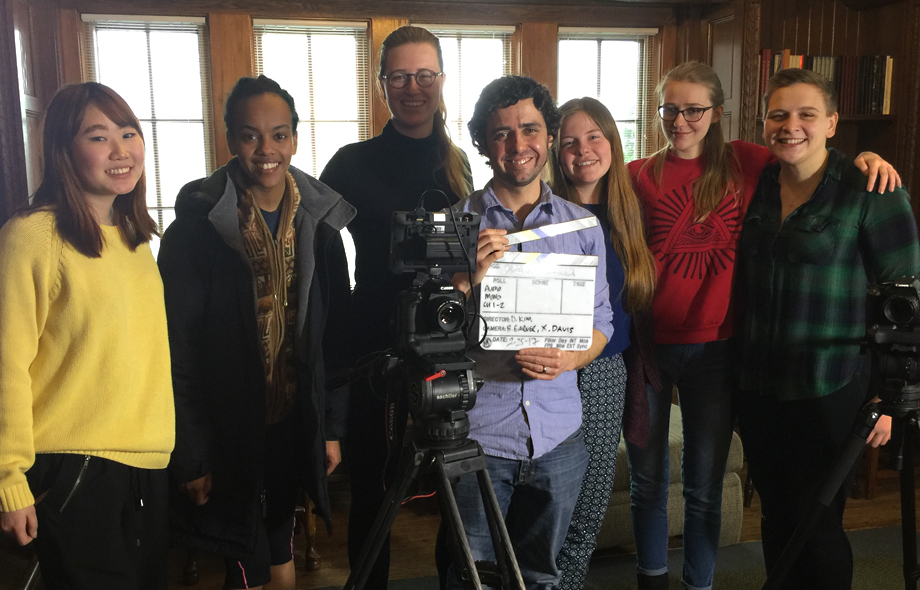 Several students from Visiting Instructor of Art Danny Kim‘s videography classes had the opportunity to interview Jeremy Sabella, author of the companion book of the new documentary, “An American Conscience: The Reinhold Niebuhr Story.”
The K students asked the questions and did all of the sound and camera work required for the interview. They focused on the reasons the filmmakers chose to tell Neibuhr’s story. Their interview will be featured on the film’s website in coming weeks. The documentary film is currently screening in select locations this spring and will air on PBS later this year. It features interviews with many internationally recognized historians and scholars, including former Kalamazoo College professor Gary Dorrien, the Reinhold Niebuhr Professor of Social Ethics at Union Theological Seminary and Professor of Religion at Columbia University.
Neibuhr was one of America’s most prominent 20th-century theologians and political thinkers, noted for his unrelenting advocacy for justice and for the incisive clarity of his thinking and writing. Presidents from Barack Obama to Jimmy Carter have credited his impact on their thinking, as well as John McCain, countless historians, theologians, political thinkers, and Dr. Martin Luther King, Jr., who cited Niebuhr in his “Letter from a Birmingham Jail”.
Niebuhr’s books, Moral Man and Immoral Society (1932), The Nature and Destiny of Man (1941–43) and The Irony of American History (1952), continue to influence theological and political thinking. His insights into human nature and its relationship to political movements and social justice propelled him to speak openly, and often critically, to an America consumed by moral certainty. The documentary includes interviews with many prominent
The K “Sabella Interview” production crew included (l-r): Christine Cho, Kalkidan Amare, Mackenzie Landman, author Jeremy Sabella, Madeline Lauver, Ximena Davis and Blair Garner. Sabella is married to Sarah Koenig, visiting assistant professor in K’s religion department.
K Plans Career Summit for April 7 and 8
A select group of K alumni who are leaders in their fields will join Silicon Valley executives and venture capitalists for Kalamazoo College’s Career Summit 2017 — two days of practical preparation for Life after K.

Through interactive break-out sessions, themed panel discussions, and networking opportunities, students of all majors will gain priceless information about what to do (and what not to do) to position themselves for success in a fast-changing and unpredictable global job market.
Led by Brad O’Neill, creator of K to the Bay and a serial entrepreneur and investor, this exclusive opportunity to connect with industry leaders takes place on the Kalamazoo College campus so as many students as possible may participate.
The scheduled speakers are:
- Jeanne Blondia ’87: Vice president of finance and treasurer, Stryker Corp.;
- Jonathan Carr: Director of finance, SurveyMonkey Inc.
- Priyanka Carr: Vice president of strategy and operations, SurveyMonkey Inc.
- Val Cole ’83: Retired senior executive, Apple Inc.; consultant and philanthropist;
- Amy Courter ’83: National president, Women in Defense; chief operating officer, inerTRAIN;
- Lindsey Haswell: Director of litigation, Uber Technologies;
- Ed Hortelano ’83: Global vice president for research and development, Loparex;
- Terri Kline ’80: President and chief executive officer, Health Alliance Plan of Michigan; executive vice president, Henry Ford Health System;
- Om Malik: Partner, True Ventures; founder, Gigaom;
- Michael McFall ’93: Co-president and chief executive officer, Biggby Coffee;
- Brad O’Neill ’93: Senior vice president of global sales and success, SurveyMonkey Inc.; creator, K to the Bay; serial entrepreneur and investor;
- Hilmon Sorey: Co-founder and chief revenue officer, CareerSofia;
- Elena Verna: Senior vice president of growth, SurveyMonkey Inc.; and
- Jeff Wycoff: Co-founder and managing partner, Fort Point Capital Partners.
For more information, visit the Career Summit schedule of events.
K Professor Co-Edits ‘Computational Neurology and Psychiatry’
Péter Érdi, the Henry R. Luce Professor of Complex Systems Studies, is the co-editor of a new book titled “Computational Neurology and Psychiatry.” He also is the co-author — along with two K alumni, Takumi Matsuzawa ’16 and Tibin John ’15 — of a paper included in that book. The paper is titled “Connecting Epilepsy and Alzheimer’s Disease: Modeling of Normal and Pathological Rhythmicity and Synaptic Plasticity Related to Amyloidβ (Aβ) Effects.”

Sometimes seeing more is a matter of new ways of looking. Such “new ways of looking” include the emerging scientific fields of computational neurology and computational psychiatry. The key word is “computational.” Researchers apply math and computer science to create computer models that simulate brain structures and brain activities associated with specific disorders (epilepsy and Alzheimer’s disease, for example). Such simulations — and new techniques of analyzing the copious amount of data that emerges from such simulations — have the potential to reveal elements of brain structure and function associated with disease and disorders, elements that have heretofore been a mystery. In other words, these “new ways of looking” may result in seeing what’s never been seen before.
Computer modeling also offers advantages of cost and convenience compared to older ways (animal experimentation and laboratory set-up) of trying to model and see brain structure and (mal)function.
A book that pioneers these new scientific fields is exciting and important, says Péter: “Adopting advanced computational methods such as modeling and data processing raises hopes that one day we will more effectively treat neurological and psychiatric disorders.”
In other news, Péter has been appointed vice president for membership of the International Neural Network Societies.
Bibliographer Honored, Shares the Story of the Vodka Plant
 The Modern Language Association’s MLA Field Bibliographer Newsletter includes a profile of a Distinguished Indexer who is none other than Kalamazoo College’s own Joe Fugate, professor emeritus of German studies and director emeritus of the Center for International Programs. Indexers and bibliographers are indispensable to the art and science of scholarship in all fields. The MLA article notes that Joe has been a field indexer longer than any other contributor, enriching the coverage in the German literature section for almost fifty years, adding thousands of citations to the MLA International Bibliography. He has also served as a member of and consultant to the Bibliography Advisory Committee. He was awarded an MLA International Bibliography Fellowship for the years 2011 to 2014. Much of the article is in Joe’s own voice. He says, “My tenure as a bibliographer has differed from that of any other bibliographer I have known because for almost 30 years while maintaining my faculty status, I held an administrative post in our study abroad program, including 18 as director.
“I was fortunate because my faculty interests–German language and literature, especially of the 18th century and in particular J. G. Herder–and my administrative post complemented each other. My frequent overseas trips visiting universities on three continents enabled me to establish personal contact with a number of foreign scholars who shared my academic interests and to perfect my fluency in other languages. The fact that my name appeared in the International Bibliography helped immensely in establishing these contacts.
“Over the years I have witnessed a number of changes in the production of the bibliography. When I first became a contributor all entries were typed or hand written on three by five slips of paper (some of which I still have in my files) and sent to MLA headquarters. These slips were replaced by the color-coded sheets which likewise were completed by hand or typed and then submitted.
“Now everything is on the computer. Traditionalist that I am however, I continue to miss the printed edition. I am sure that the MLA staff was relieved when they no longer had to deal with handwritten entries. Looking back I recall with pleasure the yearly meetings of the bibliographers with the staff at the annual convention. The gathering not only gave us an opportunity to discuss bibliographical matters but also to get to know each other personally. One of our colleagues, a contract interpreter for Russian with the State Department, would enliven our meetings with stories about her experiences with visiting Russians and their habit of proposing frequent toasts of vodka. When she was asked how she handled this, she replied that she tried to stand next to a plant into which she emptied her vodka. She never did tell us what this did to the plant.
“It was my privilege to serve on the Bibliography Advisory Committee. One issue we discussed at length was the lack of recognition as a scholarly and professional activity of being a bibliographer. In this connection I was able to cite one of my colleagues, now retired but still writing and publishing, who proclaimed for all to hear that my work as a bibliographer made his and other scholars’ possible. There are many to whom I owe a debt of gratitude for making my activity as a bibliographer an interesting and enriching experience: those who originally accepted me as a bibliographer, the heads of the bibliography department at the MLA, the section heads and the MLA staff with whom I have worked together and continue to work with even today.”
Congratulations, Joe!
Imagination Celebration
 “The Stories They Tell,” Visiting Instructor of Art Danny Kim’s documentary film about the Co-Authorship Project of Woodward Elementary School and Kalamazoo College, is an official selection of the Made in Michigan Film Festival (Frankenmuth, Michigan). It will screen on Sunday, February 5, at 4:25 p.m.
The film is no stranger to awards. It won the Kalamazoo Film Society’s “Palm d’Mitten” Award for best local film. And the documentary took second place for best feature film at the North-by-Midwest Film Festival in Kalamazoo! It also has screened at the Lake Erie Arts and Film Festival in Sandusky, Ohio, the East Lansing Film Festival in Michigan, and Reading FilmFEST in Reading, Pennsylvania.
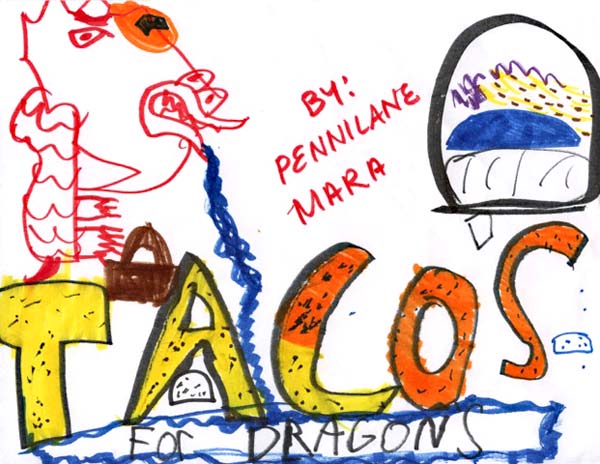
“The Stories They Tell” chronicles remarkable collaborations, like “Tacos for Dragons,” one of the many books featured in the film.
The saga of that unlikely pair (dragons and tacos) is the product of the imaginations and work of two seemingly unlikely co-authors, one a Kalamazoo College student and the other a third grader at Woodward Elementary.
 Such collaborations are unlikely no more, thanks to the Co-authorship Project, the subject of Kim’s 80-minute film and the heart of Professor of Psychology Siu-Lan Tan’s developmental psychology class for the last 15 years. The Co-authorship Project gives K students the opportunity to create an original storybook with an elementary student in order to gain a deeper insight into child development. Tan’s developmental psychology class is one of many academic service-learning courses that are designed in collaboration with the College’s Center for Civic Engagement.
The documentary showcases the project from beginning to end, starting with the picking of partners and culminating in the various unique completed works. The film spans almost a decade and a half of story making, to which Kim had unique access. He and Tan are husband and wife.
Animation infuses both the class and the film. “The project has made the developmental psychology class come to life,” said Tan,”awakening ideas with real world experience. The collaborations give my students something more than what they could get in books alone.” Likewise, Kim’s animation of the creativity in each story makes the film leap to life.
“The documentary is really about relationships, learning, connecting, and, at its core, imagination,” said Tan. “One skill that children naturally possess is imagination and creativity.”
The film highlights how much each interaction with a child can help augment what a college student knows about child development. The interactions also can affect a career path.
The life’s work of at least two of Tan’s former students offers proof. After viewing a sneak preview of the film in April of 2015, both women confirmed that the project directly influenced their decisions to pursue careers in education.
Rachelle (Tomac) Busman ’05 is a school psychologist in the Byron Center (Michigan) School District and Sally (Warner) Read ’08 is the head of the Kazoo School, an independent school in Kalamazoo.
“I remember everything about the little girl I worked with,” said Busman.
Kim thinks the contact with colleges students could help inspire their elementary school aged partners to consider college as part of their futures, and he said he hopes the documentary inspires similar projects elsewhere.
“It would be wonderful if somebody saw it and said maybe we could start something like this,” said Kim.
At K The project’s concept has been expanded and continued through a partnership with the Center for Civic Engagement. As the students (college and primary school) create these whimsical, amusing and surprising stories, the connections they make with each other have a lasting impact, not only in literacy and learning, but in understanding their pasts and futures.
Photo by Danny Kim
Art by Pennilane Mara
Matt Munoz ’14 contributed to this story.
“backyard song”
 Writer in Residence Diane Seuss has published a poem, “backyard song,” in the February issue of Poetry Magazine. Di’s poem is part of a group of a recently devised poetic form known as the Golden Shovel, an homage to the poet Gwendolyn Brooks, who would be 100 years old this year. The last words of each line in a Golden Shovel poem are, in order, words from a line or lines taken often, but no invariably, from a Brooks poem.
Di’s poem is a riff on Brook’s “a song in the front yard.” Here’s a taste of Di’s Golden Shovel poem:
Uncorked, I had a thought: I
want the want
I dreamed of wanting once, a
quarter cup of sneak-peek
at what prowls in the back, at
what sings in the
wet rag space behind the garage, back
where the rabbits nest, where
I smell something soupish, sour and dank and it’s
filled with weeks like rough
cat tongues and
the wind is unfostered, untended,
now that it’s just me here and
I am so hungry
for the song that grows tall like a weed
grows, and grows.
But you should swallow it whole: page 452 in the February issue of Poetry. Di is one of several impressive poets in the Golden Shovel group, which includes the late Philip Levine, Sharon Olds, Rita Dove, Alberto Rios and Danez Smith, who read some of his poems on campus this past Monday at the Martin Luther King, Jr. convocation. Di’s most recent collection of poems, Four-Legged Girl, was a finalist for the Pulitzer Prize. Her next book, Still Life with Two Dead Peacocks and a Girl, will come out in 2018.