Beyond the Game Connects Student-Athletes, Alumni for Career Planning

Students and athletes network during Beyond the Game
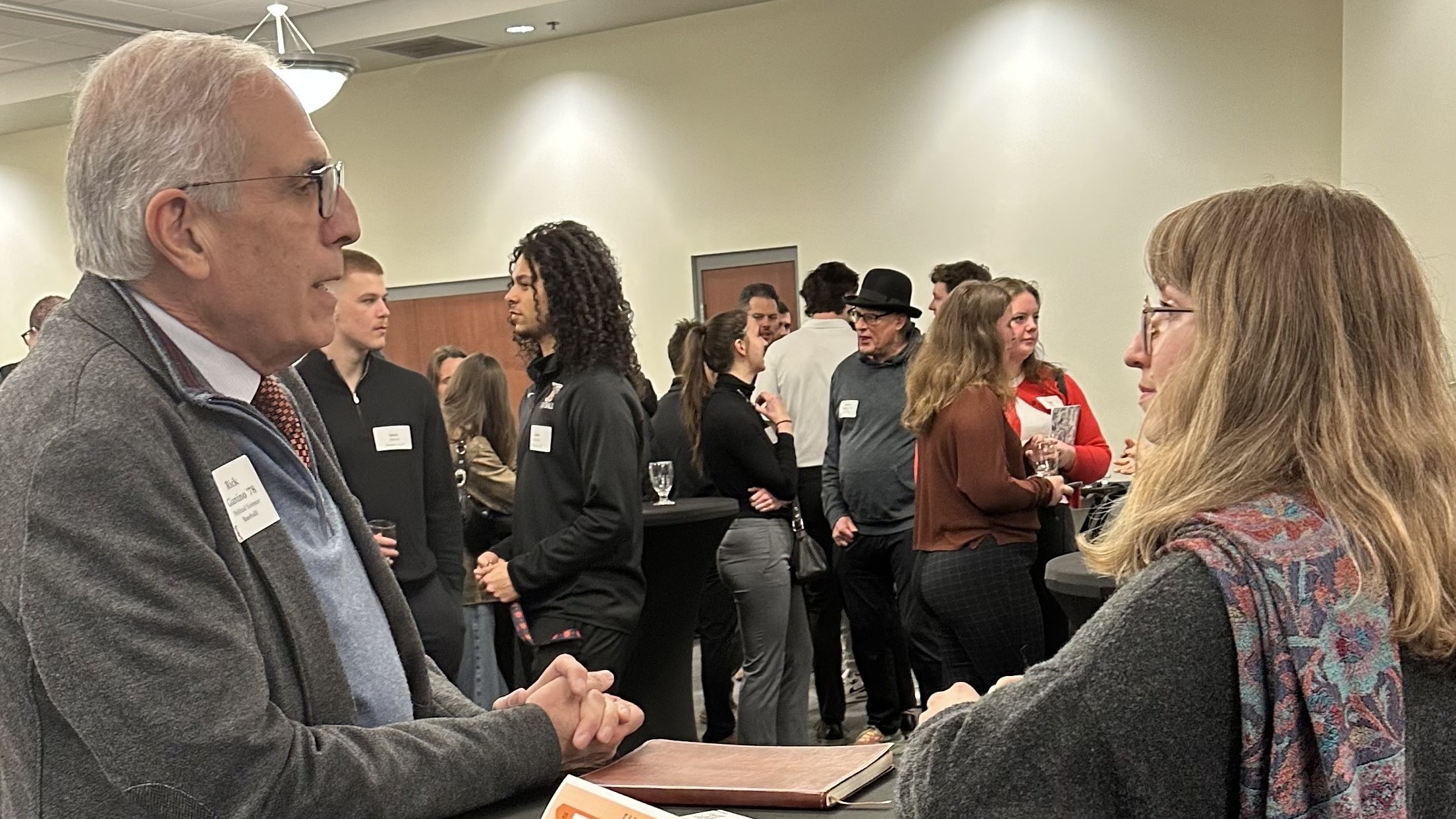
Rick Gianino ’78 talks with Maddie Hanulcik ’26 during Beyond the Game.

Editors Note: Carson Williams ’25 wrote this story for College Marketing and Communication.

At a table in the Hornets Suite, Annslee Ware ‘27 leaned into conversation with alumni, asking questions about careers, choices, and what comes next. Like many Kalamazoo College student-athletes nearing graduation, she’s beginning to look beyond the structure of practices and games to a new question taking shape: Who am I beyond the game?

That question brought junior and senior student-athletes together with alumni in March for the Beyond the Game networking event, hosted by Center for Career and Professional Development (CCPD), and the Office of Alumni Engagement (OAE), in partnership with Kalamazoo College Athletics. The gathering connected students with graduates to discuss post-graduation journeys.

“The goal of Beyond the Game was to create a meaningful space to explore careers of interest, gain advice on navigating life at and after Kalamazoo College, and continue building professional networks,” CCPD Director Valerie Miller said.

About 80 students and 20 alumni attended the event. Many participants said they valued both the opportunity to practice networking and to learn how academic experiences at K translate into careers.

Ware, a women’s lacrosse player double majoring in psychology and business, said the event helped her see new possibilities. She hopes to build a career helping others in the sports realm.

“Connecting with alumni and learning from them are essential to my career journey,” Ware said. “It was fun learning what majors and minors alums had and how they related to their profession.

She left the event looking forward to what her future could be like after K.

“My biggest takeaway was to always be open to any career paths and work hard,” she said. “Openness to experience and a strong work ethic are key when you’re aiming to be successful.”

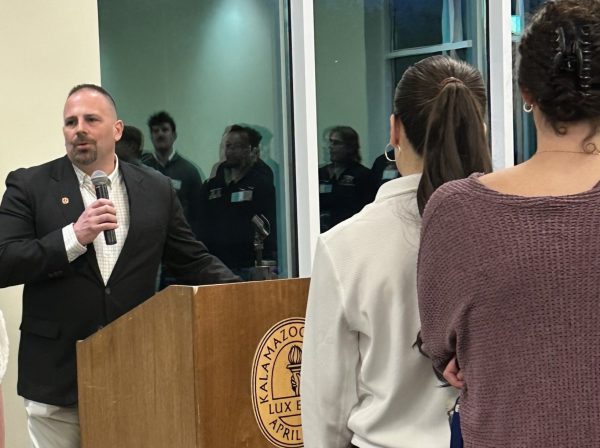
Director of Athletics Jamie Zorbo speaks to students and alumni during Beyond the Game
Director of Athletics Jamie Zorbo speaks to students and alumni during Beyond the Game.
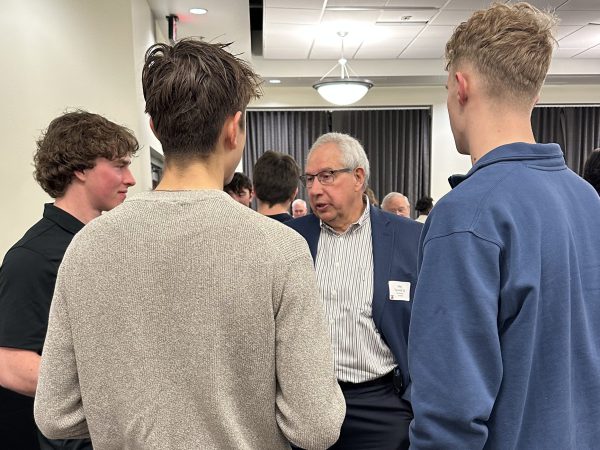
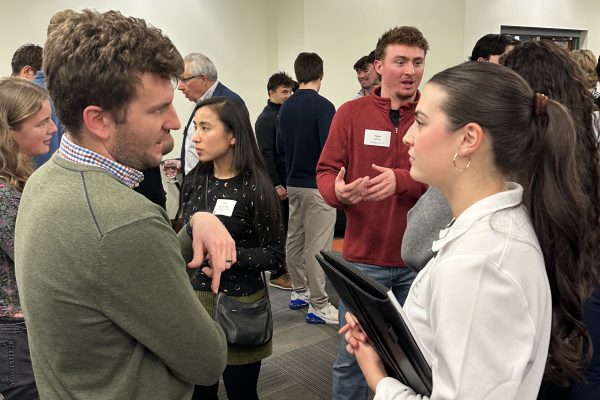
Students and an alumnus talk during Beyond the Game
Students and an alumnus talk during Beyond the Game.

Jacob Gallimore ‘15 majored in chemistry with a business minor and a biochemistry concentration and was a member of the football team. He is now Vice President of business development at Ansira, a software development company based in St. Louis, Missouri. He returned to campus for the opportunity to help fellow Hornets.

“I know how stressful it was my junior and senior years, beginning to make plans post-graduation,” Gallimore said. “I’m always about networking, and as I progress in my career, I would love to hire some Hornets down the line.”

He enjoyed talking to student-athletes across all sports and was impressed by the number of students who attended and asked pertinent questions about career paths and the job market.

“There is a new challenge current seniors face, entering a rapidly changing job market in the artificial intelligence era, where the number of entry-level roles has decreased in the past few years,” Gallimore said. “However, this reinforces the value of the K-Plan in preparing students to be adaptable and the necessity of the plethora of tools that K provides, including networking events like this one.”

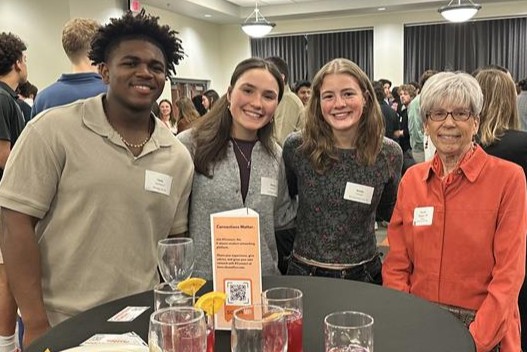
Three students and an alumna talk during Beyond the Game
Students and alumni connect in the Hornets Suite for the Beyond the Game networking event.
A student-athlete and an alumnus talk
About 80 students and 20 alumni attended Beyond the Game.

Miller says feedback from alumni about the event was overwhelmingly positive.

“Among the alumni who completed our survey, 100% said the event was a positive experience and worth their time, and that they felt it was genuinely useful for student-athletes.”

As students like Ware look ahead, events like Beyond the Game offer more than networking. They provide a starting point for imagining a future beyond college and athletics, one conversation at a time.

“At Kalamazoo College, we emphasize the ‘student’ in student-athlete by intentionally creating opportunities like this for career exploration, mentorship and meaningful connection,” Director of Athletics Jamie Zorbo said. “It also serves as a strong reminder of the reach and impact of the K network. Our alumni are deeply invested in giving back, and that support plays a critical role in helping our student-athletes move forward with confidence.”

Soccer Study: Team Dynamics Matter More Than Individual Talent

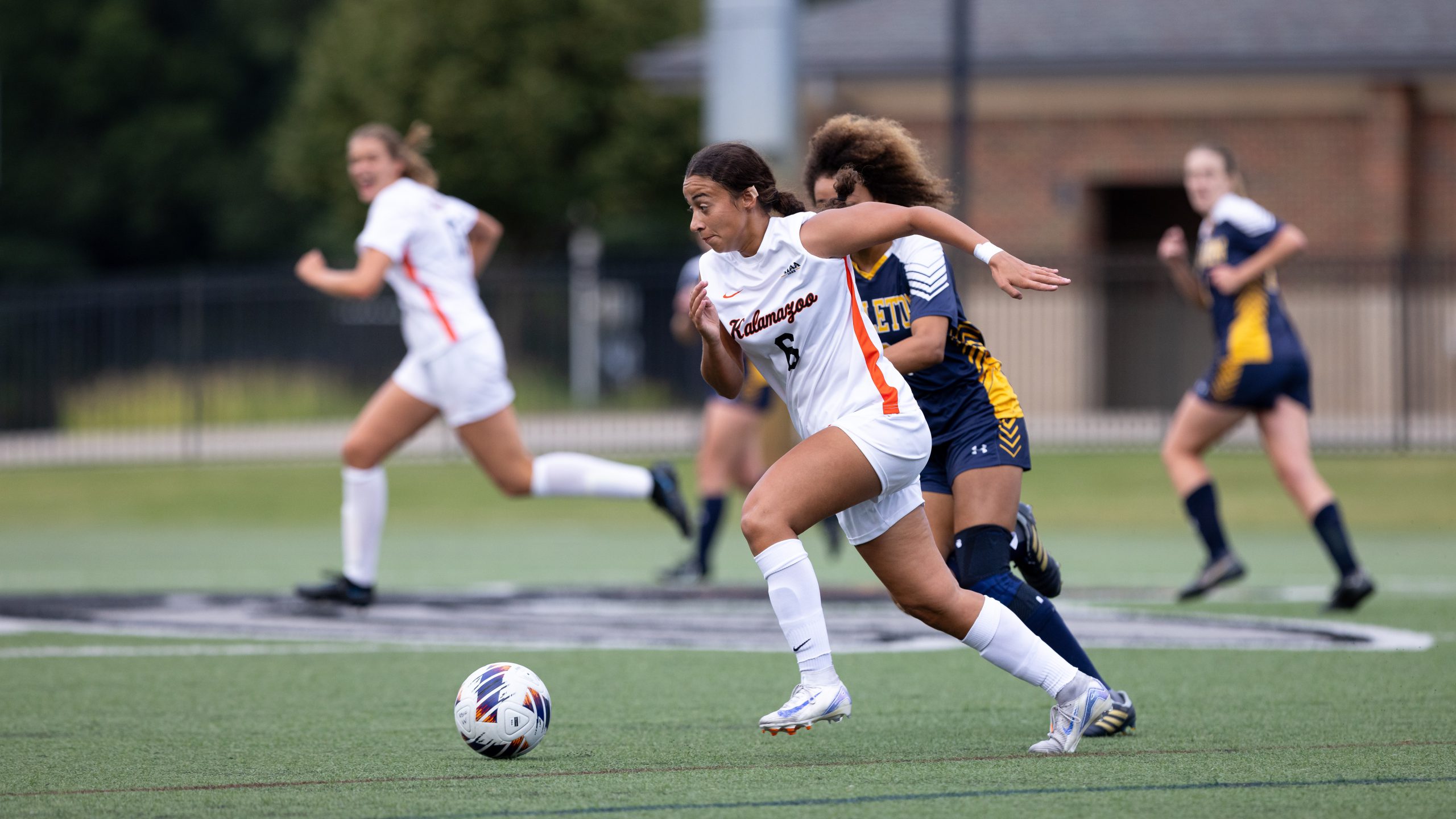
Miyani Sonera driving downfield during a Kalamazoo College women's soccer game
For Miyani Sonera ’27, a biology project about soccer was as much about learning the research process as it was about the result. “Getting to design a study, analyze data and see it published, that was incredible,” she said. “It showed me how much there is to explore when you ask the right questions.”

In soccer, chemistry might outweigh star power.

A new study from Kalamazoo College, published in Football Studies, found that a soccer player’s individual ability accounts for only about 11% of performance variation in small-sided games. Their combination with teammates? Roughly double that.

In the study, Associate Professor Santiago Salinas, soccer alumnus Shun Yonehara ’24 and student-athlete Miyani Sonera ’27 ran 78 small-sided matches—three-on-three, men and women, rotating teammates through ever-changing combinations. Because each athlete played with many different teammates, the researchers were able to separate the influence of individual ability from the impact of specific teammate combinations.

The research drew inspiration from an unlikely source in quantitative genetics. “In biology, we often separate the effects of genes and environment to understand why organisms differ,” Salinas said. “We realized we could apply the same idea to soccer. Players are like genotypes, teammates are the environment, and performance is the resulting phenotype.” 

What they found surprised even the researchers. Individual player effects accounted for only about 11% to 12% of the variation in performance, while teammate combinations explained 20% to 23%. The rest, nearly two-thirds, remained unpredictable, likely influenced by opponent dynamics, moment-to-moment decisions, and the inherent randomness of low-scoring games. 

“When you actually see the numbers, it’s eye-opening,” Yonehara said. “I expected teamwork to matter, but I didn’t expect individual impact to be that small.” 

For Yonehara, the research question was personal. A biology major who played soccer throughout his life, he had long felt that games are won in moments that often miss the highlight reels.

“People talk about great teams like they’re just a collection of great individuals,” he said. “But from playing, you know that without cohesion, without players doing the unseen work, the whole thing falls apart.”

The study also compared match performance with traditional skill assessments including passing accuracy, dribbling speed, shooting precision and ball control. Those measures, commonly used in evaluations and tryouts, did not strongly predict how much a player helped their team in games.

“That was a big takeaway for me,” Sonera said. “Being great in isolated drills doesn’t necessarily translate to being effective in real gameplay.”

Sonera, who has loved soccer since childhood, was drawn to the project because it merged science with a sport built on collaboration.

“Soccer demands understanding your teammates,” she said. “That’s part of what makes it beautiful. This research puts numbers behind that idea.”

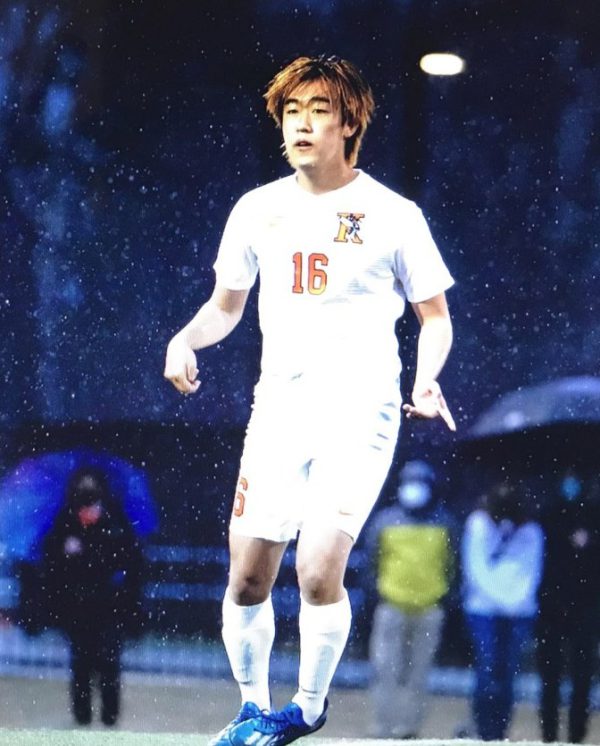
Shun Yonehara during a rainy Kalamazoo College men's soccer game
Shun Yonehara ’24 currently works as a research assistant for Momoko Yoshimoto, an associate professor at the Western Michigan University Homer Stryker, M.D., School of Medicine.
Santiago Salinas, one of five endowed chairs, kneels in a river
Associate Professor of Biology Santiago Salinas traditionally teaches classes such as vertebrate biology and human physiology. His research interests include his work in the K Fish Lab, where he and his student collaborators study the ways fish populations cope with changes in the environment.

In the men’s dataset, the researchers observed that teams made up of complementary roles such as a scorer, a facilitator and a defensive-minded player tended to outperform teams of similar player types. Although that pattern did not appear in the women’s data, Salinas cautioned that the difference might reflect sample size rather than a fundamental distinction.

Together, the results challenge conventional approaches to scouting and performance analysis, which often rely on individual statistics or fixed lineups.

“Our findings suggest that some players make everyone around them better,” Salinas said. “But that kind of impact is hard to see unless players are tested in multiple contexts.”

Sonera hopes coaches take that message seriously.

“I’d like to see coaches think beyond who looks best on their own,” she said. “Building balanced lineups and focusing on how players connect could make a huge difference.”

Yonehara echoed that idea, comparing team building to constructing a well-balanced system rather than collecting stars.

“It’s like building chemistry in a video game or a trading card deck,” he said. “It’s not just about rating, it’s about fit.”

Although the study focused on soccer, the researchers believe the approach could apply broadly across team sports, particularly those that are fluid and fast paced, such as basketball or hockey.

For the research team, the findings support a long-held belief in team sports that what matters is not just who the players are, but how they work together.

Student-Athlete Finds a Family Legacy, Her Own Mark at K

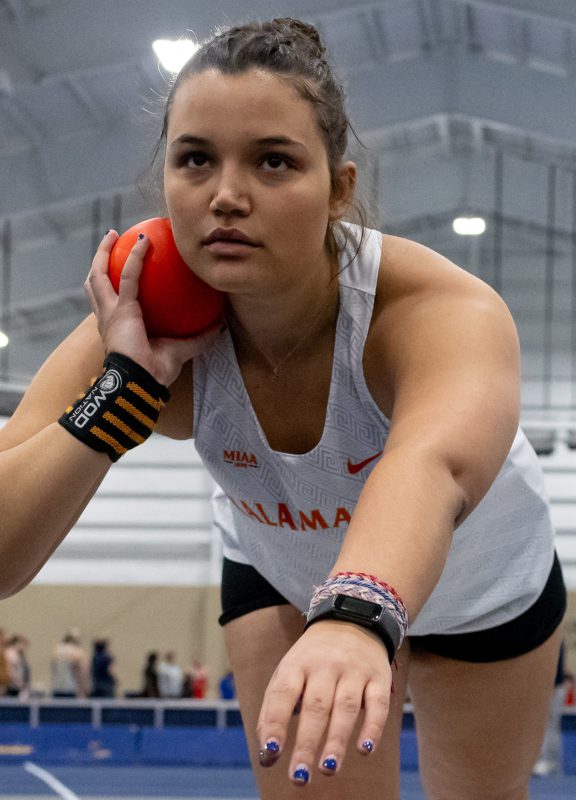
Zara Strauss prepares to throw the shot put and set a new personal mark during a women's track and field meet
Zara Strauss ’29 became the first Hornet to be named MIAA Field Athlete of the Week since Kalamazoo College relaunched track and field. All photos by Kimberly Moss.
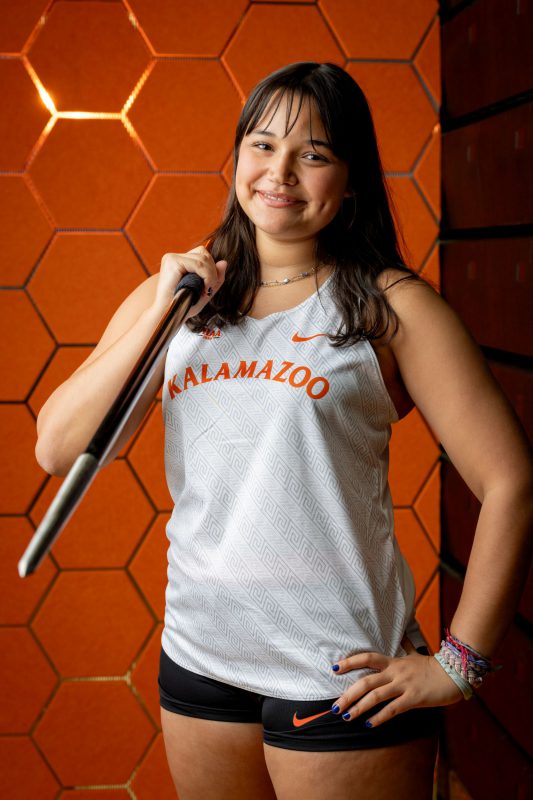
Track and field student-athlete Zara Strauss '29 holding a javelin
Strauss competes in shot put and weight throw and plans to expand into additional outdoor events this spring.
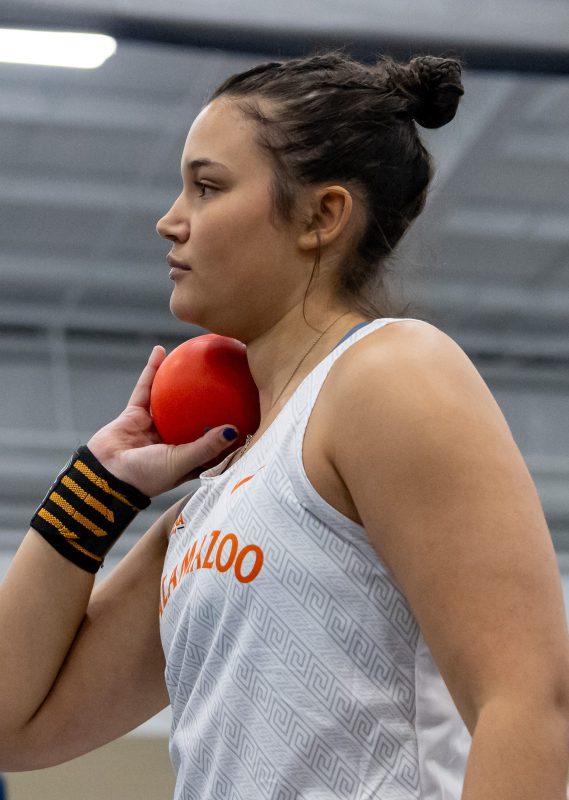
Track and field student-athlete Zara Strauss '29 prepares to compete in the shot put and set a new personal mark
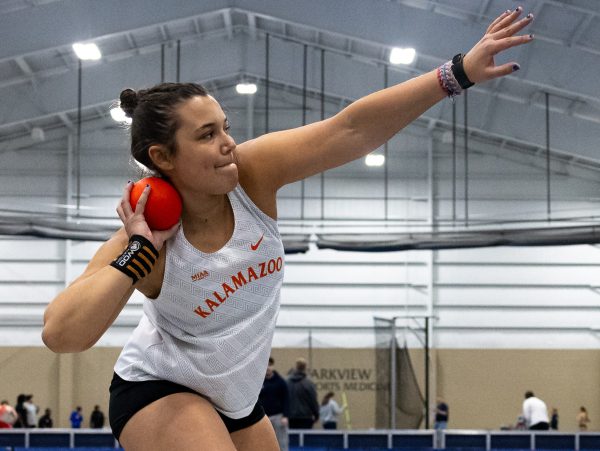
Strauss’ first collegiate track meet was January 17 at Trine University’s Sean Brady Invitational, where she beat her personal record in the shot put with a throw of 9.84 meters.

When Zara Strauss ’29 stepped into the throwing circle for her first collegiate track meet at Trine University’s Sean Brady Invitational on January 17, she was focused on one thing: beating her own mark. A personal record in the shot put—9.84 meters, nearly a third of a meter beyond her high school best—felt like a solid start, especially with a sixth-place finish in the competition. 

What she didn’t expect was the flood of Instagram tags that followed on January 20, alerting her that she had just made Kalamazoo College history. Strauss became the first Hornet to be named Michigan Intercollegiate Athletic Association (MIAA) Field Athlete of the Week since K relaunched the sport, marking an early milestone in the program’s new era. The conference honor is given to a female student-athlete who demonstrates a standout individual performance in competition. Recipients are selected from nominations submitted by head coaches at each MIAA member school.  

For the first-year international student from Tokyo, Japan, the honor was both surprising and affirming. 

“I was really shocked,” she said. “I didn’t even know the award was a possibility, to be honest. People started tagging me on Instagram when it was announced, and I wondered what was going on. I wasn’t disappointed in my performance that day, even though I wanted to do better. Getting the award boosted my confidence. I felt a lot better about how I had done.” 

When Strauss first pursued track and field as a sophomore in high school, she discovered her strength in throwing events after a coach nudged her away from sprinting. Since then, she has embraced the technical challenges of shot put, discus, javelin and hammer throw, constantly refining her form and experimenting with new techniques such as rotational throwing. 

At K, Strauss competes in shot put and weight throw during the indoor season and looks forward to expanding into additional events outdoors. She trains closely with head coach Kyle Morrison and throws coach Luke Decker, both of whom she credits with helping her see measurable improvements in technique and distance.  

But choosing K was about more than athletics. Strauss has deep family ties to the College as her grandparents, Professor Emeritus of History David Strauss and retired instructor Dhera Strauss, both taught at K. 

Her family’s connection to Japan traces back to her grandfather taking students there years ago. Her father, Benjamin Strauss, then studied abroad in Japan during college, where he later moved with her mother, Monique. An unexpected job transfer for her dad turned what was supposed to be a couple of years into 19 years in Tokyo, where Strauss was born and raised. 

With her brother and cousin also enrolled—and her cousin living immediately across the hall at Hoben Hall—campus quickly felt like home, even as she navigated life far from Japan. She visits her grandparents weekly, a routine that helped ease the homesickness she felt early on. 

That sense of connection extends to her teammates. As one of six throwers and the only woman in the group, Strauss describes the squad as tight-knit and supportive. Teammates offer feedback on technique, share late-night meals after practice and travel together to meets. A friendship formed during LandSea with sprinter Gwyneth Dunaway ’29 has also carried onto the track, reinforcing the community she hoped to find at a small college. 

Strauss admits that earning conference recognition so early in the program’s return brings a mix of pride and perspective. She feels some responsibility to continue that excellence as one of the first standouts of the relaunch, but she’s determined to keep the experience grounded in enjoyment and growth. 

Her achievement also arrives at a meaningful moment on the calendar. February 4 marks the National Day of Women and Girls in Sports, a global celebration of participation, visibility and equity. Strauss, who attended an all-girls school and helped pioneer a new wrestling team for girls in her high school league, sees the day as a reminder of why representation matters. 

“I think it’s important to create that space for women to be able to have their own league and to see themselves in their sports,” she said. “I feel like I’ve always grown up around women in sports, and it’s important to give women the attention they deserve.”  

Student-athlete Zara Strauss competes in the shot put during a track and field meet at Trine University
Choosing K was about more than athletics for Strauss, who has deep family ties to the College.
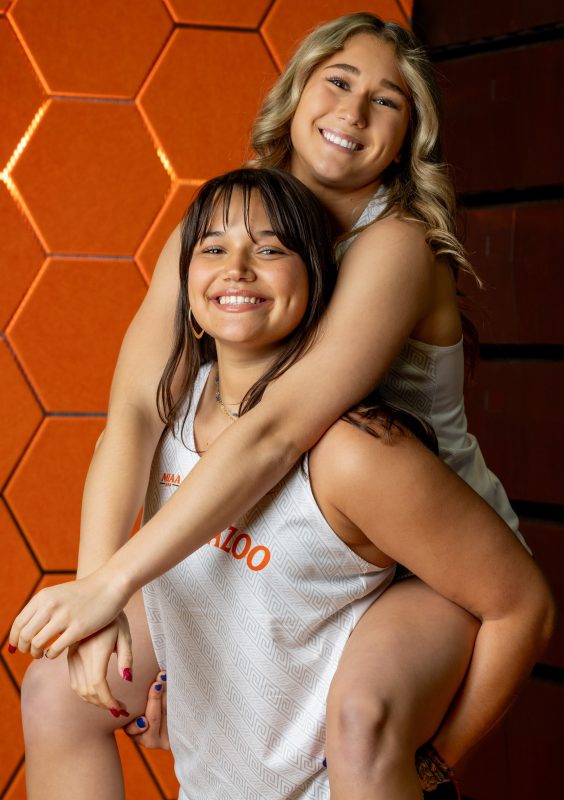
Track and field student-athlete Gwyneth Dunaway climbs on the shoulders of Zara Strauss
Strauss formed a friendship with sprinter Gwyneth Dunaway ’29 while the two participated in LandSea orientation. Their friendship has carried over onto the track.

Make Your Mark
with the Hornets

You can support Kalamazoo College student-athletes like Zara Strauss ’29 by participating in Hornet Athletics Giving Day on February 18. Visit our website to make a mark with a gift that will help fund the highest priorities of our teams and provide resources such as equipment, travel and coaching excellence.

As K’s track and field program builds momentum in its return season, Strauss hopes to keep building, too, while refining her form, chasing new personal records and contributing to a team goal of making an immediate mark on the MIAA standings. If her debut is any indication, both she and the Hornets are off to a record-setting start. 

“I’ve made some good friends, and K is a fun place to be,” Strauss said. “I’m really enjoying my first couple of months here, and I can’t wait for the next four years.”