Nature Center Nurtures Student’s Love of Writing

A nature center and biological field station in Hastings, Michigan, is home for a Kalamazoo College student this summer.

Paige Chung and Oliver Baez Bendorf at Pierce Cedar Creek Institute Nature Center
Paige Chung ’20 is at Pierce Cedar Creek Institute this summer, serving as the nature center’s Nature in Words Fellow. Assistant Professor of English Oliver Baez Bendorf, who leads poetry classes at K, is serving Chung as a consultant.

Paige Chung ’20, an English and critical ethnic studies (CES) major, is at Pierce Cedar Creek Institute, which is dedicated to environmental education and stewardship. She is serving the center as a Nature in Words Fellow by developing a collection of soundscape poetry and creative non-fiction based on her on-site explorations.

Soundscapes capture a sound or a combination of sounds that arise from an immersive environment, making Pierce Cedar Creek Institute an ideal atmosphere. The opportunity allows Chung to explore 742 acres of land, including lakes, forests and hiking trails, as she nurtures a hobby she hopes to one day parlay into a career: writing.

Bill and Jessie Pierce developed the Willard G. Pierce and Jessie M. Pierce Foundation to benefit Hastings and West Michigan in 1988. Just before they died in 1998, they had an idea to build an environmental education and nature center that became the Pierce Cedar Creek Institute.

Paige Chung Presenting at Pierce Cedar Creek Institute Nature Center
Paige Chung presents to other fellows at the Pierce Cedar Creek Nature Institute.

Now, 14 students from Michigan colleges and universities are on the property as they study animals from box turtles to rattlesnakes or pursue creative opportunities such as painting. Chung, however, is the only writer, and she feels fortunate to be there.

“I remember getting an email from the English Department about it right before bed one night in February or March,” Chung said. “At that point, I was trying to decide if I should go back home to do some community work for the summer or if I would find somewhere to stay in Michigan, so I applied. It’s phenomenal because it provides me with an abundant number of opportunities to write without the pressures of paying the rent or bills, and it fuels my ability to create my art. It shows me that writing is possible as a career.”

Pierce Cedar Creek Institute fellowship students have consultants of their choosing serving them as advisers during the summer. Chung’s consultant is Assistant Professor of English Oliver Baez Bendorf, who leads poetry classes at K.

Pierce Cedar Creek Institute Nature Center Bridge
Pierce Cedar Creek Institute covers 742 acres of land, including lakes, forests and hiking trails.

“He’s been phenomenal so far with how he pushes me to write,” said Chung, who also credits Intercultural Student Life Director Natalia Carvalho-Pinto, Assistant Professor of Critical Ethnic Studies Reid Gomez and Assistant Professor of English Shanna Salinas for inspiring her at K. Bendorf “encourages me to write and not worry about creating a perfect product. He asks questions and supports me every step of the way. He’s someone I’ll check in with throughout the writing process.”

That process for Chung includes immersing herself at the nature center, both in solitude and in the company of other students, observing and sampling sounds that end up in her poetry. “Poetry for me captures a moment,” Chung said. “There’s less pressure to have an entire plot and story line with poetry. It’s a playground for language. I also like to write plays, but those are longer-term projects for me. With poetry, I can write in one day and be done with it. I don’t necessarily need anything more than time, a piece of paper and a pen.”

At K, Chung works as a Writing Center assistant director and Intercultural Center-Arcus Center liaison, and she co-founded Resist, Magic Mastermind, a zine publication uplifting the stories of queer students, trans students and students of color. As a Los Angeles native, Chung’s inspirations have traditionally been city based, which means Pierce Cedar Creek Institute expands her writing horizons.

Chung said, “In CES, we learn from Chinua Achebe—who speaks English as a non-native speaker, allowing for something new and interesting to happen with language—that stories are stories even with a non-native tongue. We learn from the book Almanac of the Dead that stories are power. Through the power of language and stories, I am constantly asking what can be done with writing.”

This fellowship gives Chung the opportunity to explore this question in new ways.

“Through this fellowship, I ask what can be translated from the sounds of nature to sounds from hip-hop, jazz, Spanglish, Vietnamese and Los Angeles. This will help me push the boundaries of my poetry and writing to new landscapes.”

Get Versed in National Poetry Month

If your knowledge of poetry is limited, April is the perfect time to expand your horizons and practice your writing. That’s because it’s National Poetry Month, and Assistant English Professor Oliver Baez Bendorf has creatively developed ways for students to hone their skills and develop their interests in poetry to celebrate.

Kayla Park National Poetry Month
Kayla Park read at the Belladonna* Collaborative Reading last spring. She interned with Belladonna*, an independent feminist avant-garde poetry press, through the New York Arts Program during the winter 2018 term at K.

Among his classes, Baez Bendorf teaches an advanced poetry workshop, which is participating in a 21-day challenge to write every day. Students are assigned poetry-inspired aliases and write about their praxis, or practice, of writing. “Writing about writing” might sound redundant, but its purpose is to help students learn about themselves, their influences and their processes to discover what inspires them.

Audrey Honig ’21, for example, is an English and religion major with a concentration in Jewish studies from Elmhurst, Illinois. She is writing erasure poems under the alias Lyra based on what she sees through social media. Erasure poetry erases words from an existing text in prose or verse and frames the result as a poem. The results can be allowed to stand on their own or arranged into lines or stanzas.

“I thought it would be interesting to bring what normally is a distraction into my writing,” said Honig, of the social media she analyzes. “I thought I wrote a lot before this class started, but I really wasn’t creating much. I was working on my writing, but I was mostly working on the editing process. Now I’m doing something small every day.”

Her biggest takeaway from the course has been how to better give and receive feedback to classmates and other writers.

“As students, we’re used to getting feedback when a professor might say, ‘This is a B,’” she said. “In this class, we’re really thinking about the specifics of what we’re doing as writers, so we can give honest and helpful feedback without tearing anyone down.”

For her 21-day challenge, Kayla Park ’19 selects a book at random off her shelf every day and writes a poem inspired by the last sentence on page 21 in that book.

Audrey Honig Recites During National Poetry Month
Audrey Honig presents during a class at Kalamazoo College’s Humphrey House. Honig is is writing erasure poems under the alias Lyra based on what she sees through social media.

Park, who writes under the alias Pegasus, earned a Heyl Scholarship when she matriculated at K to study within a science major, and she double majors in English and physics. She said she can see how a writing genre such as poetry helps make her a better scientist.

“When you continue doing a lot of work in one field and you get used to a certain mode of thinking, that’s beneficial in making you an expert in your subject, although you can also restrict your thought patterns that way,” she said. “In poetry, I’m expressing knowledge under a set of conventions that is different, but no less valuable than in science. Engaging with different modes of thinking helps me to see connections across disciplines and approach all situations from a broader point of view.”

The creativity poetry stirs for Park complements what she does with two a cappella groups at K, Premium Orange and A Cappella People of Color (ACAPOC), as well as with Frelon, the campus’ student dance company. It also helps her deal with her own perfectionism.

“Sometimes when I sit down to write, regardless of the assignment, I get hung up on making it perfect,” she said. “Forcing myself to write every day is beneficial in letting a little of that perfectionism go. It helps me write more freely and produce something that I can always go back and edit later.”

Baez Bendorf also offers an intermediate poetry workshop. That class this month is memorizing poems such as Truth Serum and 300 Goats by Naomi Shihab Nye and To Myself by Franz Wright with the goal of reciting them in May.

“We approach it as a kind of ultimate close reading of the work, and then aim to know it by heart, hopefully for a lifetime,” Baez Bendorf said.

National Poetry Month was inaugurated by the Academy of American Poets in 1996. It since has become the largest literary celebration in the world with schools, publishers, libraries, booksellers and poets celebrating poetry, according to the American Academy of Poetry.

The organization drew inspiration for National Poetry Month from Black History Month in February and Women’s History Month in March, and it aims to highlight the legacies and ongoing achievements of American poets, encourage the public to read poems, and increase the number of poetry-themed stories in local and national media. Read more about National Poetry Month at the Academy of American Poets’ website.

Honors Day 2018 Celebrates Student Achievements

Kalamazoo College Family Weekend served as the backdrop for the Honors Day 2018 convocation. More than 250 students were recognized Friday, Nov. 2, for excellence in academics and leadership in six divisions: Fine Arts, Foreign Languages, Humanities, Natural Sciences and Mathematics, Social Sciences and Physical Education. Recipients of prestigious scholarships were recognized, as were members of national honor societies and students who received special Kalamazoo College awards. Student athletes and teams who won Michigan Intercollegiate Athletic Association awards also were honored. The students receiving Honors Day awards or recognition are listed below.

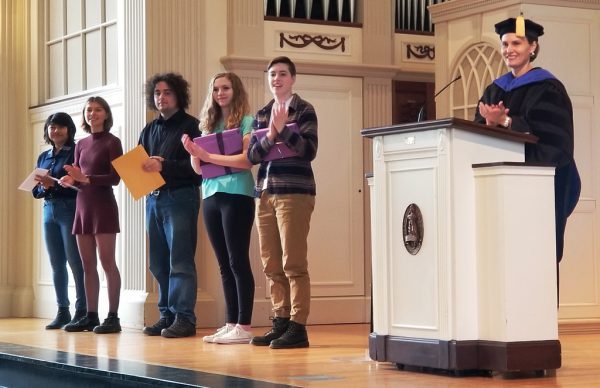
5 students and Provost on stage during Honors Day 2018 Convocation
Interim Provost Laura Lowe Furge applauds students receiving awards in the Fine Arts Division during the Honors Day 2018 convocation at Stetson Chapel.

FINE ARTS DIVISION

The Brian Gougeon Prize in Art
Isabel McLaughlin
Angela Pastor

The Margaret Upton Prize in Music
Dylan Beight

Cooper Award
Alysia Homminga
Megan Wilson

Sherwood Prize
Christina Diaz

Theatre Arts First-Year Student Award
Christina Diaz
Ynika Yuag

FOREIGN LANGUAGES DIVISION

LeGrand Copley Prize in French
Avani Ashtekar
Jessica Gougeon

Hardy Fuchs Award
Emily Eringaard

Margo Light Award
Grace Stier

Romance Languages Department Prize in Spanish
Sophia Goebel
Samantha Vasquez

Clara H. Buckley Prize for Excellence in Latin
Madeline Ward
Zhi Nee Wee

Provost’s Prize in Classics
Mara Hazen

HUMANITIES DIVISION

O.M. Allen Prize in English
Avani Ashtekar
Ynika Yuag

John B. Wickstrom Prize in History
CJ Martonchik

Department of Philosophy Prize
Johanna Jeung
Rosella LoChirco
Merrick Richardson

L.J. and Eva (“Gibbie”) Hemmes Memorial Prize in Philosophy
Max Fitzell
Daniel Qin

NATURAL SCIENCES AND MATHEMATICS DIVISION

Winifred Peake Jones Prize in Biology
Alexa Dulmage

Department of Chemistry Prize
Joseph Keller
Priya Pokorzynski

First-Year Chemistry Award
Lillian Baumann
Camden Gardner

Lemuel F. Smith Award
Sean Walsh

Computer Science Prize
Josephine Hosner
Ian Nostrant

First-Year Mathematics Award
Samuel Ratliff
Minh Dang

Thomas O. Walton Prize in Mathematics
Austin Cramer
Ethan Cuka
Michael Orwin
William Tait
Madeline Ward

Cooper Prize in Physics
Andrew Backer
Adam Decker
Emily Eringaard
Daniel Qin
Eleri Watkins

SOCIAL SCIENCES DIVISION

Departmental Prize in Anthropology and Sociology
Julia Bachmann
Nyima Coleman
Vivian Enriquez
Marcos Ferguson Morales
Yasamin Shaker

Wallace Lawrence Prize in Economics
Jade Jiang
Zachary Ray

William G. Howard Memorial Prize
Shayaan Dar

Wallace Lawrence Prize in Business
Georgie Andrews
Valentina Cordero

Irene and S. Kyle Morris Prize
Nick Klepser

William G. Howard Memorial Prize in Political Science
Alaq Zghayer

Department of Psychology First-Year Student Prize
Cavan Bonner

PHYSICAL EDUCATION DIVISION

Division of Physical Education Prize
Alex Dupree
Hannah Wolfe

Maggie Wardle Prize
Sophia Goebel

COLLEGE AWARDS

Gordon Beaumont Memorial Award
Anthony Diep
Malak Ghazal

Henry and Inez Brown Prize
Alex Cadigan
Sarah George
Nicholas Ludka
Amanda Moss

Virginia Hinkelman Memorial Award
Sara Lonsberry

Heyl Scholars – Class of 2022
Evelyn Bartley
Eva DeYoung
Thomas Fales
Madeline Guimond
Alina Offerman
Molly Ratliff
Syeda Tooba
Tatianna Tyler

Posse Scholars – Class of 2022
Sonia Arreguin
Nicholas Davis
Nathan Garcia
Zy’ere Hollis
Tytiana Jones
Aaron Martinez
Udochi Okorie
Joshua Pamintuan
Anthony Peraza
Samantha Rodriguez
Fiorina Talaba

National Merit Scholar – Class of 2022
Carter Wade

Voynovich Scholars
Haley Harris
Kathryn Martin

Alpha Lambda Delta – Class of 2019
Alpha Lambda Delta is a national honor society that recognizes excellence in academic achievement during the first college year. To be eligible for membership, students must earn a cumulative GPA of at least 3.5 and be in the top 20 percent of their class during the first year.

Nicole Bailey
Angel Banuelos
Catherine Carlberg
Justin Christopher-Moody
Nyima Coleman
Karli Crouch
Alexandro Cruz
Sela Damer-Daigle
Shayaan Dar
Adam Decker
Julia Dobry
Talea Fournier
Anna Gambetta
Camden Gardner
Sophia Goebel
Stanton Greenstone
Emily Hamel
Kelly Hansen
Kaylee Henderson
Amelia Hensler
Audrey Honig
Samantha Jacobsen
Madeline Jump
Liza Kahn
Joseph Keller
Hannah Kerns
Lu Liu
Rachel Madar
Natalie Markech
CJ Martonchik
Daniel Mota-Villegas
Kelly Nickelson
Nikoli Nickson
Abigail O’Keefe
Daniel Qin
Sage Ringsmuth
Maelle Rouquet
Kimberly Schmidt
Lily Shearer
Hannah Shiner
Caitlin Tremewan
Carter Vespi
Claire Ward
Maija Weaver
Ehren White

ENLIGHTENED LEADERSHIP AWARDS

Performing Arts: Music
Robert Barnard
Irie Browne
Rebecca Chan
Nolan Devine
Daniel Fahle
Grace Hancock
Julia Leet
Thomas Saxton
Lia Schroeder
Matthew Swarthout
Jonathan Townley
Ethan Tuck
Andrew Wright

MICHIGAN INTERCOLLEGIATE ATHLETIC ASSOCIATION (MIAA) AWARDS

The following Hornet teams earned the 2017-2018 MIAA Team GPA Award. Team members achieved a 3.3 or better grade point average for the entire academic year.

Men’s Baseball
Men’s Cross Country
Men’s Golf
Men’s Soccer
Men’s Swimming and Diving
Men’s Tennis
Women’s Basketball
Women’s Golf
Women’s Lacrosse
Women’s Soccer
Women’s Softball
Women’s Swimming and Diving
Women’s Tennis
Women’s Volleyball

MIAA ACADEMIC HONOR ROLL

The MIAA each year honors students at member colleges who achieve distinction in the classroom and in athletic competition. Students need to be a letter winner in a varsity sport and maintain at minimum a 3.5 grade-point average for the entire school year.

Alexandrea Ambs
Georgie Andrews
Ryan Andrusz
Hunter Angileri
Lauren Arquette
Julia Bachmann
Nicole Bailey
Zoe Barnes
Lillian Baumann
Jacob Bonifacio
Thomas Bryant
Jane Bunch
Alexander Cadigan
Charles Carson
Claire Cebelak
Joshua Claassens
Noah Coplan
Chase Coselman
Christina Dandar
Elan Dantus
Ricardo DelOlmo-Parrado
Guillermo Dominguez Garcia
Anders Finholt
Matthew Flotermersch
Benjamin Forhan
Maria Franco
Alex Fultz
Andre Gard
Sarah George
Jacob Gilhaus
Anthony Giovanni
Rachel Girard
Beau Godkin
Sophia Goebel
Connor Grant
Keenan Grant
Preston Grossling
Rebekah Halley
Griffin Hamel
Kaiya Herman-Hilker
Mathew Holmes-Hackerd
Matthew Howrey
Briana Huisken
Shannon Irvine
Samantha Jacobsen
Tim Jeske
Benjamin Johanski
Katherine Johnson
Lisa Johnston
Jackson Jones
Madeline Jump
Claire Kalina
Grace Karrip
Maria Katrantzi
Donald Kearns
Sai Klein
Emily Kozal
Matthew Krinock
Rosella LoChirco
Molly Logsdon
Nicholas Ludka
Rachel Madar
Cydney Martell
Eliza McCall
Courtney McGinnis
Clayton Meldrum
Tytus Metzler
Nathan Micallef
Madison Moote
Amanda Moss
Elizabeth Munoz
Kelly Nickelson
Nikoli Nickson
Jonathan Nord
Skyler Norgaard
Ian Nostrant
Abigail O’Keefe
Ryan Orr
Michael Orwin
Alexandria Oswalt
James Paprocki
Cayla Patterson
Caleb Patton
Zachary Prystash
Erika Pueblo
Daniel Qin
Erin Radermacher
Zachary Ray
Joshua Reuter
Julia Riddle
Scott Roberts
Anna Roodbergen
Justin Roop
Peter Rossi
Matthew Ryder
Claire Schertzing
Nicholas Schneider
Eleanor Schodowski
Justin Seablom
Sharif Shaker
Reagan Shapton
Danielle Simon
Jordan Skidmore
Adam Snider
Grant Stille
Shelby Suseland
Jack Tagget
Liam Tait
Kathryn Thamann
Alayna Tomlinson
Madison Vallan
David Vanderkloot
Zachary VanFaussien
Travis Veenhuis
Maija Weaver
Alex White
Jessica Wile
Jordan Wiley
Clayton Wilkey
Hannah Wolfe
Madeline Woods

Journalist to Deliver Hilberry Symposium Keynote

The Kalamazoo College English Department will conduct its annual Hilberry Symposium, which honors English majors and their Senior Individualized Projects, this Friday and Saturday.

Hilberry Symposium Keynote Speaker Lauren Trager
Lauren Trager ’07, an investigative journalist for KMOV-TV in St. Louis, will kick off the annual Hilberry Symposium with a keynote at 6:30 p.m. Friday in the Olmsted Room.

Lauren Trager ’07, an investigative journalist for KMOV-TV in St. Louis, will kick off the event with a keynote at 6:30 p.m. Friday in the Olmsted Room. Trager has spent most of her career as a reporter and anchor through the newspaper, radio and television industries, and has also worked in government. She worked as an anchor and reporter at KARK-TV in Little Rock, Arkansas, before arriving in St. Louis in 2013.

SIP presentation panels will run concurrently from 1:30 to 5:30 p.m. Saturday after an opening session at 1 p.m. at 103 Dewing Hall. A reception at the Arcus Center will follow.

The Hilberry Symposium was named for late Professor Emeritus Conrad Hilberry, who was the founder of the creative writing program at K. The event resembles a professional conference, where scholars and writers share their work and acknowledge each other’s achievements. Alumni, nominated through English Department faculty, have served as keynote speakers for the event since 2001.

Since the first Hilberry Symposium in 2000, the event has been an important collective experience for the graduating class as a ritual of remembrance and celebration. With English Department faculty members, family and friends also attending, English majors have developed a community through the symposium that has evolved over time, with the love of language as its enduring center.

Visit its website for more information on the English Department and the Hilberry Symposium.

Five Faculty Members Receive Tenure

With specialties ranging from the psychology of adolescents to Victorian literature, five Kalamazoo College professors have achieved tenure.

The milestone recognizes the scholarship and teaching they have completed to the point of tenure, and it is also a sign of confidence in the contributions they will make during their entire careers. The College’s Board of Trustees, meeting in March, voted to grant tenure to:

Kyla Day Fletcher, Lucinda Hinsdale Stone Assistant Professor of Psychology

Ryan Fong tenure
Ryan Fong
Kyla Day Fletcher tenure
Kyla Day Fletcher

Fletcher holds a Ph.D. in developmental psychology from the University of Michigan. Her scholarly work focuses on the role of culture, socialization, and decision-making on sexual health and substance use outcomes among adolescents and young adults.

Ryan Fong, assistant professor of English

Fong holds a Ph.D. in English from the University of California, Davis. He teaches a broad range of courses in 19th- and 20th-century British literature, as well as courses in women, gender and sexuality. His research focuses on Victorian literature and culture and, more specifically, how the Victorian novel has shaped and been shaped by contemporary fiction, film and popular culture.

Tenure Amy MacMillan
Amy MacMillan
Marin Heinritz tenure
Marin Heinritz

Marin Heinritz ’99, assistant professor of English

Heinritz holds a Ph.D. in English from Western Michigan University. She teaches courses in journalism, creative nonfiction writing, and literary theory. Her scholarly and creative work includes feature and arts reviews in journalism and memoir and flash essays in creative writing.

Amy MacMillan, L. Lee Stryker Assistant Professor of Business Management

MacMillan holds an MBA from Harvard University. She teaches courses in marketing and management. While she comes to academia from the corporate sector, she has developed research interests in marketing-related areas as well as in the scholarship of teaching and learning.

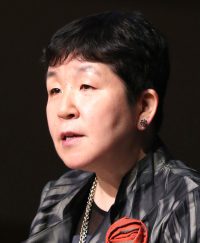
Noriko Sugimori

Noriko Sugimori, assistant professor of Japanese

Sugimori holds a Ph.D. in applied linguistics from Boston University. She teaches intermediate and advanced Japanese language courses, as well as select courses on Japanese culture and society taught in English. Her interests span multiple disciplines including sociolinguistics, linguistic anthropology, language ideology, oral history, integrating technology into teaching Japanese, and bilingualism.

K Alumni Launch Black Diaspora Project

Kalamazoo College alumni Justin Danzy ’16 and Marquise Griffin ’15 have created a virtual communal space shared by a team of thinkers and artists free to create and share content that promotes their vision of a more informed, empowered and collaborative diasporic community. The Black Diaspora Project is a collaboration between two groups of friends from opposite sides of the globe in an attempt to forge connections between millennials and members of the African diaspora. It’s also a space where people express unique worldviews and forward the vision of a more just, equitable world.

Black Diaspora Project Co-Editor Justin Danzy
Justin Danzy ’16 (right) is the co-editor of the Black Diaspora Project, which creates and shares content promoting a vision of a more informed, empowered and collaborative African diasporic community.

A month after graduating from Kalamazoo College, Danzy spent a month and a half in Uganda working with the Bavubuka Foundation, which inspires youths to embrace and celebrate their native languages, culture and tradition. It conducts a yearly hip-hop summit, which includes youth performances and workshops taught by contributing professionals in media, recording arts and writing. The relationships he built in Uganda were what led to the Black Diaspora Project, an online space created Feb. 20, 2017. Danzy expresses with great passion how his experience at Kalamazoo College prepared him for what the world would bring post-graduation.

He admits: “K really took me out of my comfort zone and forced me to learn a lot about how maneuver and preserve yourself … I met many wonderful friends and mentors who went out of their way to help steer me while I was on this journey of understanding. For instance, Di Seuss introduced me and seduced me into the world of creative writing, which has become a haven for me. She also introduced me to the executive director of the organization that I currently work at. Dr. Bruce Mills affirmed my ability as an academic in a way that really bolstered my self-confidence … His tutelage led to me presenting my SIP at the International James Baldwin Conference at American University in Paris, France last spring. Lastly,  Dr. Lisa Brock and Mia Henry provided a space for me to grow on my own terms, while also giving the language that greatly assisted in me understanding some of the things I was experiencing for the first time at K. Working with them at the Arcus Center also led to me meeting Silas Balabyekkubo, the founder of the Bavubuka Foundation, who I ended up partnering with in Uganda for our hip-hop and sustainable agriculture initiative, which planted the seed for what was to become the Black Diaspora Project.”

Danzy was joined by fellow alumnus and friend Griffin, who after graduating from K began pursuing his master’s degree in educational leadership and policy analysis at the University of Missouri-Columbia. There, he studies the structure of higher education, its administration, processes, culture and the policies that affect it. Griffin is the co-editor-in-chief, working closely with Danzy on making creative decisions regarding the Black Diaspora Project, its structure, direction and what they want from contributors.

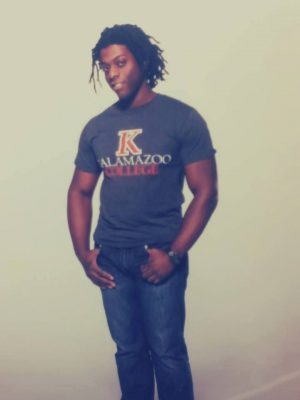
Black Diaspora Project Co-Editor Marquise Griffin
Marquise Griffin ’15 (pictured) and fellow Kalamazoo College alumnus Justin Danzy have co-created the Black Diaspora Project.

While they were students at K, Griffin and Danzy discussed their desire to spearhead a collaborative project inspired by their love of writing and the ritual of workshopping poetry. After Danzy’s experience in Uganda, Danzy went to Griffin with the idea for the Black Diaspora Project. Griffin happily helped bring the idea to fruition. Griffin admits Danzy’s “tireless enthusiasm and the amount of work he put into the site pulled me in and I began to see the potential for this to be a true collaboration of creative people, all working to expand their knowledge of themselves and others.”

Danzy said the ultimate goal of the Black Diaspora Project is to provide an honest depiction of the African diaspora and enhance the audience’s understanding of blackness on a global scale. He wants to prioritize the understanding of a global blackness, to offer diverse and positive depictions of contemporary Africa. Furthermore, to offer a resource that does not look upon Africa with pity and endow it with charity. The Black Diaspora Project can contribute to moving toward this understanding of an autonomous Africa that is full of talent and the acumen to create a better future for the continent.

Text by Aunye Scott-Anderson ’18

“backyard song”

K Professor Di Seuss ArticleWriter in Residence Diane Seuss has published a poem, “backyard song,” in the February issue of Poetry Magazine. Di’s poem is part of a group of a recently devised poetic form known as the Golden Shovel, an homage to the poet Gwendolyn Brooks, who would be 100 years old this year. The last words of each line in a Golden Shovel poem are, in order, words from a line or lines taken often, but no invariably, from a Brooks poem.
Di’s poem is a riff on Brook’s “a song in the front yard.” Here’s a taste of Di’s Golden Shovel poem:

Uncorked, I had a thought: I
want the want
I dreamed of wanting once, a
quarter cup of sneak-peek
at what prowls in the back, at
what sings in the
wet rag space behind the garage, back

where the rabbits nest, where
I smell something soupish, sour and dank and it’s
filled with weeks like rough
cat tongues and
the wind is unfostered, untended,
now that it’s just me here and
I am so hungry
for the song that grows tall like a weed
grows, and grows.

But you should swallow it whole: page 452 in the February issue of Poetry. Di is one of several impressive poets in the Golden Shovel group, which includes the late Philip Levine, Sharon Olds, Rita Dove, Alberto Rios and Danez Smith, who read some of his poems on campus this past Monday at the Martin Luther King, Jr. convocation. Di’s most recent collection of poems, Four-Legged Girl, was a finalist for the Pulitzer Prize. Her next book, Still Life with Two Dead Peacocks and a Girl, will come out in 2018.

Beloved English Professor and Poet Dies

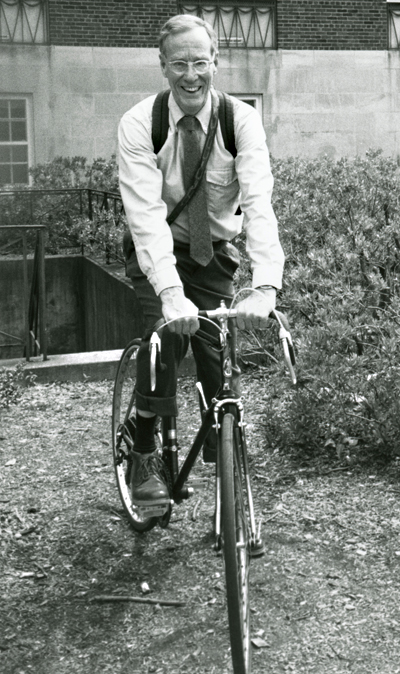
Conrad HillberryIn a speech he gave in 1987, Professor Emeritus of English Conrad Hilberry said, “When I think of poems that I am especially drawn to, I find they often have a silence, a mystery at the center.”

Today Con is that silence, a life now part of a “mystery at the center” into which words will penetrate insufficiently at best, the way sunlight beneath the surface of a deep ocean shimmers a few meters at most then disappears.

Con died on January 11, 2017. Several weeks previous, his daughter, Jane, wrote that her father had written to her that he planned to “make his exit” after Christmas but wasn’t sure he could endure that long. He endured and then died from complications of cancer and pneumonia. He was 88 years old. A campus memorial service for Con will occur on Saturday, February 4, at 1 p.m. in Stetson Chapel. A reception will follow in the lobby of the Light Fine Arts Building. Memorial donations may be made to The Katharine Hilberry Scholarship Fund at Kalamazoo College.

Con earned his B.A. at Oberlin College, his M.A. and Ph.D. at the University of Wisconsin. Attracted to “the promise of a college that was willing to try things,” Con was recruited to Kalamazoo College by Larry Barrett, a colleague in the English department and later a dear friend. Con started his career at K in 1962, the first full year of the bold and quirky curriculum called the K-Plan. He retired in 1998. In between, countless students of all majors and liberal arts inclinations fondly recall his literature and writing classes and especially his poetry courses. He wrote 11 volumes of poetry. His latest, Until the Full Moon Has Its Say, he wrote in his mid-eighties, and many of its poems are villanelles, a demanding form Con seemed to execute with ease. Like his friend and colleague Larry Barrett, whom he eulogized in 2002, Con was “in business right to the end.”

His prolificity as a poet sometimes obscured the fact that he was a marvelous writer of prose, author of the genre-bending creative nonfiction piece, Luke Karamazov, and countless essays and chapel talks, often on poets such as John Donne and Galway Kinnell, two he particularly loved, though there are many many more. Con loved to illustrate with poems the ideas he articulated in his prose as if to remind us that poetry (as he once said) can be a brief and invigorating elevation from the “lowly ground” of our inward selves–not that such ground is bereft of beauty and mystery, only that our souls seek a glimpse of something abundant beyond our own inwardness. Con often found that abundance, “a pool of meaning,” in the ordinary.

He was a remarkable teacher, entirely and joyfully at home in the “arches and vaults” of the liberal arts, created when the seemingly separate disciplines lean together and conjoin. He continually sought inspiration for his own work (both his teaching and his poetry) in the subject matters of his colleagues and friends–biology, mathematics, religion, philosophy, physics and psychology to name just a few. Often he’d audit courses in different departments as grist for his imagination, for example John Spencer’s seminar on Alfred North Whitehead and David Evans’s class on ethology. What he learned in those classes found its way into his poems, intentionally or not. Most of all he loved K students, and the effect on them of the K-Plan: their genius, he wrote, “for combining academic work and off-campus experience in just the way to allow themselves the most dramatic growth.”

In 1995, three years before his retirement, he began teaching night classes in poetry at the Stryker Center. These he continued for some 15 years, and many of his ex-students and members of the greater Kalamazoo community attended. Con helped poets make and publish their poems, and the list of these writers is impressive, including, among others, Susan Blackwell Ramsey, Corey Marks, Gail McMurray Martin, Marie Bahlke, Kit Almy, Gail Griffin, Rob Dunn, Hedy Habra, Marion Boyer, Bonnie Jo Campbell, Jane Hilberry, Amy Newday, and his lifelong student and friend, Pulitzer Prize finalist Diane Seuss. His beloved wife of 60 years, Marion, who died on April 8, 2008, often joined him in these classes.

In an essay he wrote on Galway Kinnell, Con described the opposition between poems and the notion of the final word. Comments on poems we perceive as “right on certain points and wrong on others,” he said. “But no one sees [those comments, even if they are the author’s] as the last word, equivalent to the poem itself. We always assume there is more to be said as the complexities of the poem take different configurations from other readers….Whenever a reading is taken as final, the poem is diminished.”

He managed his classes like that, starting things off, then sitting back to listen and provide space for students’ voices–for that peculiar confluence of text and the texture of readers’ lives, from which arises meaning. “I just need to choose the right books,” he once said. “Then the students notice things about the poems, and they teach each other.”

He was a poet and teacher of the people, deeply involved in the city of Kalamazoo’s Poetry on Buses program during its heyday. Often, with fellow poets (and friends) Herb Scott and John Woods (English professors at neighboring Western Michigan University) among others, Con would bring poetry into public middle schools, somehow managing to engage that always potentially intractable audience into the “best poems,” which Con considered an ineffable harmony of vividness (which the junior high students loved) and wholeness (where, often, the work began). He served as an editor of the Third Coast anthologies of Michigan poets and seemed to be a friend to every writer therein.

In his teaching prime Con’s presence was unforgettable, especially his red hair and ready smile. His limp and the rattle of his bike always suggested some past accident that had had no effect on his love of biking steep grades, celebrating gravity. And why not celebrate the force that holds us in what he called our “borrowed dust” for our short while on earth–the best, the only place for love.

In his last chapel talk (2001), using a line from a poem by Stanley Kunitz, Con said, “I have walked through many lives, some of them my own.” Indeed, Con contained multitudes.

Near the end, when Con was in the hospital, before he came home for hospice care, he said to his daughter, Jane, “I still have some talents left.  One of them is sleeping.  Another one is laughing.”

So like Con: able to sort by scent the smoke of sleep and laughter. He was, to the very end, the poet of the ordinary’s miracle.

Good Fortune Uncovers the Latest “Unfortunate Series”

Lemony Snicket Series
Photo by Joe Lederer/Netflix

Thank god for moms! Without them we wouldn’t have learned about the K connection to the new (or at least new for Netflix) series Lemony Snicket’s A Series of Unfortunate Events. Joe Tracz ’04 is one of the writers on the new series, and his mom sent word about the release (in two days, on FRIDAY THE 13th!) to Ed Menta, the James A.B. Stone College Professor of Theatre.

Her note was not so much about her son as it was about wanting to inform current students of the infinite possibilities of a K education. “We all appreciate what the Kalamazoo College environment did/does to guide these possibilities,” wrote Deb Tracz.

Lemony Snicket’s A Series of Unfortunate Events is Netflix’s newest all-ages series drop, culling an eight-episode first season from the first four books in Snicket’s best-selling 1999-2006 children’s novel series. The story recounts the tragic tale of the Baudelaire orphans–Violet, Klaus, and Sunny–whose evil guardian Count Olaf will stop at nothing to get his hands on their inheritance. The siblings must outsmart Olaf at every turn, foiling his many devious plans and disguises, in order to discover clues to their parents’ mysterious death.

Neil Patrick Harris starts as the evil Count Olaf. Other actors featured in the series include Don Johnson, Patrick Warburton, Joan Cusack, Catherine O’Hara, Alfre Woodard, Usman Ally and Aaaif Mondvi. The executive producer is Emmy Award winner Barry Sonnenfeld.

Joe Tracz is a playwright, screenwriter and librettist. His work includes Poster Boy (with Craig Carnelia; Williamstown Theatre Festival); Be More Chill (with Joe Iconis; Two River Theater); and Song For a Future Generation (Williamstown, The Management). His adaptation of the first book in the Percy Jackson series, The Lightning Thief (with Rob Rokicki; Theatreworks USA) received a Lortel nomination for Outstanding Musical. His plays have been developed at Manhattan Theatre Club, Roundabout Theatre Company and Second Stage, and published in Best American Short Plays. At K Joe majored in English and studied abroad in London, England. Two of his plays, Alison Shields and Phenomenon of Decline were produced by Festival Playhouse of Kalamazoo College. Both received regional awards from the American College Theatre Festival.

Based on the 13-book series written under the pen name Lemony Snicket (a.k.a. Daniel Handler), A Series of Unfortunate Events has been printed in 41 different languages, with sixty-five million copies sold as of 2015.

Congratulations, Joe. And thank you, Deb.

K Professor Receives Lucasse Fellowship

Kalamazoo College Professor Di SeussKalamazoo College announced today that Writer in Residence and Assistant Professor of English Diane Seuss ’78 will receive the 2017 Florence J. Lucasse Fellowship for Excellence in Scholarship. It is the highest award bestowed by the Kalamazoo College faculty, and it honors the recipient’s contributions in creative work, research and publication. Seuss is the 28th person in the College’s history to receive the award.

Seuss was named one of two finalists for the 2016 Pulitzer Prize for Poetry, a first in the history of Kalamazoo College. She is the author of three volumes of poetry, most recently Four Legged Girl, and she has a fourth book of poems forthcoming from Graywolf Press. She is every bit as remarkable a teacher as she is a writer. She is a previous recipient of the Florence J. Lucasse Lectureship for Excellence in Teaching, and many of her students have been accepted into the most prestigious M.F.A. programs in the country. Poetry, she says, holds space for everybody. A ceremony to confer the fellowship for excellence in scholarship and creative work will occur in spring term, and at that event Di will give a presentation, more than likely a delightful hybrid of poetry, story and lecture. The author of this article can hardly wait.