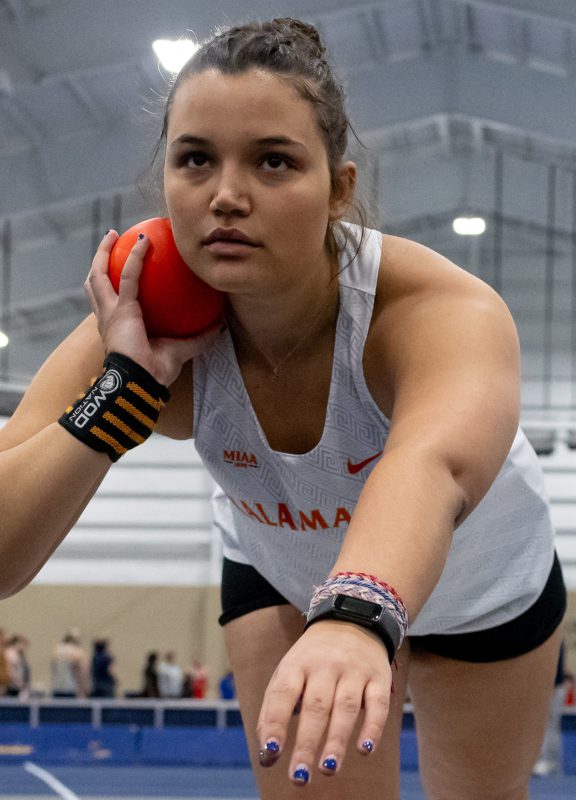
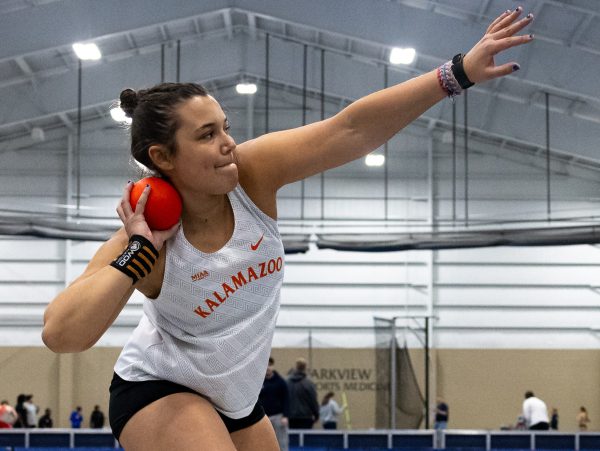
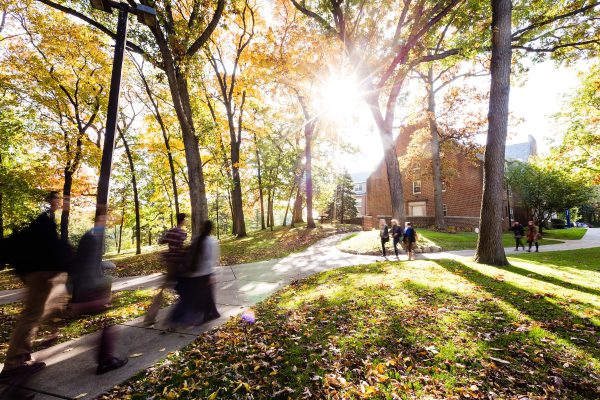
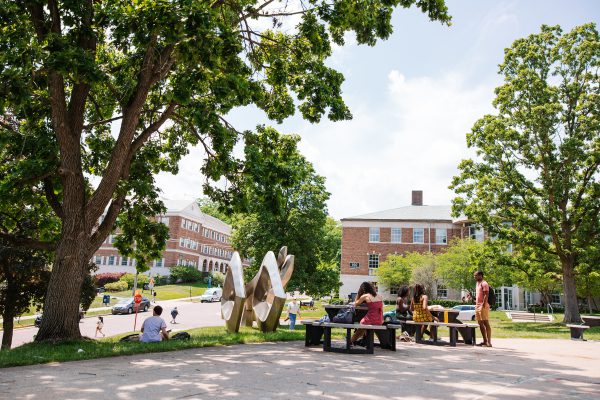
Zara Strauss ’29 became the first Hornet to be named MIAA Field Athlete of the Week since Kalamazoo College relaunched track and field. All photos by Kimberly Moss.
Strauss competes in shot put and weight throw and plans to expand into additional outdoor events this spring.
Strauss’ first collegiate track meet was January 17 at Trine University’s Sean Brady Invitational, where she beat her personal record in the shot put with a throw of 9.84 meters.
When Zara Strauss ’29 stepped into the throwing circle for her first collegiate track meet at Trine University’s Sean Brady Invitational on January 17, she was focused on one thing: beating her own mark. A personal record in the shot put—9.84 meters, nearly a third of a meter beyond her high school best—felt like a solid start, especially with a sixth-place finish in the competition.
What she didn’t expect was the flood of Instagram tags that followed on January 20, alerting her that she had just made Kalamazoo College history. Strauss became the first Hornet to be named Michigan Intercollegiate Athletic Association (MIAA) Field Athlete of the Week since K relaunched the sport, marking an early milestone in the program’s new era. The conference honor is given to a female student-athlete who demonstrates a standout individual performance in competition. Recipients are selected from nominations submitted by head coaches at each MIAA member school.
For the first-year international student from Tokyo, Japan, the honor was both surprising and affirming.
“I was really shocked,” she said. “I didn’t even know the award was a possibility, to be honest. People started tagging me on Instagram when it was announced, and I wondered what was going on. I wasn’t disappointed in my performance that day, even though I wanted to do better. Getting the award boosted my confidence. I felt a lot better about how I had done.”
When Strauss first pursued track and field as a sophomore in high school, she discovered her strength in throwing events after a coach nudged her away from sprinting. Since then, she has embraced the technical challenges of shot put, discus, javelin and hammer throw, constantly refining her form and experimenting with new techniques such as rotational throwing.
At K, Strauss competes in shot put and weight throw during the indoor season and looks forward to expanding into additional events outdoors. She trains closely with head coach Kyle Morrison and throws coach Luke Decker, both of whom she credits with helping her see measurable improvements in technique and distance.
But choosing K was about more than athletics. Strauss has deep family ties to the College as her grandparents, Professor Emeritus of History David Strauss and retired instructor Dhera Strauss, both taught at K.
Her family’s connection to Japan traces back to her grandfather taking students there years ago. Her father, Benjamin Strauss, then studied abroad in Japan during college, where he later moved with her mother, Monique. An unexpected job transfer for her dad turned what was supposed to be a couple of years into 19 years in Tokyo, where Strauss was born and raised.
With her brother and cousin also enrolled—and her cousin living immediately across the hall at Hoben Hall—campus quickly felt like home, even as she navigated life far from Japan. She visits her grandparents weekly, a routine that helped ease the homesickness she felt early on.
That sense of connection extends to her teammates. As one of six throwers and the only woman in the group, Strauss describes the squad as tight-knit and supportive. Teammates offer feedback on technique, share late-night meals after practice and travel together to meets. A friendship formed during LandSea with sprinter Gwyneth Dunaway ’29 has also carried onto the track, reinforcing the community she hoped to find at a small college.
Strauss admits that earning conference recognition so early in the program’s return brings a mix of pride and perspective. She feels some responsibility to continue that excellence as one of the first standouts of the relaunch, but she’s determined to keep the experience grounded in enjoyment and growth.
Her achievement also arrives at a meaningful moment on the calendar. February 4 marks the National Day of Women and Girls in Sports, a global celebration of participation, visibility and equity. Strauss, who attended an all-girls school and helped pioneer a new wrestling team for girls in her high school league, sees the day as a reminder of why representation matters.
“I think it’s important to create that space for women to be able to have their own league and to see themselves in their sports,” she said. “I feel like I’ve always grown up around women in sports, and it’s important to give women the attention they deserve.”
Choosing K was about more than athletics for Strauss, who has deep family ties to the College.
Strauss formed a friendship with sprinter Gwyneth Dunaway ’29 while the two participated in LandSea orientation. Their friendship has carried over onto the track.
Make Your Mark with the Hornets
You can support Kalamazoo College student-athletes like Zara Strauss ’29 by participating in Hornet Athletics Giving Day on February 18. Visit our website to make a mark with a gift that will help fund the highest priorities of our teams and provide resources such as equipment, travel and coaching excellence.
As K’s track and field program builds momentum in its return season, Strauss hopes to keep building, too, while refining her form, chasing new personal records and contributing to a team goal of making an immediate mark on the MIAA standings. If her debut is any indication, both she and the Hornets are off to a record-setting start.
“I’ve made some good friends, and K is a fun place to be,” Strauss said. “I’m really enjoying my first couple of months here, and I can’t wait for the next four years.”
The Midwest Outdoor Leadership Conference is returning to Kalamazoo College February 6–8, offering a weekend of student-led workshops, networking and hands-on learning focused on outdoor leadership and sustainability education.
The annual event will connect more than 50 students from small, medium and large institutions across the region. K students will be able to participate at no cost and without the need to travel.
“It really doesn’t matter what students’ majors are. It’s just all about outdoor leadership and sustainability education,” said Josie Belsky ’28, one of the five conference organizers including Madeline Moss ‘26, Zoe Allen ’28, Chloe Brown ’28 and Ava King ’28.
Belsky’s journey to organizing the conference began when she attended last year’s event at Earlham College. Moss had heard about the conference through her first-year seminar, Wheels of Change. After missing last year’s conference while studying abroad, Moss jumped at the opportunity to help organize when Sofia Fleming ’25, a previous conference attendee, reached out.
For Moss, an English major, the conference represents an opportunity to bridge academic interests with outdoor pursuits—a combination not always obvious to those outside the field.
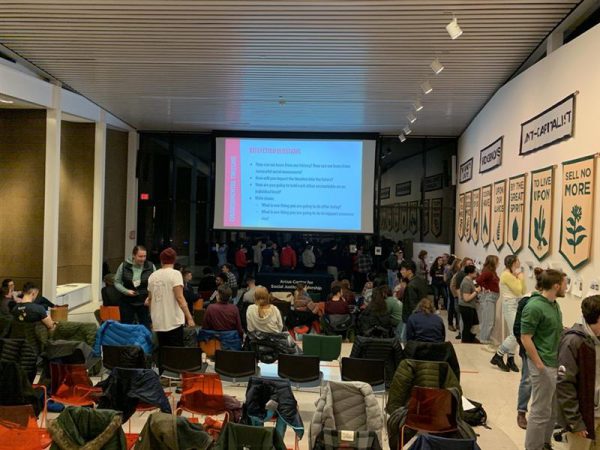
Kalamazoo College last hosted the Midwest Outdoor Leadership Conference in 2020 with gatherings like this one at the Arcus Center for Social Justice Leadership. The conference is returning to K Feb. 6–8.
“At K, we don’t have a lot of leadership-specific courses or an outdoor education major, so this is an opportunity for us to be able to touch base with students from other schools who might be interested in that and who have a lot of background in it, while also learning from them,” Moss said. “Being able to intersect my interest of the outdoors and sustainability with English is a nice thing about the conference.”
This interdisciplinary approach defines the conference’s appeal. Workshops range from technical skills such as scuba diving and rock climbing to more philosophical discussions about what wilderness means and how to decolonize one’s understanding of the outdoors.
Planning the conference has been a crash course in event management for the organizing students, who have met weekly since the start of the academic year with support from Outdoor Programs staff. The planners have coordinated with campus organizations like the Office of Student Activities. They’ve also reached out to local organizations such as the Kalamazoo Nature Center and engaged with students about their Senior Integrated Projects (SIPs) and other campus initiatives.
The organizers emphasize that the conference welcomes everyone, regardless of outdoor experience.
“One of the bigger barriers is that it can be a little intimidating to go to a conference—you feel like you have to come in with something, but in reality, it’s for everyone,” Belsky said. “There’s no experience necessary. You don’t even have to be an outdoorsy person. It’s just meant to be fun.”
Hosting the conference offers an opportunity to showcase how K’s sustainability infrastructure has evolved, particularly through the Environmental Stewardship Center.
“K has gone through a lot of changes, and I think this feels somewhat grounding back to our history of sustainability in leadership and student-led learning,” Moss said. “The fact that we hosted this conference back in 2020, before the pandemic, and a lot of things have shifted since then, and the fact we’re adapting it to the way that the school is now, says a lot about our dedication to creating a space of outdoor stewardship.”
Attending this conference at other schools has been eye-opening for K students. Last year at Earlham, for example, Belsky and others learned about Earlham’s Quaker heritage and toured facilities including horse stables, composting operations and a community building where people sell handmade art and pottery.
But beyond workshops and campus tours, the conference creates lasting connections.
“I’m still in contact with the people I met at last year’s conference,” Belsky said. “One of them came to visit me and my roommate last year, too, which was fun.”
She also emphasizes the conference’s professional value.
“It’s a good way to network with people and make connections that will help you so much in your future career,” Belsky said.
The organizers express deep appreciation for Outdoor Programs Director Jory Horner, Outdoor and Environmental Coordinator Greta Farley ’22 and Outdoor Leadership Training Center Coordinator Hannah Wolfe ’21, who provided crucial guidance. Farley’s perspective as a former student organizer has been particularly valuable.
“Sometimes we get fogged up with the student mindset and think we’re so busy that we couldn’t possibly do this,” Moss said. “But it felt grounding to have them tell us that we’re capable of it, and we could do so much more than we expected.”
With the conference happening on campus, the organizers have a simple message for the K community: Join us.
“The fact that it’s here is huge for us because we know, especially for student-athletes and people involved in student organizations, it’s hard to get away on the weekends,” Belsky said. “Your lives get busy, especially at K, because we’re always so involved. But it’s here. It’s so close, so come join us.”
For some Kalamazoo College students, study abroad can feel out of reach—too long, too expensive or too intimidating to fit into already full academic and personal schedules. But for 23 students who spent 10 days in the Dominican Republic during winter break, a short-term, faculty-led program offered something transformative: a first step into global learning that reshaped how they see the world and themselves.
Led by Associate Professor of Spanish Ivett López Malagamba, the immersive experience brought students to Santiago de los Caballeros, a mid-sized city in the Dominican Republic, where they lived with host families, conducted daily academic work and navigated life almost entirely in Spanish.
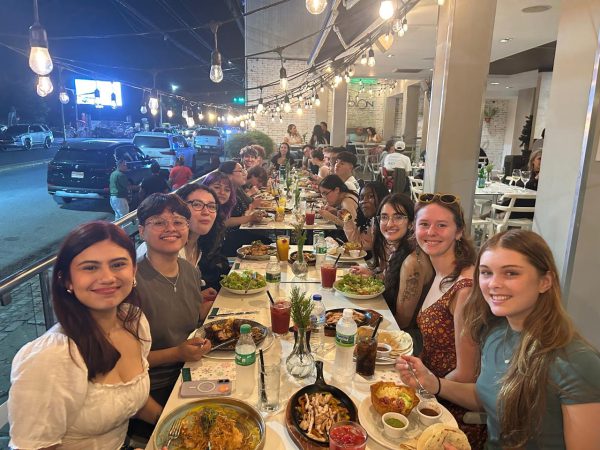
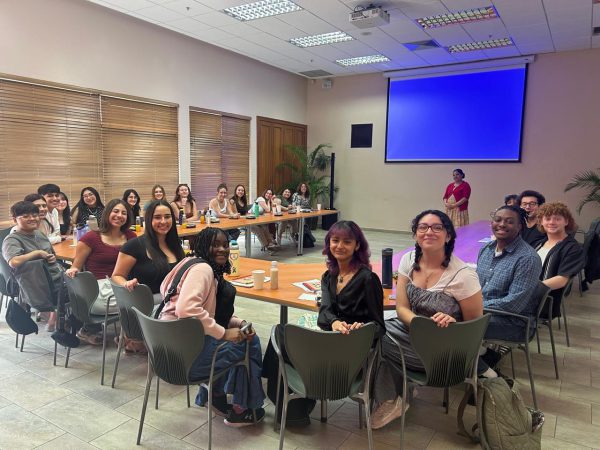
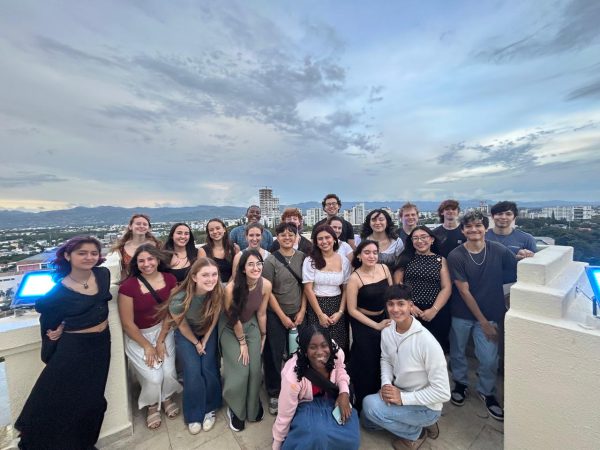
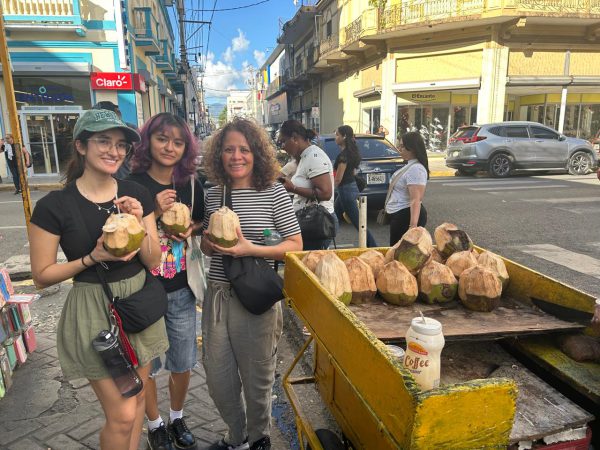
Kalamazoo College students who participated in short-term study abroad over winter break were welcomed to the Dominican Republic with a special dinner.
Students participated in an orientation when they arrived in the Dominican Republic.
An Accessible Path to Global Learning
The short-term program targets students who may face barriers to longer study abroad opportunities, including first-generation college students, students of color, student-athletes and those balancing multiple commitments on campus. It was first launched as a pilot program in 2019, funded through a grant from the Mellon Foundation, which supported faculty planning, along with Center for International Programs funds. Additionally this year, the Ambassador Martha L. Campbell and Consul General Arnold H. Campbell Foreign Study Endowment and the Robert J. Kopecky ’72 Endowed Study Abroad Fund helped high-need students afford the experience. The Campbell Endowment was established in 2009 to support and enhance the foreign study experience for K students. The Kopecky fund was established in 2022 to help maximize the number of students who participate in study abroad while encouraging students to explore the culture around them during their international experience.
For some participants, the Dominican Republic trip marked their first time traveling internationally or even boarding an airplane.
“For them, this was not just an academic experience; it was a personal milestone,” López Malagamba said.
Academically, the program is tied to the Spanish curriculum. Students must have completed Spanish 201, the final course in K’s language requirement sequence for Spanish. In the fall, participants enroll in a preparatory course and attend predeparture sessions focused on Dominican history, race relations, politics and the country’s deep connections to the United States and the Caribbean. And once they are in the Dominican Republic, the learning is nonstop.
“Every day is academic,” López Malagamba said. “Even when students are on a beach or in a community celebration, they are learning—about economics, migration, tourism, race, history and the environment.”
In the coastal region of Samaná, students encountered a lesser-known chapter of shared history: communities founded by formerly enslaved people from the U.S. who settled there in the 19th century.
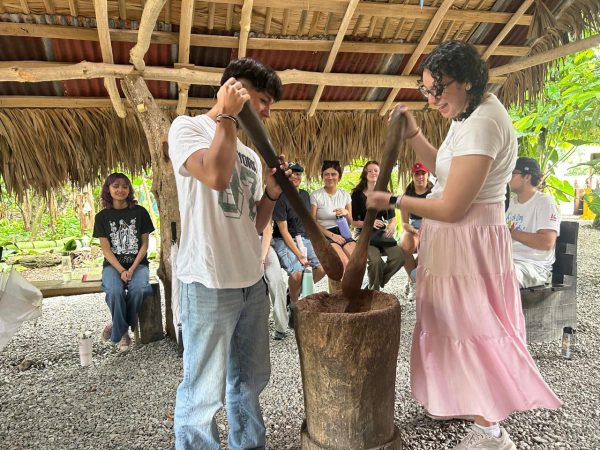
Students had a chance to make chocolate while learning about the country’s export economy through cocoa farming, studying the role of tourism in shaping cities, and examining the deep ties between the Dominican Republic and the United States.
Learning Beyond the Classroom
Students explored the Dominican Republic through lectures, guided visits and hands-on experiences that reinforced themes from their language coursework, including urban life, nature, the arts and professions. They learned about the country’s export economy through cocoa farming, studied the role of tourism in shaping cities, and examined the deep ties between the Dominican Republic and the United States.
In the coastal region of Samaná, students encountered a lesser-known chapter of shared history: communities founded by formerly enslaved people from the U.S. who settled there in the 19th century. A guide, himself a descendant of those settlers, shared how English once flourished in the region before being suppressed and how that legacy still shapes Dominican identity.
“These are moments where students realize that U.S. history doesn’t stop at our borders,” López Malagamba said. “It lives in other places, in other people’s stories.”
Environmental justice was another key focus. Students learned how coastal communities balance the economic need for tourism with the protection of ecosystems, national parks and marine environments that sustain local livelihoods.
Living with host families added another layer of immersion and challenge. Students had to adapt to new routines, unfamiliar foods and different cultural expectations, all while communicating in a second language.
“There’s always a moment where students feel overwhelmed,” López Malagamba said. “They miss their familiarity. They realize how hard it is to express themselves fully. But then something shifts.”
That shift often comes in small victories: asking for directions, explaining a preference at the dinner table or successfully navigating a conversation they once would have avoided.
“By the end, students realize, ‘I can do this,’” she said. “That confidence is powerful.”
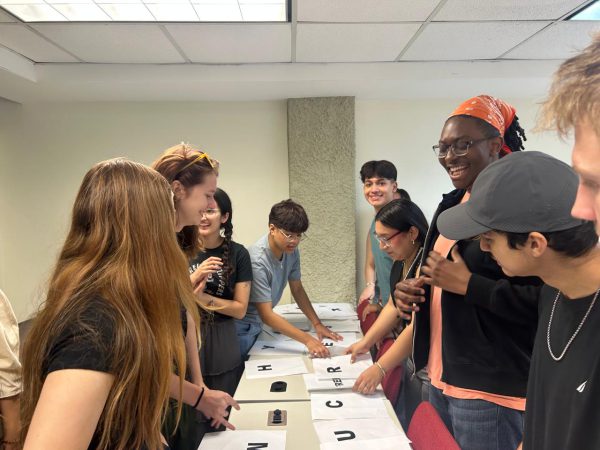
K students participated in a Spanish class while visiting the Dominican Republic.
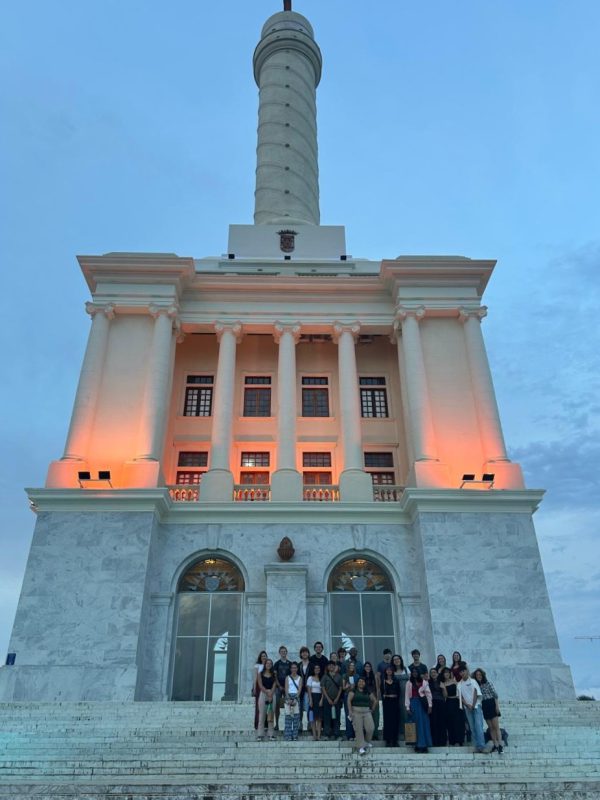
Students visited the Monumento a los Héroes de la Restauración, which was built for the 100th anniversary of the Dominican War of Independence, which was fought in 1844 to gain sovereignty from Haiti.
‘I’m Hooked’
For Tom Clark ’27, the Dominican Republic trip became a lifeline to study abroad after he had to cancel plans for a longer program in Greece. The business major, who is dual-enrolling at Western Michigan University to pursue exercise science, realized too late that he couldn’t balance a two-term study abroad with his academic timeline.
“I went through all the predeparture stuff, was all ready to go, and then I realized I wouldn’t be able to do it,” Clark said. “But right as I dropped it, I got an email about this trip to the Dominican Republic. I saw it was over winter break, so it wouldn’t take away from credits that I would need. It was perfect.”
The trip marked Clark’s first time leaving the country, and the experience immediately challenged his assumptions about privilege and perspective.
“I thought I was familiar with other cultures,” he said. “I thought of myself as an empathetic person who could put himself in the shoes of others. And then I actually took the trip, and my understanding was much different.”
Simple differences struck him immediately. Getting off the airplane, he looked for a water fountain to fill his bottle only to realize public drinking fountains don’t exist in places without widespread access to clean water. The language immersion then proved to be both challenging and rewarding. Clark hadn’t taken a Spanish class in nearly a year, and the first few days were rough. But surrounded by Spanish speakers constantly—including his host parents, who spoke no English—he found his skills returning and improving rapidly. Those challenges, in fact, became opportunities for connection.
Among Clark’s favorite moments was a joint class session with Dominican students learning English as a second language, meeting people his age from vastly different backgrounds, yet fundamentally similar. He made a friend named Casey who runs a fashion brand with 60,000 Instagram followers and is working toward getting a green card.
The experience reframed how Clark thinks about language learning. In a classroom, he explained, students have varying levels of investment. On the trip, everyone was committed, making the learning more dynamic and applicable.
“We were talking about how another language is like learning a superpower,” he said. “I learned I could travel to many countries and be perfectly fine. I could meet people and connect better. The Dominican is a tiny island, so I’m hooked on imagining what the rest of the world is like.”
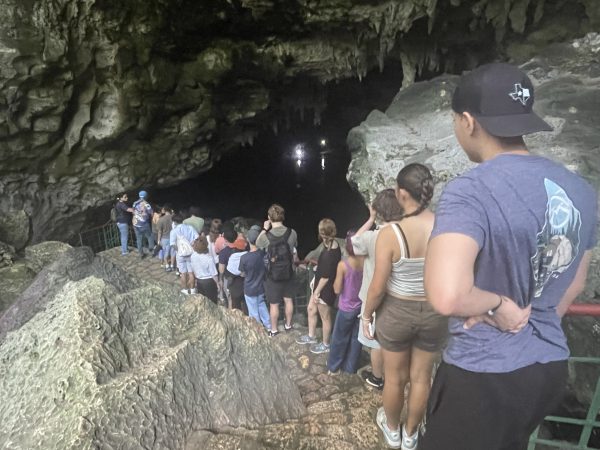
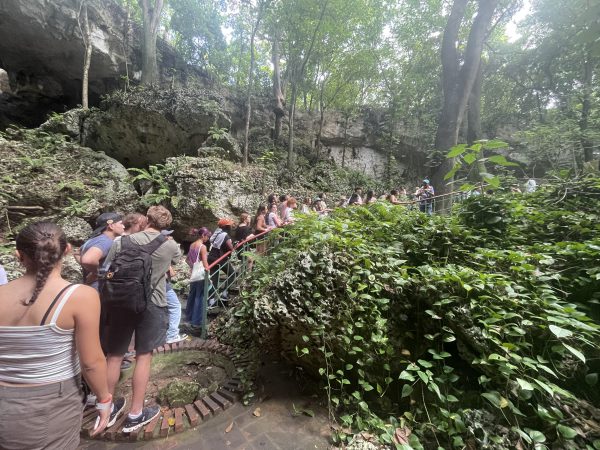
Tres Ojos, or Three Eyes National Park, is a 50-yard, open-air limestone cave.
Students walk through Tres Ojos National Park.
Discovering New Perspectives
For Sarah Guerrero Gorostieta ’28, a first-generation college student, the Dominican Republic trip offered something unexpected: a chance to see her own culture through new eyes while discovering how much she still had to learn.
“I have never learned so much in such a short amount of time about myself, my peers and an entirely new country,” Guerrero said. “With my Mexican heritage, I assumed because I’m Hispanic and because they’re Hispanic, there would be some similarities between us. There definitely were, but there was also so much nuance.”
Although Mexico and the Dominican Republic were both colonized by Spain, Guerrero learned how French and African influences shaped Dominican culture differently. More importantly, she heard those histories directly from Dominicans themselves.
Guerrero’s experience was framed with many memorable moments. She recalls feeling grateful for trying plantains for the first time, exploring caves and seeing the ocean.
“I’d never felt so many emotions packed into one trip,” she said. “And I’m really excited to carry all of those lessons into study abroad.”
Guerrero is next hoping to study at Belfast University in Northern Ireland, where she wants to explore political tensions and the media’s role in conflict—themes she first encountered in the Dominican Republic through a guest lecture on how the media weaponizes political relationships during elections.
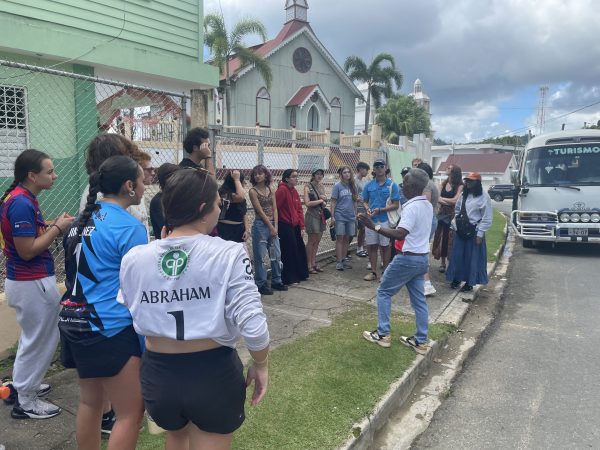
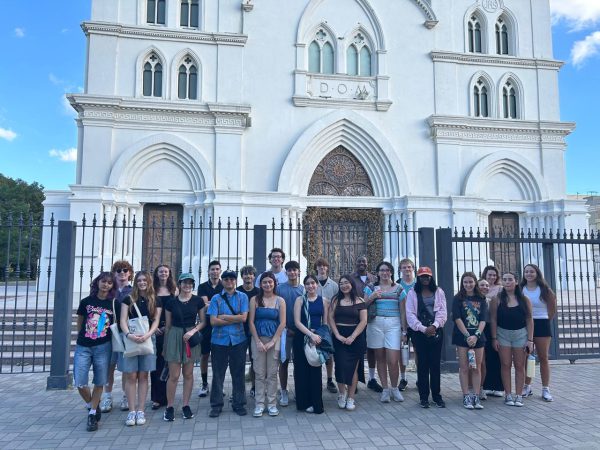
Students stopped at St. James the Apostle Cathedral during a tour of Santiago de los Caballeros in the Dominican Republic.
Associate Professor of Spanish Ivett López Malagamba (right) led the short-term study abroad experience through places such as downtown Santiago de los Caballeros.
Opening Doors for Student-Athletes
For Riley Shults ’28, a runner on K’s cross-country team, the 10-day format meant he didn’t have to choose between his sport and international experience.
The short-term trip to the Dominican Republic didn’t change Shults’ academic trajectory, he said, but it reinforced the direction he wanted to pursue. He is declaring an anthropology-sociology major in February and is now planning to study in Oaxaca, Mexico, during the winter of his junior year through a program focused on community engagement and Indigenous cultures.
“I knew that I wanted to care about people, and I knew that I wanted to travel the world,” he said. “This program was the first real experience that I got to have of that.”
One question lingered throughout the trip: Can such a short program truly transform students in the way longer study abroad experiences do? And for Shults, the answer is unequivocal.
“One hundred percent,” he said. “I barely talked to anyone on that trip before it, and now I see them every day. Every little aspect fundamentally changed who we are because we were forced to think about someone other than ourselves. It’s not just about me anymore. It’s about the whole world.”
The change came through small moments that accumulated into profound shifts. Shults discovered he loves beans and rice. He overcame his lack of confidence in his language skills and found himself thinking in Spanish. He engaged with complex political histories he’d only read about in textbooks as his host mother shared stories each morning about the country’s history under dictator Rafael Trujillo.
“I used to think one way, and now I think this other way,” he said. “Study abroad pulls people out of their comfort zones. Once you push past that boundary your learning is only limited to what you allow yourself to find.”
One particularly memorable moment came during a Sunday block party in a working-class neighborhood of Santiago. Community organizers welcomed the K group with music, announcements and open celebrations.
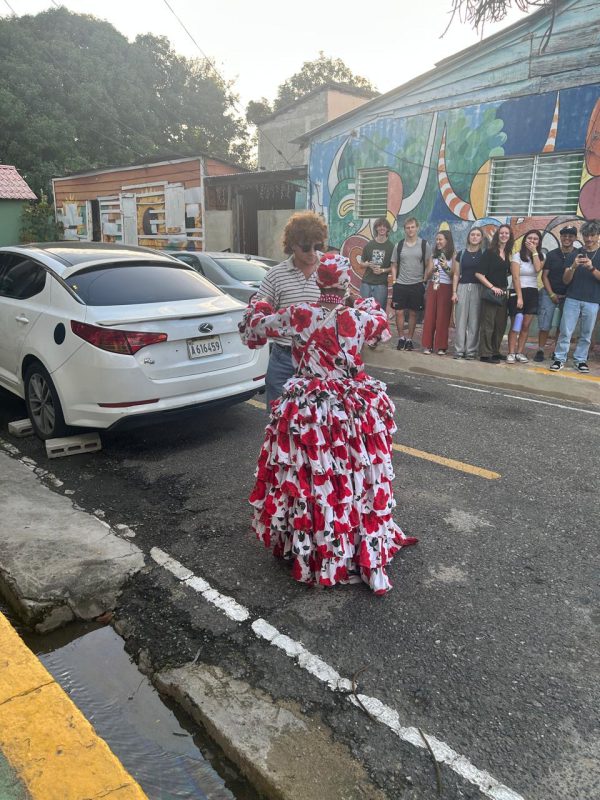
Students danced alongside children, parents and grandparents in the streets. Shults found himself at the center of that celebration, dancing with elderly women who grabbed his red hair for good luck. He moved freely without self-consciousness in a way he’d never experienced at home.
“Every single person is not caring about what other people say, they’re just moving,” he said. “It’s such a different culture than ours. Here, people don’t just dance. We’re always thinking about what other people are doing. But that’s not what they think. They’re just going to have fun.”
His experience now surfaces in unexpected moments back on campus. In a class about water systems, Shults reflected on the reality that Dominican tap water isn’t safe to drink.
“I’m sitting in class thinking, ‘I lived this,’” he said. “I lived this example where you don’t have water right on the tap.”
A resident of the Los Pepines neighborhood dances with Riley Shults ’28.
The Monumento a los Héroes de la Restauración is the tallest building in Santiago de los Caballeros in the Dominican Republic.
Distinct Opportunities Bring Transformations
Although the program lasts just 10 days, its impact extends far beyond winter break. López Malagamba noted that many students return with renewed interest in longer study abroad opportunities and greater confidence in navigating unfamiliar environments. For her, watching students undergo their transformations in just 10 days remains the most rewarding part of leading the program.
“These students come back with a different understanding of what it means to be a global citizen,” she said. “They’ve lived with families who welcomed them. They’ve navigated challenges in a second language. They’ve sat with discomfort and come out stronger.
“These programs remind students that the world is bigger than the U.S. and their immediate communities,” she said. “They learn that their actions matter, that their country has an impact elsewhere, and that shared humanity exists across borders. That’s the kind of learning that stays with you long after the trip ends.”
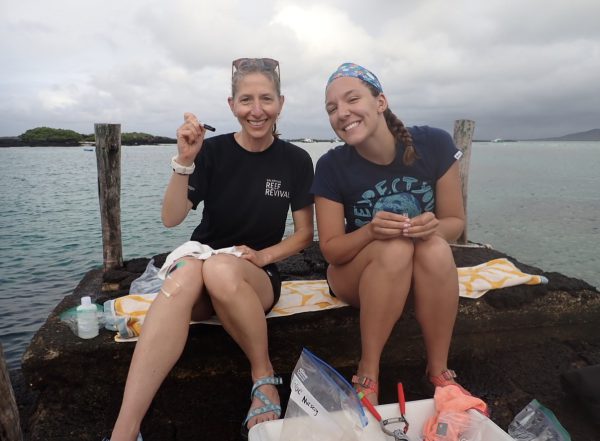
Hailey Yoder ’26 (right) teamed up with Cheryl Logan, a professor at Cal State Monterey Bay, on labeling tubes for data collection in the field.
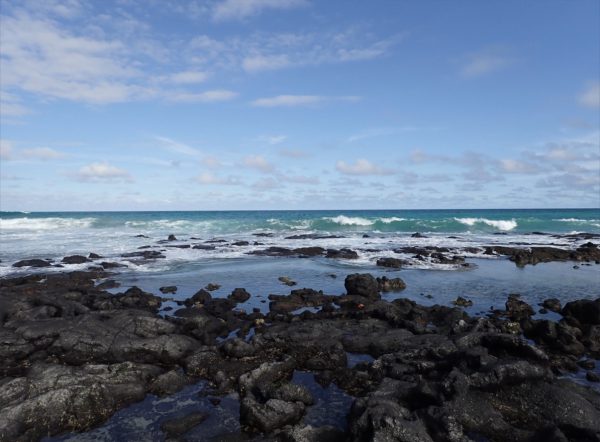
Yoder’s favorite hike in the Galapagos Islands took her to a tide-pooling area where she saw starfish, small fish, crabs and small octopi.
When Hailey Yoder ’26 tells people she researches coral reefs, their response is often the same: “You live in Kalamazoo, Michigan. How do you do that?”
For Yoder, a Kalamazoo College double major in biology and Spanish, the answer is both simple and extraordinary: It started with sending an email.
That email, sent during her study abroad program in Ecuador, connected her with Margarita Brandt, a biology professor at the Universidad de San Francisco de Quito, who works with Galápagos Reef Revival. What began as a conversation about potential research ideas soon evolved into an opportunity to study coral reef restoration in the Galápagos Islands.
“We just clicked and worked really well together,” Yoder said. “She invited me onto a project, and I really was just hoping that it would work out.”
Bringing Coral Reefs Back to Life
Yoder’s research starts with how climate change and ocean acidification have affected coral reefs in the Galápagos. The islands once boasted several coral reefs, but many have been wiped out by bleaching, leaving remaining structures vulnerable to complete destruction.
The restoration process involves collecting coral fragments from around the islands and growing them in underwater gardens, where they’re suspended from ropes and nourished by ocean currents. Once mature, researchers implant them into the seafloor in organized patterns. To assess the impact, Yoder used GoPro cameras mounted in waterproof cases and weighted with zip ties—nothing fancy, she noted—placing them at consistent locations near restored coral sites. Through snorkeling expeditions, she positioned the cameras to capture the ecosystem unfolding around eight or nine individual corals. All the research was done under permits from Galápagos National Park and CITES, the Convention on International Trade in Endangered Species.
The results have been striking. At the first site Yoder analyzed, two new fish species appeared after restoration. Afterward, four or five additional species flourished.
Community at the Center
What distinguishes this research is its deep connection to local communities. The project employs Galápagos residents, including one community member who maintains and monitors the corals year-round. Researchers also lead programs bringing women and children—particularly those without previous opportunities to explore their island’s underwater world—on snorkeling expeditions to witness the restoration firsthand.
“There are intricacies to coming into someone else’s home to perform research,” Yoder said. “I tried to focus on community and the local knowledge that people have.”
This community-centered approach culminated in a symposium in the Galápagos, where Yoder presented her research entirely in Spanish. She created a Spanish-language research poster and discussed her findings with community members invested in their island’s ecological future.
“They were all super excited about it and thought it was really cool,” she said. “It was pretty fun to be able to have that connection, too.”
Taking Marine Research to the National Stage
Yoder’s work has gained recognition beyond the islands. This January, she traveled to Portland, Oregon, to present a poster at the Society for Integrative and Comparative Biology (SICB) conference, arriving just before K’s winter term began and returning during the first week of classes.
The conference provided invaluable networking opportunities. A postdoctoral student from Boston’s National Institute of Health, who had previously worked with the same corals and researchers, offered career guidance and suggestions for future research directions. Yoder connected also with fellow undergraduates navigating similar paths.
“With these conversations, I recognized that there’s not necessarily a right or wrong path to going into some sort of research like this,” Yoder said. “That was reassuring.”
K’s Role in Marine Success
Yoder credits K’s biology and Spanish departments along with the Center for International Programs with making her research possible. In all, they provided funds through:
The Betty R. Gómez Lance Award in Latin American Studies, which was established by Lance after her retirement from K. It has been awarded posthumously until her passing in 2016;
Jim and Deanna Tiefenthal Endowed Foreign Study Fund: established by Jim and Deanna (members of the class of 1966) in 2016 to support student international learning opportunities through K’s study abroad program; and
Seminary Hill Sustainability Internship: established by Doug Doetsch ’79 and his wife, Susan Manning, to fund internships focused on sustainable agriculture or architecture.
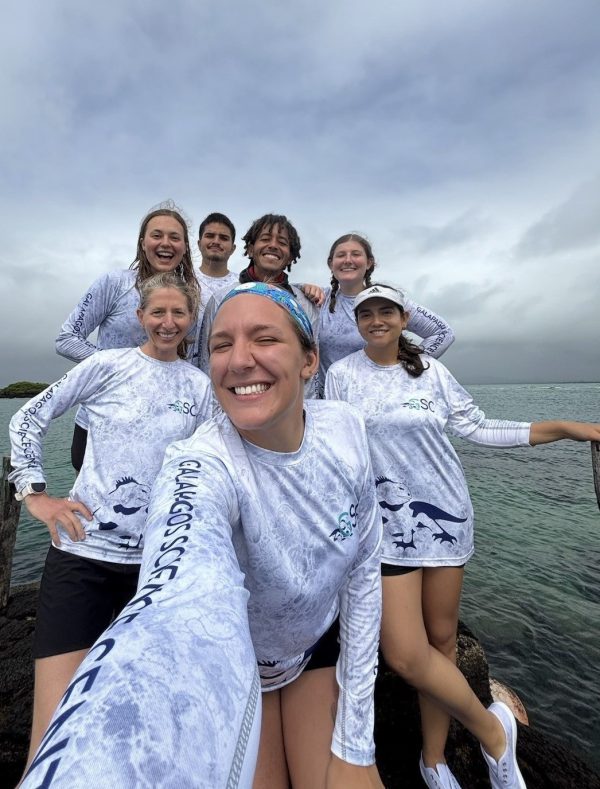
Emma Saso (back row, from left), Daniel Velasco, José Barrios and Ava Besecker with Logan (front from left), Yoder and Catalina Ulloa after a full day of collecting data for marine projects.
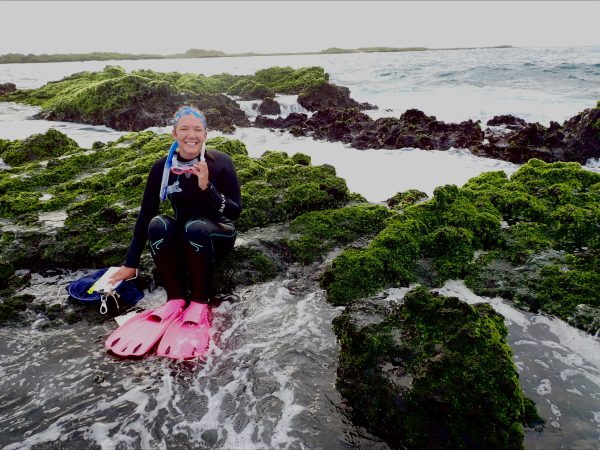
Yoder waited on the rocks right off of the bay where the coral sites are located, just after placing video cameras. “We waited here for 15 minutes as to not disturb the fish community and be out of the way before recollecting the cameras,” she said.
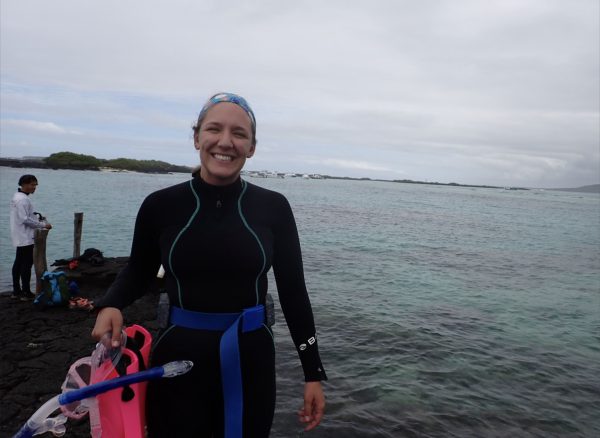
Yoder prepares to place cameras before snorkeling around to get a feel for the location and different plots and determine the most efficient way to take quality videos.
Yoder had GoPro cameras mounted in waterproof cases and weighted with zip ties so they could be placed at consistent locations near restored coral sites.
Associate Professor of Biology Santiago Salinas has been particularly supportive, helping Yoder refine her research question while providing guidance as she writes her SIP. Professor of Biology Binney Girdler has assisted with data visualization and helped Yoder narrow her focus. The department also helped fund her Portland conference trip.
“They were supportive and beyond excited for me,” Yoder said. “To have a professor you look up to say that you’re doing something they’re proud of is so cool.”
An Unexpected Love for Corals
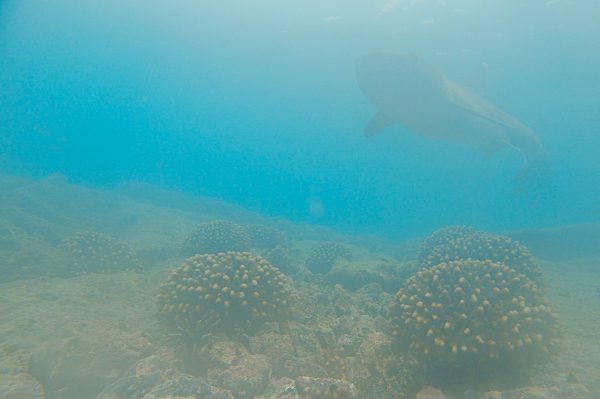
Yoder admits she initially gravitated toward sharks within the field of general biology, not coral reef or fish. However, the research transformed her perspective.
“I gained this strong love for corals, because the way they work is so interesting, and they provide so many amazing services for the land and fish that they’re near,” she said.
Her biology major, enhanced by marine research experience, positions her well for graduate school. She has applied to a master’s program to work with a different researcher studying the same coral reefs, with hopes of returning to the Galápagos over the next year to collect data from different reefs and expand her video collection. Her ultimate goal is to publish her research.
“My knowledge is so much stronger because of the undergrad opportunity,” Yoder said. “But this master’s program will be a huge thing as well, because it will allow me to dive into the specifics and work more closely with coral scientists.”
Advice for Future Hornets
For prospective biology students, Yoder emphasized the opportunities available to those willing to pursue them. But opportunity requires initiative.
“Sending the first email was just the first step of all of the things I’ve had a chance to do, because K gives you so many opportunities,” Yoder said. “You just need to be able to take advantage of them. Those resources will be there, but you have to reach out and ask for them. The answer is going to be ‘yes,’ if they can make it work.”
Her message is clear: “Send the email and do the thing you want to do. Advocate for yourself.”
For Yoder, that single email led to underwater gardens in the Galápagos Islands, international research presentations, professional connections across the marine biology field, and a future dedicated to understanding and protecting coral reef ecosystems—all from Kalamazoo, Michigan.
Margaret M. Miles, a University of California, Irvine professor emerita of art history and classics, will offer a lecture titled Trojans and Greeks in Western Sicily on Tuesday, February 10, at 4:15 p.m. in the Olmsted Room at Mandelle Hall. The event will also be livestreamed.
Miles, the Edward A. Dickson Emerita Professor of Art History and Classics, researches Greek and Roman art, architecture and archaeology. She will talk about the refugees from Troy who founded the cities of Segesta and Eryx in Western Sicily. They later were joined by some storm-driven Greek Phokians, a group that called themselves Elymians but insisted on their ancestry as Trojans well into the Roman period.
Sorting out Elymian, Greek and Phoenician influence on the city of Segesta is a challenge, Miles says. An early 5th-century BCE sanctuary and its handsome large temple—newly reconstructed on paper thanks to recent fieldwork—provide further insight and illustrate the religious history, variegated ethnic identities and engineering capabilities of 5th-century BCE Segesta.
Miles served a six-year term as the Andrew W. Mellon Professor of Classical Studies at the American School of Classical Studies in Athens. Her publications include A Reconstruction of the Temple of Nemesis at Rhamnous, Agora Excavations XXXI: The City Eleusinion, and Art as Plunder: The Ancient Origins of Debate about Cultural Property. She also has three edited volumes including Cleopatra: A Sphinx Revisited, Autopsy in Athens: Recent Archaeological Research in Athens and Attica, and Blackwell’s Companion to Greek Architecture. She is working on a book about 5th-century BCE Greek temples and religion.
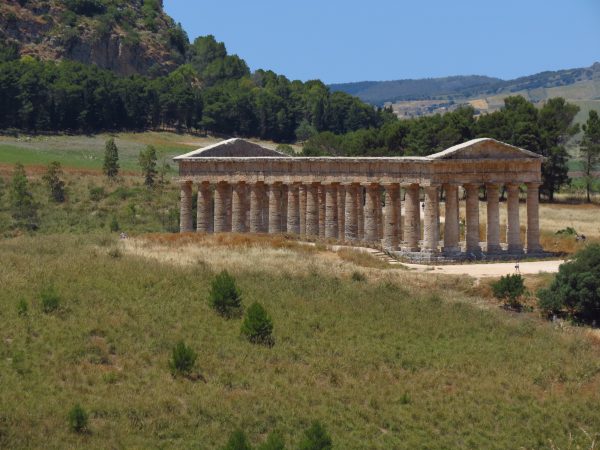
The Doric Temple of Segesta, an ancient archaeological site on Mount Barbaro in northwestern Sicily, Italy, was built around 420–430 BC by the Elymians, one of the three indigenous peoples of Sicily.
Hosted by the Department of Classics, this public event is free, and a reception will follow. For more information, email Academics Office Coordinator Sarah Bryans at Sarah.Bryans@kzoo.edu.
Jazz musician, band leader and composer Wynton Marsalis will join the Rev. Millard Southern III on the campus of Kalamazoo College for a conversation about Marsalis’ life in music, the history of jazz in the evolution of American culture, and the role arts education plays in a democratic society.
Part of the American Studies Speaker Series, the conversation will be hosted by Charlene Boyer Lewis, the Larry J. Bell ’80 Distinguished Chair in American History. It will take place at 11 a.m. Monday, February 2, in K’s Dalton Theatre at Light Fine Arts. The event is free and open to the public with advance registration required.
Marsalis is the managing and artistic director of Jazz at Lincoln Center, the director of jazz studies at The Juilliard School and president of the Louis Armstrong Educational Foundation. A world-renowned trumpeter, he is the winner of nine Grammy Awards, and he is the only musician to win a Grammy in two categories—jazz and classical—in the same year. In 1997, he became the first jazz musician to win the Pulitzer Prize for Music for his oratorio Blood on the Fields. His other honors include the National Medal of Arts in 2005, the National Humanities Medal in 2015 and the U.N. Messenger of Peace in 2001, in addition to honorary doctorates from universities such as Harvard, Yale and Princeton.
A native of New Orleans, Marsalis has produced more than 100 albums and performed in more than 66 countries while advocating for jazz as a living art form and exploring its connections to democracy, social justice and American identity.
Southern, a Chicago native, is an AME-ordained minister, jazz musician, writer, social activist and Western Michigan University doctoral candidate. His dissertation explores the intersection of race, religion, cultural democracy and the music of Wynton Marsalis. Since 2021, he has served as pastor of Allen Chapel AME Church in Kalamazoo, leading efforts to revitalize the city’s Northside neighborhood. He is also a Shared Passages instructor at K, where he has offered courses such as Let Freedom Swing and Paris Noir. The latter was inspired by a 2023 research grant to study Black art, jazz and culture in Paris. He holds a bachelor’s degree in economics from Drake University and a Master of Divinity from Union Theological Seminary in New York.
The conversation is supported by the Kalamazoo College American Studies Department with special funding from the Arcus Center for Social Justice Leadership and additional support from the Department of Music and College Advancement.
“Wynton Marsalis regards jazz and its improvisational qualities as fundamentally American—and, in form and content, as contributing to current social justice efforts,” Boyer Lewis said. “His visit to our campus is part of a wonderful continuum in an important strand of K’s history that began with abolitionist founders James and Lucinda Hillsdale Stone, including connections to Sojourner Truth and Frederick Douglass, and runs to and through figures such as James Baldwin, Angela Davis and Francis Fox Piven. We are lucky to have him as our 2026 American Studies Speaker.”
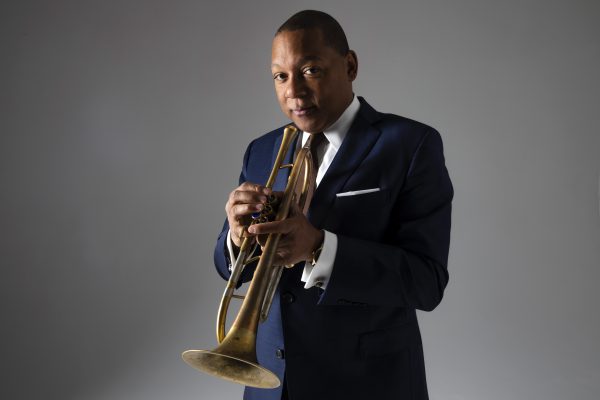
Wynton Marsalis will speak Monday, February 2, at Kalamazoo College as a part of the American Studies Speaker Series.
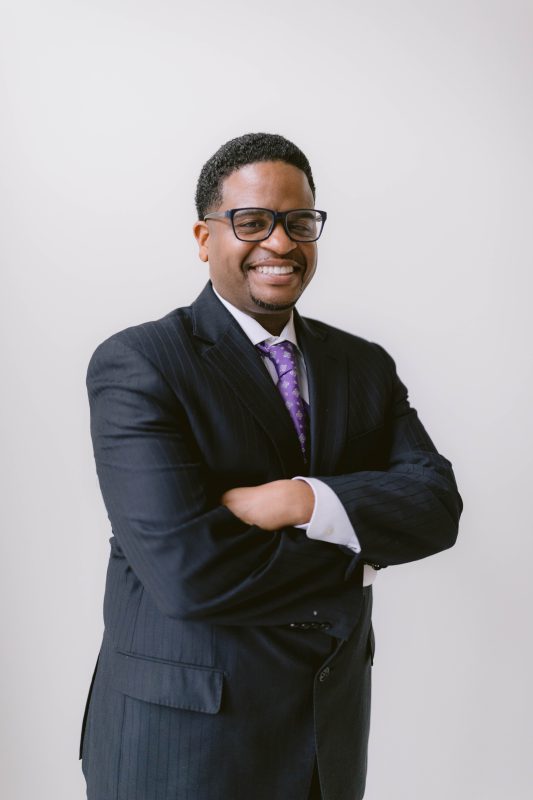
The Rev. Millard Southern III will join Marsalis for a conversation about the jazz great’s life in music, the history of jazz in the evolution of American culture, and the role arts education plays in a democratic society.
Two upcoming events will help Kalamazoo College remember and celebrate Martin Luther King Jr.
Community Reflection
The annual MLK Day Community Reflection is an opportunity for Kalamazoo College students, faculty and staff to speak from their experiences and hearts about King’s dream as it is realized on campus and beyond.
All are welcome to tune in for a livestream or join us at 11:05 a.m. Friday, January 16, at Stetson Chapel to hear from:
Lourdie Clark ’28, organist
Director of Student Experience Ron Dillard, host
Duke Duquette, singer
Milan Levy ’23, poet
Marcus Lloyd ’29, orator
The Arcus Center for Social Justice Leadership at Kalamazoo College, 205 Monroe St., will be the site for a Martin Luther King Jr.-inspired racial healing event on January 20.
“The legacy of Dr. Martin Luther King, Jr. is more relevant than ever,” Dillard said. “Considering the political tension felt in every corner of our country, remembering Dr. King and his foresight is a beacon of hope for a nation in peril.”
Racial Healing Event
All are invited on Tuesday, January 20, to an event that will bring together students, faculty, staff and community members from across Kalamazoo for meaningful discussions on the theme of Owning My Role in Racial Healing.
The event at the Arcus Center for Social Justice Leadership, 205 Monroe St., will be hosted by ERACCE (Eliminating Racism and Creating/Celebrating Equality), YWCA Kalamazoo, the Michigan Transformation Collective and the Kalamazoo College Mary Jane Underwood Stryker Center for Civic Engagement.
Register online in advance for the 4:30 p.m. dinner and the 5–7 p.m. community solidarity sessions.
Senior business majors at Kalamazoo College are stepping into a hands-on consulting experience this winter, partnering with a local coalition to explore one of Kalamazoo’s most compelling questions: How can our city foster a stronger sense of belonging and create the kind of social, cultural, and recreational experiences that encourage recent graduates to stay? With nearly 25,000 undergraduate students across the area’s colleges and universities, it’s a question with real potential to shape Kalamazoo’s future.
A 2024 report from the W.E. Upjohn Institute for Employment Research found that nationally, only 47% of public university graduates and 43% of private college graduates stay in the same metro area as their alma mater. While job opportunities often drive alumni migration, the Kalamazoo region offers notable employment options: according to the Michigan Economic Development Corporation, 20 Fortune 1000 companies have headquarters here, and the greater metro area is home to numerous smaller businesses and nonprofits, offering diverse career pathways for new grads. This project, therefore, focuses on another part of the equation: “value of place”— the cultural vibrancy, amenities and social connections that shape daily life and make a location truly stick.
To examine that element, K’s business capstone class is working with Sarah Olszowy, chief experience officer at Greenleaf Hospitality Group, and other members of the Kalamazoo Marketing Coalition, a cross-sector group representing business, regional development, city government and destination marketing. Their coalition aims to improve collaboration and synergy among marketing teams promoting the region. Additional members include Kimberly Viers, marketing and communications manager at Southwest Michigan First; K alumna Dana Wagner ’10, director of marketing and communications at Discover Kalamazoo; Meghan Behymer, downtown coordinator for the City of Kalamazoo; and Allie Lochart, senior marketing manager at Greenleaf Hospitality Group.
Amy MacMillan, L. Lee Stryker Professor of Business at K, is co-teaching the capstone with Visiting Assistant Professor of Business Matthew Schultz. Mirroring the structure of a professional consulting firm, student teams composed of team leads and associates will research the issue and develop data-driven proposals. Each recommendation will need to show meaningful potential for positive return on investment within three years.
The business capstone combines two senior-level courses, one in marketing and one in finance, into a program named The InKubator for Experiential Innovation, a teaching approach that immerses students in real-world problem solving while strengthening their analytical and design-thinking skills. As an InKubator course, students will engage with guest mentors and presenters from various disciplines, drawing on humanities perspectives to expand their creative thinking and problem-solving approaches.
“We invite artists, authors, entrepreneurs, community leaders, and other innovators to our program to help unleash our creative potential,” said MacMillan. “Our business students take courses across the liberal arts—in creative writing, psychology, languages, sociology, music, and more. Most students studied abroad. They’re often amazed to find how relevant these courses and experiences are in business problem-solving. At a time when it’s tempting to outsource brainwork to AI, we nurture human creativity to the fullest—and, yes, we’ll harness the power of AI, too.”
Expanding learning beyond the classroom, the course will meet periodically at the downtown Radisson in meeting space provided by Greenleaf Hospitality Group. Throughout the term, Olszowy will review student progress and offer guidance as teams refine their ideas.
The course will conclude with a final presentation in which students will share their proposals directly with Olszowy and other coalition representatives, offering K students an opportunity to contribute to an important conversation already underway regarding talent retention and community development in the region.
“This partnership with Kalamazoo College brings fresh perspective and real momentum to one of our community’s most important questions,” said Olszowy. “Engaging K students in this work gives us an invaluable window into what the next generation is seeking in a community. Their ideas and lived experiences support Greenleaf Hospitality Group’s role as the host of Kalamazoo and help shape a more vibrant, welcoming city that inspires recent graduates to build their future here.”
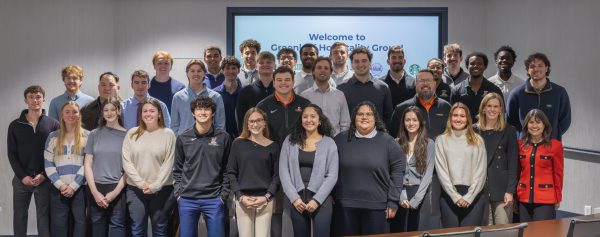
Kalamazoo College’s business capstone class is working with Sarah Olszowy, chief experience officer at Greenleaf Hospitality Group, and other members of the Kalamazoo Marketing Coalition, a cross-sector group representing business, regional development, city government and destination marketing. Their coalition aims to improve collaboration and synergy among marketing teams promoting the region.
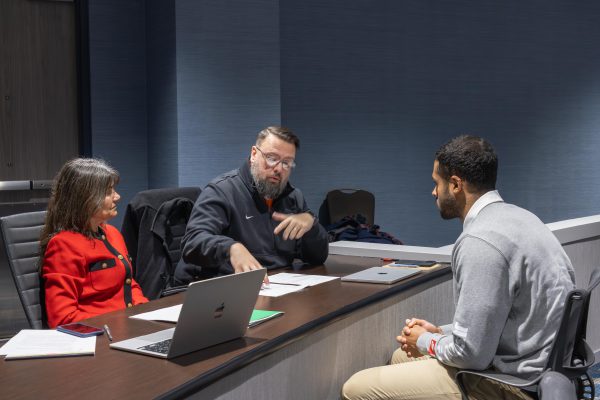
Amy MacMillan, L. Lee Stryker Professor of Business at K, is co-teaching the capstone with Visiting Assistant Professor of Business Matthew Schultz.
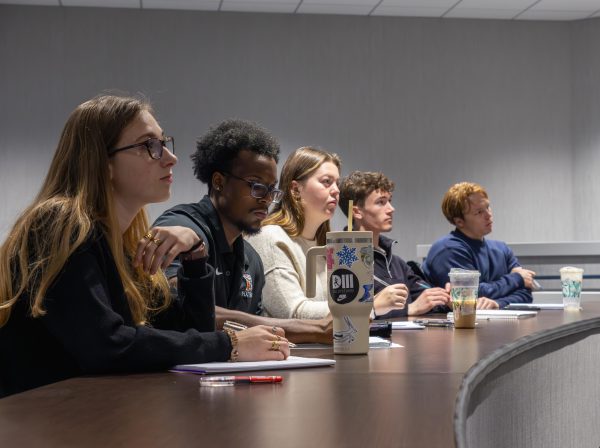
Business majors at K are partnering with a local coalition to explore one of Kalamazoo’s most compelling questions: How can our city foster a stronger sense of belonging and create the kind of social, cultural, and recreational experiences that encourage recent graduates to stay?
The course will meet periodically at the downtown Radisson in meeting space provided by Greenleaf Hospitality Group.
When Kalamazoo College alumnus Cody Colvin ’18 stepped onto a set in Traverse City last year to portray one of the most disturbing criminals in recent Michigan history, he carried with him a lesson he learned nearly a decade earlier in a voice and diction class: “Whatever comes up, comes up.”
That advice, given to him by Professor of Theatre Arts Ren Pruis during a Shakespearean sonnet exercise, would prove instrumental as Colvin tackled the challenging role of Christopher Thomas in Hulu’s Stalking Samantha: 13 Years of Terror, a crime miniseries that climbed to No. 3 on the streaming platform after its August release.
The show dramatizes the harrowing true story of Samantha Stites, a former Grand Valley State University student who endured nearly 12 years of stalking by Thomas, a man about seven or eight years her senior. The ordeal culminated with dark subject matter including a kidnapping to a dungeon-like bunker, which demanded extraordinary emotional preparation from the actors re-creating the events.
“To me, it’s about as difficult a character as anyone can ever portray,” Colvin said. “How do you get in the mindset of someone like that? How do they see themselves? How do they see the other person?”
A Lesson That Changed Everything
The answer, Colvin discovered, was in the foundation he built at K under Pruis’ guidance during her voice and diction class. Performing a Shakespearean sonnet, he unexpectedly laughed, despite the piece not being comedic.
“I thought, ‘Oh, no. I’m going to get marked down for this,’ but I kept laughing through it,” Colvin said. “And she said, ‘Go with it.’ She said, ‘Whatever comes up, comes up.’”
That simple instruction became what Colvin now calls “the most important thing about acting that almost no one ever teaches you.”
“What I’ve learned in acting and performing is that humans don’t make any sense, so when you get on stage or on screen, and you have emotion that comes up that is not what you prepared for, you go with it,” he said.
Developing a Monster
The philosophy proved essential during the intensive eight-day shoot, where 12- to 15-hour workdays were common. The production, which conducted a statewide casting search in Michigan and Illinois for its leads, brought together a professional crew including Sarah Mast, an executive producer from MTV’s The Hills.
But Pruis’ character-development class provided another crucial building block. An assignment requiring students to stay in character for two hours prepared Colvin for the demands of portraying Thomas across full shooting days.
Kalamazoo College alumnus Cody Colvin ’18 portrays Christopher Thomas, who stalked and kidnapped Samantha Stites, in the Hulu miniseries “Stalking Samantha: 13 Years of Terror.” Watch the trailer here.
Colvin is an award-winning director, producer and co-executive producer. He founded Colvin Theatrical in 2020. In 2023, he launched Colvin Media to expand into broader film, television and advertising projects.
“I already know that I could be in character for hours and hours, and improvise, respond and think as that person,” Colvin said.
Playing Thomas, described by Colvin as “a horrible criminal with little conscience,” required accessing dark psychological territory. Yet the approach Pruis instilled in him, allowing authentic emotions to surface rather than imposing preconceived choices, made the grueling schedule and the acting challenges manageable and the performance honest.
“It makes it so much easier for 12 hours a day to act, because you’re not managing your emotions, you’re just letting it all happen,” Colvin said. “And that’s what creates the best performances.”
A Love for the Camera
For Colvin, who has devoted much of his career to directing and producing, the experience reaffirmed where his true passion lies, and he expressed clear aspirations for his future.
“I’d love to keep doing stuff on screen,” he said. “That’s my dream. I just love it.”
As he continues to build his career, Colvin carries forward the transformative lessons from his K education, proof that sometimes the most profound professional preparation happens not in the spotlight, but in a college setting where a faculty member encourages a laughing student to simply “go with it.”
From milestones that shape campus life to national recognition that underscores Kalamazoo College’s academic excellence, 2025 was a year of momentum and meaning at K. The stories that resonated most reflect a community investing in its future—through new facilities, enduring traditions, global engagement and partnerships that strengthen both the campus and the city. Here’s a look back at the College’s top 10 stories of 2025 and the people, programs and progress behind them.
K appreciates the community support that helps the College keep its Lillian Anderson Arboretum open to the community. Local foundations have contributed more than $100,000 in grant support for projects and physical improvements at the Arb over the past two years.
Collaboration and partnership with the Consumers Energy Foundation, ENNA Foundation, Irving S. Gilmore Foundation, Kalamazoo Rotary Club and Seminary Hill Sustainability Internship as well as Stryker and Zoetis through the Kalamazoo Nature Center have enabled entrance trail upgrades, a new welcome sign, installation of a new well, replacement of the Batts Pond bridge, continuation of pollinator habitat research, a three-year sheep-grazing research project, and development of a land-management plan.
A butterfly perches on a sign that says Lillian Anderson Arboretum.
College-bound students interested in global experiences should take a close look at K considering its latest honors from the Fulbright Program, the U.S. government’s flagship academic exchange program. Since the 2019–20 cycle, K has earned Fulbright’s Top Producer recognition six times among baccalaureate schools while producing 32 U.S. Student Fulbrighters.
In 2025, 28 sophomores signed up as Spanish majors at Declaration of Major Day. More than 975 Kalamazoo College students have studied in Spain, Mexico, Chile and Costa Rica since 2012. Engagement with Spanish language and cultures is clearly strong, and a new fund in honor of former faculty member Margarita Costero Campos supports students who carry that torch forward.
Campos taught at K from 1988 to 1997 and passed away in May 2024 at 92 years old. Her family later established the Margarita Costero Campos Student Travel Award. The fund will assist academically dedicated students with travel to Spanish-speaking countries for purposes including research, conference presentations, internships and study abroad, with preference given to students who major or minor in Spanish.
Margarita Costero Campos taught at K from 1988 to 1997 and died in May 2024 at 92 years old. Her family, including her widower, Dr. José Luis Campos; six children; and 13 grandchildren established the Margarita Costero Campos Student Travel Award.
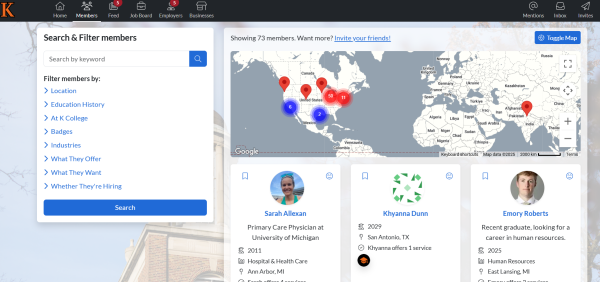
Kalamazoo College brought its tight-knit community even closer together in 2025 with the launch of KConnect, a new social media site designed exclusively for students, faculty, staff and alumni. This LinkedIn-style platform provides a professional space to build connections, seek career advice and share opportunities with fellow Hornets.
In KConnect, alumni can share one-time advice or serve as ongoing advisors to students as they control how often they want students to contact them. It’s also a place where alumni can make connections with former classmates.
Twenty years after the Kalamazoo Promise transformed access to higher education, its impact is powerfully felt at Kalamazoo College. Since K joined the Promise in 2015, more than 230 Promise scholars have enrolled at K—bringing their talents, aspirations and stories to a campus committed to supporting their success.
Tom Clark ’27: “Individuals who have been impacted by the Promise belong to a sense of community. There is a shared gratitude for the opportunity that has been given.”
Amid the hum of campus events, you might hear a sound of distinction at K. The tower of Stetson Chapel houses a set of eight English change ringing bells, one of only a few dozen towers of its kind in North America. For many students, faculty, staff and alumni, the bells are more than a treasured College artifact. And for more than 40 years, they have been woven into the fabric of daily life.
Each tower bell bears the college motto, Lux Esto, and each is inscribed with a Biblical quotation along with the name of a person associated with the college during its first century.
Kalamazoo College is again drawing national attention for its quality in higher education with three national publications—Forbes, Washington Monthly and Money—ranking the institution among the top colleges and universities in the country.
Forbes, Washington Monthly and Money honored Kalamazoo College among the top national institutions of higher education in 2025.
When prospective families weigh the return on investment of a college education, they can rest assured that Kalamazoo College provides one of the best values in the U.S., according to the Princeton Review.
For the fourth consecutive year, the education services company has included K on its Best Value Colleges list, placing the institution among the top 209 in the country for 2025 regardless of size, location or private/public status. K is one of just five Michigan institutions overall and two private institutions to receive the honor.
For the fourth year in a row, Kalamazoo College has been rated among the nation’s best values by the Princeton Review, an education services company.
Kalamazoo College President Jorge G. Gonzalez announced in April that he will retire from his position at the end of his contract on June 30, 2026, after 10 years leading the institution. In his time at K, Gonzalez has overseen strategic planning efforts designed to enrich curricular and co-curricular experiences, foster an inclusive and supportive campus for all, strengthen financial and enrollment sustainability and modernize K’s historic campus.
Board of Trustees Chair Jody Clark ’80 is leading a national search for a new president at K. President Jorge G. Gonzalez announced in April that he will retire in June 2026.
K announced in April that it was launching plans to build new residence halls on its historic campus, a step that reflects the College’s long-term commitment to enhancing student life and academic experiences as detailed in its latest campus master plan.
The new residence halls are part of an effort to meet a growing need for affordable, sustainable on-campus housing as off-campus housing costs continue to increase. The growing popularity of an already strong study abroad program also is prompting a demand for on-campus housing each midyear as students return from overseas.
Construction on the project along West Main Street in Kalamazoo began in May. The halls currently are scheduled for occupancy in fall 2027.
Two new residence halls will have several features supporting sustainability efforts when they open in fall 2027.