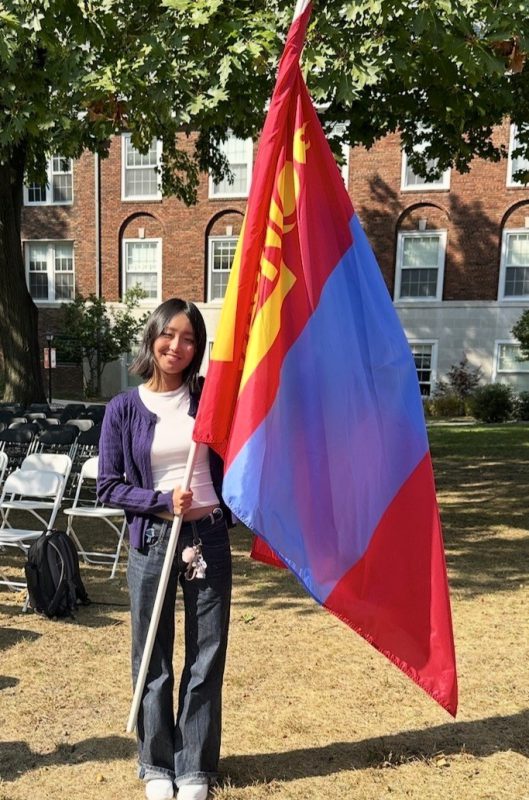
The classic back-to-school essay prompt asks students to describe what they did during summer vacation. When Anar Bayanmunkh ’28 returns to Kalamazoo College this fall, she’ll have quite a story to tell after conducting bioinformatics research at the National University of Mongolia, leading a youth peace walk through the Mongolian countryside, and exploring how science, culture and community can shape her future career.
In July, Anar will go home to Mongolia to complete an internship in a bioinformatics laboratory, an experience supported by a stipend from the College’s Center for Career and Professional Development (CCPD). She will also lead a Davis Projects for Peace initiative that encourages young people to reconnect with themselves, nature and their cultural heritage through a technology-free walking retreat.
Together, the experiences reflect her goal of bridging science and human connection. The internship represents a key step in her growing interest in biology and neuroscience, fields she discovered after arriving at K.
“As I started taking biology courses, I realized how interesting the field is,” she said. “Even when classes were difficult, I felt like this was something I wanted to keep pursuing.”
Seeking hands-on experience, Anar began searching for a summer internship. Through a connection provided by her grandmother, she reached a professor at the National University of Mongolia who put her in touch with a bioinformatics researcher, Associate Professor Mijiddorj Batsaikhan, whose work aligns with her interests.
The faculty member welcomed Anar into the lab and offered to tailor the experience to her interests in bioinformatics and computational neuroscience. Anar’s work will involve learning and applying bioinformatics approaches, particularly RNA-sequencing analysis, to understand biological systems through computational methods.
“I’m hoping to gain hands-on experience with analyzing biological data, understanding how researchers use computational tools to study gene expression, and learn more about how bioinformatics can be applied to questions in biology and neuroscience,” Anar said. “If possible, I’m also interested in exploring the opportunity to develop a small independent research question/project during my time in the lab.”
The CCPD’s internship stipend program supports students who pursue unpaid internships. Anar received a $5,000 stipend to help cover expenses while she gains professional experience in Mongolia. The funding is one example of the support she has received from the CCPD since arriving at K.
“They helped with my resume, found opportunities for me and made this internship possible,” she said. “It has opened so many doors for me.”
While in Mongolia, Anar will also lead Walking Back to Ourselves: A Youth Peace Walk, a personal project funded through the Davis Projects for Peace program. The program allows students at partner institutions, including K, to design their own grassroots plans for peace that they implement anywhere in the world. About 100 projects a year are selected from proposals at 85 campuses for the $10,000 grants.
Anar’s initiative will bring together 15 to 20 young adults from Ulaanbaatar, Mongolia, for a seven- to 10-day walking and reflection retreat in Mongolia’s Zavkhan Province. Participants will leave behind phones and electronic devices while walking through the countryside, living in tents, engaging with local nomadic families and participating in guided reflection and discussion activities. Anar developed the project in response to what she sees as growing stress, digital dependence and emotional isolation among young people in Mongolia.
“My definition of peace begins within the individual,” she wrote in her proposal. “A society cannot be truly peaceful if its people are disconnected from themselves.”
Working in partnership with the nonprofit organization Nomiin Tsenher Tig, which has organized walking journeys throughout Mongolia since 2013, Anar hopes participants will develop stronger emotional awareness, deeper cultural connections and a renewed sense of community.
The project also reflects Anar’s own experiences navigating life between traditional Mongolian culture and the modern world.
“For the past five years, I have personally experienced the emotional disconnection that many young Mongolians feel in modern life,” she wrote. “This project reflects my desire to transform that experience into something meaningful for others.”
Anar credits K faculty and staff members, including her academic advisor, Jessica Fowle ’00—who is K’s director of health careers, fellowships and undergraduate research—for encouraging her ambitions and helping her pursue opportunities that connect her academic interests with meaningful work.
“When I go there, I’ll bring some American college student perspective to Mongolia,” she said. “And when I come back, I’ll be bringing hands-on experience in a bioinformatics lab from Mongolia. I don’t think a lot of people have that kind of opportunity.”
Anar describes herself as someone who moves between worlds—traditional and modern, Mongolian and American, scientific and humanistic—and she sees her summer as a chance to deepen that role. She also hopes the summer helps her narrow down the possibilities for her future direction.
“This will help me narrow down what I’m interested in and decide whether I want to go deeper into that pathway,” she said. “Kalamazoo College gives you many opportunities to explore and helps you figure out what you want to do. Maybe I won’t like the internship. Maybe after going through it, I’ll think, ‘This is not what I want to do.’ Or maybe I’ll want to go deeper in that pathway. Either way, I’ll know more about myself.”