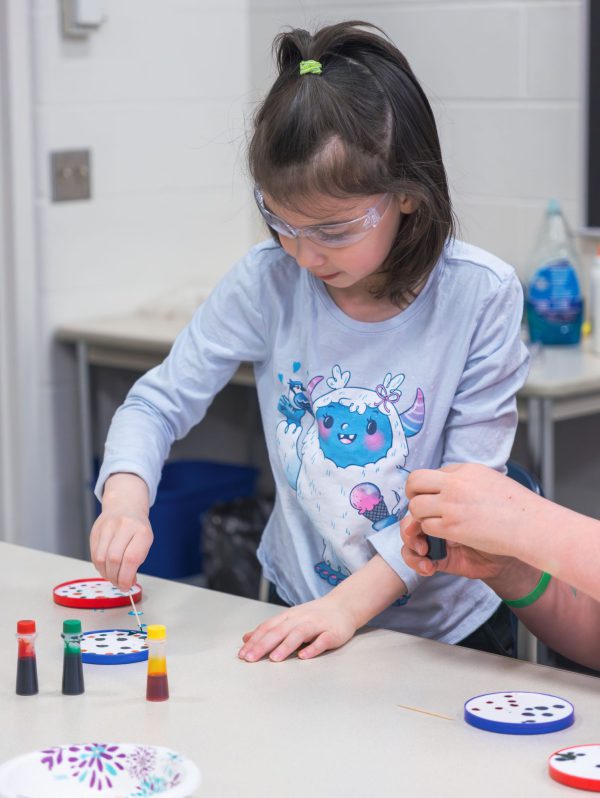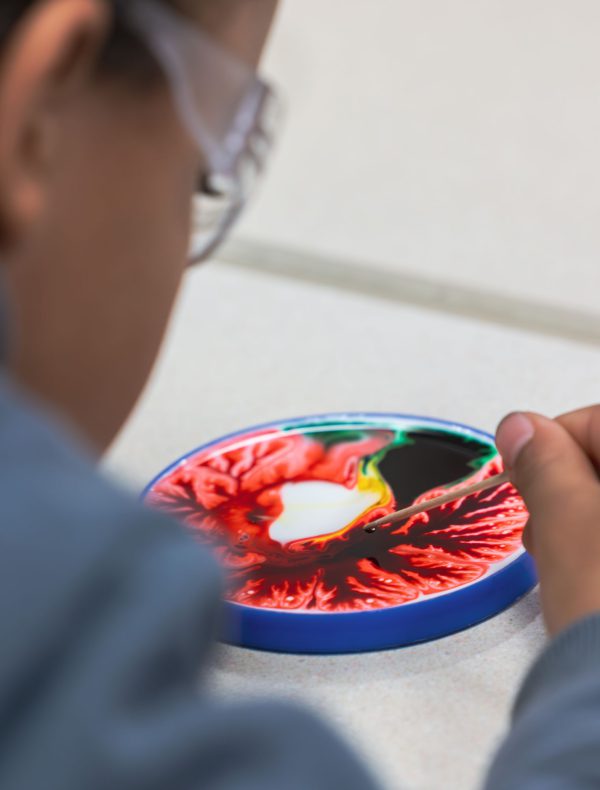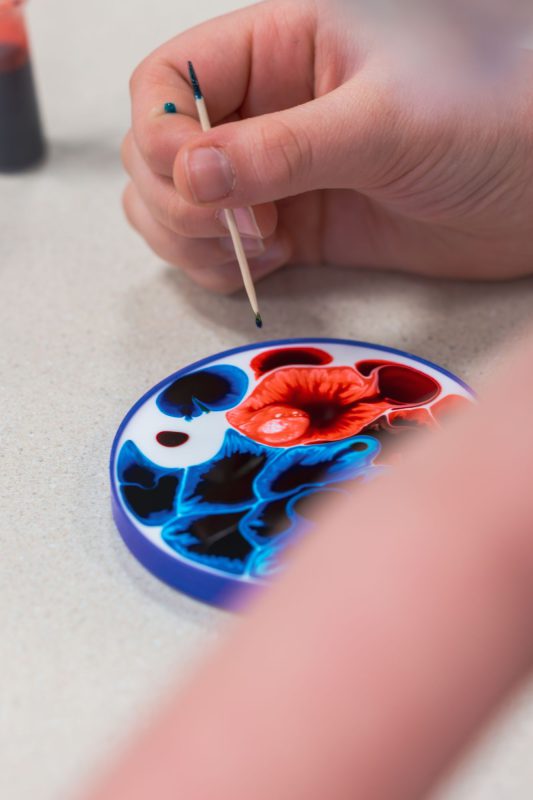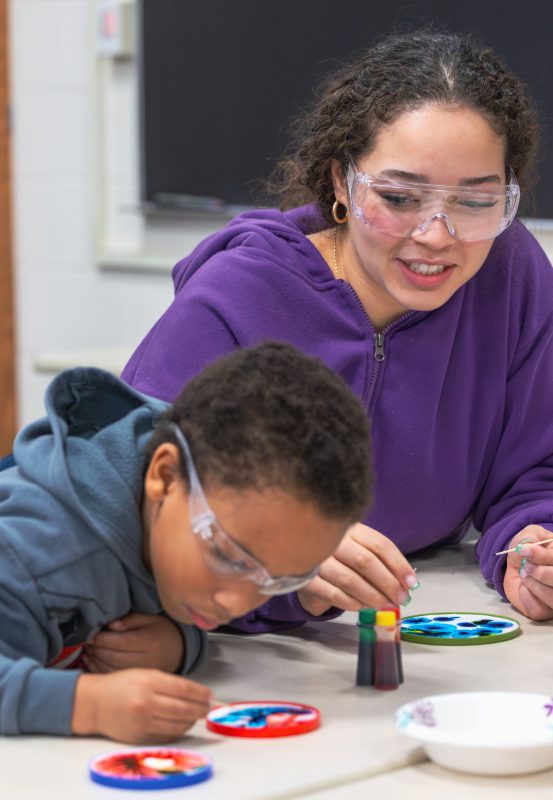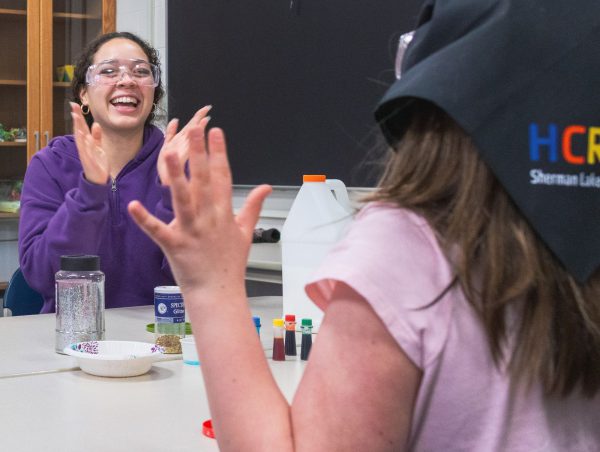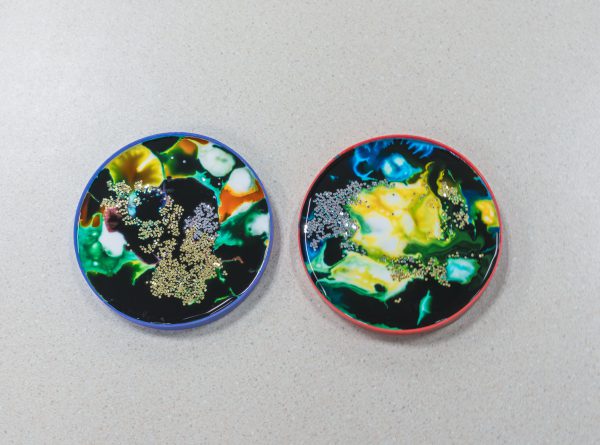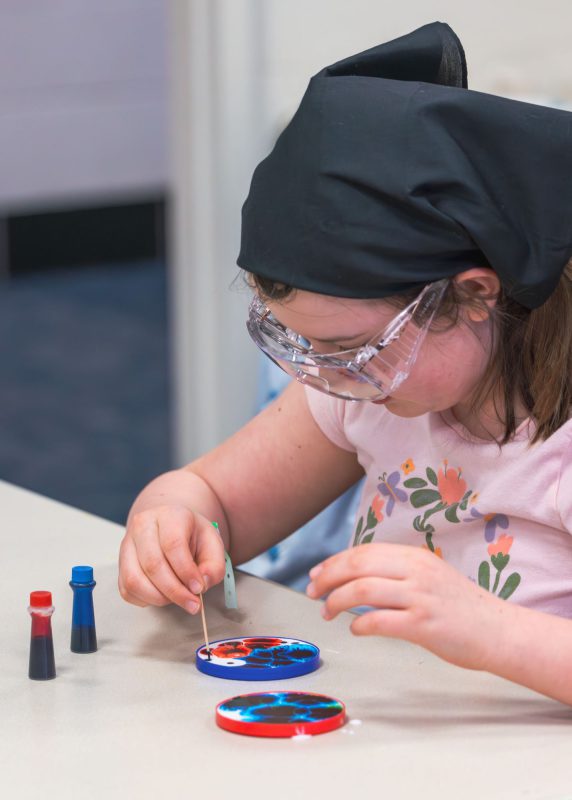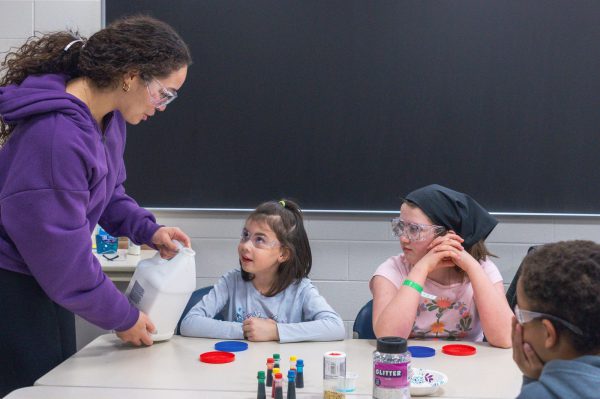
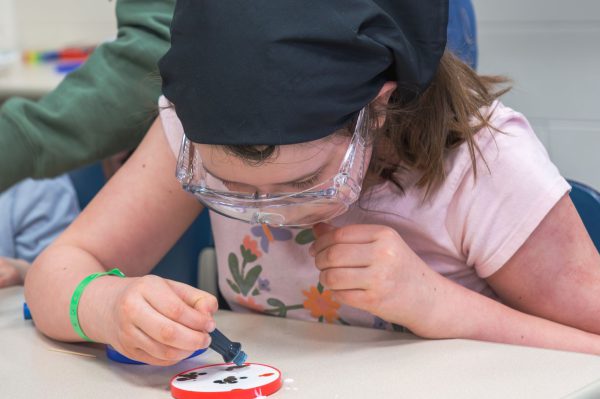
One recent afternoon at Northglade Montessori Magnet School in Kalamazoo, fourth and fifth graders gathered around a table for a simple science experiment involving water, soap and glitter.
“Think about what happens when germs spread,” a college student presenting the experiment told them.
Moments later, a finger dipped into the mixture, and the glitter scattered across the surface of the water. The room filled with laughter, surprise and a few delighted yells of “Whoa!”
For the kids, it looked like magic. For the mentors leading the activity, it was something more powerful. It was a chance to spark curiosity about science through a lesson that showed just how quickly illnesses can jump from one person to another.
The demonstration was one small moment in a program that has quietly shaped young learners in Kalamazoo for a quarter century. Sisters in Science—a student organization at Kalamazoo College—is celebrating its 25th anniversary of presenting hands-on STEM experiences to local kids. The group partners with Communities In Schools of Kalamazoo to visit youths at Northglade and Woodward Elementary, where K students run experiments and serve as mentors for children discovering science in new ways.
A Founding Conversation
Sisters in Science owes its existence to a chance conversation on a school sidewalk. Regina Stevens-Truss, the Dorothy H. Heyl Professor of Chemistry at K and the program’s faculty advisor since its founding, arrived at Northglade in 2001 to pick up her children. A sixth-grade teacher pulled her aside with a question that would stay with her.
The teacher had noticed that her female sixth-grade students consistently outperformed the boys in math and science. But when she saw those same students again in ninth grade, something had changed. The girls who once loved science no longer seemed interested. She wanted to know why.
Stevens-Truss couldn’t stop thinking about that conversation. Research backed what the teacher had observed: girls often lose interest in science and math during the transition from elementary school to junior high, as social pressures begin to reframe those subjects as less compatible with femininity. She brought the idea of a mentorship program to the chemistry department’s office coordinator, who suggested the name Sisters in Science, and then to Leslie Tung, who was serving as interim provost at the time. Tung pointed out that every department in the science division had at least one female faculty member, and he encouraged Stevens-Truss to build a program in which K students would mentor girls at Northglade.
Sisters in Science launched as a one-on-one mentoring program, pairing individual K students with sixth-grade girls at the school in a big sister, little sister model. The pairs would meet weekly to talk about science, math and what it meant to be a young woman with those interests. As demand grew and the sixth grade was moved to the middle school, the model shifted from individual pairings to group sessions at Northglade, and now also at Woodward Elementary School. While the program originally focused on encouraging girls to pursue science, feedback from students led Northglade organizers to expand participation so boys could join as well. The college mentors remain the “sisters” leading the activities, but the sessions now welcome all students. The change reflects the program’s broader mission, which is to make science accessible to everyone.
From Lunch Tables to Laboratories
The program is simple but effective. Students bring their lunches into a classroom, where the college volunteers introduce a short experiment. Before long, the room becomes a laboratory filled with egg drops, slime, miniature rockets and glitter experiments.
“They eat their lunch, and then they pretty much jump right into it,” said Emma Braford, a site coordinator at Northglade for Communities In Schools of Kalamazoo. “They’re always very hands-on. It’s all very fun and interactive things that get the kids really engaged with science and loving science in a way that’s not just textbooks.”
The program typically serves about 30 elementary students across the partner schools, with three to five K students guiding activities each visit. Over the course of the school year, the mentors work with the same groups of children, building relationships along the way. That mentorship, Braford said, can be just as important as the science lessons themselves.
“I think it’s cool for them to have that older peer mentor relationship,” she said. “The college students intentionally get to know four or five of the students really well over that time.”
Opening Doors to Science
Sisters in Science is led this year by Pauline Hawkes ’26 and Madison Vrba ’26.
For Vrba, a biochemistry major, the organization represents a natural blend of two passions, science and mentorship. Before joining Sisters in Science, she worked as a pitching instructor for young softball players and discovered how empowering it could be for young girls to realize what they could do.
“When girls feel confident exploring science and asking questions, it not only benefits them individually but also strengthens the entire scientific community,” Vrba said.
Historically, STEM fields have been male dominated, she noted, which can make it harder for girls to picture themselves in those careers. Programs like Sisters in Science help change that narrative by introducing science early and making it approachable.
Success, Vrba said, often comes in small moments.
“If even one student walks away feeling more confident about science or more interested in learning how things work, I consider that a success,” she said.
Inspired to Give Back
For Hawkes, a biology major who hopes to pursue a career in physical therapy, the motivation to mentor younger students is personal.
Growing up, she watched her mother navigate a series of back injuries and surgeries, which sparked her interest in the human body and how it works. She also had an influential role model close to home in her older sister, Isabelle Hawkes ’24, who was also involved in Sisters in Science.
“I’ve always looked up to her,” Hawkes said. “She was able to answer questions and help me understand things when I was struggling. I want to be that resource for other people and open doors they might not know existed.”
Each week during the academic term, Hawkes and other leaders visit partner schools for two days between classes. The goal isn’t simply to perform experiments, she said. “We’re just learning together,” Hawkes said. “It’s a safe, comfortable space where they’re not afraid to ask questions or try different things.”
Learning Science Through Discovery
But the lessons go beyond the experiments. Sometimes, students are surprised simply to learn that the College mentors are studying science themselves.
“I’ve heard some of them say things like, ‘We didn’t know you could study this in college,’” Braford said. “It gives them a broader perspective of different career options that exist.”
“It’s important for everyone to see what’s possible,” Hawkes said. “This is where you’re developing your interests.”
That openness, along with the enthusiasm of both the college mentors and elementary students, helps explain the program’s longevity.
One alumna whose connection to Sisters in Science continues to resonate is Caitlyn VanGelderen ’12. She was deeply devoted to the program during her time at K. Caitlyn loved combining her passion for chemistry with her commitment to mentoring younger students, and she found joy in helping elementary girls discover their own interest in science. Since her passing in 2020, her parents have honored that passion by making annual donations to support Sisters in Science in her memory, ensuring the work that meant so much to her continues to inspire new young scientists.
“I think people want to be part of it,” Hawkes said. “There’s always going to be interest in teaching kids about science and letting them do experiments they might not otherwise have the opportunity to try.”
A Spark for the Future
As Sisters in Science marks its 25th anniversary, the leaders hope to celebrate the milestone with commemorative T-shirts for participants and increased visibility for the program. But the true impact is less tangible. It’s the moment when a student’s eyes widen during an experiment, the moment when a child asks a question no one expected, or the moment when a young student realizes science might be something they love.
“Science can sometimes feel intimidating,” Vrba said. “But programs like this show students that it can also be creative, fun and something they’re a part of.”
Stevens-Truss sees the secret to its longevity in the relationships it builds across multiple constituencies at once: the K students who join as first-year students and grow into leaders, the elementary students who see themselves reflected in the mentors above them, and the community partners who have been with the program since the beginning.
Stevens-Truss said she does little to keep the program running year to year. Each spring, the current leaders identify their successors. Each fall, she reaches out to those students, and they take it from there. The group maintains its own website and keeps its supplies—reagents and materials for experiments—in a cabinet in the science building.
“There’s never been a year since we started Sisters in Science that the program has not run,” she said. “I don’t hound them; they come to me.”
And if the excitement in those classrooms is any indication, the next 25 years of Sisters in Science might inspire just as many future scientists as the first.