“K” students Will Guedes ’15, Tibin John ’15, Chris Clerville ’13, Jiakan Wang ’13, Lucas Kushner ’14, and Trung Hoang ’12.
Students from Kalamazoo College worked together to build their mental endurance and speed in anticipation of a big test held Oct. 21-22. No, not mid-terms—the 36th annual Association for Computing Machinery International Collegiate Programming Contest sponsored by IBM. Regional competitions for the so-called “Battle of the Brains” attracted tens of thousands of students from schools in about 90 countries on six continents, all with the same dream to walk away with prizes, scholarships, job opportunities, and a coveted spot among the top 100 teams invited to the World Finals in Poland in May 2012.
Two Kalamazoo teams competed against the smartest collegiate IT talent from 122 colleges and universities in Michigan, Indiana, Ohio, Pennsylvania, and Ontario, including teams from MSU, UM, Purdue, Notre Dame, and Ohio State. Each three-student team applied its programming skills to solve complex real world problems under a grueling five-hour deadline huddled around a single computer.
“The two ‘K’ teams did great,” said Pam Cutter, associate professor of computer science. “We had seniors through freshmen participating.”
The “Black Hornets” finished tied for 48th, and the “Orange Hornets” finishing 53rd.
“We’re proud of their effort and for standing up to the ‘big schools.’ It was time well spent and a great learning experience for all.”
Ten Kalamazoo College students who are creating their own theater production this spring with guidance from a guest director from Varanasi, India, will take the show to Varanasi this summer and get a chance to see a country whose culture they have been exploring in class and on stage.
The “Kahani” project — which came about through a unique collaboration of the College’s Theatre Arts Department, Center for International Programs, and Arcus Center for Social Justice Leadership—combines many of the key elements of a K education: rigorous scholarship, critical thinking, international engagement, interdisciplinary exploration, social-justice discussions…and don’t leave out creativity and performance opportunities.
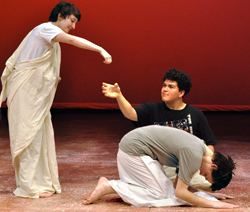
Students are spending just seven weeks devising the scenes for “Kahani” (which means “Story” in Hindi) before they present it May 10-13 at the College’s Nelda Balch Playhouse. And they are required to attend both rehearsals and a class taught by guest director Irfana Majumdar, a visiting fellow of the Arcus Center. In the photo at left, Jane Huffman ’15 (standing), Joe Westerfield ’15 (seated), and Sam Bertken ’12 rehearse for the play. Majumdar assigned readings of a novel and short stories by Indian women writers as jumping-off points for script creation, and many of those pieces explore gender and power dynamics within close relationships.
“Instead of using big issues like communalism, which are also very important in the world, I decided to stay inside smaller, closer human relationships, like within a family,” Majumdar said, “I think it’s very important for men and women to explore these issues of gender together.”
Much of the theater work Majumdar does is “devised work,” meaning it does not begin with a set script. “What is interesting about the project we’re doing, and exciting,” she said, “is…that it’s really a lot about the actors. And since they’re students and they’re just learning to act and beginning their journey of theater, it’s a way to really explore more of themselves and bring that into a project.”
The chance to create a theater piece with fellow students has been exhilarating for senior theater major Sam Bertken, a 22-year-old from northern California.
Samantha Jolly ’15 (left) and McKenna Kring ’15 rehearse for Kahani at Kalamazoo College, a play that will be performed by Kalamazoo College students in the Nelda Balch Playhouse on the K campus May 10-13, and in Varanasi, India, in July.
“I love the possibility for something completely new to be created,” said Bertken when the group was about three weeks into the project. He said the students started off doing exercises to “create a physical vocabulary” and build trust and then focused on their compositional skills. To create potential scenes for the final production, they split into small groups and began voicing their ideas, one right after another.
The process has not been without its challenges, though. “It’s tough,” Bertken said. “Every time you come in you have to be really open to possibilities. The biggest problem is time. There’s this balance of ‘Are we including everybody’s ideas?’ and then ‘Are we being efficient with our time?’”
But they have had a great teacher in Majumdar, he said. “She’s been able to make those of us who’ve never done a devised theater piece feel very confident about our ability to accomplish this project, which is something to be said.”
Back in Varanasi, Majumdar leads a theater studio that’s part of a nongovernmental organization called Nirman, which offers arts-based education for primary and secondary students and study-abroad opportunities for college students. It became one of K’s 43 study-abroad sites in 2010, according to CIP Associate Director Margaret Wiedenhoeft.
The “Kahani” project got started after K religion professor Carol Anderson met Majumdar during a sojourn in India. Majumdar and her mother, Nita, who also helps run the Nirman organization, then visited K about two years ago, and Anderson introduced Professor of Theatre Arts Ed Menta to the women.
“I found out Irfana has a great theater background, and she’s also a filmmaker,” said Menta. “And I thought, ‘Wow, we gotta do something. The stars are lining up right to sort of have a convergence of theater, social justice, and interculturalism. What could be better? It’s like many of the programs and aspirations of the College coming together in one project.’”
Jaime Grant, executive director of the Arcus Center, sees Majumdar as “a perfect visiting fellow” whose work can broaden “theater people’s visions of what theater is for” and “social justice people’s ideas of what’s in their toolbox to create change.”
“If you look at social justice movements throughout the world, theater is often part and parcel of that work,” Grant said. And because the “Kahani” project is a collaborative one in which everyone has a voice, “the process itself speaks to social justice,” Grant added.
The project has been a perfect fit for “Kahani” stage manager Kathleen “Kat” Barrett, a junior majoring both in Theater Arts and in Human Development and Social Relations, a course of study that combines anthropology, sociology and psychology. She said she wanted a college experience that would boost her critical-thinking skills and challenge her thinking about the world. She also likes to keep really busy.
“I’m in various rehearsals from six to midnight most nights,” Barrett said, “but I love what I’m doing. And this production is such an amazing project that the faculty has put together for us.”
“Kahani” will take the stage at Nirman in July as the students travel to India for about 10 days, accompanied by Majumdar, Grant, Menta, and Professor of Theatre Arts Lanny Potts. For Barrett, the journey will be a return trip. She spent July through December studying at Nirman and then a few more weeks traveling through India.
“I’m really excited to go back,” said the 21-year-old, who grew up in the small northern Michigan town of Shelby. “I loved India. I loved the city (of Varanasi). It’s not Delhi. It’s not modernized in a lot of ways. But it has so much character. It’s one of the most religious locations in India because it’s right on the holy Ganges River. It has so many stories and so many people and so much culture.”
Barrett, like so many others at Kalamazoo College, is also thrilled about this opportunity for her fellow students. “I’m so excited that they put in so much work, so much critical energy and then they get to go to India and not only perform it but see the world they’ve been thinking about so much.”
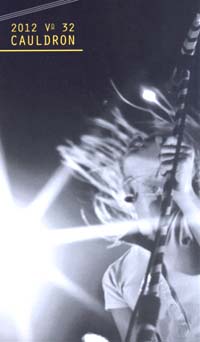
“Sight and Voice Revealed: Unveiling the Cauldron,”was the theme of the Week 6 (May 4) Community Reflection in Stetson Chapel. With support from the Student Activities Fee, each member of the audience received a free copy of the 32nd edition of the literary magazine, which features art, photography, and writing created by K students.
Editors Cam Stewart ’12 and Rebecca Staudenmaier ’12 discussed the Cauldron’s ability to unite students across interests and talents:
“We are the community bound at the book’s spine,” said Staudenmaier.
Writer-in-Residence Diane “Di” Seuss presented the Stephanie Vibbert Award to Erin Donevan ’12. This accolade memorializes the English/psychology double-major from Class of 2003 who died during her senior year at K. The award honors a current student whose writing exemplifies the intersection between creative writing and community engagement. Seuss said that Vibbert would have endorsed Donevan’s work promoting creative writing in Botswana and Kalamazoo.
The College’s Writing Center Director Amy Newday announced the three winners of the Divine Crow Award, which is bestowed on writers of outstanding Cauldron entries. Newday said the winners “wove connections for me through time, space and experience.” They were Paul Lovaas ’13 (for his nonfiction short story “Darkrooms”), Fran Hoepfner ’13 (for her poem “to shatter when dropped”), and Kelly Bush ’12 (for her fantasy short story “Ariadne”). Each student read excerpts from their winning work.
Divine Crow Award runners-up were Umang Varma ’14, Carolyn Stordeur ’12 and Nicholas Canu ’12.
Community Reflection offers a unique forum for discussion, worship, performance, and community expression each Friday at 10:50 AM (refreshments at 10:30) in Stetson Chapel. The entire campus community and general public are invited. Week 7 (May 11) Reflection will be “Perspectives from a Global K,” in which members of the International Student Organization share their experiences and reflections about current global issues
Students stand with their cardboard recreation of Stetson Chapel
Stetson Chapel received another life recently when K students erected a new and recyclable cardboard version of the building on the Quad, breaking a collegiate environmental record along the way.
Sustainability intern Scott Beal ’12 asked EnvOrg (Environmental Organization) to help him break the world’s record for the largest cardboard castle. The group considered several ideas for using boxes bound for recycling and decided to build a cardboard version of Stetson Chapel.
Construction day was April 27. With the assistance of Recycling Coordinator Rob Townsend, students built the Chapel replica on the quad using 760 boxes, which eclipsed Brigham Young University’s then-record 734-box castle.
Harvard University set the original record with a 566-box structure on their campus.
In academic year 2011-12, some 28 Civic Engagement Scholars (CES) are leading 20 different service-learning programs in collaboration with some 17 community partners. According to Breigh Montgomery, Mary Jane Underwood Stryker Institute for Service-Learning, Institute programming this year will focus on food justice – with CES for MiRA (Migrant Rights Action), Farms to K, El Sol Elementary School Garden, Community Garden/Nutrition Liaison, and Club Grub at Woodward Elementary School.
Other programs use creative expression for empowerment among incarcerated youth and returning citizens; promote health (including provision of Spanish interpreter services in clinical settings and reproductive health education to young women); educate public school children about nutrition and gardening; encourage critical dialogue about access to arts; advocate for fair and local food; foster adult literacy; and reduce educational disparities and promote college access by working with hundreds of Kalamazoo Public School students in schools, community-based organizations, and on our campus.
This year’s civic engagement scholars and programs are:
Luis Basurto-Jimenez (Kalamazoo Center for Medical Studies Medical Spanish Interpreter Program),
Zena Blake Mark (Keeping the Doors Open Math Enrichment Program ),
Ebony Brown (KDO),
Fanny Cruz (Helping Youth Through Personal Empowerment),
Standing (l-r) are Huang, Mulder, Fink, and Song. Seated are Adhikari, Hoang, and Esman.
By Maggie Kane ’13
Add ‘em up: FOUR teams of Kalamazoo College students finished among the top 10 at the 2012 Lower Michigan Mathematics Competition, with one K team bringing home the top prize. The three-hour competition held April 14 at Calvin College in Grand Rapids pitted multiple teams from 10 colleges against each other.
The ten-question exam “involved all branches of mathematics that undergraduates are familiar with,” said Rosemary K. Brown Professor of Mathematics and Computer Science John Fink, who accompanied the teams to the competition. He said unlike other colleges, K teams don’t practice before competitions because of their busy schedules.
“It’s like pickup soccer to them,” Fink said of his students, “Except they are people who like to play recreational mathematics.”
The K team of Dan Esman ’12, Trung Hoang ’12, Hang Nguyen ’14 took first place with a perfect score of 100. It’s the second straight year a K team has brought home the top trophy. Jinyuan Huang ’14,Renjie Song ’13, and Jiakan Wang ’13, finished third. Utsav Adhikari ’14, Sajan Silwal ’14, and Mojtaba Tafti ’15 finished sixth. The two-person team of Philip Mulder ’15 and Umang Varma ’14 finished ninth.
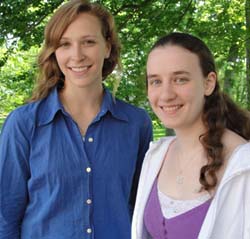
Class of 2013 members Lauren Wierenga (left) and Erica Dominic have been selected to receive prestigious Clare Boothe Luce Scholarships for Women in Science and Engineering. The scholarships will cover tuition for each quarter they are enrolled on campus during the 2011-12 and 2012-13 academic years.
Erica Dominic, from Farmington Hills, Mich., is pursuing a double major in mathematics and English. She is a teaching assistant for a calculus class and works at the College’s Math and Physics Academic Resource Center as a math peer consultant. Through the College’s Mary Jane Underwood Stryker Institute for Service-Learning, she tutors elementary and middle school students in math. During summer 2010, Erica participated in a math Research Experience for Undergraduates at Michigan State University. During the upcoming fall and winter terms, she’ll study at the University of Aberdeen, in Scotland.
Lauren Wierenga, from Grand Rapids, is pursuing a biology major and math minor with a concentration in biophysics. She is co-leader of Kalamazoo’s student organization Sisters in Science, and is a member of the Women’s Ultimate Frisbee team. During summer 2010, she interned at Walter Reed Army Institute of Research in Silver Spring, Md. This summer, she will intern for nine weeks in the Princeton University molecular biology department. In the fall, she will attend Kalamazoo’s Budapest Semester in Cognitive Science at Eötvös University in Budapest, Hungary. Eötvös is Hungary’s premier science and liberal arts university.
The Clare Boothe Luce (CBL) program is funded by the Henry Luce Foundation. Since its first grants in 1989, CBL has become the single most significant source of private support for women in science, mathematics and engineering. Thus far, the program has supported more than 1,500 women.
Clare Boothe Luce was a playwright, journalist, U.S. Ambassador to Italy, and the first woman elected to Congress from Connecticut. In her bequest establishing this program, she sought “to encourage women to enter, study, graduate, and teach” in science, mathematics and engineering.
Kalamazoo College was invited to apply by the Henry Luce Foundation, and was selected to receive the scholarships based on evidence of its strength in science and engineering, and of its commitment to Mrs. Luce’s vision of increasing the representation of women in these areas. Three Kalamazoo students received CBL scholarships in 2002, and three more in 2003. Additionally, Associate Professor of Mathematics Michele Intermont received a Clare Boothe Luce scholarship during her graduate school days at University of Notre Dame, in South Bend, Ind.
Left to Right: Popli, Nagy, Diffenderfer, Parson, and McNamara
Kalamazoo College enjoyed a strong scientific presence at the Washington, D.C. meeting of the American Society for Biochemistry and Molecular Biology (ASBMB). Associate Professor of Chemistry Laura Furge served as a judge in the 15th Annual Undergraduate Poster Competition, in which five “K” students competed against more than 200 other undergraduates from throughout the country.
Laura Diffenderfer ’11 presented a poster titled “Autodock as a method for predicting binding for substrates and inhibitors of human cytochrome P450 2D6,” based on a sliver of the research she’s conducted for the past two years in Furge’s lab. Diffenderfer plans to attend Wayne State Medical School this fall. Alyssa McNamara ’11, a four-year denizen in the lab of chemistry professor Regina Stevens-Truss, presented “Suramin discriminates between the calmodulin-binding sites of neuronal and inducible nitric oxide synthase.” She will work for the Schuler Family Foundation in Chicago before she enrolls in medical school in 2012.
Leslie Nagy ’09 and Diffenderfer presented “Mechanism-based inhibition of human cytochrome P450 2D6 by Schering 66712,” work recently accepted for publication in Drug Metabolism and Disposition. Nagy is completing a two-year appointment as a laboratory research associate in Furge’s lab.
Tanav Popli ’11 presented a poster based on his SIP work at University of California-San Francisco. His poster was titled “Tmtc4 interacts with C3G, Wntless, and Zfhx4: a yeast two-hybrid trap for proteins associated with development of the corpus callosum.” Tanov plans to work in a laboratory after graduation and then apply for an M.D./Ph.D. program.
Emily Parson ’11 presented a poster titled “Characterization of a real time PCR assay for the detection and quantification of Plasmodium malariae parasites.” She did her SIP, which was based in part on her study abroad experience in Kenya, at the Walter Reed U.S. Army Medical Research Unit in Washington, D.C. After she graduates this spring, Emily will return to Walter Reed to continue research in related areas.
“Attendance at a national meeting is a tremendous opportunity for students to hear and meet leading scientists, to see how scientists share ideas with each other, and to see how scientific research accumulates and allows for the formation of new hypotheses,” said Furge.
And it’s an opportunity that depends on philanthropy. Student travel to this meeting was supported by a grant to “K” from the Howard Hughes Medical Institute. Popli received a travel award from the Undergraduate Affiliation Network of Kalamazoo College headed by Stevens-Truss. Stevens-Truss organized the first annual ASBMB workshop titled: “Fostering Partnerships Between Colleges/Universities and Junior High School Teachers,” and she noted that it got off the ground despite her absence due to and airline grounding. “I was disappointed to miss the workshop when my flight was grounded in Kalamazoo,” said Stevens-Truss. “But I’m glad the idea is now a successful reality.”
The second offering of the workshop will occur next April in San Diego.
When it comes to the Senior Individualized Project, sculptor Daedalian Derks ’12 thinks BIG—as in the kind of installation measured by “chain” (a forestry metric of 66 and one-half feet), as in a three-dimensional sculpture stronger than the urge to procreate. No kidding!
“The Binary Strip,” the fourth and largest sculpture in Derks’ SIP quartet (the other works are called “The Purple Pieces,” “Primary Shapes Weather Vane,” and “Fractal Reflections”), was installed for one week only at the Lillian Anderson Arboretum “Magnificent Pines” trail (see photo). Any longer and it might have affected spring mating rituals of local fauna (who says art’s not stronger than sex?). The piece includes 228 freely spinning black-and-white square panels made from aluminum roofing flashing and grouped into sections of eight, like the binary language in computer science. Conceived at first as a way to “see the wind,” the project evolved into a deeper exploration of the way art interacts with a specific natural setting.
Said Derks (an art-major- classics-minor convert from a history-and-art double major from, originally, a biology major): “I wanted to install it as a flat plane, but the swaying of the pines would have destroyed anything other than a catenary,” a long architectural curve that, in the case of “The Binary Strip,” changes its arc as the trees move. What an interesting way to learn architecture from the natural world! (Derks one day hopes to do graduate work in a program that combines art, culture, technology, and architecture.)
Still, for many, one week was too short to see the piece. If you missed it at the Arb, you can see it at the Light Fine Arts Building on Thursday, April 26, at 4 P.M. when Derks will share his entire SIP sculpture project during an artist presentation open to the public.
Three of Professor of Music Jim Turner’s voice students placed in the 2012 Great Lakes Regional National Association of Teachers of Singing auditions, which were held in early March at Grand Valley State University.
Hannah Shaughnessey-Mogil ’14 was awarded an Honorable Mention for First Year Women. Jenna Hunt ’’13 took third place in Junior Women. And Erin Donevan ’12 placed first in Musical Theatre.



 By Elaine Ezekiel ’13



 When it comes to the Senior Individualized Project, sculptor Daedalian Derks ’12 thinks BIG—as in the kind of installation measured by “chain” (a forestry metric of 66 and one-half feet), as in a three-dimensional sculpture stronger than the urge to procreate. No kidding!