
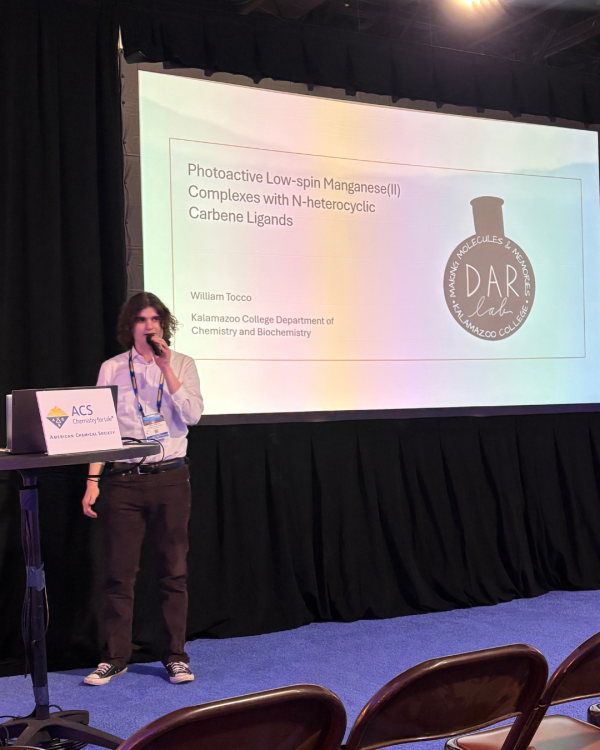
Will Tocco ’26 joined an elite group this spring as one of just six undergraduates nationwide selected from more than 1,400 nominees to present at the American Chemical Society’s Presidential Symposium in Atlanta.
Tocco’s selection came through two pathways. He had already been approved to present at a specialized inorganic chemistry symposium at the ACS National Meeting, one of the field’s premier annual gatherings. Separately, because Kalamazoo College offers an ACS-certified degree, the chemistry department was invited to nominate a student for the Presidential Symposium and put Tocco’s name forward.
“I felt very honored,” Tocco said. “It was a great experience to network, meet people and learn how professionals found their way, because I’m still figuring out what I want my career to look like.”
Roger F. and Harriet G. Varney Assistant Professor of Chemistry Daniela Arias-Rotondo and Dorothy H. Heyl Professor of Chemistry Regina Stevens-Truss nominated Tocco. For Arias-Rotondo, sending students to conferences is central to her lab’s mission.
“Every opportunity for students to share their work and practice presenting is valuable,” she said. “Conferences give them the chance to get feedback from experts in the field and expose them to perspectives they may not encounter on campus.”
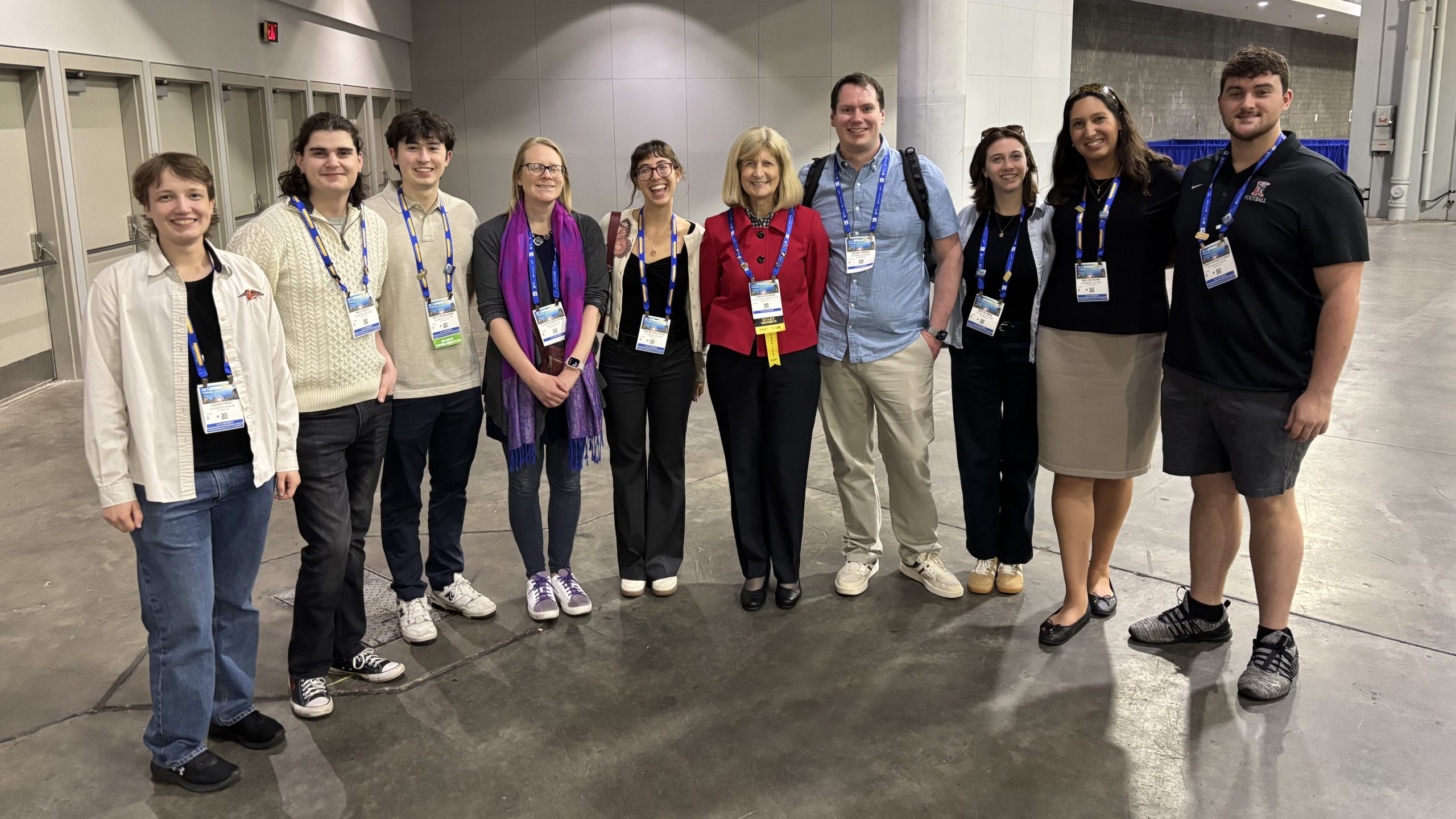
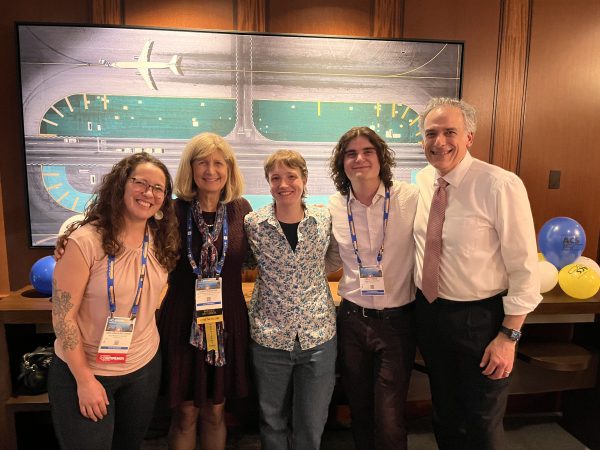
One highlight of the experience was a private reception hosted by the ACS president the evening before the symposium, where Tocco mingled with leading scientists and industry professionals. He met a senior scientist from Pfizer, the president of the Goldwater Foundation and the president of the ACS. He also connected with ACS president-elect Christina Bodurow ’79, a K alumna and member of the College’s Board of Trustees.
Absorbing Light, Moving Electrons
The opportunity stemmed from research Tocco has been developing in Arias-Rotondo’s lab at the intersection of chemistry and renewable energy. Building on work started by Maxwell Rhames ’25, he has helped develop single-molecule dyes capable of absorbing light and converting it to electricity, an approach with potential applications in next-generation solar panels and hydrogen fuel production.
“They can be used to split water into hydrogen and oxygen, and then you can burn that hydrogen as a fuel source,” Tocco said.
Tocco synthesized one such complex and demonstrated that it can move electrons through nearly every step of the energy-transfer process.
“It can absorb the light and do everything up until the handoff, but it doesn’t want to release the electron,” he said. “A solar panel needs to absorb light and give off electrons.”
Unlocking that final step by enabling the compound to release its electron and complete the cycle will be the focus of future work in the lab after Tocco graduates. His contributions have already refined procedures for synthesizing key molecules, giving future students a strong foundation to build on.
“Will is a strong synthetic chemist, and his work is opening the door for new students to join this project and make contributions,” Arias-Rotondo said. “It is impossible to overstate his contributions to our research group, both scientifically and personally. He is always willing to support and encourage others.”
Tocco’s presentation was well received, particularly at the inorganic symposium as more of the audience was familiar with the topic. Ahead of the conference, he contacted faculty at the University of Notre Dame, where he will begin his doctoral studies this fall, and one professor made a point to attend.
“He had his own presentation, but he took the time to come see mine,” Tocco said. “That was really inspiring.”
Tocco also earned an honorable mention for the National Science Foundation’s Graduate Research Fellowship Program (GRFP), a highly competitive award that provides three years of funding for graduate study. Although the honorable mention does not include funding, it is a significant distinction.
“As an undergrad, getting that honorable mention is big because I’m a year behind most others applying,” he said. He plans to apply again next year as a first-year doctoral student.
From Math Major to Chemist
Tocco did not arrive at K intending to pursue chemistry. He planned to major in mathematics, entering with dual enrollment calculus credits, before taking General Chemistry I with Arias-Rotondo.
“I just had so much more fun than I did in any other class,” he said. “Even what some might consider boring felt kind of cool.”
On the first day of class, Arias-Rotondo—known to her students as Dr. DAR—mentioned her research and invited interested students to speak with her. By the next term, Tocco had joined her lab, where he has worked since.
“When I first started chemistry, I thought I’d get my bachelor’s degree and find a job,” he said. “But I kept going to conferences, kept learning and realized I wanted to pursue a Ph.D. A lot of that was Dr. DAR’s influence.”
Tocco also credits Associate Professor of Chemistry Blakely Tresca, who organized a group of graduate student mentors to help K students navigate the demanding GRFP application process.
“I wouldn’t have started it without his help,” Tocco said.
The process also strengthened his Senior Integrated Project, as feedback on his grant proposal turned into improvements.
Tocco’s undergraduate experience also has included a Research Experience for Undergraduates fellowship at Duquesne University and a study abroad term in Belfast, Northern Ireland. He will graduate this spring with a major in chemistry and a minor in mathematics.
A Lab Community in Atlanta
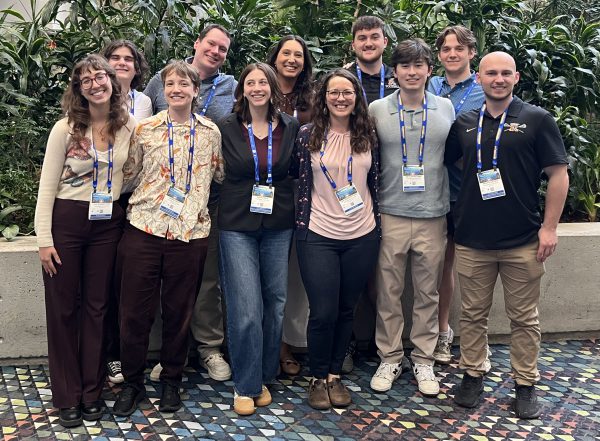
Tocco was not the only K student to attend the conference. He was joined by fellow chemistry and biochemistry students Caden Frost ’26, Ava Schwachter ’27, Bea Putman ’26, CJ Aldred ’26, Jack Bungart ’26, Max Plesscher ’26, Baylor Baldwin ’26 and Devi DeYoung ’26, along with Arias-Rotondo and Tresca. The students shared an Airbnb, and the trip became as much a bonding experience as a professional one.
“We went to the Georgia Aquarium, went to dinner, hung out and watched movies,” Tocco said. “It was a great experience to be professionals and also just spend time together.”
That blend of close community and high-level research is what Tocco sees as distinctive about K.
“Kalamazoo College punches above its weight class,” he said. “Our professors are well connected, so if we don’t have an instrument, we know someone who does. I’ve built relationships with all of the chemistry faculty, and that wouldn’t always happen at a larger institution.”
Arias-Rotondo has seen the impact firsthand. After returning from Atlanta, she led students through a debrief, reflecting on what they learned.
“Every time we take students to conferences, colleagues from other schools tell me how well our students present,” she said. “We could see the growth that happened in just a few days.”
Looking ahead, Tocco imagines returning one day to a lab that has continued to evolve.
“It’ll be exciting to see what others build,” he said. “That’s what makes it special.”