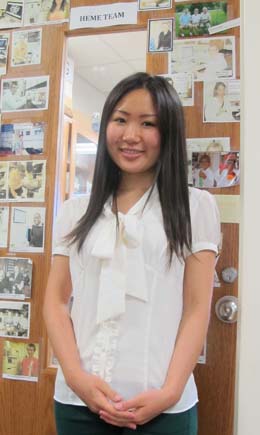
Liver Chemists

Rina FujiwaraBecause its name sounds like a vintage fighter plane, one might think the “Heme Team” that works with this enzyme is a group of pilots or aviation mechanics. But P450 (short for Cytochrome P450) refers to a family of enzymes that do vital work in the human body such as clearance and transformation of pharmaceutical drugs in the liver. And the “Heme Team” (named for heme, an iron-containing chemical component in all members of the P450 family) are four student research assistants working this summer in the chemistry lab of Professor Laura Furge. The team includes Rina Fujiwara ’15 (pictured at left), Amanda Bolles ’14, Mara Livezey ’13, and Parker De Waal ’13.

According to Fujiwara, Cytochrome P450 2D6—one member of the enzyme family—is responsible for the metabolism (think: conversion into a useful form) of some 20 percent of the medicines we take. So it’s definitely a P450 worthy of study—which, of course, means nature made it difficult to grow in a laboratory setting (as sure as the vegetables your mother said were good for you always tasted terrible). In fact, a great many P450 enzymes are intriguing, and the chemical modification of them and their mutations could one day have significant application in making medicines more effective.

Enter the Heme Team. Part of its summer work, says Fujiwara, has been to use recombinant bacteria (bacteria modified to include the DNA of P450 2D6) to grow the enzyme. Then team members try to separate the purified enzyme from the bacterial culture. Last year, they came close to achieving the goal. This year they developed a new protocol in which the bacteria cells (think: P450 factories) grow more slowly. Fujiwara is also doing work to obtain an even more difficult to express mutant version of 2D6, and that work might become the basis of her Senior Individualized Project next year.

On the threshold of her third year at K, the international student from Japan (chemistry major and thinking about a second major in biology) has always loved science, particularly the area of nutrition. This is her first year in the Furge lab, and she loves working with Dr. Furge and her fellow research assistants. “They are great mentors,” says Fujiwara, “and always help me with my many questions, no matter how elementary those questions may seem.” One exciting side effect of her work this summer, she adds, is the enthusiasm it has sparked for cell biology and biochemistry, two courses she is eager to take during her junior year.

Another great side effect is Dr. Furge’s expertise in another kind of chemistry—baking! “She makes delicious carrot cake and blueberry pies and brings them in for her research students,” says Fujiwara. “I love this lab!”

Cool Frustration

Chemistry major Virginia GreenbergerDuring the second summer of research on her Senior Independent Project (SIP), chemistry major Virginia Greenberger (pictured at left) is spending more time in method development than data collection. Here’s the thing about that: “We’ve never done this work before,” says Greenberger. (The other member of “we” is her SIP supervisor, Professor of Chemistry Regina Stevens-Truss; they are trying to develop a method to determine how certain protein pieces—called peptide sequences—kill bacteria.) That “never-having-done-this-work-before” means her SIP research is on the far edge of new discovery, which makes it very cool. But it can also be very frustrating—just one example: the peptide sequences are “sticky” and prone to clump, which makes methods to effectively study them more difficult to develop.

Some back story, which goes back further than last summer. About a decade and a half ago, Stevens-Truss noticed that bacteria she’d altered to produce a certain peptide were being killed by that peptide. Very interesting discovery, on hold for a dozen or so years. Then last summer Stevens-Truss and Greenberger began to study in earnest the protein components responsible for killing the bacteria. These peptide sequences are spiral in shape and carry a positive charge. Shape and charge are matters of chemistry and potential chemical alteration. Summer number one focused on which peptide sequences were the most effective killers of which kinds of bacteria–gram positive (Staph aureus, for example) and gram negative (E-coli, for example). The research team devised a method that uses light to determine the degree to which various peptide sequences inhibit various bacteria. Roughly speaking, “cloudy” or opaque solutions (that block light) mean the bacteria are not much affected by the peptide sequence, but a clear solution indicates significant antibacterial activity. The research could eventually prove very important. Ours is an age of antibiotic resistance. Certain bacteria cause serious infectious diseases, but their reproduction rate (combined with human misuse of antibiotics) selects for resistant strains.

Summer two’s work seeks to repeat (and confirm) the results of last summer and determine how the effective bacterial assassins do their work. How does one determine that? Greenberger is currently working on a method that infuses liposomes with dyes. Liposomes are bag-like structures whose membranes mimic the membranes of cells. A killing mechanism by which the spiral-shaped peptide sequences drill through bacterial cell membranes would be suggested if the liposome look-alikes suddenly release their dyes. That’s the method on which Greenberger was currently at work at the time of this interview. The working title of her SIP is “Studying Antibiotic Action of Peptide Sequences containing a Cationic Amphipathic Helix Structure.” But that could change, depending on that ever-changing ratio of “cool” to “frustrating.”

Strong Tradition

Kalamazoo College retired faculty membersKalamazoo College retired faculty members meet weekly on Thursdays. Every quarter the group has a special dinner (including spouses in the fall). And once a year they meet with new faculty members. “There are no papers or program for our weekly meetings,” says Joe Fugate, professor emeritus of German and director emeritus of the foreign study program. No agenda does NOT mean what happens at the meetings isn’t important. The meetings keep faculty together and serve to pass along the traditions that make Kalamazoo College what it is. The teaching experience represented by the group spans the 1950s through 2013. “Our conversations range widely,” says Fugate. Topics include, among others, College matters, political developments, education issues such as the defense of the liberal arts, and practical advice on healthcare subjects. “It’s an important way to keep the K community alive and vital,” adds Fugate. One of the more well attending meetings occurred this June. Pictured are (l-r): front row–Con Hilberry, English; George Nielsen, mathematics; Henry Cohen, Romance languages; Romeo Phillips, education; Sally Olexia, biology; Mary Beth Birch, music; Margarita Campos, Spanish; Marigene Arnold, anthropology and sociology; Tish Loveless, physical education and athletics; second row–Jean Calloway, mathematics; Rolla Anderson, physical education and athletics; Ed Baker, physical education and athletics; Larry Smith, music; Carol Smith, library; Don Flesche, political science; back row–Paul Olexia, biology; Joe Fugate, German and foreign study; Dick Carpenter, mathematics and computer science; Jeff Smith, mathematics; Stan Rajnak, mathematics; and Bob Stauffer, anthropology and sociology.

K History Professor Will Deliver Public Lecture in Berlin

David Barclay, History, will deliver a public lecture at the Free University of Berlin. The title of his talk is “Old Glory und Berliner Baer: Die USA und West-Berlin 1948-1994 [Old Glory and the Bear of Berlin: The USA and West Berlin 1948-1994].” The event commemorates the collaboration of the German Studies Association (GSA) with the Free University and also the 50th anniversary of the famous “Ich bin ein Berliner” speech by President John F. Kennedy. Barclay is the executive director of GSA. He will be introduced by Elke Loeschhorn, director of international programs at the Free University, and by Professor Harald Wenzel from the John F. Kennedy Institute of American Studies at the Free University. Barclay’s talk will be moderated by Professor Andreas Etges of the America Institute at the University of Munich. Commentary on the talk will be provided by Walter Momper, mayor of Berlin when the Berlin Wall fell in 1989; Professor Dorothee Brantz of the Technical University of Berlin and director of its Center for Metropolitan Studies; and Dr. Klaus Dettmer of the Landesarchiv Berlin (Berlin State Archives).

K professor talks about complex Bonaparte

Book cover of Elizabeth Patterson Bonaparte: An American Aristocrat in the Early RepublicK Professor of History Charlene Boyer Lewis ′87 is the author of the 2012 biography, Elizabeth Patterson Bonaparte: An American Aristocrat in the Early Republic. Boyer Lewis is quoted in a recent Baltimore Sun article about a new historical exhibit in Baltimore on its famous 19-year-old citizen who married Napoleon Bonaparte′s younger brother. Read more about Elizabeth′s long, colorful, and controversial life and view photos and a video about the new exhibit at http://www.baltimoresun.com/entertainment/arts/bs-ae-betsy-bonaparte-20130608,0,1051008.story#ixzz2VqTTxKXU.

Faculty Honors in Art and Science

Peter Erdi, Physics and Complex Systems Studies, has been selected to deliver the “Ignite” talk at the Science of Success symposium (June 17, 2013) at Harvard University (Cambridge, Mass.). The title of his address is “Prediction of Emerging Technologies.”

In other recognition of faculty work, the artwork “Kohler Pile”–a collaborative piece that Associate Professor of Art Sarah Lindley and her husband Norwood Viviano created during their Arts-Industry Residency at John Michael Kohler Arts Center (Sheboygan, Wis.)–was accepted for publication in New Glass Review 2013. Their project was one of 100 selected from a pool of 2,973 submissions by 1010 artists/designers from 48 countries. New Glass Review is an annual survey of glass in contemporary art, architecture, craft, and design created in the previous year by emerging and established artists, as well as students. The works are chosen by a changing jury of curators, artists, designers, art dealers, and critics. The book/journal will come out in July.

Building A Community Course

     Creators and members of the capstone course "Engaged Community Membership"
Creators and members of the capstone course “Engaged Community Membership” included (l-r): front row–Dan Kilburn and Alex Armstrong; back row–Jensen Sprowl, Marissa Rossman, Kiran Cunningham, Sara Haverkamp, Kami Cross, and Nicole Allman. Not pictured are Chris Cain and Ellen Conner. Cunningham is a member of the Class of 1983. Everyone else is a member of the Class of 2013.

The seniors taking the class, “Engaged Community Membership” (see photo), can build more than a good retaining wall in the College’s Grove area. They also can build a valuable course. And they did–their own capstone course.

In the winter quarter some 50 interested seniors met to begin to plan a “Senior capstone” course, one that would reflect the best thinking of seniors about a course that  structures reflection on their previous three and two-thirds years of academic and experiential rigor. The result of this winter planning was the spring quarter pass-fail class: “Engaged Community Membership.” The notion of community became the theme, according to class member and anthropology-sociology major Nicole Allman ’13.

The class eventually attracted nine seniors representing some 10 majors and Professor of Anthropology Kiran Cunningham ’83.

“We determined the course goals, set projects, and created the syllabus,” said Allman. “We focused on skill-based, concrete ideas surrounding the concept of community,” she added. Two projects in particular became the core of the course–a senior class recipe and cook book, tapping the experience of the Class of 2013 both on- and off-campus, including extending families throughout the world; and a landscaping and retaining wall project in the College’s Grove area.

Allman loved the class for both its hands-on and reflective qualities. “It was a valuable capstone experience that drew out and extended what we’d learned in the classroom and out over the past three years,” she said. “For me it clarified what it means to build a community and provided a blueprint for doing so that I can use to become a part of new communities.” The cookbook, she added, will be published (electronically) and shared with classmates and wider audiences.

More information access the project will be shared in the future.

K at Michigan Academy of Science Arts and Letters

The 2013 Michigan Academy of Science Arts and Letters annual conference featured some 450 participants presenting in 33 academic sections on a wide range of topics. Seven of those presenters were Kalamazoo College students: Alex Armstrong ’13, Ryan Berry ’13, Ian Flanagan ’13, Alexander Numbers ’13, Jonathan Romero ’13, Hayden Uihlein ’14, and Jennifer Wendel ’14. These students were sponsored by Charlene Boyer Lewis, associate professor of history, and Chris Latiolais, associate professor of philosophy.

Strong K Presence at National Science Meeting

Six students presented research work at the annual ASBMB meeting
Six students presented research work at the annual ASBMB meeting. From left: Josh Abbott, Erran Briggs, Amanda Bolles, Mara Livezey, Michael Hicks, and Nic Sweda. Hicks is a biology major; the other five are majoring in chemistry.

Six Kalamazoo College students joined two of their chemistry professors and mentors (Regina Stevens-Truss and Laura Lowe Furge) at the American Society for Biochemistry and Molecular Biology National Meeting in Boston, Mass. The students–Nicholas Sweda ’13, Mara Livezey ’13, Michael Hicks ’13, Josh Abbott ’13, Amanda Bolles ’14, and Erran Briggs ’14–presented results of their summer and academic year research experiences (Senior Individualized Projects in the cases of Nick and Josh). Nearly 300 posters from colleges across the country were part of the 17th Annual Undergraduate Student Research Poster Competition and Professional Development Workshop. Professor Furge was a judge in the competition.

The lab of Professor Paul Hollenberg at the University of Michigan was the site of Abbott’s SIP research on the role of CYP2B6 metabolism of the chemotherapeutic drug cyclophosphamide. The other five posters were based on research done at Kalamazoo College. Sweda presented ongoing studies from Professor Stevens-Truss’s lab on suramin selective inhibition of nitric oxide synthases. This work is the basis of a manuscript in preparation with Sweda and Alyssa McNamara ’11 as co-authors. Livezey, Hicks, Bolles, and Briggs each presented individual posters with results of three projects from Professor Furge’s lab on the interactions of inhibitors with human cytochrome P450 enzymes. The work presented by Bolles and Briggs is currently being prepared in a manuscript for publication with both students as co-authors along with Livezey. The posters presented by Hicks and Livezey are the basis of current NIH-funded studies in the Furge lab. In addition to the poster sessions, students attended talks, award lectures, and exhibits. Students also met with graduate school recruiters.

During the meeting, Professor Stevens-Truss directed her third annual teaching workshop for middle school and high school science teachers in the Boston area. The workshop attracted more than 70 teacher-participants from the Boston area, a record number for these ASBMB associated events. Professor Stevens-Truss’s efforts in structuring the workshops have provided a new platform for scientists to collaborate and mentor the nation’s secondary school science teachers. Scientists from across the country helped make the workshop a meaningful experience for school teachers. It was funded by a National Science Foundation grant to Stevens-Truss. Next year’s meeting will be in San Diego, Calif., and K expects to be there.