
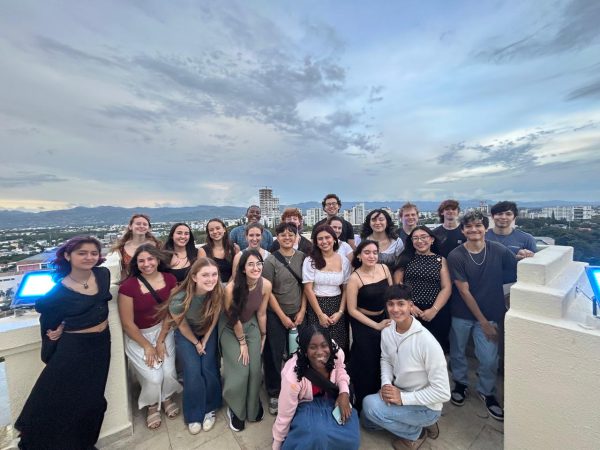
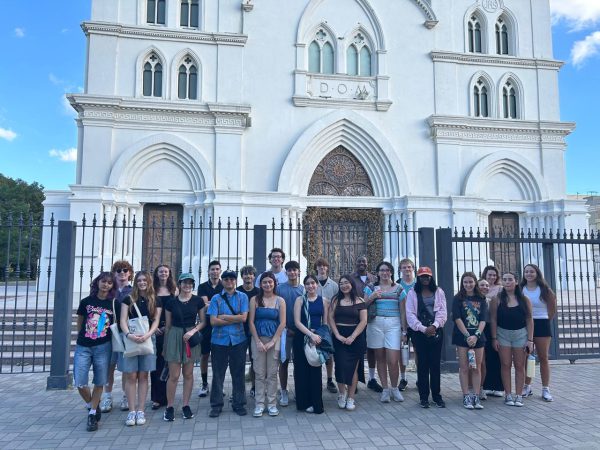
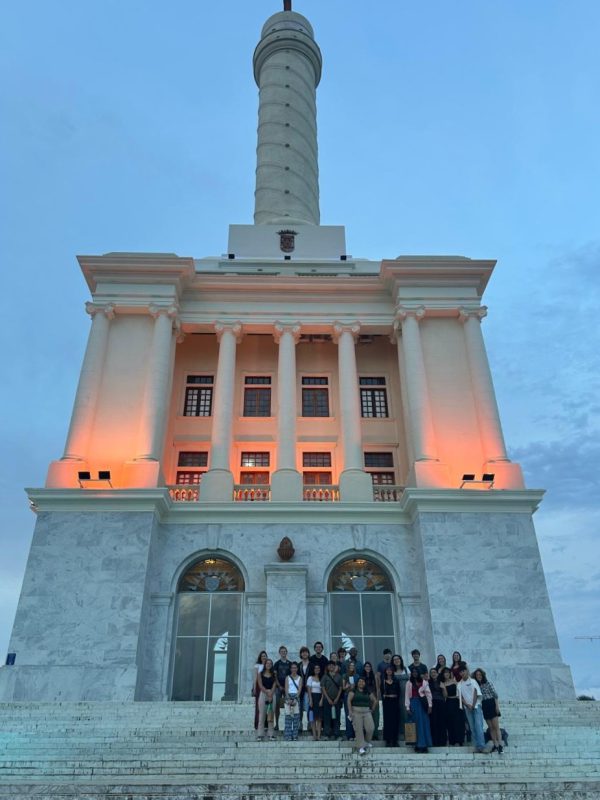
For some Kalamazoo College students, study abroad can feel out of reach—too long, too expensive or too intimidating to fit into already full academic and personal schedules. But for 23 students who spent 10 days in the Dominican Republic during winter break, a short-term, faculty-led program offered something transformative: a first step into global learning that reshaped how they see the world and themselves.
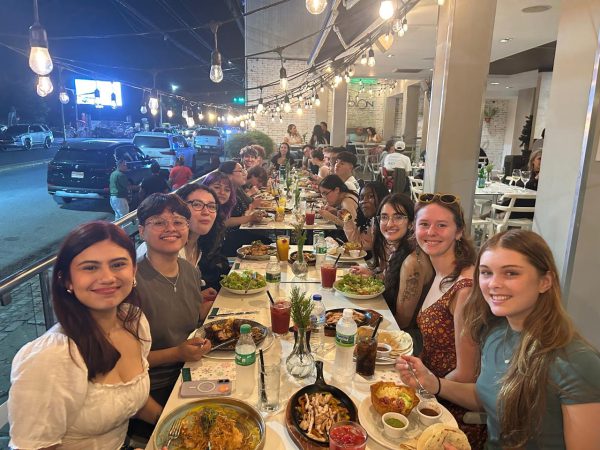
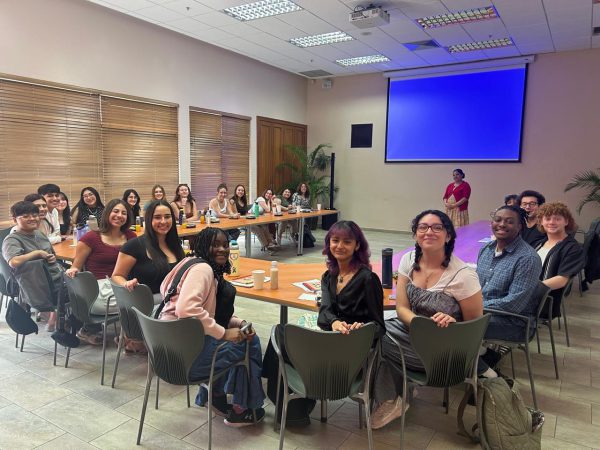
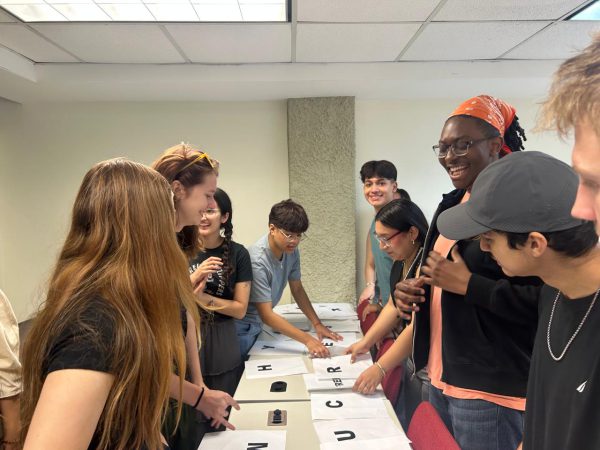
Led by Associate Professor of Spanish Ivett López Malagamba, the immersive experience brought students to Santiago de los Caballeros, a mid-sized city in the Dominican Republic, where they lived with host families, conducted daily academic work and navigated life almost entirely in Spanish.
An Accessible Path to Global Learning
The short-term program targets students who may face barriers to longer study abroad opportunities, including first-generation college students, students of color, student-athletes and those balancing multiple commitments on campus. It was first launched as a pilot program in 2019, funded through a grant from the Mellon Foundation, which supported faculty planning, along with Center for International Programs funds. Additionally this year, the Ambassador Martha L. Campbell and Consul General Arnold H. Campbell Foreign Study Endowment and the Robert J. Kopecky ’72 Endowed Study Abroad Fund helped high-need students afford the experience. The Campbell Endowment was established in 2009 to support and enhance the foreign study experience for K students. The Kopecky fund was established in 2022 to help maximize the number of students who participate in study abroad while encouraging students to explore the culture around them during their international experience.
For some participants, the Dominican Republic trip marked their first time traveling internationally or even boarding an airplane.
“For them, this was not just an academic experience; it was a personal milestone,” López Malagamba said.
Academically, the program is tied to the Spanish curriculum. Students must have completed Spanish 201, the final course in K’s language requirement sequence for Spanish. In the fall, participants enroll in a preparatory course and attend predeparture sessions focused on Dominican history, race relations, politics and the country’s deep connections to the United States and the Caribbean. And once they are in the Dominican Republic, the learning is nonstop.
“Every day is academic,” López Malagamba said. “Even when students are on a beach or in a community celebration, they are learning—about economics, migration, tourism, race, history and the environment.”
Learning Beyond the Classroom
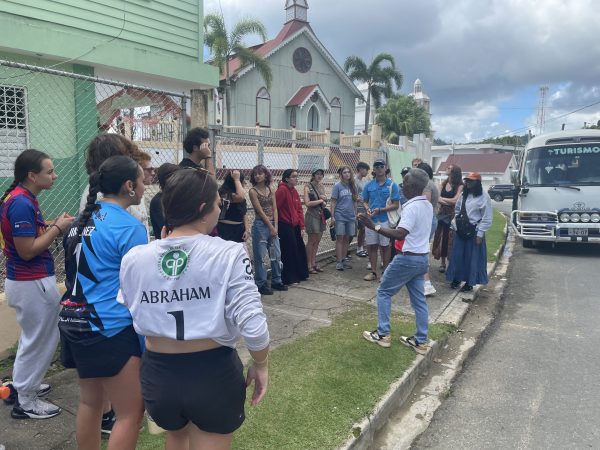
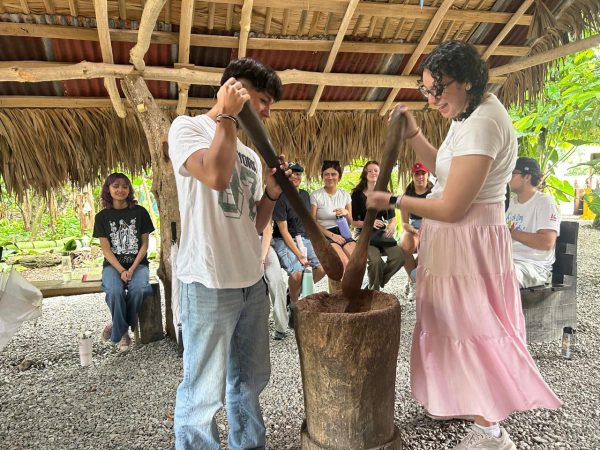
Students explored the Dominican Republic through lectures, guided visits and hands-on experiences that reinforced themes from their language coursework, including urban life, nature, the arts and professions. They learned about the country’s export economy through cocoa farming, studied the role of tourism in shaping cities, and examined the deep ties between the Dominican Republic and the United States.
In the coastal region of Samaná, students encountered a lesser-known chapter of shared history: communities founded by formerly enslaved people from the U.S. who settled there in the 19th century. A guide, himself a descendant of those settlers, shared how English once flourished in the region before being suppressed and how that legacy still shapes Dominican identity.
“These are moments where students realize that U.S. history doesn’t stop at our borders,” López Malagamba said. “It lives in other places, in other people’s stories.”
Environmental justice was another key focus. Students learned how coastal communities balance the economic need for tourism with the protection of ecosystems, national parks and marine environments that sustain local livelihoods.
Living with host families added another layer of immersion and challenge. Students had to adapt to new routines, unfamiliar foods and different cultural expectations, all while communicating in a second language.
“There’s always a moment where students feel overwhelmed,” López Malagamba said. “They miss their familiarity. They realize how hard it is to express themselves fully. But then something shifts.”
That shift often comes in small victories: asking for directions, explaining a preference at the dinner table or successfully navigating a conversation they once would have avoided.
“By the end, students realize, ‘I can do this,’” she said. “That confidence is powerful.”
‘I’m Hooked’
For Tom Clark ’27, the Dominican Republic trip became a lifeline to study abroad after he had to cancel plans for a longer program in Greece. The business major, who is dual-enrolling at Western Michigan University to pursue exercise science, realized too late that he couldn’t balance a two-term study abroad with his academic timeline.
“I went through all the predeparture stuff, was all ready to go, and then I realized I wouldn’t be able to do it,” Clark said. “But right as I dropped it, I got an email about this trip to the Dominican Republic. I saw it was over winter break, so it wouldn’t take away from credits that I would need. It was perfect.”
The trip marked Clark’s first time leaving the country, and the experience immediately challenged his assumptions about privilege and perspective.
“I thought I was familiar with other cultures,” he said. “I thought of myself as an empathetic person who could put himself in the shoes of others. And then I actually took the trip, and my understanding was much different.”
Simple differences struck him immediately. Getting off the airplane, he looked for a water fountain to fill his bottle only to realize public drinking fountains don’t exist in places without widespread access to clean water. The language immersion then proved to be both challenging and rewarding. Clark hadn’t taken a Spanish class in nearly a year, and the first few days were rough. But surrounded by Spanish speakers constantly—including his host parents, who spoke no English—he found his skills returning and improving rapidly. Those challenges, in fact, became opportunities for connection.
Among Clark’s favorite moments was a joint class session with Dominican students learning English as a second language, meeting people his age from vastly different backgrounds, yet fundamentally similar. He made a friend named Casey who runs a fashion brand with 60,000 Instagram followers and is working toward getting a green card.
The experience reframed how Clark thinks about language learning. In a classroom, he explained, students have varying levels of investment. On the trip, everyone was committed, making the learning more dynamic and applicable.
“We were talking about how another language is like learning a superpower,” he said. “I learned I could travel to many countries and be perfectly fine. I could meet people and connect better. The Dominican is a tiny island, so I’m hooked on imagining what the rest of the world is like.”
Discovering New Perspectives
For Sarah Guerrero Gorostieta ’28, a first-generation college student, the Dominican Republic trip offered something unexpected: a chance to see her own culture through new eyes while discovering how much she still had to learn.
“I have never learned so much in such a short amount of time about myself, my peers and an entirely new country,” Guerrero said. “With my Mexican heritage, I assumed because I’m Hispanic and because they’re Hispanic, there would be some similarities between us. There definitely were, but there was also so much nuance.”
Although Mexico and the Dominican Republic were both colonized by Spain, Guerrero learned how French and African influences shaped Dominican culture differently. More importantly, she heard those histories directly from Dominicans themselves.
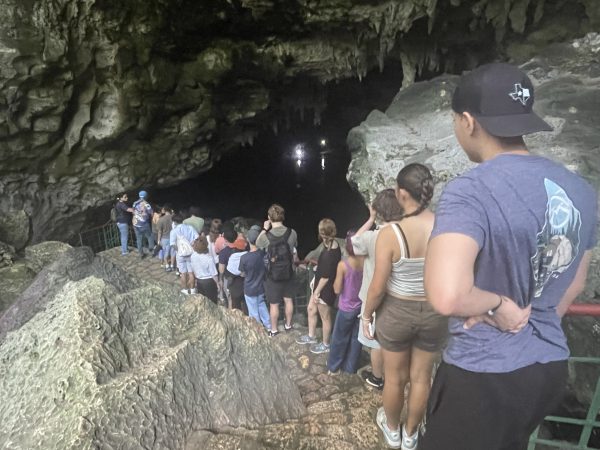
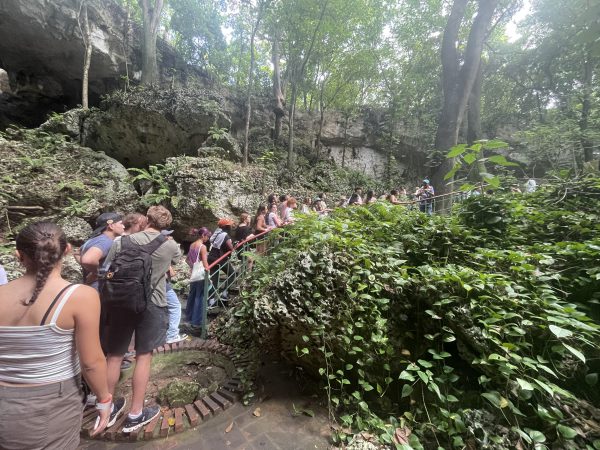
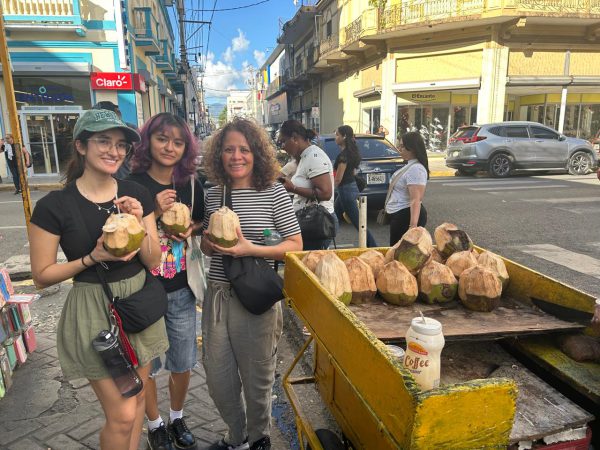
Guerrero’s experience was framed with many memorable moments. She recalls feeling grateful for trying plantains for the first time, exploring caves and seeing the ocean.
“I’d never felt so many emotions packed into one trip,” she said. “And I’m really excited to carry all of those lessons into study abroad.”
Guerrero is next hoping to study at Belfast University in Northern Ireland, where she wants to explore political tensions and the media’s role in conflict—themes she first encountered in the Dominican Republic through a guest lecture on how the media weaponizes political relationships during elections.
Opening Doors for Student-Athletes
For Riley Shults ’28, a runner on K’s cross-country team, the 10-day format meant he didn’t have to choose between his sport and international experience.
The short-term trip to the Dominican Republic didn’t change Shults’ academic trajectory, he said, but it reinforced the direction he wanted to pursue. He is declaring an anthropology-sociology major in February and is now planning to study in Oaxaca, Mexico, during the winter of his junior year through a program focused on community engagement and Indigenous cultures.
“I knew that I wanted to care about people, and I knew that I wanted to travel the world,” he said. “This program was the first real experience that I got to have of that.”
One question lingered throughout the trip: Can such a short program truly transform students in the way longer study abroad experiences do? And for Shults, the answer is unequivocal.
“One hundred percent,” he said. “I barely talked to anyone on that trip before it, and now I see them every day. Every little aspect fundamentally changed who we are because we were forced to think about someone other than ourselves. It’s not just about me anymore. It’s about the whole world.”
The change came through small moments that accumulated into profound shifts. Shults discovered he loves beans and rice. He overcame his lack of confidence in his language skills and found himself thinking in Spanish. He engaged with complex political histories he’d only read about in textbooks as his host mother shared stories each morning about the country’s history under dictator Rafael Trujillo.
“I used to think one way, and now I think this other way,” he said. “Study abroad pulls people out of their comfort zones. Once you push past that boundary your learning is only limited to what you allow yourself to find.”
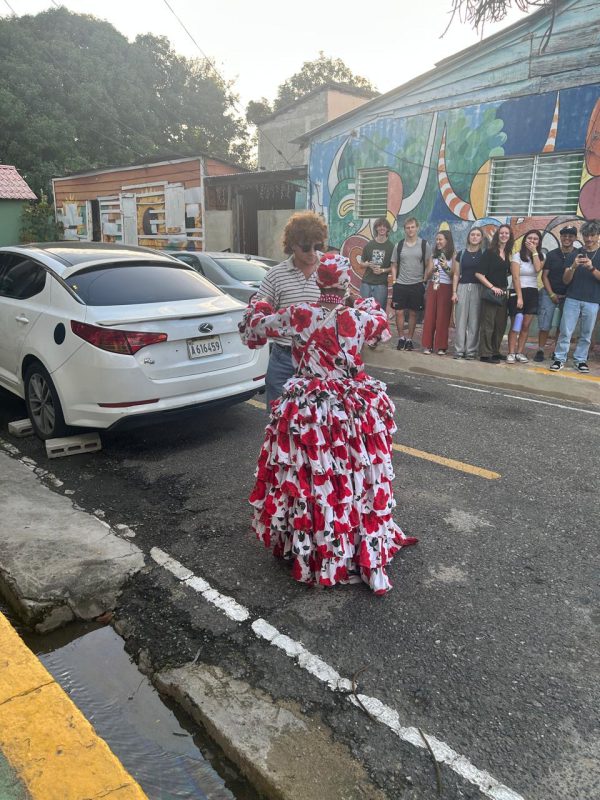
One particularly memorable moment came during a Sunday block party in a working-class neighborhood of Santiago. Community organizers welcomed the K group with music, announcements and open celebrations.
Students danced alongside children, parents and grandparents in the streets. Shults found himself at the center of that celebration, dancing with elderly women who grabbed his red hair for good luck. He moved freely without self-consciousness in a way he’d never experienced at home.
“Every single person is not caring about what other people say, they’re just moving,” he said. “It’s such a different culture than ours. Here, people don’t just dance. We’re always thinking about what other people are doing. But that’s not what they think. They’re just going to have fun.”
His experience now surfaces in unexpected moments back on campus. In a class about water systems, Shults reflected on the reality that Dominican tap water isn’t safe to drink.
“I’m sitting in class thinking, ‘I lived this,’” he said. “I lived this example where you don’t have water right on the tap.”
Distinct Opportunities Bring Transformations
Although the program lasts just 10 days, its impact extends far beyond winter break. López Malagamba noted that many students return with renewed interest in longer study abroad opportunities and greater confidence in navigating unfamiliar environments. For her, watching students undergo their transformations in just 10 days remains the most rewarding part of leading the program.
“These students come back with a different understanding of what it means to be a global citizen,” she said. “They’ve lived with families who welcomed them. They’ve navigated challenges in a second language. They’ve sat with discomfort and come out stronger.
“These programs remind students that the world is bigger than the U.S. and their immediate communities,” she said. “They learn that their actions matter, that their country has an impact elsewhere, and that shared humanity exists across borders. That’s the kind of learning that stays with you long after the trip ends.”