
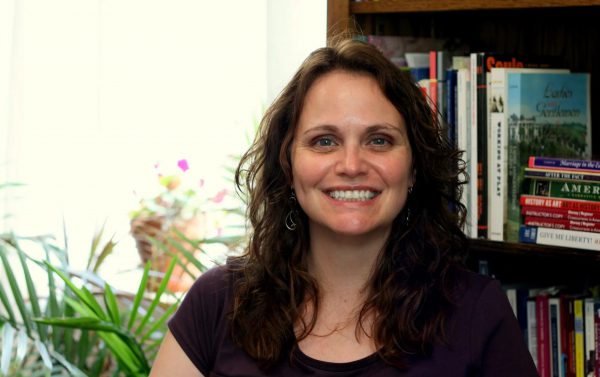
When Americans think about the Revolution, they often picture the Boston Tea Party, the Siege of Yorktown, the signing of the Declaration of Independence, and the famous men who shaped these iconic events. Charlene Boyer Lewis ’87, the Larry J. Bell ’80 Distinguished Chair in American History, reminds us that the American Revolution wasn’t just fought by generals and statesmen; it unfolded in kitchens, camps, farms, and city streets, where women’s decisions, labor, and political thought shaped the outcome of the war. For Women’s History Month, Boyer Lewis reflects on how women across racial, economic, and political lines experienced and contributed to the founding of our Republic—their influence still shaping the nation 250 years later.
Q: How should we rethink the role of women in the American Revolution?
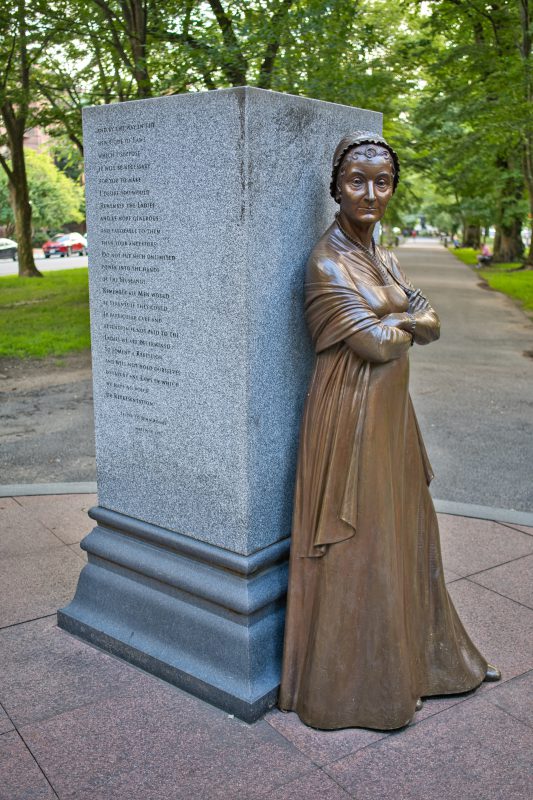
Boyer Lewis: Women at the time did not have access to formal leadership or political roles. However, the American Revolution didn’t just happen with “those guys in Philadelphia” or the men fighting on the battlefield. A revolution is essentially a civil war, so there is no real distinction between the homefront and the battlefront. Roughly a third of the colonists were Loyalists, a third Patriots, and a third what historians call disaffected—they hadn’t really chosen a side. During the war and the period leading up to it, women were often calculating and making choices about their allegiance based on what was best for their families. Yes, there were some women who were making choices based on political ideology—Mercy Otis Warren, the poet and playwright; Martha Washington; Abigail Adams, writing to John Adams to “remember the ladies.” Mrs. Benedict Arnold, whom I write about, started as a Loyalist flirt, then became a Patriot bride, and then became a very strident Loyalist when she and her husband committed treason. But most women were choosing whether to be a Patriot or a Loyalist based on which side their families were taking and what would be best for their families, their community, and their neighbors. As the British and Patriot forces moved around, women would often shift their loyalties to whichever troop had occupation at the time.
Once the Revolution started in 1775 and 1776, women had to choose sides, just like men did, and women very much understood that they were moving from being subjects in a monarchy to citizens in a republic. They understood the stakes.
Q: In what concrete ways did women participate in the Revolution, both before the fighting began and during the war itself?
Boyer Lewis: Most women spent the years leading up to the Revolution involved in the protests and boycotts against tea and British imported goods. The boycotts would not have been successful otherwise; you needed women to forego purchasing those items for their households. They were eschewing imported silk, cotton, and linen; they were gathering to share each other’s spinning wheels and looms to make homespun fabric, and they were conscious that in doing so, they were taking a stance against English oppression. Some of them said they felt nationalistic while they were doing it.
As the war started, women weren’t removed from warfare. When you live on a rural farm near a battlefield, the violence is going to come right into your home or your surrounding area. Women in these situations served multiple purposes for armies, bringing water, serving as laundresses and cooks, and taking care of wounded and sick men in their homes. Along with these really basic services to the army, they also provided sexual services to soldiers. That was, frankly, a really effective way for women to make money.
Women were also an important part of the army encampments, known as camp followers. Many had no choice but to follow their husbands, fathers, or brothers serving in the army, as they could not afford to stay at home, so they were feeding, laundering, and tending to sick men in the encampments. George Washington complained regularly that all these women, children, and literal baggage made it difficult to move an army quickly. But he also recognized their importance, and the women were provided half rations.
There are a handful of women that we know of who disguised themselves as men. A woman named Deborah Sampson was an ardent Patriot who wanted to go and fight. She cut her hair, bound her breasts, and fought in the Continental Army for a couple of years. Despite being wounded several times, it wasn’t discovered that she was a woman until she fell ill with fever and was found out by a doctor when he undressed her. He was shocked because everybody knew this soldier as Robert Shurtleff. Of course, they kicked her out immediately when they realized she was a woman. She received an honorable discharge, and 30 years later, she applied to Congress for a pension, like any other Continental Army soldier. Congress sent Paul Revere to Massachusetts to interview her, and he found her case deserving. So, she became the first woman to receive a military pension in American history.
Most women experienced the Revolution from afar. They kept the farms going, kept the newspapers in print. Women ran taverns. They ran shops. They were picking up for the men and learning all sorts of skills. Abigail Adams actually made more money for the farm than when John Adams was running it. There are many letters back and forth between wives and their husbands about logistics, like, when should I sell the corn? When do I plant? They start with lots of questions, and over time, the women become more and more confident. Instead of saying, when do I do this? They say, “Oh, I sold all the corn last month.” They now know how to take care of it.
But there was a scary side to this independence. In any war, troops often use violence to subdue a population, so women were sexually assaulted; they were physically abused. Women watched in terror while their houses were turned topsy-turvy as soldiers looked for money, weapons, clothing—anything to sell—because soldiers were allowed to come in and pilfer. Women lived with that terror every day during this war, and it’s clear many of them suffered later from trauma. This is what I mean by no separation between the homefront and the battlefront: there was no safe homefront. The battlefront was everywhere. You could walk the street and be hassled by a soldier. You could walk the street and be questioned at bayonet point as to which side you are on.
Women also smuggled things over lines using the fact that they were women and not combatants. Women were very good spies because soldiers were often hesitant to accost women and say, “What’s on your person?” So, women often tucked things under their dresses. We know of one story where two women were walking the Philadelphia line, going from British into Patriot territory, and soldiers thought they were pregnant, but under their alleged bellies were leather shoes, leather belts, and some food.
Q: How did the Revolution unfold differently for Black and Native American women?
Boyer Lewis: We tend to think of slavery as a southern phenomenon, but at the time of the Revolution, there were enslaved people in every single one of the 13 Colonies. It was the British who first offered freedom to enslaved people, and they offered it very early on. It wasn’t altruistic; they understood this was good strategy, offering freedom to those enslaved under Patriot masters. Thousands took that offer, and the number of Black Loyalists was tremendous. Whenever the British came near a Patriot farm or homestead, enslaved women fled, and they would take their children with them to look for freedom behind British lines. Many ended up in different parts of the British Empire—Canada, for instance, New Brunswick, Nova Scotia—and the British gave them farms there. Some of them ended up in England. Tragically, when the British started running out of supplies, some of these women were sold into slavery in the Caribbean, which is basically a death sentence. The Americans also eventually offered freedom and land to enslaved men who joined them, so many Black men fought valiantly for the Continental Army, in the hopes of surviving the war and owning their own land.
Other enslaved women and their families took advantage of the chaos of war to run away. Historians estimate that 25,000 to 30,000 enslaved Africans chose to run, usually north, to cities like Philadelphia or Boston, where it was easy to slip in and not be noticed.
Enslaved people were also hearing the Patriots’ language of liberty, independence, and equality, and were writing petitions, or having white allies write petitions on their behalf, petitioning legislatures in Massachusetts, Connecticut, and Rhode Island to abolish slavery, arguing that it was oppositional to what the Patriots advocated. Many Patriots understood that slavery was antithetical—Massachusetts, for instance, abolished slavery immediately. Vermont, the first new state after the Revolution, did not allow slavery. So, the voices of these enslaved women were having an impact.
There’s a marvelous poet named Phyllis Wheatley, who was owned by a Massachusetts family, and they taught her English, Greek and Latin. She gets published during the Revolution, and she writes poetry to George Washington and to some of the other Continental Army officers. She’s a very ardent Patriot, and George Washington actually writes her back, complimenting her on her genius. He even invites her to visit camp.
But Black women also experienced the most violence during the war. When soldiers came to a homestead, farm, or town house, and there was an enslaved or even a free Black servant, they were the ones most likely to be abused or dragged into helping the army. When white families were running short of food, they would feed their own family first over their enslaved people, so Black women experienced starvation more than white women did.
Just like white women, Black women and Native American women were taking stances and choosing sides. Molly Brant, an Iroquois woman, was a highly influential Loyalist among her tribe. She ended up getting a sizeable pension from the British government for her efforts during the Revolution.
Q. What did the Revolution change—or not—about women’s role in political life?
Boyer Lewis: Ultimately, these changes were very temporary. When the men returned, the women didn’t want to keep running the farm, the store, or the tavern, and they gave back that responsibility. However, they were still aware of themselves as political beings and very much engaged in the political conversations of the time. You can look at letters, and it’s clear that women gained more confidence in the household, and there’s probably a more equal sense of give and take with their husbands.
But while the Patriot revolutionaries got rid of a lot of British laws that they decided were too oppressive, too tyrannical, they never questioned the inferiority of women. They never questioned the law, which is known as coverture, that establishes how, upon marriage, a woman legally ceases to exist and is subsumed by her husband’s identity. As I mentioned earlier, Abigail Adams argues to John Adams in an incredibly famous letter, “Remember the ladies.” She says, “Remember, all men will be tyrants if they could.” She’s asking him to remove coverture in the Declaration of Independence, using the language of the Revolution. John Adams writes back to her, “As to your extraordinary code of laws, I cannot but laugh.” Coverture remains untouched after the war.
Yet one huge impact of the Revolution is the idea that, if women were political beings and had political thoughts, what role would they play in this new republic? Women will be acknowledged as citizens. They’ll be counted in the census, counted for the House of Representatives, and taxed as citizens, but they’re not going to be given any political rights.
So, a group of progressive-minded men and progressive-thinking women crafted a role in the 1780s and 1790s for women that was known as Republican Motherhood, and this is how women were meant to contribute. They were going to raise good, virtuous citizens—meaning boys—who would continue to sacrifice their private interests for the good of the Republic. Women—middle- and upper-class women—saw Republican Motherhood as a way to act politically.
One important outcome of Republican Motherhood is that it demanded that women be educated. This led to a huge surge in women’s education in the coming decades. This idea that women have equal intellect and should be educated to serve the Republic is tremendous. There’s no going back.
The young women who then go to school in the early 1800s will be the ones who lead the women’s rights movement in the 1840s—Susan B. Anthony, Elizabeth Cady Stanton, all are the beneficiaries of this notion of Republican Motherhood. Elizabeth Cady Stanton at Seneca Falls in 1848 rewrites the Declaration of Independence in terms of women’s independence, and where Thomas Jefferson referenced the tyranny of King George, Elizabeth Cady Stanton referenced the tyranny of men over women. It’s a marvelous full-circle moment. The American Revolution didn’t change women’s lives that dramatically, but by 1848 they’re going to use the language of the Declaration of Independence to call for their rights.
Q: How does expanding the story of the Revolution reshape our understanding of who made our republic possible and what it takes to sustain it?
Boyer Lewis: In 1787, Elizabeth Willing Powel, a prominent social figure and friend of the Washingtons, asked Benjamin Franklin, “Well, Doctor, what have we got, a republic or a monarchy?” And he famously replied, “A republic, if you can keep it.”
If we want to tell a story as inclusive as possible about the American Revolution, we have to center women’s experiences equally with men’s experiences. Where was this Revolution fought? It was fought everywhere, in every single city, in every town, on every farm. The women were shaping the Revolution as much as any man with a musket or as much as any founding father who signed his name to the Declaration of Independence.
Women’s participation in boycotts became just as important as Patrick Henry standing up and saying, “Give me liberty or give me death.” They were protesting the Stamp Act, the Sugar Act, and the Townshend Acts. They were writing to newspapers. They were forming organizations to collect money for the Continental Army. Women were the ones who kept the farms and shops running. Without them, there would have been nothing left to fight for—and no republic to keep.
Charlene M. Boyer Lewis is a professor of history at Kalamazoo College. She is the author of Ladies and Gentlemen on Display: Planter Society at the Virginia Springs, 1790-1860 and Elizabeth Patterson Bonaparte: An American Aristocrat in the Early Republic. Her current project is a biography of Margaret Shippen Arnold titled Traitor, Wife: Peggy Shippen Arnold and Revolutionary America, forthcoming from Norton in 2027.