
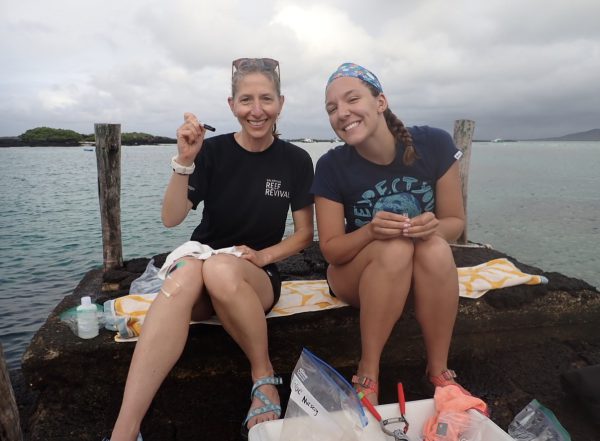
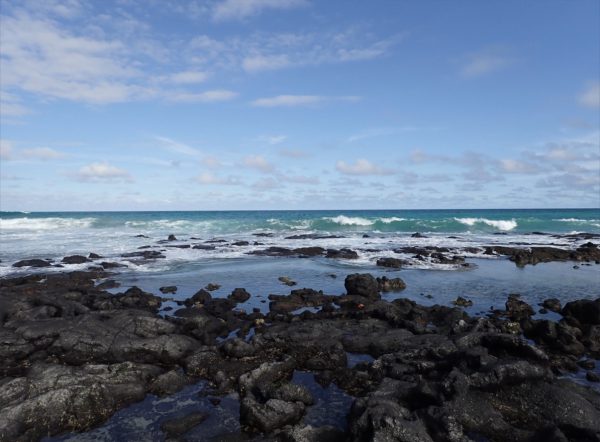
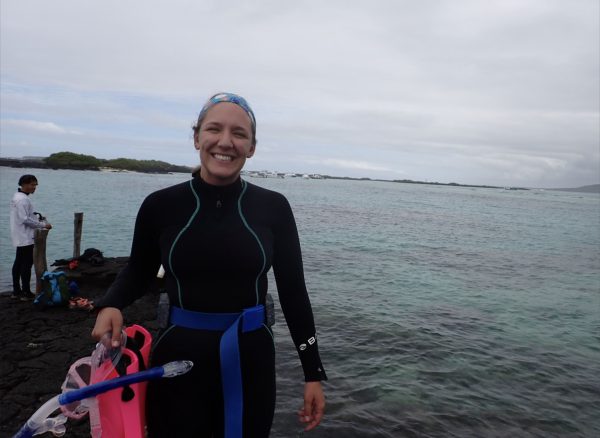
When Hailey Yoder ’26 tells people she researches coral reefs, their response is often the same: “You live in Kalamazoo, Michigan. How do you do that?”
For Yoder, a Kalamazoo College double major in biology and Spanish, the answer is both simple and extraordinary: It started with sending an email.
That email, sent during her study abroad program in Ecuador, connected her with Margarita Brandt, a biology professor at the Universidad de San Francisco de Quito, who works with Galápagos Reef Revival. What began as a conversation about potential research ideas soon evolved into an opportunity to study coral reef restoration in the Galápagos Islands.
“We just clicked and worked really well together,” Yoder said. “She invited me onto a project, and I really was just hoping that it would work out.”
Bringing Coral Reefs Back to Life
Yoder’s research starts with how climate change and ocean acidification have affected coral reefs in the Galápagos. The islands once boasted several coral reefs, but many have been wiped out by bleaching, leaving remaining structures vulnerable to complete destruction.
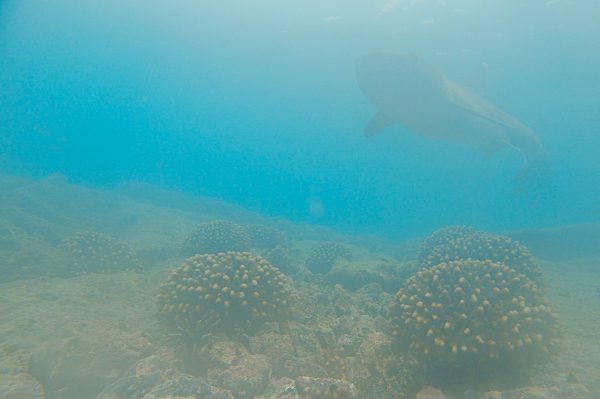
The restoration process involves collecting coral fragments from around the islands and growing them in underwater gardens, where they’re suspended from ropes and nourished by ocean currents. Once mature, researchers implant them into the seafloor in organized patterns. To assess the impact, Yoder used GoPro cameras mounted in waterproof cases and weighted with zip ties—nothing fancy, she noted—placing them at consistent locations near restored coral sites. Through snorkeling expeditions, she positioned the cameras to capture the ecosystem unfolding around eight or nine individual corals. All the research was done under permits from Galápagos National Park and CITES, the Convention on International Trade in Endangered Species.
The results have been striking. At the first site Yoder analyzed, two new fish species appeared after restoration. Afterward, four or five additional species flourished.
Community at the Center
What distinguishes this research is its deep connection to local communities. The project employs Galápagos residents, including one community member who maintains and monitors the corals year-round. Researchers also lead programs bringing women and children—particularly those without previous opportunities to explore their island’s underwater world—on snorkeling expeditions to witness the restoration firsthand.
“There are intricacies to coming into someone else’s home to perform research,” Yoder said. “I tried to focus on community and the local knowledge that people have.”
This community-centered approach culminated in a symposium in the Galápagos, where Yoder presented her research entirely in Spanish. She created a Spanish-language research poster and discussed her findings with community members invested in their island’s ecological future.
“They were all super excited about it and thought it was really cool,” she said. “It was pretty fun to be able to have that connection, too.”
Taking Marine Research to the National Stage
Yoder’s work has gained recognition beyond the islands. This January, she traveled to Portland, Oregon, to present a poster at the Society for Integrative and Comparative Biology (SICB) conference, arriving just before K’s winter term began and returning during the first week of classes.
The conference provided invaluable networking opportunities. A postdoctoral student from Boston’s National Institute of Health, who had previously worked with the same corals and researchers, offered career guidance and suggestions for future research directions. Yoder connected also with fellow undergraduates navigating similar paths.
“With these conversations, I recognized that there’s not necessarily a right or wrong path to going into some sort of research like this,” Yoder said. “That was reassuring.”
K’s Role in Marine Success
Yoder credits K’s biology and Spanish departments along with the Center for International Programs with making her research possible. In all, they provided funds through:
- The Betty R. Gómez Lance Award in Latin American Studies, which was established by Lance after her retirement from K. It has been awarded posthumously until her passing in 2016;
- Jim and Deanna Tiefenthal Endowed Foreign Study Fund: established by Jim and Deanna (members of the class of 1966) in 2016 to support student international learning opportunities through K’s study abroad program; and
- Seminary Hill Sustainability Internship: established by Doug Doetsch ’79 and his wife, Susan Manning, to fund internships focused on sustainable agriculture or architecture.
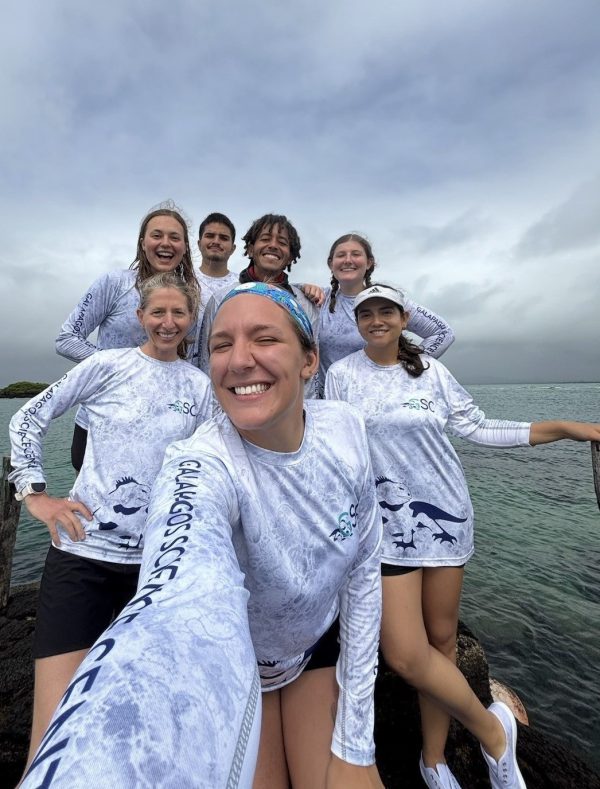
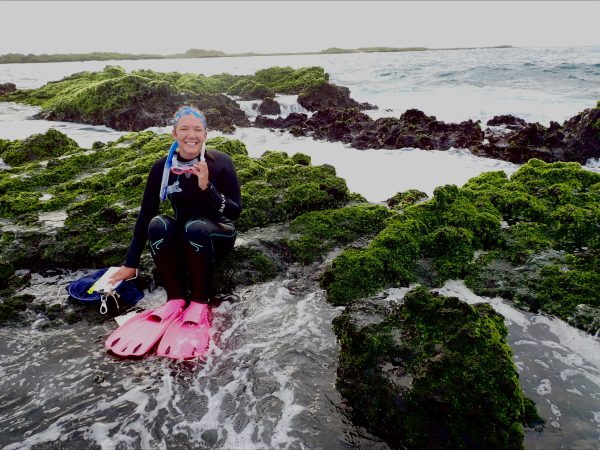
Associate Professor of Biology Santiago Salinas has been particularly supportive, helping Yoder refine her research question while providing guidance as she writes her SIP. Professor of Biology Binney Girdler has assisted with data visualization and helped Yoder narrow her focus. The department also helped fund her Portland conference trip.
“They were supportive and beyond excited for me,” Yoder said. “To have a professor you look up to say that you’re doing something they’re proud of is so cool.”
An Unexpected Love for Corals
Yoder admits she initially gravitated toward sharks within the field of general biology, not coral reef or fish. However, the research transformed her perspective.
“I gained this strong love for corals, because the way they work is so interesting, and they provide so many amazing services for the land and fish that they’re near,” she said.
Her biology major, enhanced by marine research experience, positions her well for graduate school. She has applied to a master’s program to work with a different researcher studying the same coral reefs, with hopes of returning to the Galápagos over the next year to collect data from different reefs and expand her video collection. Her ultimate goal is to publish her research.
“My knowledge is so much stronger because of the undergrad opportunity,” Yoder said. “But this master’s program will be a huge thing as well, because it will allow me to dive into the specifics and work more closely with coral scientists.”
Advice for Future Hornets
For prospective biology students, Yoder emphasized the opportunities available to those willing to pursue them. But opportunity requires initiative.
“Sending the first email was just the first step of all of the things I’ve had a chance to do, because K gives you so many opportunities,” Yoder said. “You just need to be able to take advantage of them. Those resources will be there, but you have to reach out and ask for them. The answer is going to be ‘yes,’ if they can make it work.”
Her message is clear: “Send the email and do the thing you want to do. Advocate for yourself.”
For Yoder, that single email led to underwater gardens in the Galápagos Islands, international research presentations, professional connections across the marine biology field, and a future dedicated to understanding and protecting coral reef ecosystems—all from Kalamazoo, Michigan.