Kalamazoo College 2015 Global Prize Finalist: Bavubuka Foundation

Kalamazoo College has announced the ten finalists for its 2015 Global Prize for Transformative Social Justice Leadership, a juried competition hosted by the College’s Arcus Center for Social Justice Leadership. Finalists will present during a Prize Weekend, Oct. 9-11, and one project will receive a $25,000 prize. Below is one in a series of profiles on the ten finalists.

We invite individuals who are familiar with this project to use our Community Input form to comment on its “grassrootedness” and transformative leadership practices. Input received before September 8 will be submitted to our jurors. Please see videos submitted by each finalist, as well as our rubric and other information about the Global Prize here.

Man writes at a blackboardBavubuka Foundation

A Ugandan organization working to empower youth in the east African nation is using several elements of modern, popular arts and culture to reunite younger generations with their pasts.

For ten years, the Bavubuka Foundation has been exposing youth to music and the arts as a way to transform lives and unify diverse communities. The organization does this by reconnecting young leaders to their authentic indigenous roots and developing their understanding of the value of their culture and heritage.

“Many in the younger generations have left the villages and the countryside for the cities, and in the process have become disconnected from their heritage,” says Silas Balabyekkubo, aka, ‘Babaluku,’ founder and executive director of the foundation.

“Modern culture has uprooted the old ways. But we are turning that on its head, using modern culture as a vehicle to enable youth to get back in touch with their roots and express the newfound pride they have in their indigenous communities and pasts.”

Uganda has one of the world’s largest youth populations, many of whom have minimal resources and few platforms to be heard.

The foundation, which takes its name from the Luganda word for ‘youth,’ provides spaces, education and opportunities for youth to express their indigenous heritage in several ways. Their expression takes the form of storytelling through music, photography, journalism, dance, fashion, sustainable agriculture, and entrepreneurship.

The most popular form of expression is urban hip-hop, with the country becoming a wellspring of young emcees utilizing a type of rap called “Lugha Flow,” Swahili for ‘language’, to vocalize community issues and solutions, celebrate the wisdom of their elders and encourage the preservation of native languages.

“Regardless of what it is, the message from the youth is the same: that the truth of my past comes from my land, my culture and my language,” says Babaluku. “Youth are recognizing that, even though they may not live in their indigenous communities, they take the wisdom of their elders with them. They don’t disregard where they came from just because times have changed.”

The movement has seen a merging between old and young, an acceptance between the generations as they share an appreciation for a shared cultural experience and identity, the traditional both respected and remade within new, progressive art forms, Babaluku says.

“We are seeing kids doing some really inspiring work, and in the case of music, using indigenous hip-hop as a tool to tap into untapped leadership potential. “Theirs is a new, authentic voice that is being used to advocate for solutions, while breaking tribalism and other stereotypes, through the passion of hip-hop and other arts. The message is reconnection, restoration, healing and awakening to their authentic, true selves. It’s spreading everywhere. We are galvanizing multitudes because of the appeal of the arts.”

Some Dust and Then a Pony!

Enlarged graphic shows Campus Drive behind the Hicks Student Center
Effective August 24, Campus Drive behind Hicks Center will be one-way west, allowing a gain of 20 new angle parking spaces.

A stall full of horse manure is a litmus test for optimism. One person may see only a thankless chore; but a second rejoices in the likelihood of a pony.

Well, pardon our dust,and then get ready for a metaphorical pony.

From midnight on Thursday, August 20, until midnight on Sunday, August 23, two parking lots (Crissey-Severn and Upper Fine Arts) and Campus Drive behind the Hicks Student Center will be closed for resealing and striping. we apologize for that inconvenience. Here comes the pony part.

When Campus Drive reopens (August 24), the street will be one way (west only) from the east end of the Hicks Center to Lovell Street. Drivers will no longer be able to enter Campus Drive from Lovell Street. Campus Drive will continue to be accessed from Academy Street and will remain two-way from Academy Street to the east end of the Hicks Center. The new configuration will provide space for at least 20 new parking places, six of which will be reserved for alternative fuel vehicles. And the one-way traffic flow behind Hicks Center will also increase safety for pedestrians and ease congestion.

Again, we apologize for any inconvenience the repaving and striping may cause, and we sure look forward to additional parking spaces on campus. This project takes its place among others–the library and Hicks Center renovations, the athletic fields complex, the social justice center building, the fitness and wellness center–wherein a temporary inconvenience is followed by a permanent improvement.

Kalamazoo College 2015 Global Prize Finalist: Black on Both Sides

Kalamazoo College has announced the ten finalists for its 2015 Global Prize for Transformative Social Justice Leadership, a juried competition hosted by the College’s Arcus Center for Social Justice Leadership. Finalists will present during a Prize Weekend, Oct. 9-11, and one project will receive a $25,000 prize. Below is one in a series of profiles on the ten finalists.

We invite individuals who are familiar with this project to use our Community Input form to comment on its “grassrootedness” and transformative leadership practices. Input received before September 8 will be submitted to our jurors. Please see videos submitted by each finalist, as well as our rubric and other information about the Global Prize here.

Global Prize Finalist: Black on Both SidesBlack on Both Sides

The foster care system in the United States has a darker side to the benevolent image it tries to portray to the public, according to one social justice organization trying to demolish foster care altogether.

What hides in the shadows of this child care and rearing model is a kind of unofficial pipeline to the prison industrial complex, says Charity Tolliver, founder of Black on Both Sides, a project working to build a new generation of Black organizers towards the abolition of the foster care and prison systems.

Studies have shown that 80 percent of the prison population had spent time in the foster care system when they were younger, Tolliver says.

“That is not just surprising, it’s indicative of a messed up system,” she says. “It’s a dysfunctional system for those it’s supposed to serve.”

The majority of foster care children are removed from their biological homes for neglect – which really means poverty, Tolliver says. But instead of providing additional resources to struggling families to keep children with their parents, benefits – WIC, food stamps, and other assistance measures – are being cut, while at the same time, foster families are being paid to care for these kids.

“It’s hypocritical,” Tolliver says.

These young, mostly Black youth are taken away from their mothers, who are negatively stereotyped as abusive, loud, oversexed and unruly, set into the foster care system, where they are more likely to wind-up immersed in the juvenile justice system and, eventually, the prison system at-large, she says. This model eerily resembles the slavery-era practice of slave masters removing children from their mothers, treating the mothers merely as aspects of production and their children as commodities, she adds.

“It’s got less to do with money and more to do with disposable black bodies and create places to put them, to confine them in a post-slavery, neo-liberal society,” Tolliver says. “This pipeline, starting when a person is young, ensures a policy of sequestration of disposable, black bodies from the rest of society, while the increasingly for-profit foster care and prison industrial complex is able to increase profitability with a steady stream of new inmates.”

Although this issue hits poor white and Latino families, it impacts – indeed, targets – the Black community especially hard. Take New Mexico for example. Blacks make up 1 percent of that state’s population, but represent 5 percent of the foster care cases, Tolliver says. In Arizona, where blacks comprise 3 percent of the population, they make up 10 to 12 percent of the foster care population. Finally, in Illinois, where the organization is based, blacks make up 16 percent of the population but 54 percent of children in foster care and 32 percent of Chicago’s population but 95 percent of new foster care cases in the city.

The project highlights the voices and experiences of Black youth who have experienced both the foster care system and the juvenile or adult justice system, while launching a direct action organizing campaign to address the root causes of the foster care to prison pipeline.

Blacks on Both Sides pushed for a foster care bill of rights for foster kids in Illinois, which has passed through the state’s Senate and House, as well as a restorative justice model to deal with non-violent issues in a foster home, like arguments, stealing money or running away, problems where law enforcement is routinely called. Studies show that a foster child who is arrested – even for these minor offenses – is 15 percent more likely to wind up in prison, Tolliver says. The organization is looking to move nationwide with its restorative justice efforts and push for a national bill of rights for foster kids.

“We all know that children are best kept with their parents,” she says. “All of our work is focused on righting these injustices and reuniting families, where kids are their healthiest.”


Kalamazoo College 2015 Global Prize Finalist: Association of Injured Workers & Ex-Workers of General Motors Colmotores

Kalamazoo College has announced the ten finalists for its 2015 Global Prize for Transformative Social Justice Leadership, a juried competition hosted by the College’s Arcus Center for Social Justice Leadership. Finalists will present during a Prize Weekend, Oct. 9-11, and one project will receive a $25,000 prize. Below is one in a series of profiles on the ten finalists.

We invite individuals who are familiar with this project to use our Community Input form to comment on its “grassrootedness” and transformative leadership practices. Input received before September 8 will be submitted to our jurors. Please see videos submitted by each finalist, as well as our rubric and other information about the Global Prize here.

Association of Injured Workers and Ex-Workers of General Motors Colmotores

Association of Injured Workers & Ex-Workers of General Motors Colmotores (ASOTRECOL)

For four years, a small but committed group of injured auto workers fired from the GM Colmotores assembly plant in Bogota, Colombia have been living in a tent encampment outside the U.S. embassy, drawing attention to the plight of employees there in a nation that has few worker protections. They suffer nerve damage and spinal, hand or shoulder injuries sustained in a factory with poor working conditions.

Over the years, the men in The Association of Injured Workers & Ex-Workers of General Motors Colmotores (ASOTRECOL) have gone on several hunger strikes, some sewing their mouths shut with needle and thread, to protest GM’s inhumane treatment of workers at the plant. Plant managers would fudge workers’ medical records and injury claims in order to keep insurance premiums as low as possible and increase profits, Hammer said. Some hunger strikers endured several months on just a liquid diet.

“At the core of all this is the question of the sacred right to dignified work,” said Frank Hammer, a lead organizer with the ASOTRECOL Solidarity Network. “That’s how the Association’s leader, Jorge Parra, explains their struggle.”

Colombia ranks as one of the most dangerous countries in the world for labor organizers, Hammer said, a nation where only 4 percent of the working population is a member of a trade union. In the early 1990s, the unionized population was four times that.

When a contingent of UAW and GM officials traveled to the plant in 2012, union inspectors said the safety standards at the plant were comparable to those in United States factories in the 1970s. GM promised to install modern machinery and ensure more transparency in the handling of injury claims in response to the ex-workers’ protest. But the UAW leadership never fully engaged with the protesting ex-workers, who had, as one of their demands, the right to form a union, Hammer said.

“The workers wanted their jobs back, or in lieu of that, to receive disability payments for their injuries, he said. The company declined both requests, offering limited severance payments instead.

Still, the improvements at the plant were seen as a victory to the men. GM has also stopped firing injured workers, placing them instead on other jobs they can do. Their commitment to their cause has inspired injured workers from other industrial sectors to join with them in solidarity, including workers from Colombia’s construction and oil drilling sectors, and Coca-Cola bottling operations. ASOTRECOL member Parra traveled to Detroit in 2012 to meet with UAW officials, and while he did not get the support he was looking for, rank-and-file union members and community activists showered ASOTRECOL with support, raising $10,000 for their efforts.

At the moment, about a half-dozen or so ASOTRECOL members and supporters are still living in the tents, still fully engrossed in their fight for worker rights and protections. And as corporations become more multinational, the need for cooperation between workers across borders has never been greater, Hammer said.

“That’s one of the biggest messages of the inspirational struggle of these men,” Hammer said.

“The broader objective being to build solidarity between workers employed by the same companies in different countries who experience the same mistreatment. The companies are becoming more global; we have to as well.”


Kalamazoo College 2015 Global Prize Finalist: At a Crossroads: Forest Dwellers of India

Kalamazoo College has announced the ten finalists for its 2015 Global Prize for Transformative Social Justice Leadership, a juried competition hosted by the College’s Arcus Center for Social Justice Leadership. Finalists will present during a Prize Weekend, Oct. 9-11, and one project will receive a $25,000 prize. Below is one in a series of profiles on the ten finalists.

We invite individuals who are familiar with this project to use our Community Input form to comment on its “grassrootedness” and transformative leadership practices. Input received before September 8 will be submitted to our jurors. Please see videos submitted by each finalist, as well as our rubric and other information about the Global Prize here.

Forest Dwellers of India
At a Crossroads: Forest Dwellers of India — one of ten finalists in the 2015 Kalamazoo College Global Prize for Transformative Social Justice Leadership.

At a Crossroads: Forest Dwellers of India

Western culture – obsessed with perpetual development, ever-increasing profits and uninterrupted growth – could learn a lot from the forest-dwelling native tribes on the Indian subcontinent, many of whom are unknown even in their own country.

Steeped in this economic paradigm, many tribes have become disconnected from the earth they consider their mother, losing the sensation of soil on their hands, the taste of fresh water, the ability to sense the wind, and what weather it might bring.

“These (indigenous) people wouldn’t even use a hoe on the earth, because they thought they were hurting their mother. They would simply mix their seeds, spread them and see what grew,” said Arunima Sharma, an organizer affiliated with Ekta Parishad, a nonviolent people’s movement that works to build community, self-reliance and power to India’s poorest people.

These indigenous peoples’ way of life is being seriously threatened, with government agencies in India seeking to remove them from the land they’ve taken care of for countless generations. The push to ‘Westernize’ these people – bringing them into the modern economic fold, teaching them different languages, exposing them to the educational system – has meant their way of life is slipping away.

Case in point, Sharma says, is the loss of the knowledge of several plant medicines, because the tribes are losing their languages and becoming smaller. The “At a Crossroads: Forest Dwellers of India” project empowers the dream of tribal communities to grow back forests, converting wastelands into healthy ecosystems, thus returning sustenance, agroforestry-based livelihood, and rootedness to community.

Some tribes, who have taken to living in forests redefined as ‘protected’ by the Indian government, have had their crops destroyed by government officials, Sharma says.

“These people have been called ‘backward’ by the government,” she says. “But in our view, it’s the modern society and its economic models that are unsustainable. Perhaps it’s ironic, but in order to go forward, we must go backward, to sustainable models of development.

In advocating for the autonomy native peoples, Ekta Parishad is revitalizing the relationship of cultural indigeneity and biodiversity by celebrating tribal traditions, supports indigenous education provided by elders to youth, retaining memory, history and culture and deconstructing hierarchy and re-defining progress.

There is a deep, respectful, symbiotic relationship between the native, forest-dwelling people of India and the land they call home. They use all their senses when interacting with their natural world, Sharma says.

“We are creating an opportunity for tribal communities to share their stories with the world, giving visibility to those lost and forgotten,” she says. “We need to question what out notion of progress is, and these native people can teach us a lot. We have a collective case of environmental amnesia, and are in such denial we forgot where we came from. These people may have no idea what life in the modern world is like, and are considered the poorest of the poor, but in many ways they are the ones who show us how to move forward, with love, respect and honor for the home we all share – the Earth.”


Kalamazoo College Announces 10 Finalists for 2015 Global Prize for Transformative Social Justice Leadership

Advertisement for Global Prize for Transformative Social Justice LeadershipKalamazoo College is pleased to announce the ten finalists for its 2015 Global Prize for Transformative Social Justice Leadership, a juried competition hosted by the Arcus Center for Social Justice Leadership (ACSJL), in which one project will receive a $25,000 prize.

The 24-member Global Prize jury that selected the finalists included Kalamazoo College faculty, staff, and students, as well as social justice advocates from the Kalamazoo region. All have done work on relevant social justice issues represented in the applicant pool.

Kalamazoo College received 87 entries—in the form of eight- to ten-minute videos—from 22 nations and 18 states within the United States.

Finalists’ projects collectively address economic justice, cultural and environmental preservation, immigration, mass incarceration, reproductive justice, racial justice, gendered violence, trans and queer liberation, workers’ rights, and issues specifically impacting people with mental illness, youth, indigenous communities and children in the foster care system. The scope of each project varies, some focusing on local communities, others looking at national or transnational issues.

Here are the ten projects, listed in alphabetical order with their location.

  • At Crossroads: Forest Dwellers of India. Madhya Pradesh, India.
  • Bavubuka: Transformative Voices of Justice. Kampala, Uganda.
  • Black on Both Sides. Chicago, Ill.
  • Familia: Trans Queer Liberation Movement. Los Angeles, Calif.
  • Justice for the Injured Colombian General Motors Workers. Bogota, Colombia.
  • Mujeres, Lucha y Derechos Para Todas A.C. Región Norte del Estado de México, México.
  • Our Community Is Our Campaign. Madison, Wisc.
  • Radical Mental Health: Paths for Individual & Collective Liberation. New York City.
  • Trans Women of Color Collective: Shifting the Narrative. Washington, D.C.
  • Uno por Uno: Puente Human Rights Movement. Phoenix, Ariz.

“We believe these ten projects provide outstanding examples of transformative thinking and practice on both personal and systemic levels,” said ACSJL Executive Director Mia Henry. “The Global Prize weekend promises to be both inspirational to our community and pivotal for finalists. Leaders from all ten projects will have opportunities to learn from one another, as well as receive capacity-building support.”

All finalists will be awarded $1,000 and brought to K’s campus Oct. 9-11 for Prize Weekend. During the weekend, finalists will present their work to an audience consisting of a jury of global activists, members of the K campus, and the public. They will also engage with each other through a Global Leadership Exchange.

The recipient of a $25,000 Global Prize will be announced by Kalamazoo College President Eileen B. Wilson-Oyelaran during the weekend. A full schedule and the list of jurors will be announced later this summer.

Kalamazoo College’s inaugural Global Prize for Social Justice Leadership, now a biennial event, was held in 2013. Jurors for that competition chose to split the prize among three projects.

The Arcus Center for Social Justice Leadership was launched in 2009 with support from the Arcus Foundation (www.arcusfoundation.org), including a $23 million endowment grant in January 2012. Supporting Kalamazoo College’s mission to prepare its graduates to better understand, live successfully within, and provide enlightened leadership to a richly diverse and increasingly complex world, the ACSJL will develop new leaders and sustain existing leaders in the field of human rights and social justice.

Kalamazoo College (www.kzoo.edu), founded in Kalamazoo, Mich., in 1833, is a nationally recognized liberal arts college and the creator of the K-Plan that emphasizes rigorous scholarship, experiential learning, leadership development, and international and intercultural engagement. Kalamazoo College does more in four years so students can do more in a lifetime.

Kalamazoo College Receives 87 Entries from 22 Countries and 18 States for 2015 Global Prize for Transformative Social Justice Leadership

Global Prize for Transformative Social Justice Leadership 2015 advertisementKalamazoo College has received 87 entries from 22 countries to its 2015 Global Prize for Transformative Social Justice Leadership. Entry deadline for the juried competition was April 17. Ten finalists will be announced in early July and vie for a $25,000 prize during a Global Social Justice Leadership Exchange, Oct. 9-11, on the K campus in Kalamazoo, Michigan.

Entries came from Africa, Asia, the Middle East, Central America, North America, and South America. Entries from the United States came from 27 cities in 18 states and the District of Columbia. Eleven entries came from Michigan, including four from the Kalamazoo area.

“We are thrilled by the number and geographic scope of the entries we received,” said Mia Henry, executive director of K’s Arcus Center for Social Justice Leadership (ACSJL), which is hosting the competition. “We are impressed and inspired by the breadth and depth of the issues the applicants are addressing,” she added.

The 87 entries address 12 distinct themes: art and justice, economic justice, educational equity, environmental justice, food justice, gender and sexualities, health equity, human rights, immigration, mass incarceration, politics and justice, and race and racism.

Jurors, consisting of Kalamazoo College faculty, students, administrators, and community members have been hard at work to determine the ten finalists. Each entry—in the form of an eight- to 10-minute video—has been reviewed by three jurors.

Each finalist will be awarded $1,000 and brought to the K campus Oct. 9-11 where they will present their video and make a case for their projects to an audience consisting of a second jury, other finalists, Kalamazoo College campus members, invited guests, and the general public.
Jurors will select one project to receive the $25,000 Global Prize at the end of the weekend gathering.

“The competition was open to anyone in the world doing grassroots, transformative social justice work that challenges structural inequality and that centers the voices of those most impacted,” said ACSJL academic director Lisa Brock, Ph.D.

“The prize weekend will feature a leadership exchange that includes workshops and think-tank discussions among the finalists, an online publication, and video documentation that finalists can share long after prize weekend is over,” Brock said.

More information about the Kalamazoo College Global Prize for Transformative Social Justice Leadership is available at www.kzoo.edu/SocialJusticeLeadershipPrize.

Kalamazoo College held its inaugural Global Prize in Social Justice Leadership in May 2013.
Instead of awarding a single $25,000 prize, as had been planned, the jurors were split and ultimately decided to award three Global Prizes for $10,000 each.

The Arcus Center for Social Justice Leadership was launched in 2009 with support from the Arcus Foundation (www.arcusfoundation.org), including a $23 million endowment grant in January 2012. Supporting Kalamazoo College’s mission to prepare its graduates to better understand, live successfully within, and provide enlightened leadership to a richly diverse and increasingly complex world, the ACSJL will develop new leaders and sustain existing leaders in the field of human rights and social justice.

Kalamazoo College (www.kzoo.edu), founded in Kalamazoo, Mich., in 1833, is a nationally recognized liberal arts college and the creator of the K-Plan that emphasizes rigorous scholarship, experiential learning, leadership development, and international and intercultural engagement. Kalamazoo College does more in four years, so students can do more in a lifetime.

Kalamazoo College President Announces Retirement

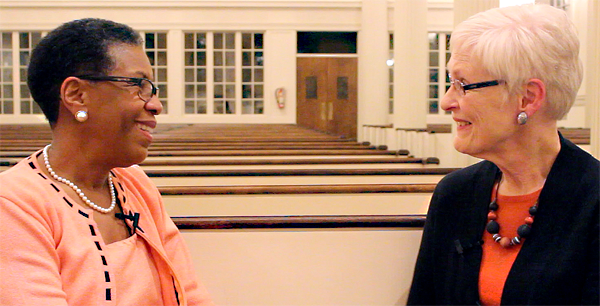
Eileen B. Wilson-Oyelaran and Charlotte HallPresident Eileen B. Wilson-Oyelaran today announced her retirement from Kalamazoo College, effective June 30, 2016. She made the announcement at the College’s spring term all-campus gathering, a meeting of faculty and staff.

President Wilson-Oyelaran was unanimously elected the 17th president of Kalamazoo College by the board of trustees on December 11, 2004. She began her duties in July of 2005. Prior to the presidency of K she served as vice president and dean of the college of Salem Academy and College in Winston-Salem, North Carolina.

A native of Los Angeles, President Wilson-Oyelaran earned her undergraduate degree (sociology) from Pomona College, a liberal arts school in Claremont, California. She studied abroad in England as an undergraduate, and used a postgraduate fellowship to study in Africa (Ghana, Nigeria, and Tanzania) for 16 months.
Eileen B. Wilson-OyelaranShe returned to the U.S. to earn a master’s degree and Ph.D. in child development and early childhood education (Claremont Graduate University) and then taught in the departments of education and psychology at the University of Ife in Nigeria for 14 years. She married Olasope (Sope) Oyelaran in 1980, and they have four children—Doyin, Oyinda, Salewa, and Yinka.

The family moved to the United States in 1988. President Wilson-Oyelaran taught or served in administrative leadership positions at North Carolina Wesleyan College and Winston-Salem State University prior to joining the faculty of Salem College.

At K she led the development of a 10-year strategic plan for the college that, among other priorities, focused on the re-imagination and integration of the elements of K’s internationally renowned curriculum, the K-Plan. “We’re helping students integrate and reflect on the building blocks they use to construct their own unique K-Plans,” said President Wilson-Oyelaran: classroom explorations in the liberal arts, study abroad, career internships and networking opportunities, civic engagement, social justice leadership, and the capstone experience that is the senior individualized project. “Those elements, alone and in concert, enhance the four years that students spend at Kalamazoo College and will enhance students’ lives for years to come,” added President Wilson-Oyelaran.

Other curricular improvements during her tenure include revised graduation requirements, implementation of the Shared Passages Seminar Series (which helps students reflect upon and integrate their academic and experiential opportunities), three new academic majors (business, women and gender studies, and critical ethnic studies), two new intercollegiate sports (men’s and women’s lacrosse), the Arcus Center for Social Justice Leadership, and new career and professional development programs such as the Guilds of Kalamazoo College.

President Wilson-Oyelaran helped envision and implement another key focus of the College’s strategic plan: building a campus community whose diversity reflects the world where K students will live and work. She acknowledged that much work remains to be done in order to create a learning environment that is equitable and inclusive for each member of K’s diverse learning community–the most diverse in its history. In this the 10th year of her tenure, 26 percent of K students identify as U.S. students of color. International students (degree-seeking and visiting) are nearly 10 percent of the student body. Fifteen percent of K students are the first in their families to attend college; and one in four comes from a family of modest income.

President Wilson-Oyelaran has reinvigorated campus spaces that students and employees use to solidify the sense of community that characterizes Kalamazoo College. Not since Presidents Hoben and Hicks has the physical campus made such extraordinary gains in beauty and utility. New spaces that have been renovated or erected during President Wilson-Oyelaran’s tenure include the Hicks Center, the athletic fields and field house, and the extraordinary work of architecture that houses the social justice center. In addition to these spaces, construction of a new fitness and wellness center will begin at the end of summer, and preliminary design of a new natatorium is complete.

Also, per the strategic plan, enrollment has grown to nearly 1,500 students (the 2017 goal specified by the plan), and the College has implemented an ambitious alumni engagement plan. President Wilson-Oyelaran also has led the most successful fund-raising campaign in the College’s history. That effort, called the Campaign for Kalamazoo College, is in its final stages, having raised $123 million of its $125 million goal.
Charlotte HallChair of the Board of Trustees Charlotte Hall ’66 said that the search for a new president would begin immediately. She noted that the search committee would include trustees, alumni, students, faculty, and staff. The 18th president of Kalamazoo College is expected to assume those duties on July 1, 2016.

That new president will have big shoes to fill. “Eileen, we are so grateful for all the ways you’ve helped prepare K for its future,” said Hall. “I know I speak for the entire K community, the Kalamazoo Community, and all the people you have touched throughout your time in higher education when I say we hope the best for you and Sope.”

President Wilson-Oyelaran cited the “singular honor” of serving at Kalamazoo College and shared her belief that, K, “the very best is yet to come.”

Her legacy here is truly a blessing for our entire community. More than a decade ago, when she was considering the decision to move from Salem Academy and College to Kalamazoo College, Eileen Wilson-Oyelaran was seeking some sort of sign to tip the scale. She found it when she learned that the great abolitionist and women’s rights activist Sojourner Truth had once met with kindred spirit Lucinda Hinsdale Stone (head of the female department at K, which was one of the first colleges in the country to provide higher education for women). “Ever since I was a child,” President Wilson-Oyelaran said in 2004, “Sojourner Truth has been an icon for me.”

Now, in turn, Kalamazoo College President Eileen B. Wilson-Oyelaran can be an icon for us.

K Goes Test Optional

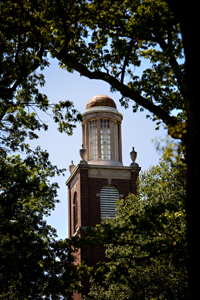
Stetson Chapel towerAfter the current 2014-15 admission cycle, Kalamazoo College will no longer require ACT or SAT standardized test scores to be part of a prospective student’s application. The change will affect students applying for enrollment in fall 2016.

The change makes K part of a growing trend in higher education called “test optional” admission. More than 800 colleges and universities in the country admit students without regard to test scores, including a substantial number of highly-ranked national liberal arts colleges. Kalamazoo College would be the first elite liberal arts college in Michigan to join the movement.

“Admission to K always has been — and will continue to be — very selective,” says Dean of Admission and Financial Aid Eric Staab. “Admission is determined by various factors that express a student’s qualities and abilities and likelihood to thrive at K,” he added.

According to Staab, these factors include high school grade point average, academic rigor of the high school curriculum, the application essay, participation in co-curricular activities, and letters of recommendation.

“Students may continue to submit test scores as additional information,” said Staab, “but for students applying to enroll at K in 2016, test scores will no longer impact the admission decision.”

Studies show that standardized test scores have little broad predictive value for undergraduate success. A two-year study by Kalamazoo College supports that finding. The study, completed by faculty and staff members serving on K’s Admission and Financial Aid Committee (AFAC), looked at data from the four classes that matriculated to K from 2009 through 2012 for correlations between academic performance at K and the admission factors, including standardized test scores.

According to Staab, high school GPA was the best and most consistent predictor of academic performance at K across race, ethnicity, and socioeconomic categories. Scores on standardized tests tend to correlate with family income and may say more about an applicant’s economic advantages — or disadvantages — than about academic potential.

“Given that studies have found a correlation between income and test scores, it seems unfair to use test scores in the admission process,” Staab said.

Staab said he and others at the College expect the test-optional change to have no effect on the quality of students who will constitute future incoming classes. The College will conduct follow-up research to measure the performance of the new test-optional approach, as well as its possible effects on first-year GPA, retention and graduation rate, areas of study, and “first destination” data (a.k.a. employment, graduate school, or other) after graduation.

Kalamazoo College Associate Professor of Biology Ann Fraser, who served as the AFAC study’s principal investigator, said “K’s research suggests that test scores were telling us very little regarding a student’s potential for success at K, and that high school GPA and curriculum rigor were predicting better and perhaps more fairly. We believe the change will attract students who may not do well on standardized tests but who tend to think outside the box. And that prospect can be very exciting for the College.”

Her colleagues on the Kalamazoo College faculty agreed. The test optional change was approved by a large majority of the College’s faculty in November 2014. K joins the growing ranks of test-optional colleges, including Bates, Beloit, Bowdoin, Denison, Earlham, Middlebury, and others. A list of test-optional colleges and links to studies and other information on the test-optional topic may be found at the National Center for Fair and Open Testing website.


Spring Break Update and Message From Kalamazoo College President Eileen Wilson-Oyelaran

Kalamazoo College President Eileen Wilson-Oyelaran

Spring Break 2015 at Kalamazoo College begins Wed. March 18 at 12 noon. The following message was sent to all K students, faculty, and staff on Monday March 16…

Dear Members of the Campus Community:

As some of you prepare for Spring Break I wanted to provide an update to recent campus events and concerns.

The investigation into the identity of the persons who posted hate speech and a specific threat in the StuComm document continues. We are hopeful that the Kalamazoo Department of Public Safety and the FBI can determine the perpetrator(s), and we are mindful that sufficient evidence to pinpoint with certainty the individual or individuals responsible may not be discoverable.

Throughout the week I have had an opportunity to talk with many of you regarding your thoughts on how effectively we have handled the most recent threats.  Your feedback has been extremely helpful, and the campus crisis management team will make changes in light of your comments and suggestions.

Many of you have also offered suggestions regarding the various ways K might move forward in light of the multifaceted reality of students who feel marginalized at K.  This will be difficult work and everyone on campus must play a part.

Very early in spring term I will outline the process—a process co-developed with a small group of students, faculty, and staff—that we will use to address the marginalization that some of our students experience. That process will allow us to get to work quickly and to enlist the minds and hearts and actions of everyone at the College in productive and creative ways. The work will be demanding, and some of the changes will be structural and fundamental. The work will yield actions, some of which we hope to implement very quickly.

I thank you and hope that each of you find some time for rest and reflection during the Spring Break. Several of you requested possible resources to consult.  I can think of none better than “In Their Own Words” (a report in the voices of K students from the K student focus groups of April and May 2013) and an article referenced in that report: “Talking About Race, Learning About Racism: The Application of Racial Identity Development Theory in the Classroom,” by Beverly Daniel Tatum.

At K, we share many things in common, and we differ from one another. Engaging fully with those truths, with compassion and empathy, will get us where we need to be as a larger community.

Eileen Wilson-Oyelaran