
Why Study Japanese at K?
Studying Japanese at K is an enriching experience thanks to immersive study abroad opportunities, small class sizes and engaging courses.
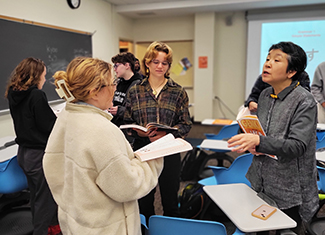
Housed within the East Asian Studies Department, the Japanese program teaches you about Japan’s rich history, culture and language. By the time you graduate, you will have been exposed to historical and modern Japanese literature and culture and understand the social and political influences that shaped them.
You will learn about Japan through language classes—from beginner to advanced—and cultural and linguistic courses taught in English, such as Post-War Japanese Literature in Translation, Japanese Language in Society, and Manga/Anime and Gender in Modern Japan.
For complete immersion into Japanese language and culture, you can take advantage of K’s stellar study abroad programs with opportunities to live, for one to three terms, in Hikone, Nagasaki, Kyoto or Tokyo, Japan.
The robust education required for a minor in Japanese prepares students for careers in international relations, education and business. In fact, many of our alumni teach English in Japan or work for Japanese companies.
Note: Students can only Minor in Japanese; if they choose to continue their studies, they can major in East Asian Studies. However, due to the significant overlap in their programs, a student cannot major in East Asian Studies and minor in Japanese or Chinese.
What can you do with a Japanese minor?
Below are some of the careers, employers, and graduate schools of our Japanese alumni.
Careers
- English Teacher
- Digital Marketing Specialist
- Software Engineer
Employers
- Japan Exchange and Teaching (JET) Programme
- United Nations
- Winrock International
Graduate Schools
- University of Michigan
- American University
- University of Chicago
Program Spotlights
Personalized Japanese Study Abroad Programs
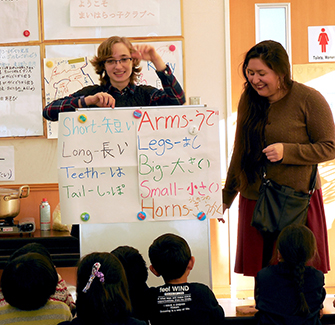
As a Japanese language student, you may choose from any of the College’s 50+ study abroad programs, including five distinct options within Japan. Each program is tailored so that no matter your study abroad goals, there is an option suited for you: Dive deep into Japanese culture in Nagasaki, increase your fluency at Kyoto’s intensive language program, participate in an Integrative Cultural Project and research alongside faculty in Hikone, or stay with a host family in Tokyo, Japan’s capital.
Take a Deep Dive into Japanese Studies at the Nagai Kafu Lecture
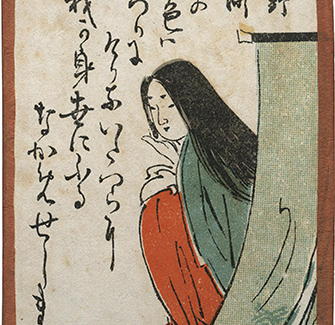
Named after the esteemed Japanese author who briefly attended Kalamazoo College in the early nineteen hundreds, the Nagai Kafu Lecture is an annual celebration of Japanese studies with guest speakers coming to campus to share their scholarship. The lecture provides you the opportunity to learn about aspects of Japanese culture, history, and writing from the field’s leading scholars. In 2022 Dr. Christina Laffin from the University of British Columbia spoke about Japanese women’s poetry in the tenth and twelfth centuries.
Meet the Current Departmental Student Advisor

McKenna Acevedo
(she/they)
Major: East Asian Studies
Minors: Psychology and Studio Art
Study Abroad: Nagasaki, Japan
Best Adjective to Describe You: Lively
What is the best thing about being part of this department?
The close knit community allows for stronger connections between students and professors.
What drew you to the department?
Being an East Asian Studies major, it was easy for me to concentrate on Japanese due to the language requirement. But, as I began to take more classes, the more connections I made and admiration I had grew for the department. I have made some of the closest friends by being in the Japanese department, and I wouldn’t change a thing.
How have you taken advantage of the flexiable curriculum or experienced breadth in your education?
From the beginning of freshman year, I have been so focused on my major requirements that I have only now begun to take advantage of this open curriculum. I took a Taiko class, Japanese drums, and while I do focus on Japan for my major- I do not have much of an interest in music itself. I am grateful that it was offered because I wouldn’t experienced it otherwise.
What is your favorite thing about K?
My favorite thing about K is the community. I think because of the rather smaller sized campus, we are able to grow connections better with each other. The variety of campus clubs we have compared to other bigger schools is unmatched; we are able to connect in a common area faster and often find those in the same major or minors. The professors are easy to communicate with, and the staff within the Student Development Center, Dining Hall, and other areas are always so helpful I never feel afraid to reach out.
What is your Senior Integrated Project (SIP)?
My SIP is Experiences of English as a Foreign Language Teacher in Japan. I will interview English Teachers, and find the common ground of what brought them to Japan, and if they participated in a program known as the Japan Exchange and Teaching Programme, otherwise known as the JET Program. I will see if there is any differences between those that participated in the program, and those that have not.
What are your career aspirations/next steps after K?
I aspire to become a Teacher of the English Language in Japan. I hope to apply to the JET Program to locate schools in Japan in need of these teachers.