LandSea Pre-Orientation Program Earns National Recognition

When first-year students arrive at Kalamazoo College, many carry with them the same questions: Will I fit in? Will I find my people? Can I handle what college throws at me? For those who begin their college experience with K’s LandSea outdoor pre-orientation program, national data suggest the answers are increasingly “yes.”

 According to the 2025 Outdoor Orientation Benchmarking Survey (TOOBS), LandSea continues to stand out among peer institutions nationwide for helping students build communication skills, perspective-taking and problem-solving. The survey ranked K’s program first nationally in several leader-trust metrics and in resilience, which measures students’ increased confidence in handling difficult situations after participating. Research shows these qualities help students persist academically and socially throughout their education.

For LandSea and Outdoor Programs Director Jory Horner, the results are affirming.

“It’s gratifying,” Horner said. “We put a lot of time and energy into this program, especially into leader training, and it’s nice to see that investment showing up in meaningful ways for both participants and leaders.”

Not Just for ‘Outdoor People’

Held each year before first-year orientation, the optional LandSea pre-orientation program includes hiking, camping, paddling, rock climbing and nights under the stars. But Horner dispels the idea that the program is only for seasoned outdoor enthusiasts.

“Most of the students who come on LandSea aren’t outdoorsy people at all,” he said. “We have students who have never slept outside before.”

For some, the experience can feel intimidating at first. Yet that discomfort often becomes one of the program’s most powerful teaching tools.

“One of the things TOOBS measures is a student’s ability to face challenges after the trip,” Horner said. “That’s something we’ve scored highly on for many years.”

The numbers reflect what students themselves describe when they return to campus.

“We hear students say things like, ‘I just got back from LandSea, and I did more than I thought I could,’” Horner said. “They’ll say, ‘There’s no test that’s going to scare me now.’ That mindset carries over into academics and everything else.”

Participants live and travel in small groups, typically of eight to 10 students, working together for 18 days in the Adirondack Mountains. There’s also a shorter six-day option at Camp Merrie Woode in Kalamazoo for students who want more creature comforts. In both experiences, students cook meals together, navigate trails, problem-solve and manage daily challenges as a unit alongside people they have just met.

“You’re learning how to live closely with a small group, how to communicate and how to handle differences,” Horner said. “These are the same skills students need when they’re back on campus.”

Measuring What Matters—After the Dust Settles

TOOBS is sent to students at about 25 participating colleges each year, around six weeks into the fall term—after classes have begun, friendships have formed, and the realities of college life have set in. K has participated since about 2012, placing LandSea within an ongoing national conversation about how experiential education supports student transition.

The survey uses a “proxy pretest” approach, asking students to think back on how they perceived their skills, confidence, and perspectives before LandSea and then assess how those changed afterward. The method, developed and presented through research connected to the University of New Hampshire and scholar Brent J. Bell, aims to measure growth rather than surface-level enthusiasm.

“That timing is really important,” Horner said. “If you ask students about a program like this right when they finish it, they’re riding the high of the experience. TOOBS lets that afterglow wear off and asks them to reflect once they’ve had time to compare LandSea to everything else they’re experiencing at college.”

‘Finding My People’

Research connected to TOOBS consistently shows that students’ biggest fear entering college is not academic rigor, but whether they will fit in and find a sense of belonging. By the time LandSea students arrive on campus for orientation, many already have a core group they recognize, trust and feel comfortable with during the first challenging weeks.

The outcomes measured by TOOBS align closely with internal data collected by K’s Office of Institutional Research. An analysis comparing LandSea participants and non-participants between 2012 and 2022 revealed consistently higher outcomes for those who completed the program. LandSea participants showed higher retention rates, greater persistence to graduation, and higher cumulative GPAs than their peers.
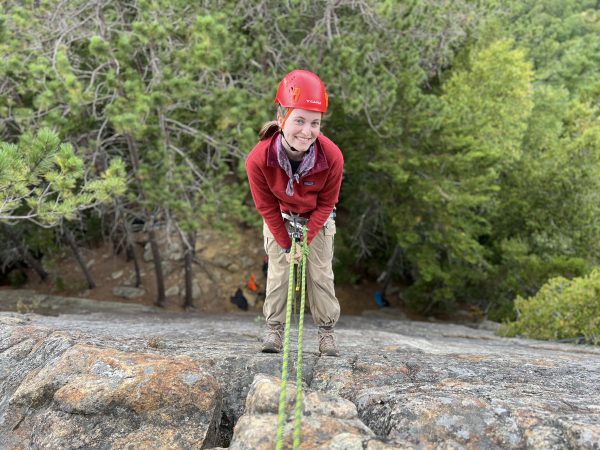
LandSea Pre-Orientation rock climbing
Tess Peters ’29 was among the LandSea Adirondacks participants last fall.
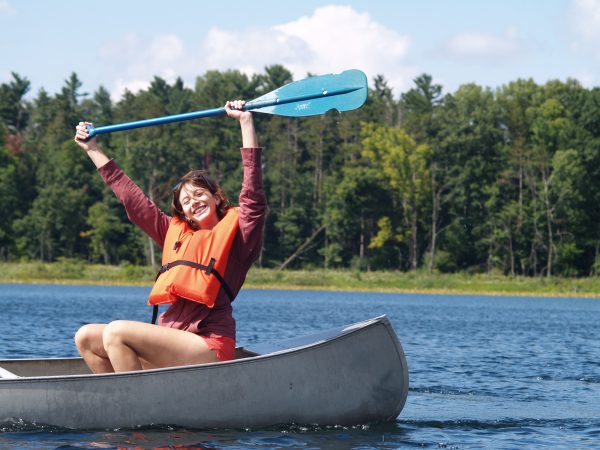
LandSea Pre-Orientation canoeing
Bea Putman ’26 was among the LandSea Kalamazoo leaders last fall.
LandSea Leaders
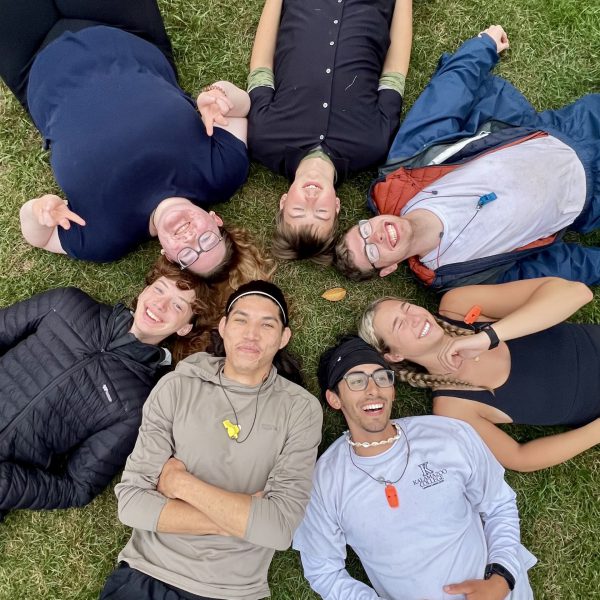
Although LandSea is designed for incoming students, Director Jory Horner emphasizes that its success rests heavily on student leaders.
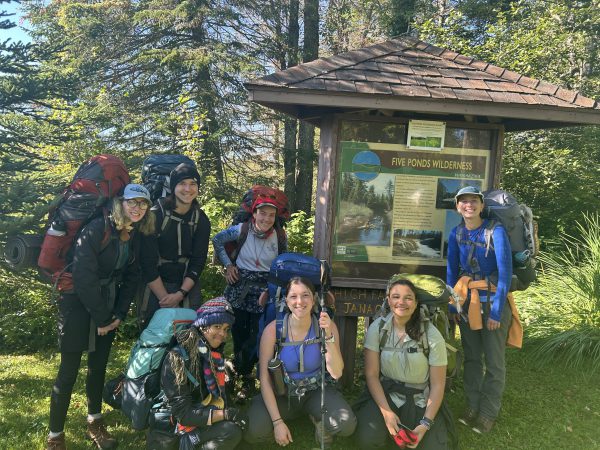
LandSea backpacking group
The LandSea program includes activities such as hiking, camping, paddling and rock climbing.

Support LandSea

Help LandSea continue to set the standard for pre-orientation excellence. Make a gift to ensure future students have a strong start to their K journey. 

“For us, that’s really validating,” Horner said. “It confirms that the things we’re focusing on—belonging, trust, confidence—actually matter in measurable ways.”

LandSea Leaders Make it Possible

Although LandSea is designed for incoming students, Horner emphasizes that its success rests heavily on student leaders.

“They give an incredible amount of time,” he said. “They’re balancing classes, jobs and other commitments, and then they dedicate weeks to training in leadership, wilderness medicine and emergency response.”

Many leaders are drawn not by the outdoors, but by the chance to help others.

“The number one reason they give is, ‘I wanted to help ease the transition to K for the next incoming class,’” Horner said. “They take that responsibility seriously.”

And as LandSea continues to earn national recognition, Horner sees the results not as a conclusion but as affirmation.

“Our goal has always been to help students start college feeling capable, connected and supported,” he said. “Seeing those outcomes reflected in the data makes all of us really proud.”
Outdoor Leadership Conference Returns to K

The Midwest Outdoor Leadership Conference is returning to Kalamazoo College February 6–8, offering a weekend of student-led workshops, networking and hands-on learning focused on outdoor leadership and sustainability education. 

The annual event will connect more than 50 students from small, medium and large institutions across the region. K students will be able to participate at no cost and without the need to travel. 

“It really doesn’t matter what students’ majors are. It’s just all about outdoor leadership and sustainability education,” said Josie Belsky ’28, one of the five conference organizers including Madeline Moss ‘26, Zoe Allen ’28, Chloe Brown ’28 and Ava King ’28. 

Belsky’s journey to organizing the conference began when she attended last year’s event at Earlham College. Moss had heard about the conference through her first-year seminar, Wheels of Change. After missing last year’s conference while studying abroad, Moss jumped at the opportunity to help organize when Sofia Fleming ’25, a previous conference attendee, reached out. 

For Moss, an English major, the conference represents an opportunity to bridge academic interests with outdoor pursuits—a combination not always obvious to those outside the field. 

Outdoor Leadership Conference
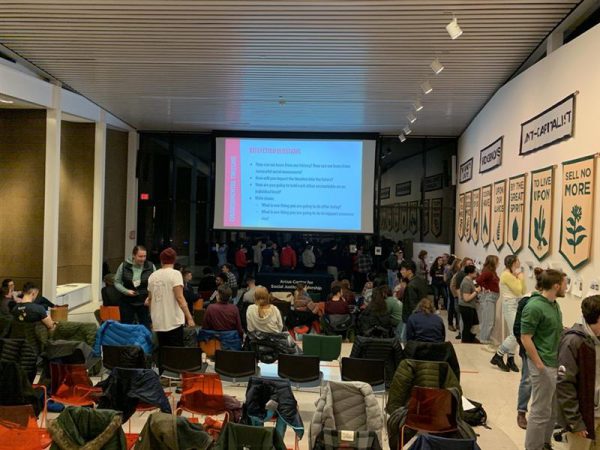
Kalamazoo College last hosted the Midwest Outdoor Leadership Conference in 2020 with gatherings like this one at the Arcus Center for Social Justice Leadership. The conference is returning to K Feb. 6–8.

“At K, we don’t have a lot of leadership-specific courses or an outdoor education major, so this is an opportunity for us to be able to touch base with students from other schools who might be interested in that and who have a lot of background in it, while also learning from them,” Moss said. “Being able to intersect my interest of the outdoors and sustainability with English is a nice thing about the conference.” 

This interdisciplinary approach defines the conference’s appeal. Workshops range from technical skills such as scuba diving and rock climbing to more philosophical discussions about what wilderness means and how to decolonize one’s understanding of the outdoors.  

Planning the conference has been a crash course in event management for the organizing students, who have met weekly since the start of the academic year with support from Outdoor Programs staff. The planners have coordinated with campus organizations like the Office of Student Activities. They’ve also reached out to local organizations such as the Kalamazoo Nature Center and engaged with students about their Senior Integrated Projects (SIPs) and other campus initiatives. 

The organizers emphasize that the conference welcomes everyone, regardless of outdoor experience. 

“One of the bigger barriers is that it can be a little intimidating to go to a conference—you feel like you have to come in with something, but in reality, it’s for everyone,” Belsky said. “There’s no experience necessary. You don’t even have to be an outdoorsy person. It’s just meant to be fun.” 

Hosting the conference offers an opportunity to showcase how K’s sustainability infrastructure has evolved, particularly through the Environmental Stewardship Center. 

“K has gone through a lot of changes, and I think this feels somewhat grounding back to our history of sustainability in leadership and student-led learning,” Moss said. “The fact that we hosted this conference back in 2020, before the pandemic, and a lot of things have shifted since then, and the fact we’re adapting it to the way that the school is now, says a lot about our dedication to creating a space of outdoor stewardship.” 

Attending this conference at other schools has been eye-opening for K students. Last year at Earlham, for example, Belsky and others learned about Earlham’s Quaker heritage and toured facilities including horse stables, composting operations and a community building where people sell handmade art and pottery. 

But beyond workshops and campus tours, the conference creates lasting connections. 

“I’m still in contact with the people I met at last year’s conference,” Belsky said. “One of them came to visit me and my roommate last year, too, which was fun.” 

She also emphasizes the conference’s professional value. 

“It’s a good way to network with people and make connections that will help you so much in your future career,” Belsky said. 

The organizers express deep appreciation for Outdoor Programs Director Jory Horner, Outdoor and Environmental Coordinator Greta Farley ’22 and Outdoor Leadership Training Center Coordinator Hannah Wolfe ’21, who provided crucial guidance. Farley’s perspective as a former student organizer has been particularly valuable. 

“Sometimes we get fogged up with the student mindset and think we’re so busy that we couldn’t possibly do this,” Moss said. “But it felt grounding to have them tell us that we’re capable of it, and we could do so much more than we expected.” 

With the conference happening on campus, the organizers have a simple message for the K community: Join us. 

“The fact that it’s here is huge for us because we know, especially for student-athletes and people involved in student organizations, it’s hard to get away on the weekends,” Belsky said. “Your lives get busy, especially at K, because we’re always so involved. But it’s here. It’s so close, so come join us.” 

For more information, registration and schedules, see the conference’s website

Build Skills for the Great Outdoors This Spring

A Kalamazoo College department is expanding its offerings to help the greater community build skills that are convenient for the great outdoors.

The College’s Outdoor Programs team launched the Outdoor Leadership Training Center (OLTC) in January, providing public in-person community courses, workshops and certifications for every level of expertise in outdoor education, wilderness medicine, first aid and CPR/defibrillator (AED) training.

Opportunities are expanding this spring to include new workshops:

  • A backpacking series continuing in April with map and compass navigation, first aid, shelter building and trip planning, ranging from $35 to $70 per class.
  • A climbing series that will cover climbing anchor principles (May 16), natural anchor building (May 17) and a skills test (May 18), ranging from $35 to $150 per class. Register for all three as a package for $225, a discount of $30 over signing up separately.
  • A mountain biking clinic available May 25 or July 5 at Maple Hill Trail for $150. Expert trainers will lead riders of all experience levels, covering fundamental techniques such as braking, cornering and shifting, along with advanced skills such as climbing, descending and line selection. Bikes and helmets can be provided when they’re needed.

Sign up for any of these programs at the Outdoor Programs website. Its representatives also are accepting suggestions for future offerings through email at outdoor.programs@kzoo.edu.

“The Outdoor Leadership Training Center is here to provide the community with a fun, safe and welcoming space to learn essential outdoor skills,” OLTC Training Coordinator Hannah Wolfe said. “As a new resource in the area, we’re filling a need for accessible, hands-on training that helps people connect with nature while staying safe. Whether you’re a beginner who wants to explore the outdoors with confidence or someone looking to refine your wilderness skills, we’ve got something for you. Our courses are perfect for outdoor enthusiasts, families, educators or anyone wanting to prepare for any outdoor adventure. We love helping people of all backgrounds gain the confidence to enjoy the outdoors and discover new skills along the way.”

The Outdoor Leadership Training Center helps participants in a wilderness first aid course with more outdoors training coming available
The Outdoor Leadership Training Center at Kalamazoo College in January provided new public in-person community courses, workshops and certifications for every level of expertise in outdoor education, wilderness medicine, first aid and CPR/defibrillator (AED) training. Additional courses for all levels of expertise will be available this spring.

Outdoor Orientation Program Prepares Students for Success

Incoming students who participate in LandSea, Kalamazoo College’s outdoor orientation program, have opportunities to meet their peers, gain self-confidence, earn a partial physical education credit and develop classroom skills even before moving to campus. Two K administrators will attest to that after participating in and reaffirming the program’s success.

8 students and 2 admistrators participating in LandSea Outdoor Orientation Program
Vice President for Student Development and Dean of Students Sarah Westfall and Associate Dean of Students Brian Dietz traveled to the 6-million-acre Adirondack State Park in New York State to observe and experience the outdoor orientation program called LandSea, ongoing through Monday, and meet many of the 66 students participating.

Vice President for Student Development and Dean of Students Sarah Westfall and Associate Dean of Students Brian Dietz traveled to the 6-million-acre Adirondack State Park in New York State to observe and experience the outdoor orientation program, ongoing through Sept. 3, and meet many of the 66 students participating. The 18-day program is in its 44th year, and was among the first of its kind in the country.

The state park features the largest system of hiking trails in the country, along with 3,000 lakes and ponds, 1,200 miles of rivers, and the state’s highest mountains. K students are divided into six to nine patrols for the outdoor orientation program, with at least two trained leaders per patrol. After three days of training, they challenge themselves on the rivers, lakes, trails and peaks through one of two choose-your-own adventures, Expedition or Basecamp, both with a climb-and-rappel day, a service-and-reflection component and a day of rafting.

The Expedition adventure consists of backpacking and canoeing, and allows participants the choice of extending the distance of the backpacking or canoeing portion of the trip. The Basecamp adventure offers more of a group camping experience, with bunks in canvas tents at Massawepie Lake. The students build skills including canoeing, hiking and backpacking, with opportunities for day trips and expanded service projects.

Friendships that begin during LandSea often remain fundamental connections for a lifetime. Plus, participants of outdoor orientation trips such as LandSea are more likely to develop social connectedness, feelings of belonging, campus involvement and independence with increased retention rates and higher grade-point averages. To best understand these benefits, Westfall and Dietz said it was important to examine the program first hand.

“We’ve always thought LandSea was great, although we’re paid to worry,” Westfall said.

Westfall and Dietz, though, saw how Outdoor Programs Director Jory Horner and Assistant Director Sara Stockwood had the students prepared for everything from necessities such as water sterilization, to common challenges such as hot days and cold nights, to possible emergencies such as lightning storms.

“Any student who comes to K should do this,” Westfall said. “Don’t let finances be a barrier because Outdoor Programs helps find gear for participants, and scholarships are available to help cover other program costs for students who demonstrate financial need. And don’t let a thought like ‘I don’t camp’ be a barrier. This program is for everyone. We hear from families who say their student is a different person after LandSea.”

The success of the program, Dietz said, is evaluated long-term based on whether the participating students stay at K and graduate, gain confidence, maintain their friendships as alumni, recognize their growth and learn about environmental responsibility. Here’s what some students have said:

  • “It is unforgettable, and when you climb a mountain, it teaches you that you can overcome any obstacle.”
  • “It was one of the best things I’ve ever done. I’ll carry it with me forever.”

“I had never been to LandSea,” Dietz said. “I was intrigued by the logistics with it being in a 6-million-acre park, but you never know what it’s like until you see it. All the work (Horner and Stockwood) do is amazing. It’s neat to see new students in that element.”