
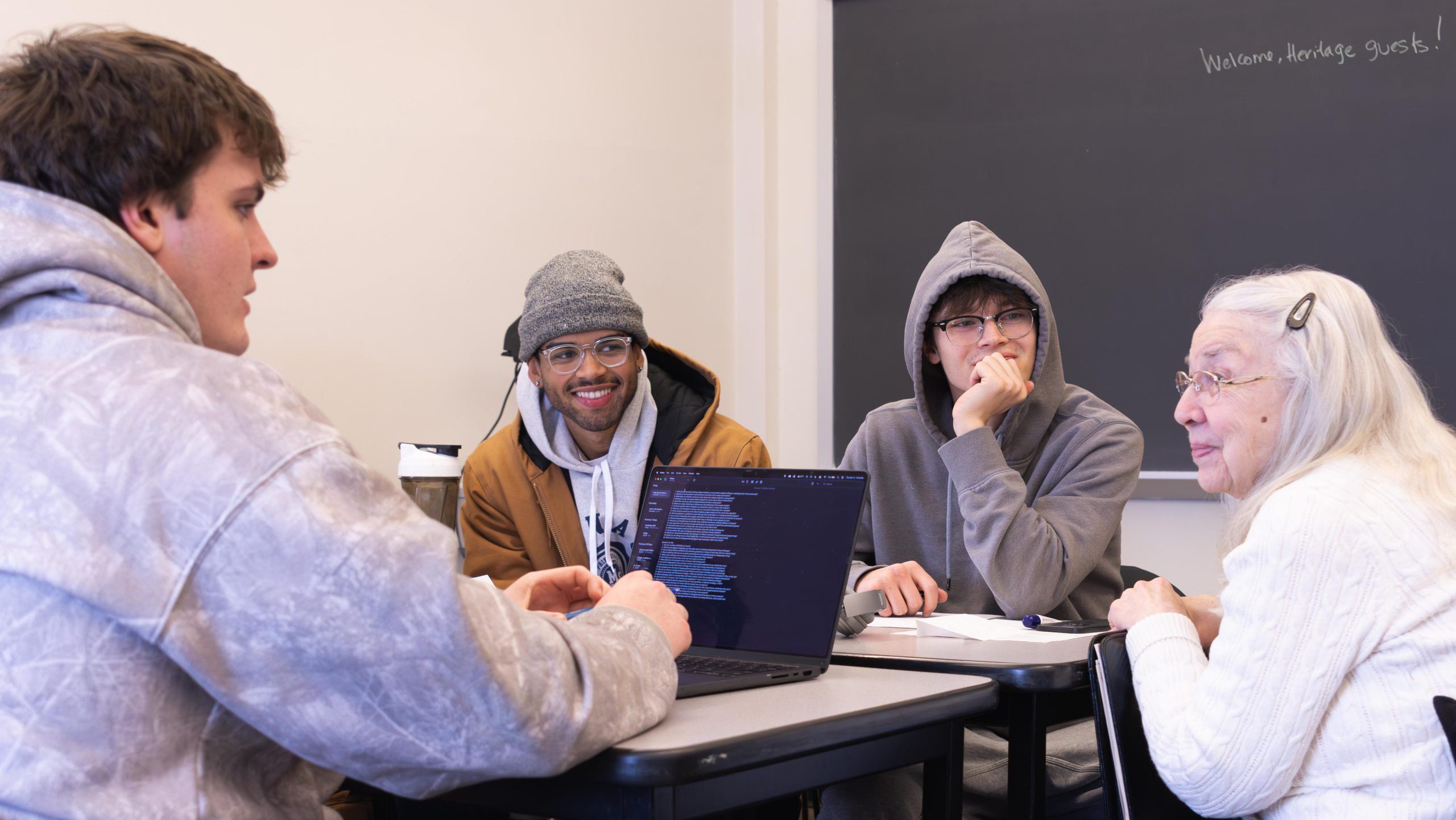
When Amy MacMillan, the L. Lee Stryker Professor of Business at Kalamazoo College, sat down with Matt Shankle to talk through a vision for her Principles of Marketing course, neither could have predicted exactly where it would lead. But their partnership resulted in one of the most hands-on learning experiences her course has ever offered: students were tasked with devising a plan to help Heritage Community—a senior living facility in the Portage area—evolve to meet the future needs, wants and desires of prospective Baby Boomer clients.
“Once we just got started and let things evolve from there, I think it energized both of us and some additional faculty at K,” said Shankle, the vice president of marketing and business development at Heritage Community of Kalamazoo.
Along the way, students met regularly with Shankle and Heritage residents who visited campus. Their work extended beyond the textbook, as they built out detailed proposals through a series of weekly milestones and ultimately traveled to Heritage to present their finished plans in person.
Meet the Market Where It Lives
Organized into groups of four or five, the students began their work with research. They fanned out to interview members of the Baby Boomer generation—including grandparents, friends’ parents and neighbors—seeking to learn what mattered most to them as they approached or entered retirement. Groups channeled those insights into their projects.
A group that included Agustin Creamer ’28, for example, called its concept Heritage Hub: a membership-based lifestyle hub open to residents and nonresidents of Heritage, offering pickleball, yoga, fitness classes, a pool, dining services, a coffee shop and private event space. The idea was to let people experience the Heritage community and build connections there without requiring the full commitment of moving in.
“We combined two of the main things that we thought Baby Boomers would want: an active lifestyle and socializing,” he said.
Jack Hartung ’27, a junior from Ann Arbor majoring in political science and business, described how his group’s research revealed the importance of intergenerational connections and maintaining independence. Their proposal had two parts: a subscription service for Heritage residents to access outings—such as plays, sporting events and restaurants downtown—and an idea for Heritage to acquire houses in a central location for a more independent, upscale alternative to traditional assisted living.
“Matt and the Heritage residents who came to class seemed receptive to those ideas, but Matt also talked with us about the importance of density and the feasibility of buying a neighborhood of houses,” Hartung said. “Different residents would have different mobility levels, too, so having a whole house might not be best for them. We transitioned that into having one floor of an apartment building that didn’t feel like assisted living.”
Basi Okromchedlishvili ’28 described her group’s concept as “bringing Florida to Michigan” with a resort-style addition to Heritage complete with a pool, sauna, spa and themed events, designed to evoke the warm-weather retreats that Baby Boomers are known to seek in retirement.
“Most of the residents were excited about it,” she said. “They were the ones who recommended theme nights. Matt gave us some recommendations about what we could include, like the sauna, and he also mentioned it being open to the public to generate more revenue so the residents wouldn’t have to worry about costs so much. Even with that idea, we had to make sure that it was mostly focused on Heritage and their residents.”
Elisabeth Wilks ’28, a Kalamazoo native majoring in quantitative economics, said her group zeroed in on a project targeting purpose and service. The idea tapped into the intergenerational connection that students experienced in class by having Baby Boomers serve as mentors.
“The shift to retirement can be difficult,” she said. “Our interviews revealed how much it matters to retirees that they make meaningful contributions after spending decades in the working world, so we call our program Bridging Futures. It gives Baby Boomers that sense of purpose through volunteering as they go into retirement.”
Spencer Rasmussen ’26 came in thinking his group might pitch a virtual golf simulator. He said the conversations with Heritage residents quickly changed his team’s direction.
“We found that the people we talked to really just wanted opportunities to be heard because they all had stories to share,” Rasmussen said.
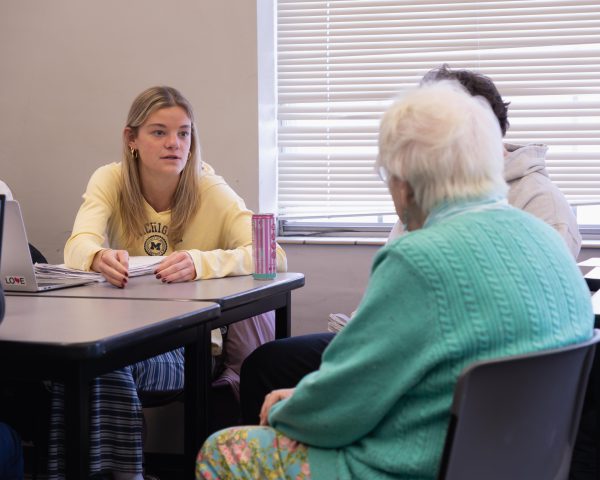
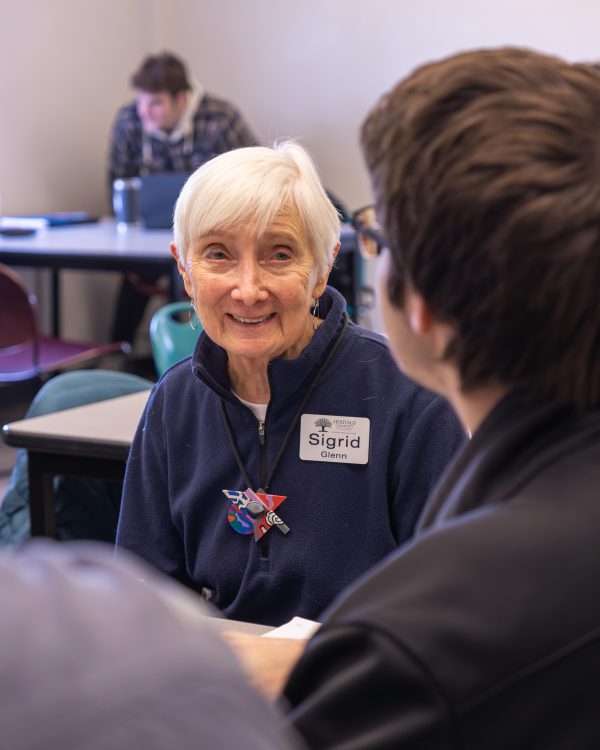
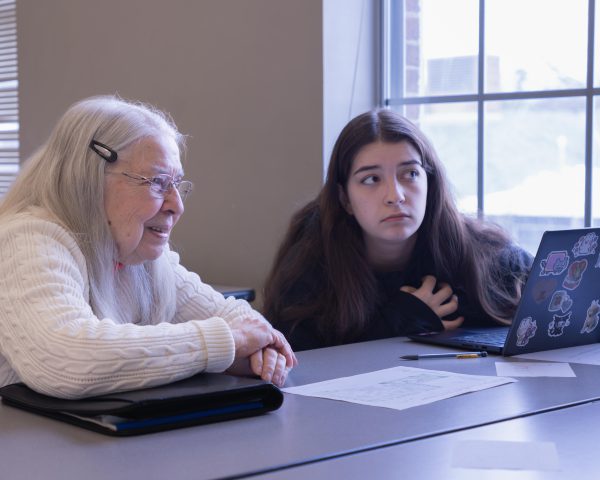
That realization led his group toward a student fellowship model, where K students would spend time at Heritage, benefiting residents through connection and activity, while helping students gain hands-on experience in fields such as nursing, psychology and fitness.
The Real World Walks into Class
One of the course’s most distinctive features was the regular presence of Heritage residents in the classroom itself. Several times throughout the term, residents made the trip to campus to hear the students’ ideas and offer feedback.
“One who sticks out in my mind is Bill,” Hartung said. “He’s 97, and it was amazing because it made me appreciate that people at these ages aren’t just sitting in a chair—they come out and do things. They can be sharp-minded and healthy, even at 97.”
For Wilks, one resident in particular left a lasting impression.
“Every time Mary comes to our table, she says, ‘This is my favorite idea. I love it.’ She worked for an airline as a flight attendant, and she loves talking about her career with us. There are so many different aspects of being a flight attendant that I never would have known about. She’s always so happy and bubbly.”
Rasmussen remembered a light moment between his group and a regular visitor when they taught her about technology, especially the flashlight on her iPhone. The levity pointed to something deeper.
“I didn’t realize before I was in this class how lively a retirement home can be and how much activity actually goes on,” Rasmussen said. “It’s been an absolute joy working with them.”
Shankle, who has witnessed many intergenerational programs in his career, said the classroom visits were exactly what he had anticipated.
“The mutual interest in seeing the students produce something meaningful meant both residents and students bought-in almost immediately,” he said.
He also was impressed by the students themselves.
“As a graduate of a liberal arts college myself, I can see that K students are a high-caliber group,” he said. “They’re well-rounded. They’re not just studying business, but also religion, ethics and psychology, for example. I think K students are well-prepared for the modern-day workforce that’s ultimately going to need someone with a diversity of thought who can make an impact in society.”
The term culminated with the student groups traveling to Heritage to present their proposals in person, for five minutes each plus questions and answers, in the room where their ideas, if adopted, might one day come to life. The groups took the occasion seriously.
“A couple of groups even had matching shirts that they had made, or they dressed up in the theme of their projects,” Shankle said. “They really had a lot of fun with it, and I was impressed, first and foremost, with the students and their presentation skills. They had never been to Heritage before, and they came prepared.”
But the conversation didn’t end at the presentations. Shankle said two of the student projects are now under active consideration for development.
“I think there are some ideas that I’d like to create a task force for, with a combination of our staff, a few of our residents, and some of the students,” he said.
Shankle envisions a program that would match Heritage residents with K students in their fields—pairing a future health care worker with a retired health care worker, a pre-law student with a former attorney—to create genuine mentorship alongside real-world practicum experience.
“With two of the group projects being very similar, we can get the synergy of both groups thinking as one,” he added.
Where Marketing Comes to Life
If the students and Shankle are enthusiastic about the partnership, they are equally vocal about the professor, MacMillan, who made it happen.
“She has a lot of knowledge in her area, which is marketing, but she’s also good at teaching that knowledge,” Creamer said. “This class is unique because it’s more about how we can apply these concepts in real life rather than just studying them without knowing how to apply them.”
Okromchedlishvili said MacMillan’s class has her thinking about future opportunities in marketing, possibly starting with an internship this summer.
Wilks described MacMillan as engaging on a personal level, quick with constructive feedback, and consistently enthusiastic in a way that makes an early class feel like somewhere worth being.
For Hartung, the class’s value extends beyond marketing. He is considering law school—either for business law or a career in political campaigns—and sees the lessons learned as applicable to either path.
“If I go into politics, that’s all marketing,” he said. “Marketing yourself, marketing a candidate—the same baseline concept applies.”
Rasmussen, who will graduate in June with his sights set on medical device sales, said, “I haven’t missed a class yet. It’s one of those classes where it doesn’t feel like I’m working and I enjoy what I’m doing.”
Shankle said MacMillan’s approach has a rare quality: the ability to ground marketing theory in practice without losing its theoretical foundation.
“She teaches from a book, but she really encourages students to use their own experiences to relate to the teachings,” he said. “Every class I attended, students were presenting on the marketing process through their own lived experiences, and they articulated what they learned.”
It’s a blueprint Shankle and MacMillan hope to build on. Whether the task force produces a mentorship program, a fellowship or something yet to be imagined, the students who spent eight weeks thinking carefully about Heritage Community have left a mark on Heritage residents, each other and future versions of the Principles of Marketing course.
“Amy and I are already talking about next steps and what this could look like in the future,” Shankle said. “I could see a lot more doors opening for these types of engagements where students and older adults are working together.”