
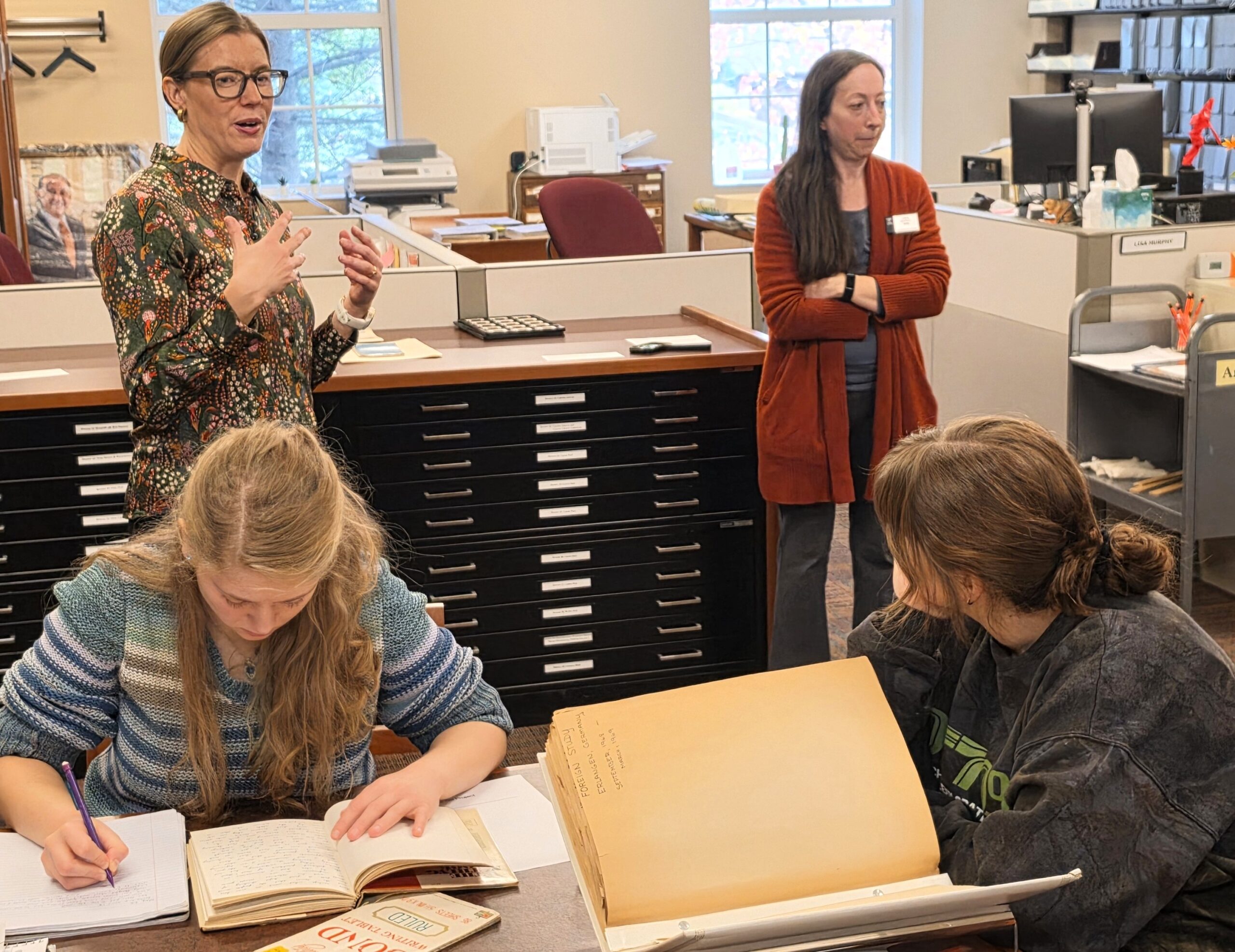
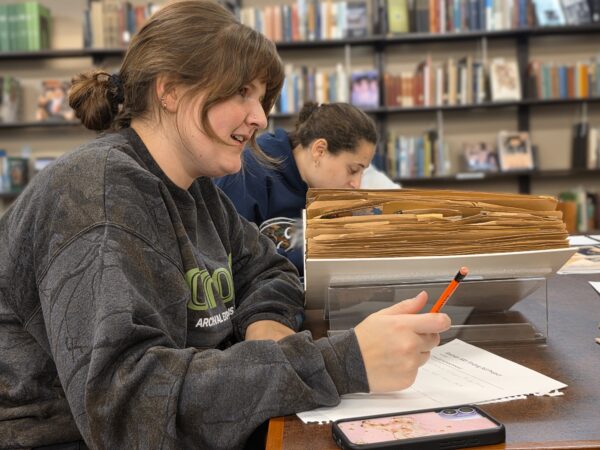
A plastic-wrapped rose sits on the first page of a scrapbook in the Kalamazoo College Archives. Next to it is a letter from a boyfriend back home, still sealed more than 50 years later. When Paige Peterson ’27 opened the scrapbook this fall, she felt an unexpected connection to its owner.
“She really was a college girl a lot like me,” Peterson said of its owner, a member of the Class of 1970 who studied in Erlangen, Germany, the same program Peterson attended. “She was leaving behind Mom and Dad, and a loving boyfriend at home.”
The scrapbook is one of the materials students in German 440: German Diary Cultures are working with as the capstone project for the course, taught by Associate Professor of German Studies Kathryn Sederberg. Over the summer, Sederberg and College Archivist Lisa Murphy put out a call to alumni for study abroad diaries and other personal records. The response surprised them.
“We received some really amazing materials: diaries, scrapbooks, even old audio from the 1970s sent home from Germany during study abroad,” Sederberg said.
Alumni also sent materials from study abroad programs beyond Germany.
“I think this really highlights the amazing history of study abroad at K,” she added.
More than Words on a Page
Students in the course spent the first part of the term reading famous diaries, among them the writings of Anne Frank, Franz Kafka and Ruth Maier, and asking hard questions about what a diary really is. Is it an honest record of private thoughts, or a story its writer chooses to tell? What happens when a diarist rewrites entries for publication?
Peterson said the class has pushed her to treat diaries as complicated primary sources. Applying that to the scrapbook, she finds herself asking what narrative its creator is giving her and what she might be leaving out.
“Maybe she was having so much fun that she forgot to write things down, or maybe it was too painful that she didn’t want to write it down,” Peterson said.
Pavel Stojanovski ’27 came to the question from the opposite direction. He believes a diary should be raw and unfiltered, and said that once a writer reshapes entries for readers, the result starts to look more like a novel. A fictional World War I diary he read in class reinforced his belief that invented journals teach what an author wants readers to understand, rather than document what happened.
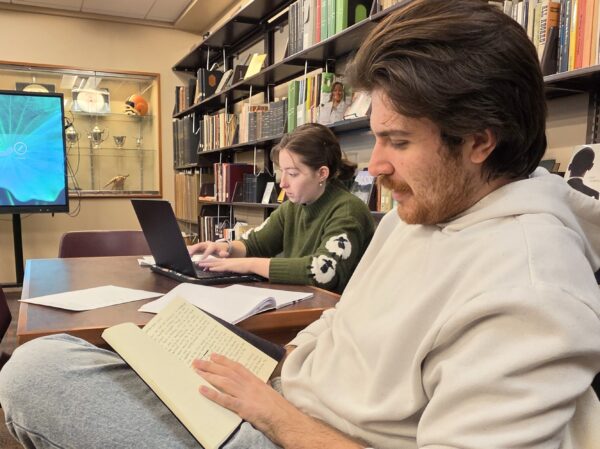
That is why he values the journal on his table: “I don’t see any type of narrative,” he said. “It’s just, ‘this is me, this is what I’m doing.’”
Ryleigh Jaworski ’27, a history major who is also a German teaching assistant, said the course has sharpened her sense that no diary holds the whole truth.
“People immediately think, ‘Oh, a diary is private thoughts, it’s inherently honest,’ and that’s just not the case,” she said.
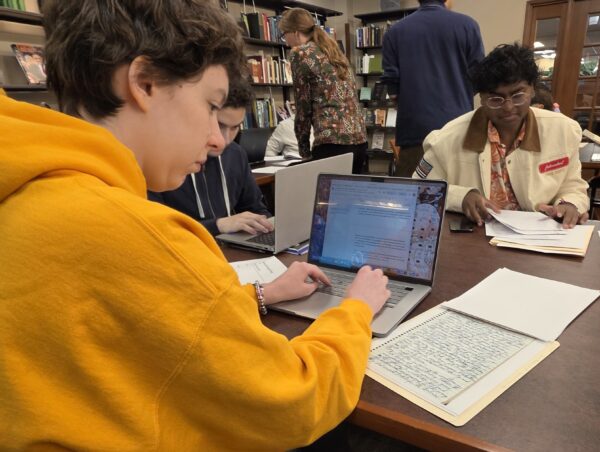
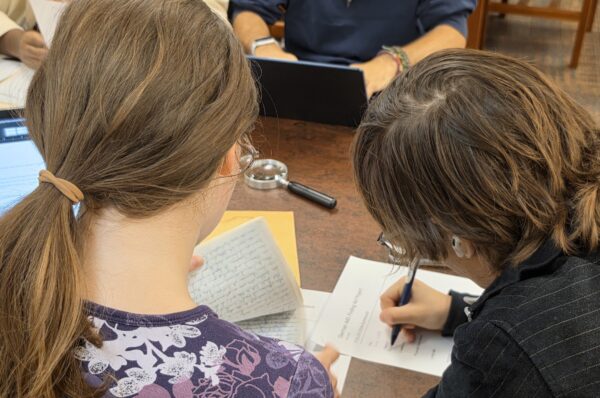
The class also emphasizes material culture, including how a diary looks, feels and was assembled. Jaworski is working with a notebook whose dates are out of order and whose binding raises questions. She suspects its writer may have copied letters into a store-bought blank book.
“You’re not just looking at what the words on the page are,” she said. “You’re looking at how the changes in handwriting are happening, how the changes in ink look, why they might be that way.” Then, she added with a laugh, as a diarist herself, “Sometimes my pen just runs out of ink.”
Familiar Fears
For many students, the strongest reaction came from the overlap between their own study abroad experiences and those of alumni who went decades earlier.
Stojanovski is reading the journal of a student named Stuart who studied in Germany about a decade ago. As an international student himself, Stojanovski connected with a passage about being proudly independent while wishing his parents were nearby. The two also arrived in Germany with similar German skills, far from fluent and still stumbling through conversation.
Stojanovski, who studied abroad in northern Germany, will soon interview Stuart. He hopes to hear about life in southern Germany, where he would like to live one day, and about studying within the German university system rather than an American program abroad.
Jaworski chuckled at her diarist’s worries about the exchange rate, which had slipped to 1.95 Deutschmarks to the dollar. Her diarist, a member of the Class of 1980, also left behind about 50 slides from 1978. In another entry, the writer described visiting art museums, echoing something Jaworski had said just days earlier about wanting to see Gustav Klimt’s work in person.
“To read that exact same sentiment in the diary was really interesting to me,” she said.
The differences are telling, too. Peterson noticed that the 1970s materials feel carefree, full of solo rail travel and little worry.
“We’re just in a cultural climate where there’s a lot more fear and anxiety when we go abroad,” she said.
How to Help the Diaries Project
When Associate Professor of German Kathryn Sederberg and College Archivist Lisa Murphy asked alumni for their study abroad diaries and personal records over the summer, the response surprised them. Alumni responded by scanning or taking photos of their materials, some sent in digital copies and a few transcribed journal entries. Others have loaned their materials. If you would like to contribute study abroad materials to the College Archives, contact Murphy at archives@kzoo.edu.
Learning the Work of an Archive
Understanding the diaries is only part of the assignment. Students are also learning how personal materials become part of an institutional archive; they are researching each collection, contacting alumni and preparing archival reports; they are working on oral and written presentations they will make in German; and they will make a digital exhibit of Instagram posts for the College Archives about their sources.
Some materials are on loan and will be returned to their owners. Others will be formally cataloged by Murphy and added to the College Archives, where future students can use them for courses, Senior Integrated Projects or their own curiosity about study abroad.
The details matter. Students learned how an inaccurate measurement can make an archival object difficult to locate. The class has also confronted the choices embedded in every archive.
“Archives are incredibly subjective,” Jaworski said, noting that the College Archives can only hold what alumni donate and what space allows. Peterson put the question this way: “Whose materials do we pay attention to and why?”
For Jaworski, who is considering a career in archives or conservation, the project is real-world practice. It has also made the alumni connection tangible. At Homecoming, she heard from members of the Class of 1976 who still treasure their time in Erlangen. One class agent teared up talking about it. After emailing the alumna whose diary she is studying late at night, a reply arrived before she even woke up the next morning, with an enthusiastic offer to meet by FaceTime or phone.
Their Own Legacies
Asked what they would want students to know if their own materials were opened in 50 years or so, the three students gave answers shaped by what they found in the archive.
Peterson wants future readers to see her as she sees her diarist: a young student leaving for study abroad, homesick and missing her parents. Jaworski said she would attach a note making clear how much the experience meant to her. Stojanovski, who admitted he rarely keeps souvenirs, said the course has made him wish he had kept a diary. He now hopes to start one and perhaps someday send it to K from Germany, where he hopes to live.
Decades from now, their own diaries, photographs or keepsakes might offer another generation of students the recognition Peterson found in a scrapbook from the 1970s. For Jaworski, that possibility captures why preserving these materials matters.
“These materials are the College,” she said. “These people are the College, and when they’re gone, these materials are the people.”