A Kalamazoo College alumna has been awarded a prestigious NASA Hubble Fellowship, an honor given to just 24 early-career scientists nationwide.
Hayley Beltz ’18, a postdoctoral researcher at the University of Kansas, was selected from a pool of more than 400 applicants for the highly competitive program, which supports independent research in astrophysics.
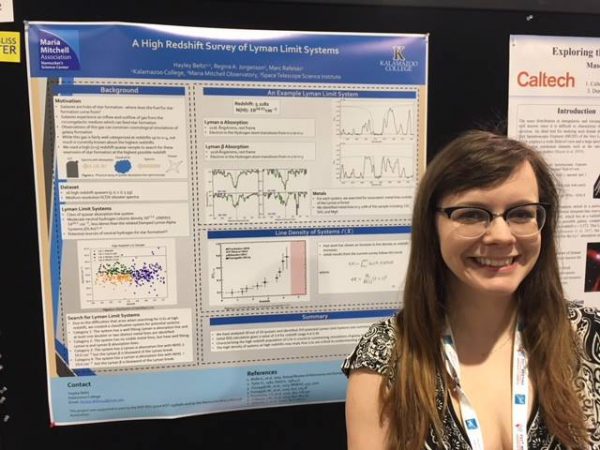
As a senior double majoring in physics and mathematics at K, Beltz received an Astronomy Achievement Student Award and a Chambliss Medal through the American Astronomical Society (AAS), recognizing her exemplary Senior Integrated Project (SIP) presentations at the organization’s meetings. Her SIP involved quasar spectroscopy, meaning she analyzed light that is billions of years old to find and measure the large concentrations of hydrogen that develop as stars form.
“My time at Kalamazoo College gave me the strong physics and math background that I needed for graduate school,” Beltz said. “I loved working as a consultant for the Math and Physics Center, which helped me grow my skills as a mentor and teacher. Being able to try out research with multiple professors at K helped solidify my desire to continue my education and become a scientist. I am very grateful to all the faculty who answered my many questions in office hours, wrote me letters of recommendation, and helped shape me into the astronomer that I am today.”
Beltz earned her doctorate from the University of Michigan in 2023. She then conducted postdoctoral research at the University of Maryland from August 2023 to January 2026 before moving to her current position in Kansas. Recently, her work has focused on “Hot Jupiters,” which are gas giant exoplanets about the size of Jupiter that orbit extremely close to their stars, completing an orbit in just a few days. Temperatures during their daytime can exceed 2,000 degrees.
The Hubble Fellowship will support Beltz’s research for the next three years as she continues developing computer models of exoplanets beyond our solar system with a focus on how magnetic fields shape their atmospheres.
“Learning about these other planets helps us understand the full range of planet formation in our galaxy,” Beltz said. “Magnetic fields are especially important because they play a key role in shaping environments like Earth’s, where life can exist.”