
Margaret M. Miles, a University of California, Irvine professor emerita of art history and classics, will offer a lecture titled Trojans and Greeks in Western Sicily on Tuesday, February 10, at 4:15 p.m. in the Olmsted Room at Mandelle Hall. The event will also be livestreamed.
Miles, the Edward A. Dickson Emerita Professor of Art History and Classics, researches Greek and Roman art, architecture and archaeology. She will talk about the refugees from Troy who founded the cities of Segesta and Eryx in Western Sicily. They later were joined by some storm-driven Greek Phokians, a group that called themselves Elymians but insisted on their ancestry as Trojans well into the Roman period.
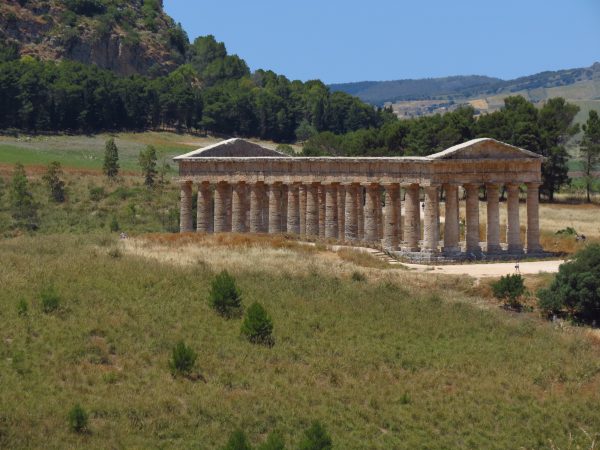
Sorting out Elymian, Greek and Phoenician influence on the city of Segesta is a challenge, Miles says. An early 5th-century BCE sanctuary and its handsome large temple—newly reconstructed on paper thanks to recent fieldwork—provide further insight and illustrate the religious history, variegated ethnic identities and engineering capabilities of 5th-century BCE Segesta.
Miles served a six-year term as the Andrew W. Mellon Professor of Classical Studies at the American School of Classical Studies in Athens. Her publications include A Reconstruction of the Temple of Nemesis at Rhamnous, Agora Excavations XXXI: The City Eleusinion, and Art as Plunder: The Ancient Origins of Debate about Cultural Property. She also has three edited volumes including Cleopatra: A Sphinx Revisited, Autopsy in Athens: Recent Archaeological Research in Athens and Attica, and Blackwell’s Companion to Greek Architecture. She is working on a book about 5th-century BCE Greek temples and religion.
Hosted by the Department of Classics, this public event is free, and a reception will follow. For more information, email Academics Office Coordinator Sarah Bryans at Sarah.Bryans@kzoo.edu.