
When Harper Schrader ’26 arrived last year in Jordan for her study abroad experience, she had never spoken a word of Arabic. Three months later, she returned to Kalamazoo College not only fluent enough to navigate daily life in the Middle Eastern nation, but also with ideas for a career path that would take her back across the globe.
Today, she interns remotely for the Jordanian embassy in Washington, D.C., combining her passions for journalism and international relations.
“I definitely couldn’t have imagined this experience had I not attended K,” Schrader said. “Being able to study abroad and graduate on time—while also getting to do my (Senior Integrated Project) abroad and the internship—is cool.”
Schrader, a Kalamazoo native who came to the College through the Kalamazoo Promise, was drawn to K specifically because of its study abroad opportunities. Unlike some institutions where studying overseas can delay graduation or limit academic options, K’s flexible curriculum allowed her to pursue international experiences without sacrificing other opportunities.
Choosing the Road Less Traveled
When it came time to select a study abroad destination, Schrader deliberately avoided the well-trodden paths to Europe that many students take. She considered Senegal and Korea before narrowing her focus to the Middle East, ultimately choosing Jordan, which is also known as the Hashemite Kingdom of Jordan.
“I wanted to go somewhere that a lot of people weren’t going,” she said. “I was more interested in the Middle East, so that’s how I narrowed it down.”
A conversation with a Jordanian international student during her sophomore year helped seal the decision. That student provided invaluable insights into the program and what daily life in Jordan would be like, easing Schrader’s concerns about diving into an entirely new culture and language.
The program, run through CET Academic Programs—one of K’s partner organizations with centers in China, Brazil and Jordan—required students to take a language pledge upon arrival, committing to speak only Arabic. For Schrader, who had no prior experience with the language, this was daunting.
“I was a little nervous, but it actually helped having the language pledge, because I was in an environment where that was all I was hearing,” she said. “I started picking up words without realizing it.”
The program began with two intensive weeks of Arabic instruction before students launched into elective courses. Schrader and her cohort attended classes at a center within walking distance of their apartments, where they were paired with “jirans”—an Arabic term that loosely translates to “neighbors”—who were Jordanian university students that helped with assignments and led cultural excursions around the city.
Adjusting to a New Reality
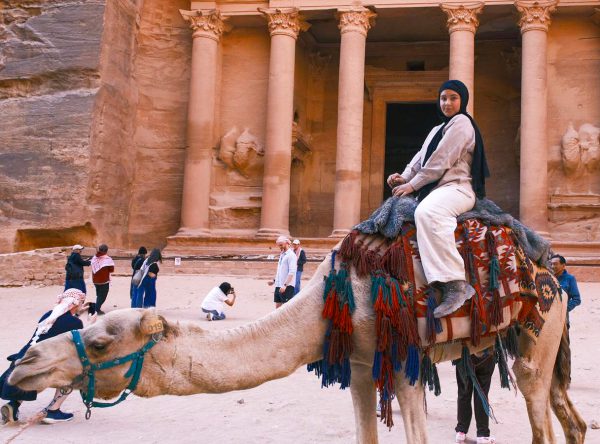
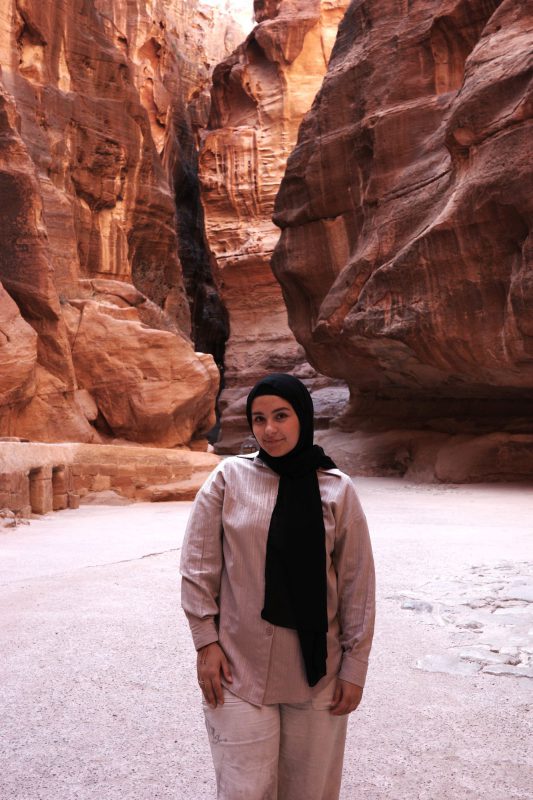
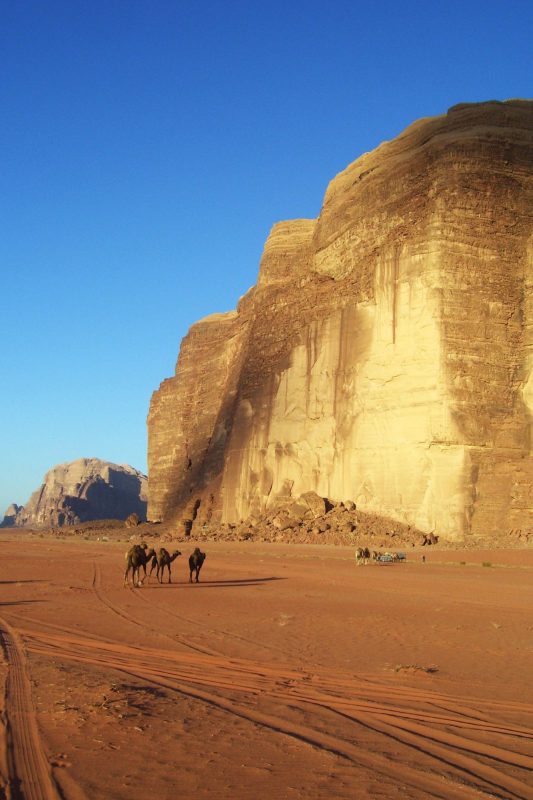
Jordan is home to numerous ancient attractions including two of Schrader’s favorites: Petra, which is an ancient city famous for its rock-cut architecture and water engineering near the modern town of Wadi Musa; and the Citadel, an archaeological site and historic landmark on the highest hill in downtown Amman, offering panoramic city views while showcasing layers of history from the Bronze Age through the Roman, Byzantine and Umayyad period.
For Schrader, exploring these historical treasures became a highlight of her stay, although the experience still had its adjustments and challenges. She began wearing a hijab the day she arrived in Jordan, a personal decision that felt natural in her new environment.
An unexpected challenge emerged as she navigated the range of perspectives represented among the American students in the program. Many were preparing for government service careers and approached learning Arabic purely in terms of future policy or security work. This experience deepened her commitment to approaching international relations and journalism with cultural sensitivity and respect, values that would shape her academic and professional pursuits.
Pursuing Journalism in Amman
Schrader hadn’t thought seriously about journalism until she took an introductory course with Professor of English Marin Heinritz ’99 during her first spring semester. Yet watching journalists like Clarissa Ward and Anthony Bourdain on CNN had already planted seeds of interest, and the class caused those seeds to grow.
In Jordan, she enrolled in a media course focused on the Middle East, where discussions covered cultural considerations in reporting and the role of social media during the Arab Spring. The class visited the Jordan Times newspaper, where students met with the editor-in-chief to discuss reporting in the region.
“There are a lot of differences between the U.S. and Jordan when it comes to the customs of interacting with people,” Schrader said. “For example, it wouldn’t be common to have a male person interviewing a woman there, or a woman interviewing a male.”
She also noted that topics such as royal families and religion are often approached more cautiously if at all out of respect for cultural sensitivities.
“Someone wouldn’t write something negative about the small Christian population, for example, because it would be seen as disrespectful,” she said.
Schrader had initially planned to intern with the Jordan Times during her study abroad semester, but scheduling conflicts prevented it. Undeterred, she returned to Jordan this past summer and spent three months working with the English-language newspaper, focusing primarily on digital content and video editing.
From Study Abroad Student to Intern
When Schrader returned from Jordan in September, she brought with her not just memories and language skills but a professional opportunity that perfectly merged her interests. A roommate from her study abroad program had worked for the Jordanian embassy, and when Schrader reached out about internship possibilities, the timing proved fortuitous.
“I applied, not really thinking I would get it just because I don’t have any experience in international relations, but I did get it,” she said.
Now, working remotely with the embassy’s Information Bureau in Washington, D.C., Schrader monitors press releases, think tank events and social media posts by politicians, compiling them into reports while helping to draft media statements.
“It’s really fun for me to combine an international relations interest with journalism,” she said. “It’s like the perfect intersection.”
The position, which she plans to continue until around June, has its limits as only Jordanian citizens can be hired for full-time positions. Yet it has already opened doors and created valuable connections. She has worked with officials close to the ambassador and met other students passionate about Jordan and the Middle East.
Confronting Media Narratives
Through her work monitoring international media coverage, Schrader has developed strong opinions about how the Middle East is represented in Western journalism. Although she believes Jordan itself is portrayed fairly, she’s critical of the coverage of other countries in the region.
“I think especially places like Iraq or Palestine are dehumanized,” she said. In fact, she’s found herself relying less on mainstream outlets such as the New York Times and the Washington Post, instead turning to social media to follow journalists on the ground, particularly in Gaza.
Jordan hosts refugees from Iraq, Palestine, Syria and Yemen, bringing international recognition. The country maintains a delicate balance—about 60% of Jordan’s population is estimated to be of Palestinian origin, which can create tension when the king maintains relationships with the United States and other Western powers.
“In Jordan, of course, it can feel frustrating for people if seeing the king, for example, be friends with the United States when a majority of the population there is Palestinian,” Schrader said. “But when you put it into the perspective of Jordan having little natural resources, their biggest strength is that they’re a peaceful country.”
This understanding of geopolitical complexities is precisely what Schrader hopes to bring to her future career. She’s currently applying to master’s programs to pursue a thesis examining how different regions and wars are represented in media, with a particular focus on how media can manufacture consent for conflicts and military actions.
Looking Forward
Schrader’s journey from Kalamazoo to Jordan and back again has been shaped by supportive mentors, including Professor of English Babli Sinha, who serves as her SIP advisor despite Schrader never having taken her classes.
“She’s inspired me the most,” Schrader said. “She doesn’t make me limit myself when it comes to journalism. She encouraged me with journalism and to follow what I’m passionate about.”
For her SIP, Schrader wrote a narrative journalism piece about her two visits to the West Bank and Jerusalem during her time in Jordan, including a stay with a family in Bethlehem. “It’s been rewarding to write what I’m passionate about,” she said.
On campus, she helps run both the student newspaper, The Index, and the literary magazine, The Cauldron. She’s also been involved with Students for Justice in Palestine since her first year and helped revive the Muslim Student Association after returning from study abroad.
When asked what she’d want Americans to know about Jordan, Schrader’s answer cuts to the heart of why cross-cultural exchange matters.
“I think that it can be easy to let what we’ve been told about the Middle East come to mind when we’re first thinking about these countries, but it’s really important to go there and to talk to the people,” she said. “You’ll realize that the people your age—and people in general —are more like us than we think. I think that’s the biggest thing.”
For Schrader, study abroad wasn’t just an academic experience or a chance to see the world. It was a transformative experience that helped her discover her calling. From struggling through her first Arabic conversations to working for a foreign embassy, she’s living proof that stepping outside one’s comfort zone can lead to extraordinary opportunities.
“It helped me meet other people interested in the same things I’m interested in and opened my eyes up to what I can do outside of what I’m studying at K, which is cool,” she said.