
While some pre-law students focus on statutes and precedents, Ella Miller ’26 has spent her senior year exploring the emotional truths and human lives that exist in the gaps between court rulings.
As an English major at Kalamazoo College, Miller’s Senior Integrated Project (SIP) began as an ambitious challenge to bridge the plain reasoning of the U.S. Supreme Court with the realities of immigrant experiences. Her Race, Law and Politics class, along with her Advanced Nonfiction course, inspired her to pair four major Supreme Court cases on immigration with four books written by authors deeply connected to the decisions’ impacts. Through the combination of case briefs and literary analysis, Miller examined how legal reasoning resonates beyond the courtroom.
“It was stylistically interesting to insert a Supreme Court opinion while also providing facts, and the organization intrigued me,” she said. “I thought it would be interesting to write reviews about books that were influenced by these major Supreme Court decisions, some of which I was learning about in class.”
Connecting Law and Literature
Miller organized her SIP around four immigration-related groups and eras: Chinese immigrants during the Chinese Exclusion Era, Japanese Americans during World War II, Latin American immigrants affected by contemporary policies, and refugees impacted by the 2018 Trump v. Hawaii ruling.
She selected landmark cases associated with each topic, then sought books across genres that offered lived perspectives on the decisions’ consequences. Her final author list included:
- John Okada, No-No Boy, paired with Korematsu v. United States.
- Erika Lee and Judy Yung, Angel Island: Immigrant Gateway to America, tied to the era of Chinese exclusion.
- Sandra Uwiringiyimana and Abigail Pesta, How Dare the Sun Rise: Memoirs of a War Child, connected to modern refugee issues.
- Areli Morales, Areli Is a Dreamer, linked to DHS v. Regents of the University of California, related to the recent Deferred Action for Child Arrivals (DACA) case.
By examining fiction, nonfiction, a memoir, and even a children’s book, Miller highlighted the diverse ways personal stories illuminate historical and legal realities.
“What makes them all special is the different ways a story can be told,” she said. “A historical nonfiction book offers documented evidence, while a novel can convey emotional truths through fictional characters. And the children’s book, which was my favorite, brings hope and understanding.”
Bringing Clarity to Complex Cases
Drawing on skills from her constitutional law coursework, Miller began each book review with a one-page case brief, which is a concise summary designed to make a legal case accessible to any reader.
“Case briefs can be eight pages long, so I wanted to take the most prominent parts and briefly summarize them with background, the main issue, and the court’s ultimate decision,” she said. “I talk about the author, how we can see some of the big issues in society reflected in how the decision was reached, and how that decision was then felt by the people impacted by the decision.”
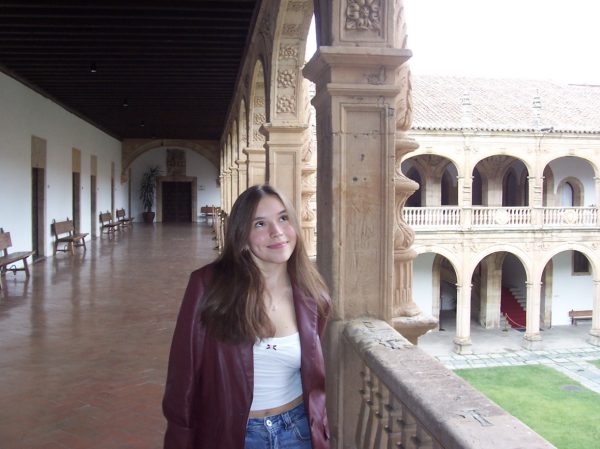

With that foundation in place, she used each book to explore how the court’s rulings were experienced by real people. For Miller, the contrasts revealed what legal texts alone seldom show.
“I think each of these books is valuable, and you can take away a lot on your own,” she said. “But having a real understanding of how the court was reasoning through these decisions adds another layer to how people are affected. In Korematsu v. the United States, for example, the decision allowed for Japanese internment to be held constitutional for domestic safety. But when you read No-No Boy, you can see that Japanese Americans on the West Coast were not a threat in any way.”
Ichiro, the protagonist of No-No Boy, returns home from years in an internment camp and has to come to terms with his dual heritage and how to build a future in the country that imprisoned him.
A Project That Shaped a Future Career
Although the SIP more than satisfied academic requirements, it also reshaped Miller’s confidence and confirmed her path toward law school.
“K is great with giving you lots of creative control in your work, and I’ve never felt stifled,” she said. “But to be given a blank slate where I could choose the topic and my sources while exploring what’s interesting to me gave me a lot of confidence as a writer. It made me feel more prepared for the next steps in my life because I plan to go to law school, and writing is super important. I need to think argumentatively and critically, so I feel my SIP was valuable in giving me the confidence to know that I can produce something like this.”
Faculty mentors played a key role. Miller credits Associate Professor of English Shanna Salinas for ongoing guidance, Associate Professor of Political Science Justin Berry for deepening her interest in law, and Professor of English Amelia Katanski ’92, her advisor, for helping her explore connections between law and literature.
Outside the classroom, Miller holds leadership roles in K’s student organizations related to law. She’s the president of the Phi Alpha Delta law fraternity chapter and the secretary for the Aspiring Law Students Organization. She said the experiences strengthened her sense of purpose.
Next Steps: Spain, Service and Law School
After graduating this spring, Miller hopes to spend a year teaching English in Spain through a Fulbright grant. If she’s not selected, she will teach through the North American Language and Culture Assistants Program (NALCAP), which is also based in Spain. She studied abroad in Madrid and hopes to return to deepen her language skills and global perspective.
“International relationships are really relevant to law,” she said. “The experience would help shape the kind of legal career I want.”
Law school applications will follow next year. But if there’s one lesson Miller hopes readers take from her SIP, it’s that Supreme Court decisions are not abstract.
“The law impacts people in enormous ways,” she said. “If you’re not directly affected, it can be hard to understand that. Literature gives us a way to see what those impacts look like in real life.”