Young Scientist

Mara Richman standing by her research posters
Mara Richman presented research at the North America Society for the Study of Personality Disorders.

Mara Richman ’15 has built an impressive scientific résumé in three short undergraduate years–and she has yet to reach her Senior Individualized Project (SIP) term!

During her study abroad in Budapest, Hungary the psychology major collaborated with Dr. Zsolt Unoka on research in depression and borderline personality disorder. She presented that work, titled “Mental state decoding deficit in major depression and borderline personality disorder: a meta-analysis,” at the North America Society for the Study of Personality Disorders. Think the age of David (when he confronted Goliath) or of Joan of Arc … Mara was the youngest presenter at NASSPD! And she will be one of the youngest oral presenters at the prestigious International Congress on Borderline Personality Disorder and Allied Disorders (Rome, Italy), where her paper was accepted and where she will detail the meta-analysis she completed with Unoka. Their research also has been submitted in manuscript form to Clinical Psychology Review.

To date, Mara has six manuscripts published or in review for publication on research into schizophrenia, drug courts, and borderline personality disorder. She has presented research (or had research accepted for presentation) at Stanford University, the Association for Psychological Science, the Midwestern Psychological Association, the Mid America Undergraduate Research Conference, and the Michigan Undergraduate Psychology Conference. And she will present her work at the American Psychological Association in August. Most of this BEFORE she begins in earnest her SIP work. That will happen this summer at Harvard University Medical School’s Department of Psychiatry under mentor ship of one of the world’s foremost experts on borderline personality disorder, Dr. Mary Zanarini.

Given her youth and her accomplishments so far, it may not be too surprising that Mara will graduate after her senior fall term. She hopes to work in a lab for nine months or so and then apply to graduate school. She plans to earn a Ph.D. in clinical psychology and focus her research on borderline personality disorder.

Four in More Than 15,000

Three female students who presented at the 2014 Experimental Biology Meeting
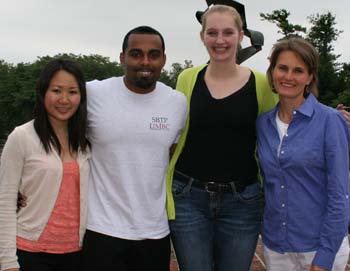
K student researcher/presenters at the 2014 Experimental Biology Meeting included (l-r): Amanda Bolles, Rina Fujiwara, and Virginia Greenberger. Not pictured is Michael Korn.

Four Kalamazoo College students attended at the 2014 Experimental Biology Meeting: Amanda Bolles ’14, Chemistry; Rina Fujiwara ’15, Chemistry; Virginia Greenberger ’14, Chemistry; and Michael Korn ’14, Biology. Experimental Biology is a joint meeting of six different societies including the American Association for Biochemistry and Molecular Biology (ASBMB) as well as societies for physiology, nutrition, pharmacology, pathology, and anatomy. The meeting provides a great opportunity for students to present their work and attend a variety of engaging scientific talks. More than 15,000 scientists attended the event in San Diego, Calif.

Bolles and Fujiwara presented their research findings during the Undergraduate Poster Competition and during the regular scientific session for ASBMB. Their research involves recent work completed in the laboratory of Professor of Chemistry Laura Furge. That work has shown that two different (but related) compounds inactivate P450 3A4, an enzyme in the liver and intestine that metabolizes (or processes) a major pharmaceutical drug. The titles of the Bolles and Fujiwara posters were, respectively, “5-Fluoro-2-[4-[(2-phenyl-1H-imidazol-5-yl)methyl]-1 piperazinyl]pyrimidine is a mechanism based inactivator of CYP3A4” and “Mechanism-based inactivation of human CYP3A4 by a piperazine-containing compound.” The ASBMB competition includes posters of some 300 students from a variety of college and universities across the country. One grand prize award was presented to a student in each of four research categories (bioenergetics/protein structure, cell biology/developmental biology, DNA/gene regulation, and immunology/microbiology/neurobiology). Bolles won the $500 grand prize in the bioenergetics/protein structure category and was recognized the next day before an audience of hundreds of scientists, educators, and students at the award lecture for outstanding contributions to education. Bolles’s presentation derived from her Senior Individualized Project (SIP), which will be published later this year along with results from co-author Fujiwara.

Greenberger conducted her SIP research in the laboratory of Professor of Chemistry Regina Stevens-Truss. The abstract she presented at the meeting was titled “Bacterial Action of Novel Cationic Peptide Sequences.” As more antibiotic resistance is observed in patients, new sources of antibiotics are being investigated, including short peptide sequences. Greenberger’s work in the Truss lab was aimed at determining the antibiotic activity (and the precise mechanisms of action that yielded the activity) of two newly studied peptide sequences.

Dr. Furge also presented a poster in the ASBMB regular scientific session based on work started last year by Parker de Waal ’13. The work began as part of a course assignment in Furge’s “Advanced Biochemistry” course and grew into an elegant computational study of structural differences between select variants of the drug-metabolizing enzyme P450 2D6. de Waal used molecular dynamics methods to show how subtle differences in the enzyme structure can help explain differences in the metabolizing abilities of the enzymes. The study is being completed by Kyle Sunden ’16. While in San Diego, Furge spent an afternoon at the Skaggs School of Pharmacy at the University of California-San Diego discussing the implications and approach of the study with other scientists in this field.

Korn attended the American Physiological Society (APS) portion of the Experimental Biology meeting. He presented the results of his SIP work (conducted in the laboratory of Dr. Christopher Mendias at the University of Michigan) in the APS Student Poster Competition. Korn’s abstract received the David Bruce Outstanding Undergraduate Abstract Award. The title of his presentation was “Simvastatin reduces myosteatosis following chronic skeletal muscle injury.”

The future is promising for all four of these outstanding student researchers. In the fall, Bolles will enter the University of Michigan Graduate Program in Biomedical Sciences; Greenberger will matriculate to the chemistry department at Pennsylvania State University to begin work on her Ph.D; Korn will attend the University of Michigan Medical School; and Fujiwara will complete her SIP with Furge this summer. She plans to attend graduate school after her June 2015 graduation from K.

Professors Furge and Truss are both members of the ASBMB and attend the annual meeting each year. Truss also directs a National Science Foundation (NSF)-funded workshop for area high school science teachers in connection with the annual ASBMB meeting. This year’s workshop attracted more than a dozen local teachers who learned science and teaching strategies to use in their classrooms. Attendees at the workshop are also eligible for mini-grants to support further development of their teaching after the workshop. A recent article describes the impact of this workshop (which is in its fourth year).

In other meeting news, the Ruth Kirschstein Diversity in Science Award was given jointly to President Freeman Hrabowski III and Professor Michael Summers of University of Maryland-Baltimore County. Professor Summers was the SIP mentor to Erran Briggs ’14 and has worked closely with Professor Truss on the Professional Development and Minority Affairs Committees of ASBMB. Professor Summers also visited K’s campus in 2010 as a Howard Hughes Medical Institute Guest Scholar Lecturer. Given the connections, and important work of Summers and Hrabowski, Professor Truss arranged for Bolles, Fujiwara, and Greenberger to interview Summers for Kalamazoo College’s Arcus Center for Social Justice Leadership’s Praxis Center. Following the interview, Summers treated the students and Truss to lunch overlooking the San Diego Harbor marina! Notes from the interview will be posted on the Praxis website.

Travel to ASBMB for Bolles, Fujiwara, and Greenberger was supported by grants from the Provost Office, the Heyl Foundation (Greenberger), and the ACSJL. Korn’s travel to the meeting was sponsored by grant funds from his SIP advisor and the University of Michigan. Furge and Truss were supported by the Hutchcroft Endowment as well as their NIH and NSF grants, respectively. Next year’s Experimental Biology Meeting will occur in Boston, Mass.

Four Share Research on Japanese Culture

Four students sharing their research on Japanese cultureFour Kalamazoo College students presented their research at the annual Michigan Japanese Heritage and Culture Conference. The conference was sponsored by Grand Valley State University’s Japanese Cultural Association, and attendees–some 50 students and teachers–shared their studies in Japanese culture, including Japanese relations within Michigan and contemporary issues affecting Japan and the United States. Several presenters were members of the Japanese community, including employees of government agencies, colleges and universities, and university organizations. The K presentations focused on food, fabric dyeing, cinema, and nontraditional romantic relationships. The four K students were classmates in Assistant Professor of Japanese Noriko Sugimori’s winter term class, “Intermediate Japanese II,” when most of their research was done. The students (and the titles of their research presentations) are (l-r): Anh Lam ’17 (“Mochi: Where Cultures Meet”), Jamie Heywood ’16 (“Shibori: Re-visitation, Reinvention, and Revival”), Penelope Owen ’16 (“Alternative Love”), and Edwin Salvatierra ’16 (“Kitano’s Gokudou: Reinventing the Yakuza Film Genre”). The three sophomores will study abroad in Japan during their entire junior year–Heywood and Owen in Kyoto, Salvatierra in Hikone.

The Bees’ Needs

K alumna Rachel Mallinger holds a visual presentation for Wisconsin’s Wild Bees
Rachel Mallinger

The power of science in large part is the power of great storytelling. When the stories lead into mystery … well, that’s when science continues, generating more stories and encountering more mysteries. The University of Wisconsin-Madison’s Genetics/Biotech center harnesses the power of stories during a public series called Wednesday Nite @ The Lab, occurring every Wednesday, 50 times a year. Attendance is high, and K alumna Rachel Mallinger ’05 will be the featured presenter on Wednesday, March 26. Her topic: “Wisconsin’s Wild Bees: Who Are They, What Do They Do, and Why Should We Conserve them?” Rachel earned her B.A. in biology at K, her M.S. in entomology and agroecology (UW-Madison) and is currently pursuing her Ph.D. in entomology at UW-Madison. Wisconsin has more than 500 species of native wild bees, and their contributions to pollination are becoming more and more important as honey bee populations decline. Mallinger’s talk will focus on effect of land use change and farm management on the abundance and diversity of wild bees. “I will also discuss the role of wild bees in crop pollination, and address whether or not they can fulfill our food needs,” she wrote. Mallinger wants to learn more about the roles of insects in agricultural ecosystems and how insects can be managed to enhance the sustainability of farming. She currently studies wild bees and pollination services within fruit orchards. She enjoys working with farmers, experimenting in her own vegetable garden, and cross-country skiing during the winter. At K, Rachel studied abroad in Thailand, and she also mentored a SIP student supervised by Ann Fraser, associate professor of biology. According to Fraser, that student is now applying to Ph.D. programs to work on wild bees. “That will make at least four grads in the last eight years who have done to work on wild bees,” adds Fraser. “I’ll be working with three students this summer on another bee project (looking at the impacts of honey bees on wild bees), and a student organization on campus is starting work on constructing ’buzz boxes’ on campus to improve foraging and nesting habitat for wild bees. Maybe,” grins Fraser,” we need a new college mascot.” The hornet’s probably safe for now.

Research Sheds Light on Liver Cancer Pathway

Diane DeZwaan ’05 is conducting cancer research in the Department of Anatomy and Cell Biology at the University of Iowa Carver College of Medicine. She is one of the authors of a research article whose impact of has been much larger than expected. The article, which appears in the journal PLOS/Genetics, is titled “The Stress-Regulated Transcription Factor CHOP Promotes Hepatic Inflammatory Gene Expression, Fibrosis, and Oncogenesis.” Her research provides evidence of a chain of events that leads to the formation of liver cancer (hepatocellular carcinoma, or HCC), the third most common cause of cancer death worldwide. Liver cancer is most commonly caused by viral hepatitis, alcoholism, or obesity, all of which activate cell stress in the liver. DeZwaan’s research may be the first that links  elements of this stress response–specifically the expression of a stress-regulated transcription factor called CHOP–to the appearance of cancerous tumors in the liver.  The research also showed that exposure (in mice) to a tumor-causing agent when CHOP is absent results in fewer tumors and less cell death. The findings of the research establish CHOP as a biological marker for liver cancer and showed its importance in promoting liver tumor formation. It’s possible that the genesis of tumors by CHOP is a common feature of liver cancer. The research raises intriguing questions that require additional research, which may lead to important new insights into the development of liver cancer. The editors of the magazine were so taken by the potential of the work that they contributed a perspectives article (“The Integrated Stress Response in HCC: Not Just CHOPped Liver”) on it. Television and print media outlets in Iowa have published stories on DeZwaan’s research. As an undergraduate at K DeZwaan majored in biology, studied abroad in Australia, and played on the Hornet basketball team.

Headline and Lead Combine “Data,” “Value,” and Kalamazoo College

Associate Provost Paul Sotherland
Associate Provost Paul Sotherland is an expert on K outcomes in the Collegiate Learning Assessment.

A Wall Street Journal article (“College Uses Test Data to Show Value,” by Douglas Belkin, February 20, 2014) describes K’s efforts to measure (and market) the gains its students experience in critical thinking and problem solving skills because of the K undergraduate learning experience.

The article notes that K leads a growing trend of colleges and universities becoming more transparent about sharing test data and other metrics to show the learning outcomes of a higher education. For his story Belkin interviewed Dean of Admission Eric Staab and Associate Provost Paul Sotherland as well  students and their parents for his article. The piece notes that K (Sotherland) shares data that documents the effect and value of a K education with parents and prospective students during campus visits.

Much of that data originates from the Collegiate Learning Assessment, currently the most reliable direct measure of students’ gains in critical thinking, analytical reasoning, writing, and problem solving as a result of particular undergraduate learning experiences. What distinguishes the CLA from other assessments is its focus on direct measures of learning rather than an aggregate of surrogate markers that include, for example (in some rankings), the size of an institution’s endowment or the number of alumni that provide annual gifts.

Sound Affects DOOM

Sound off or sound on?

Turns out that music makes better DOOM–or, more precisely, players of that first-person video shooter game score a lot higher with the sound (music and effects) on … at least according to one study.

Associate Professor of Psychology Siu-Lan Tan joined renowned video game composer Sascha Dikiciyan (Sonic Mayhem) to give an interview on the psychological effects of video game music. The interview occurred on the blog Consequence of Sound, a.k.a. CoS. That interview went live a couple days ago and is nearing 1,500 views on YouTube.

In order to tell the rest of the science behind the story, Professor Tan used her Psychology Today blog to post a related piece: “Video Games: Do you play better with sound on or off?”

Turns out the science is complicated. The results of the aforementioned DOOM study were seemingly contradicted by a study of Ridge Racer V, which found that gamers with the fastest lap times had the music off.

And it gets more complicated than that. Professor Tan’s K research (a collaboration with her SIP student John Baxa ’09) studied gamers playing Twilight Princess-Legend of Zelda (ya gotta love these names!). In the Twilight study, the worst performers played with both music and sound effects off. And the study found that the more the game’s audio was incrementally added, the more performance improved. And yet (in another wrinkle) the best performances occurred to background music UNRELATED TO THE GAME (!) … think boom box across the room. A closer examination suggested more nuances based on game familiarity and gaming skill. Turns out that average skill level newbies tune out the audio to focus exclusively on visual cues when first navigating the game. Not so for high skill level players, new to the game or not. These players are skilled, in part, because they pay attention–and effectively integrate–auditory and visual cues, both of which provide feedback for the best moves.

Tan writes: “I’m also reminded of what a participant in our study expressed so well: ’There’s more to a game than just high scores. It’s also about being transported and immersed in another world, and music and sound effects are what bring you there.’”

Indeed, writes Tan, “When you have a great soundtrack, music can be the soul of a game.”  NOTE: Tan and Baxa (along with Matt Sprackman) published their music/video game research in 2010 and 2012. Baxa said it aided his entrance to graduate school for study on video games. He is currently a Ph.D. student at Carnegie Mellon University.

Of Bears and Babies

Associate Professor of Psychology Siu-Lan Tan writes a blog for the magazine Psychology Today under the topic heading “What Shapes Film? Elements of the Cinematic Experience.” That assignment keeps her eye on YouTube videos that go viral. For example, recently, some 4 million viewers have had the “cinematic experience” of watching a three-month old polar bear take his first wobbly steps at the Toronto Zoo. Where most of us may see a bear only, Tan sees human beings as well. Her recent blog post notes that both share a phenomenon of physical development known as the cephalocaudal principle, which means that bear and baby’s first movements tend to be in reverse. The blog is a fun, informative read with some pretty cute video illustrations. Part of the fun derives from the fact that both species are subject to a lot of individual variation when it comes to learning self-locomotion. Crawlers, rollers, and scooters, oh my!

Tan is a popular blogger on other academic topics.  One of her posts on singing and emotional contagion was named #4 of Oxford University Press Blog’s Top 10 Posts of the Year 2013.  That post was also selected as #22 of Psychology Today’s Top 25 Posts of the Year 2013, out of a total of about 14,000 annual posts.

In other news, Tan’s article titled “Visual Representations of Music in Three Cultures: UK, Japan, and Papua New Guinea” was published in December in the Empirical Musicology Review. Her blog is also posted at Oxford University Press.

Research Published on Alzheimer’s Molecules

Biology professors Jim Langeland ’86 and Blaine Moore join one K student and three K alumni as authors of an important paper that will soon be published in the journal Molecular Biology and Evolution. The co-authors are Nathalie Botezatu ’14, Maddie Gillentine ’13, Ashley (Boehmke) Benson ’08, and Kyle Wilson ’08. All were (or are) biology majors at K, and in the case of some, the scientific work—which describes the evolution of key molecules involved in Alzheimer’s disease—was part of a Senior Individualized Project (SIP). The work is groundbreaking in at least two ways. First, it approaches Alzheimer’s disease from an evolutionary perspective. And second, it illustrates a particular niche approach to research that the scientific environment at K is well positioned to pull off.

“The experiments that culminated in this paper began in 2007 with the SIP work of Benson and Wilson,” says Langeland. “The six-year duration shows that science can take a long time to come to fruition.” That duration derives, in part, from the complementary expertise of the two collaborating labs—Langeland’s expertise in gene evolution and Moore’s background in Alzheimer’s disease research and experience with cellular expression of proteins.  According to Langeland, for most of the larger labs the exigency of understanding Alzheimer’s in order to development treatments for it may not favor such an extended timeline or evolutionary approach. Indeed, Moore says, “Most researchers in the Alzheimer’s field are exclusively focused on inhibiting the production of protein fragments that have been linked to the progression of the disease. One of the exciting aspects of this project was the chance to take a broader view of the proteins involved in the disease process.”

A broader view allows for unique approaches (suggesting that time and creativity are the two pillars of the particular niche approach to research for which K is so well-equipped). Six years ago Langeland decided to investigate the evolution of two molecules associated with Alzheimer’s—APP and BACE. BACE acts like a scissors to cut (or cleave) APP. The excess accumulation of one of the “cut pieces” (a.k.a. products or substrates, this particular one known as A-Beta) is linked to the development of the disease. Benson and Wilson sought answers to how far back on the evolutionary tree of life these molecules could be found. Turns out that APP is nearly a billion years old. BACE (and its cleavage effect) is much younger, about 500 million years old. Just down the hall, Moore’s lab had been studying the regulation of enzymes that produce A-Beta, and had well-developed systems for expressing Alzheimer’s proteins and analyzing cleavage products. Put the two together and you have a unique project that would have been unlikely at a larger institution or medical school.

The principle of natural selection suggests that BACE’s action on APP is vital to life in ways we don’t yet understand, according to Langeland. The A-Beta substrate may be some kind of mistake that natural selection is unable to “correct” because Alzheimer’s expresses so late in human lifetimes, usually long after reproductive success has been achieved. Moore says, “It’s essentially a wrong place, wrong time phenomenon. The APP substrate evolves the A-Beta motif, then comes in cellular contact with preexisting BACE. The result is a devastating disease process that is most likely an accidental by-product of some normal, as yet unknown, cellular process.”

Moore and his lab (including Gillentine and Botezatu) conducted an elegant experiment to confirm the importance of the BACE molecule. They expressed the BACE molecule from an organism—in this case a primitive marine dweller called amphioxus—that diverged from the human evolutionary branch some 750 million years ago. Amphioxus has no A-Beta. Then, Moore’s group discovered that amphioxus BACE nevertheless acts as a scissors to the human APP molecule. The result adds evidence to the biological importance (albeit unknown) of BACE’s cleaving action.

According to Langeland, an evolutionary approach to diseases may suggest molecular targets for treatment intervention, and, just as important, the limitation of a non-nuanced approach to potential targets.

The paper is titled “Asynchronous Evolutionary Origins of A-Beta and BACE-1.” The work was supported, in part, by a Great Lakes Colleges Association (GLCA) New Directions Initiative Grant, a program that supports professional growth of mid-career liberal arts faculty, with particular emphasis on projects outside traditional boundaries.

Face Time

We love faces; our lives depend on it from an early age. And a close-up on a face is one of the most notable differences between the experience of a movie and the experience of live theater. When we choose to see a film instead of a play it may be, in part, because were drawn to the human face. In her latest installment of her Psychology Today blog (What Shapes Film?) Associate Professor of Psychology Siu-Lan Tan explores what attracts us to cinematic face time. Her article is aptly titled “3 Reasons Why We’re Drawn to Faces in Film.” Maybe it should be four reasons, because music plays a big role as well. It’s a fascinating read, and Tan demonstrates her points with faces from some pretty famous films, including Amelie, It’s a Wonderful Life, Saving Private Ryan, and Toy Story 2, among others. Of particular interest is how facial close-ups make us, the audience, both mirror and blank-canvas-and-painter, depending on a face’s intensity or nuance, respectively.