
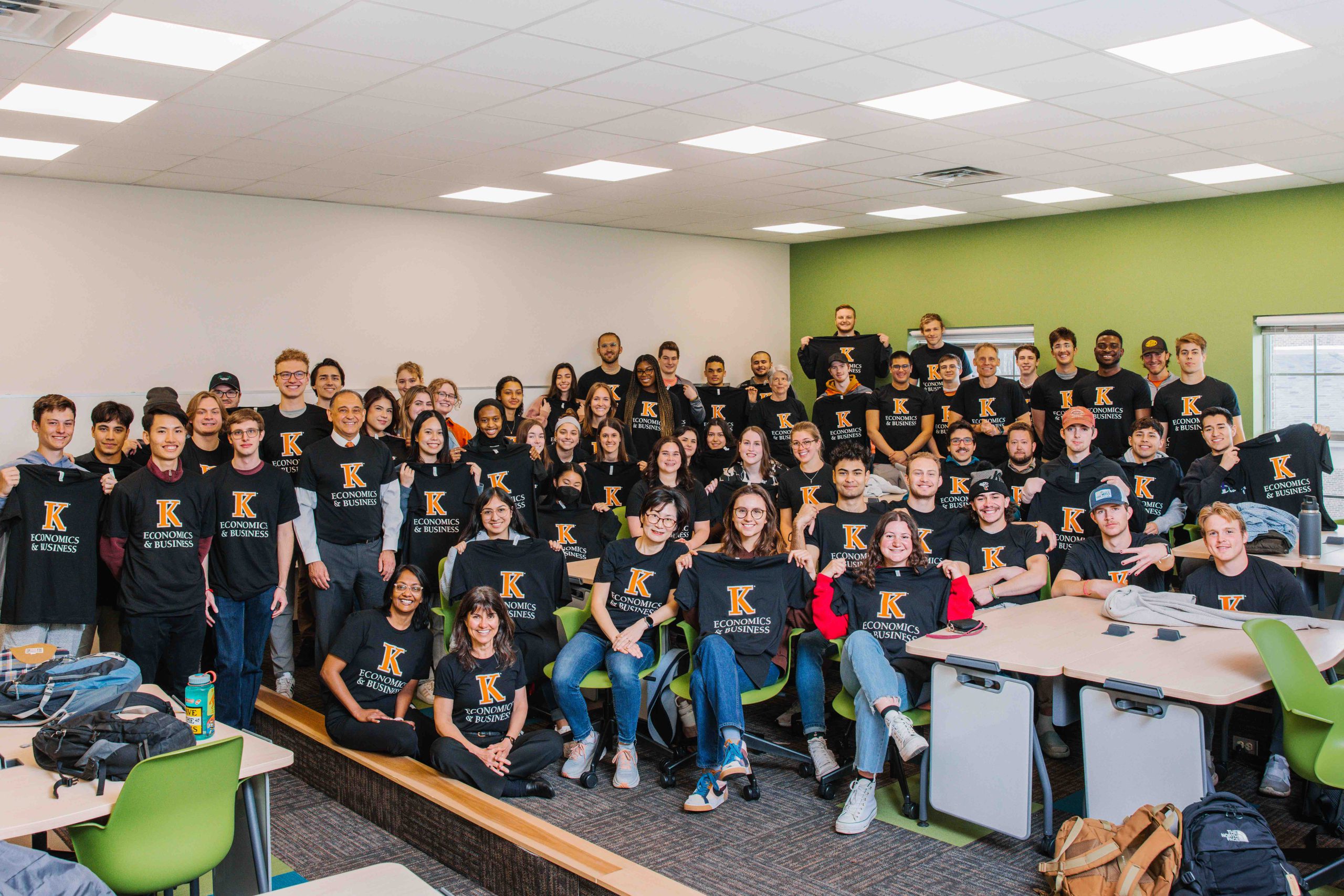
Why Study Economics and Business at K?
Integrating Economics and Business, theory and practice, we develop creative, broad-minded problem-solvers and leaders.
In the business and economics department, you will learn how to apply theories to real-world problems and develop the critical thinking, quantitative analysis, and historical perspective necessary to succeed in your future career.
Throughout your four years with the department, you will be exposed to a wide variety of ideas by taking classes focused on economic theory (Principles of Economics; Macroeconomics), quantitative tools and methods (Statistics for Business and Economics; Econometrics), fundamental business principles (Accounting; Marketing), and field-specific topics (Environmental Economics; Principles of Investments). These courses will empower you to build upon theoretical foundations to address pressing real-world problems.

With the tangible skills and broad knowledge base you will gain as a business, economics or quantitative economics major—in addition to the experiential education and completion of your Senior Integrated Project—you will be equipped with the talents to be successful in many professional settings. Notably, our alumni have thrived in private, public, nonprofit, domestic and international business sectors.
Choosing the Right Major
The business, economics and quantitative economics majors are three separate major programs housed within the same department. Due to the significant overlap in their programming and courses, students cannot major in multiple degree programs within the department.
Students intending to study economics or finance at the graduate level are encouraged to major in quantitative economics, where students will be exposed to the necessary quantitative skills. Those students who are interested in law school, public policy, or really, any career path, are well served by the major in economics. Students who discover a passion for marketing, finance, accounting, or management may consider a major in business, which emphasizes analytical, problem-solving, communication, and teamwork skills.
What can you do with a business or economics major?
Below are some of the careers, employers, and graduate schools of our business and economics alumni.
Careers
- Financial or Investment Management
- Entrepreneur
- Law
- Marketing or Sales Management
- Public Policy
Employers
- U.S. Department of Labor
- Deloitte
- Liberty Mutual
- Fleishman Hillard
- Federal Reserve Bank of Chicago
Graduate Schools
- University of Texas at Austin
- University of California Irvine
- Michigan State University
- Texas A&M University
- Washington University in St. Louis
Program Spotlights
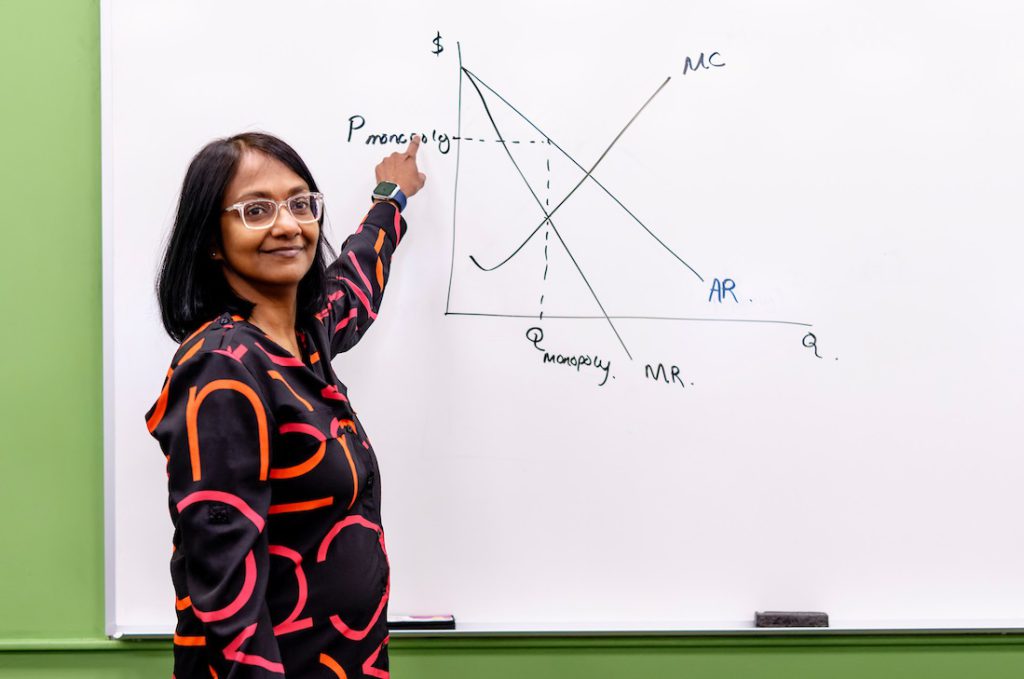
Faculty Excellence: Learn from the Experts
You will benefit from learning from our stellar faculty, who are all experts in their fields or entrepreneurs who have demonstrated success in business practices. With an array of different backgrounds and specialties, our faculty cooperate to further their respective fields, such as Professors Hultberg and Udayanganie, who collaborated to research how international economic policies can combat climate change. While our faculty take pride in their research and practices, K is a teaching-first institution, and our professors take immense joy in the close mentorship they develop with students.
Apply your Learning and Gain Experience through Internships
As a business and economics student, many of the skills you need to be successful post-graduation are best learned through professional experiences and internships. The department and the College’s Center for Career and Professional Development will coach you through the process of landing a meaningful internship and potentially even providing funding for unpaid opportunities for high-need and first-generation students. It is through these internships that you can begin to contextualize and experience your education first-hand.

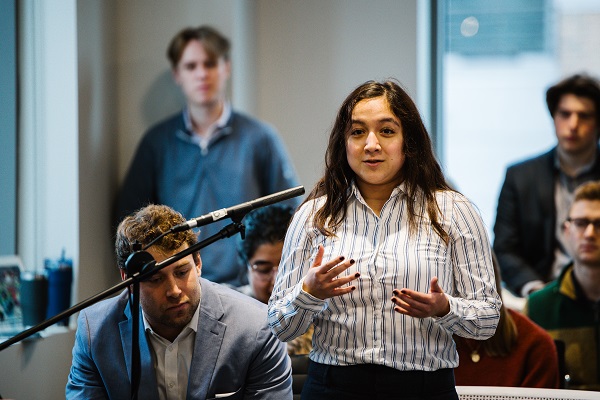
Be Actively Engaged in your Learning
All your classes with the department balance theory with practice. For example, in Negotiation and Persuasion, you will learn how to influence others during crucial conversations by drawing from the latest research, use cases and exercises. Each week you will practice these skills through mock negotiations, giving you the confidence to negotiate your worth and resolve conflicts.
Your courses will also take you out of the classroom and into the world, as is the case with Principles of Marketing where you will create real-life, actionable business plans to assist local business owners in meaningful ways.
Showcase your knowledge with your Senior Integrated Project (SIP)
For an economics or business SIP, you can choose to either design and execute a research study, expand upon your previous coursework with more in-depth analysis, or take part in an internship that relates to your studies. For example, Mihail Naskovski ’22 received funding through the Gilchrist Economics and Business SIP Research Grant to conduct his research, titled, “Econometric Analysis of the Relationship Between Domestic Economic Growth and Levels of Inflow of Remittances Among Developing Countries.”
Meet the Current Departmental Student Advisors
Business

Jackie Stoddard
(she/her)
Major: Business
Minor: Psychology
Study Abroad: Madrid, Spain
Best Adjective to Describe You: Dependable
What is the best thing about being part of this department?
The welcoming atmosphere and the opportunity to take courses that are both interesting, relevant and practical
What drew you to the department?
Originally, I was drawn to the department for its business courses and the opportunity to explore different areas within the field; however, what kept me in the department was how welcoming and supportive the professors are. They’ve always been approachable and genuinely invested in students’ success.
What is your favorite thing about K?
My favorite thing about K is the community and being able to connect with faculty, professors, and other students on a personal level.
How have you taken advantage of the flexible curriculum or experienced breadth in your education?
I’ve taken advantage of the open curriculum by exploring classes in philosophy, political science, and music. Even though they weren’t required for my major or minor, I’ve found that branching out has given me a broader perspective and created new areas of interest for me.
What is your Senior Integrated Project (SIP)?
My SIP is a reflection on my summer internship at ComEd and its relation to the courses offered in the Business Department at K.
What are your career aspirations/next steps after K?
My current career aspiration is to get a job in Business administration or finance after K.
Economics

Tony Väisänen
Majors: Quantitative Economics, Mathematics, and Physics
Study Abroad: Quito, Ecuador
Best Adjective to Describe You: Hardworking
What is the best thing about being part of this department?
The department is very tight knit, you will find yourself becoming accustomed to a lot of your peers in the classroom.
What drew you to the department?
My father is an economist, and it has always been an aspiration of mine to work in the field.
What is your favorite thing about K?
My favourite thing about K is the community, as you will be meeting people on a regular basis anywhere on campus, whether it be in class, in the cafeteria, or in the gym.
How have you taken advantage of the flexible curriculum or experienced breadth in your education?
Coming into the college, I believed that I would spend the majority of my time studying economics. Now I am entering my final year of studies and I have broadened my studies to the mathematics and physics departments, alongside having completed a 2 term study abroad program in Ecuador. The college provides many opportunities in studying outside of your area of study, and while you can, I believe anyone should take the opportunity to do so.
What is your Senior Integrated Project (SIP)?
My SIP is going to be marketing and selling an application for developing strength athletes.
What are your career aspirations/next steps after K?
Currently I am planning on moving on to post-graduate studies in economics.